Working From Anywhere: Why Freedom Also Brings Fear
You've freed yourself from the office. No fixed location anymore, no boss looking over your shoulder, no daily commute. You work from a beach in Bali, a café in Lisbon, a coworking space in Bangkok. Working from anywhere promises ultimate freedom. But somewhere along the way, perhaps without you consciously noticing, something else has crept in: a restlessness you can't quite place. A fear that doesn't go away, even as the sun sets over the ocean.
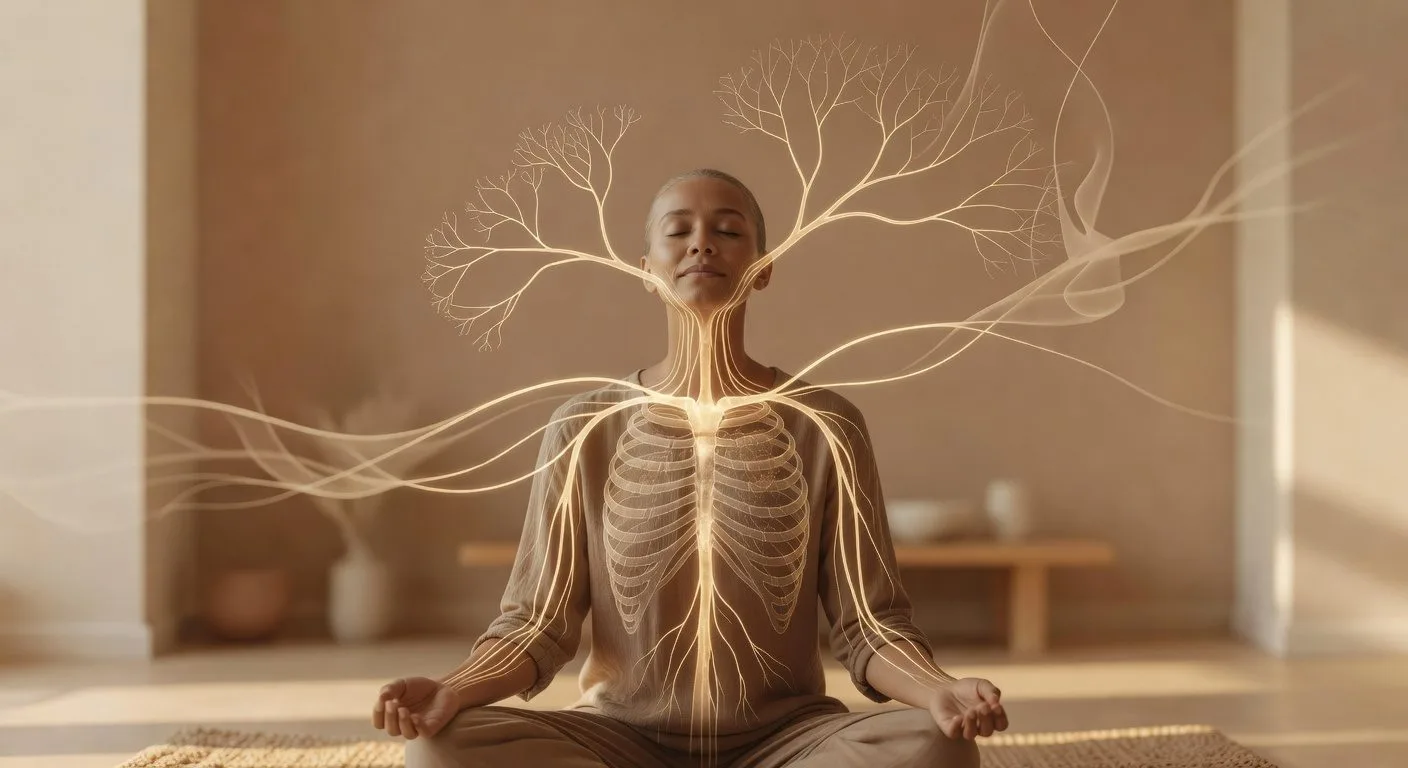
You're not broken. Your nervous system is doing exactly what it's designed to do.
- What is working from anywhere?
- Working from anywhere (also called location-independent or remote work) means doing your job from changing places — beach, café, coworking — without a fixed office. That freedom promises autonomy, but also asks for inner anchors because your nervous system treats the familiar as safe.
The Freedom Paradox: Why Your Body Confuses Freedom with Unsafety
Picture this: you're sitting with your laptop on a beautiful beach. The waves are crashing, palm trees swaying, your Instagram feed looks perfect. But inside? There's a soft whisper that won't stop: Where do I actually belong? Is this even real? Shouldn't I be "home" somewhere?
This experience isn't a flaw. It's biology.
Your nervous system is evolutionarily programmed to interpret the familiar as safe. For thousands of years, this was essential for survival. Unknown = potential danger. Fixed patterns, fixed places, fixed people = safety. But location-independent work breaks precisely those patterns. Every day a different environment. Different sounds. Different people. Different rhythm.
Polyvagal theory (Porges, 2018) calls this neuroception: your nervous system continuously — unconsciously — scans for safety. Without fixed anchors, it remains in a low-alert state. Even though you're rationally safe. Even though you have a five-star Airbnb. Even though your life looks "perfect" on paper.
Does this resonate? That restlessness despite all the freedom? You're not broken. Your nervous system is responding exactly as designed.
Fromm's "Fear of Freedom": Why People Flee from Freedom
Back in 1942, psychoanalyst Erich Fromm described something in his classic work The Fear of Freedom that perfectly captures the digital nomad experience today: freedom evokes existential anxiety. People unconsciously seek new "cages" to dampen that anxiety — ideologies, relationships, structures, or in your case: constant travel, packed schedules, productivity pressure.
Fromm understood it already: total freedom without inner structure isn't freedom. It's drifting aimlessly with a first-class ticket.
The greatest paradox of the nomad existence? The more freedom you create, the louder your inner critic screams for stability.
The Autonomy Paradox: More Freedom = More Stress?
- What is the autonomy paradox?
- The autonomy paradox is the mechanism whereby more freedom can mean more stress if there’s no internal structure. Telecommuting raises autonomy but also isolation and work-life blur — autonomy alone isn’t enough; you also need competence and relatedness.
Research confirms what Fromm intuitively understood. Gajendran & Harrison (2007) showed in their meta-analysis that telecommuting increases autonomy, but also causes isolation and work-life boundary blurring. The paradox: more freedom = more stress if there's no internal structure.
Self-Determination Theory (Deci & Ryan, 2000) goes further: autonomy alone isn't enough for well-being. You need three things:
- Autonomy — the feeling that you're choosing
- Competence — the feeling that you're capable
- Relatedness — the feeling that you belong somewhere
Digital nomads often score high on autonomy, but low on relatedness. And without relatedness, freedom becomes loneliness.
Thompson (2019) documented this phenomenon in digital nomads: elevated allostatic load — the cumulative stress burden that arises from constant adaptation to new environments. Your nervous system never gets rest. Never gets the chance to say: "here I am safe, here I can rest."
- What is digital nomad stress?
- Digital nomad stress is the diffuse, existential restlessness of constantly adapting to new environments — not clear deadline stress, but background alarm. Thompson (2019) describes elevated allostatic load: your nervous system never gets to land in “here I am safe.”
What Feels Like Weakness Is Actually Wisdom
Perhaps you've blamed yourself: Why can't I just enjoy this? Why do I feel restless when my life looks like what others dream of?
But what if the fear you feel with so much freedom isn't a flaw? What if it's the most natural signal there is?
Your body is whispering something important to you: freedom without inner anchoring isn't freedom. It's fleeing. And fleeing — however beautiful the destinations — remains fleeing.
The invitation isn't to be less free. The invitation is to build inner safety that you can take with you wherever you go.
5 Exercises for Inner Safety (Portable, Anywhere)
The difference between a cage and an anchor is flexibility. A cage locks you in. An anchor keeps you connected — wherever you are. Here are five exercises you can do anywhere, in any location, without locking yourself into a new structure.
1. The Minimum Ritual (5 minutes per day)
Choose three non-negotiable actions per day. Three. Not ten. For example:
- Morning tea in silence
- 10-minute afternoon walk
- Evening journal: three sentences about what you felt
On every location. This gives your nervous system an "I am here, it is safe" signal through repetition. Research on circadian rhythms (Walker, 2017) shows that consistency — not perfection — signals safety.
2. Arrival Check-in (3 minutes)
Every time you arrive at a new workspace — café, coworking, Airbnb — do this:
- Feet flat on the ground
- Three conscious breaths (in through nose, out through mouth)
- Name three things you see (aloud or in your head)
This resets your neuroception from "new = unsafe" to "new = okay". It takes three minutes. It changes your whole day.
3. Work-Private Transition Ritual (2 minutes)
The biggest loss without an office? The transition. At home, you walk from your workspace to the couch. At the office, you walk to the car or bike. But when your workspace is everywhere? Then there's no boundary anymore.
Create a conscious "I'm stopping work" ritual:
- Laptop closed
- Stretch breath: arms up, deep in, slowly out
- One sentence in your journal: "Work is done. I am here."
Your nervous system learns: there is a boundary. Even without walls.
4. Social Connection Check (weekly)
Schedule two to three real contact moments per week. No text messages. No DMs. Voice or video or live.
SDT research (Deci & Ryan, 2000) shows that relatedness is the foundation for autonomy-enjoyment. Without community, freedom becomes loneliness. And loneliness is no small stressor: Holt-Lunstad et al. (2015) showed that social isolation increases mortality by 29% — comparable to smoking 15 cigarettes per day.
You don't have to drift alone. Connect with like-minded people at Spiriators.
5. Body-as-Home Meditation (10 minutes)
Sit still, hands on belly and heart. Imagine that your body is your home — the only constant in all the traveling. Scan from feet to crown:
This is where you live. Always. Everywhere.
This meditation integrates interoception research (Craig, 2002) and somatic therapy. It reminds you: you're not your location. You're your body. And that's always with you.
Want to deepen this? In our yin yoga sessions, we work precisely on this body connection — applicable everywhere, always available.
When Freedom-Anxiety Is Your Problem
How do you know if this is your situation? Signals of freedom-anxiety:
- You feel restless despite your life looking "perfect" on paper
- You fill every free minute with work or travel
- You miss a "home" even though you have an Airbnb everywhere
- You sleep poorly in new places, even though they're comfortable
- You feel guilty when you "do nothing"
These are signals of a nervous system confusing freedom with unsafety. And that's solvable — not by creating less freedom, but by building more inner anchoring.
Related insights can be found in our blog about feeling at home everywhere and the science behind nervous system and stress.
Frequently Asked Questions
Why does so much freedom make me anxious?
Your nervous system is evolutionarily programmed to interpret the familiar as safe. Total freedom means: no predictable structure, no social anchors, no fixed rhythm. Polyvagal theory (Porges, 2018) shows that your neuroception unconsciously scans for safety. Without fixed patterns, you remain in a low-alert state. This is not weakness — it's biology.
How do I build structure without putting myself in a new cage?
The difference between a cage and an anchor is flexibility. Create minimal rituals (not rules) that work from any location. E.g., a morning ritual of 3 actions, not "I must wake up at 6 AM." Inner structure is portable — external structure is not. Self-Determination Theory (Deci & Ryan, 2000) confirms that autonomy + rhythm optimally coexist.
Is digital nomad stress different from regular work stress?
Yes — fundamentally. Regular work stress often has a clear source (deadline, conflict, workload). Nomadic stress is more diffuse and existential: no clear "enemy," but constant background alarm. Thompson (2019) shows elevated allostatic load in nomads — the cumulative stress of continuous adaptation to new environments, without recovery moments.
Can yin yoga help with remote work anxiety?
Absolutely. Yin yoga directly impacts the nervous system through long, passive poses that activate the parasympathetic system. It trains interoception — the ability to perceive internal body signals — essential for recognizing stress before it escalates. Yin yoga also creates a portable ritual that can be done anywhere, exactly what the location-independent worker needs.
How do I know if freedom-anxiety is my problem?
Signals: (1) you feel restless despite your life looking "perfect" on paper, (2) you fill every free minute with work or travel, (3) you miss a "home" even though you have an Airbnb everywhere, (4) you sleep poorly in new places even though they're comfortable, (5) you feel guilty when you "do nothing." These are signs of a nervous system confusing freedom with unsafety.
The Invitation
Freedom isn't a destination. It's a practice. A daily choice to be present — wherever you are.
Try the minimum ritual this week. Three things. Every day. Notice what changes.
And if you discover you want more support in building inner safety? We're here. With breathwork coaching that teaches your nervous system to rest. With yin yoga that teaches your body to trust. With a community that understands that freedom without anchoring isn't freedom.
You don't have to drift alone.
Warm greetings, Johannes and Tessa — Spiriators
Go deeper: Read our pillar pages on retreats and nomadic travel, and explore yoga or breathwork to support your inner journey.