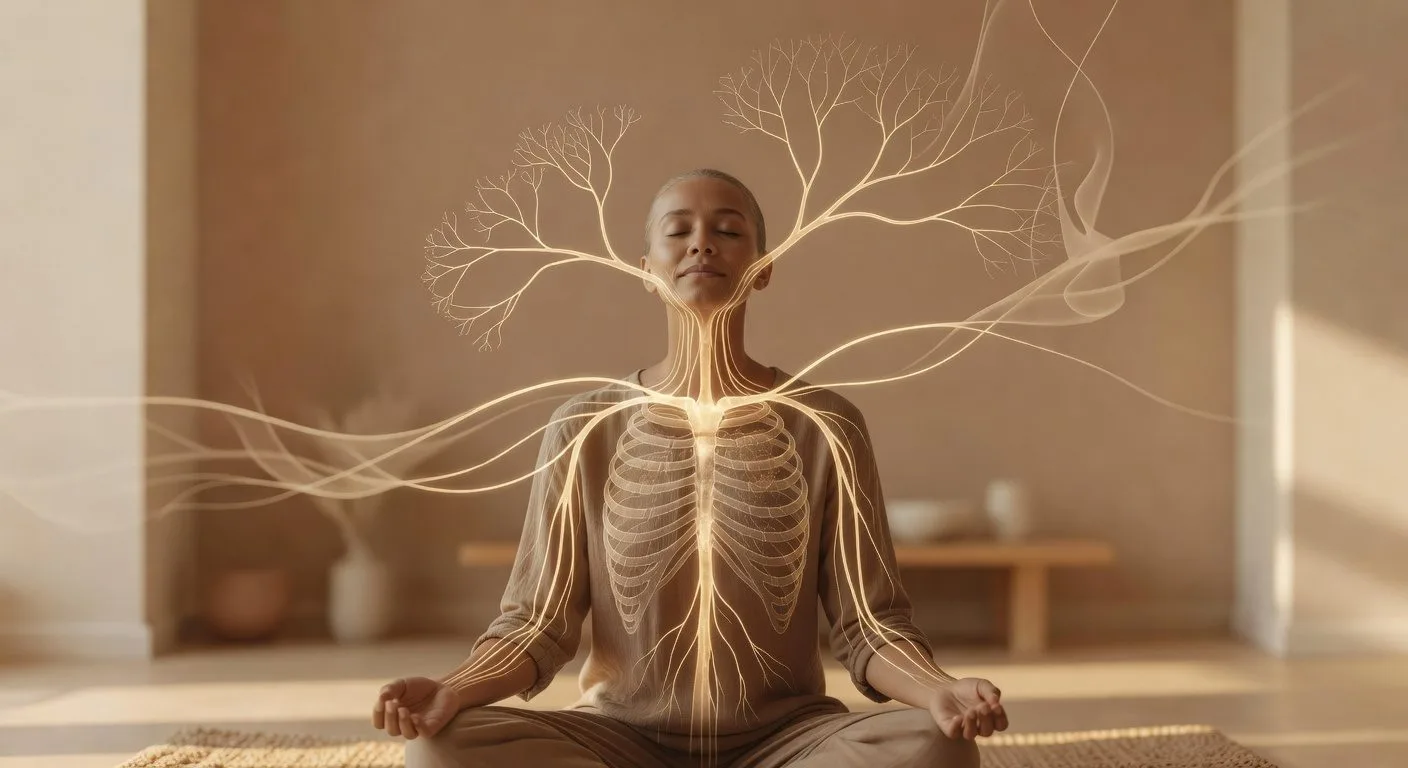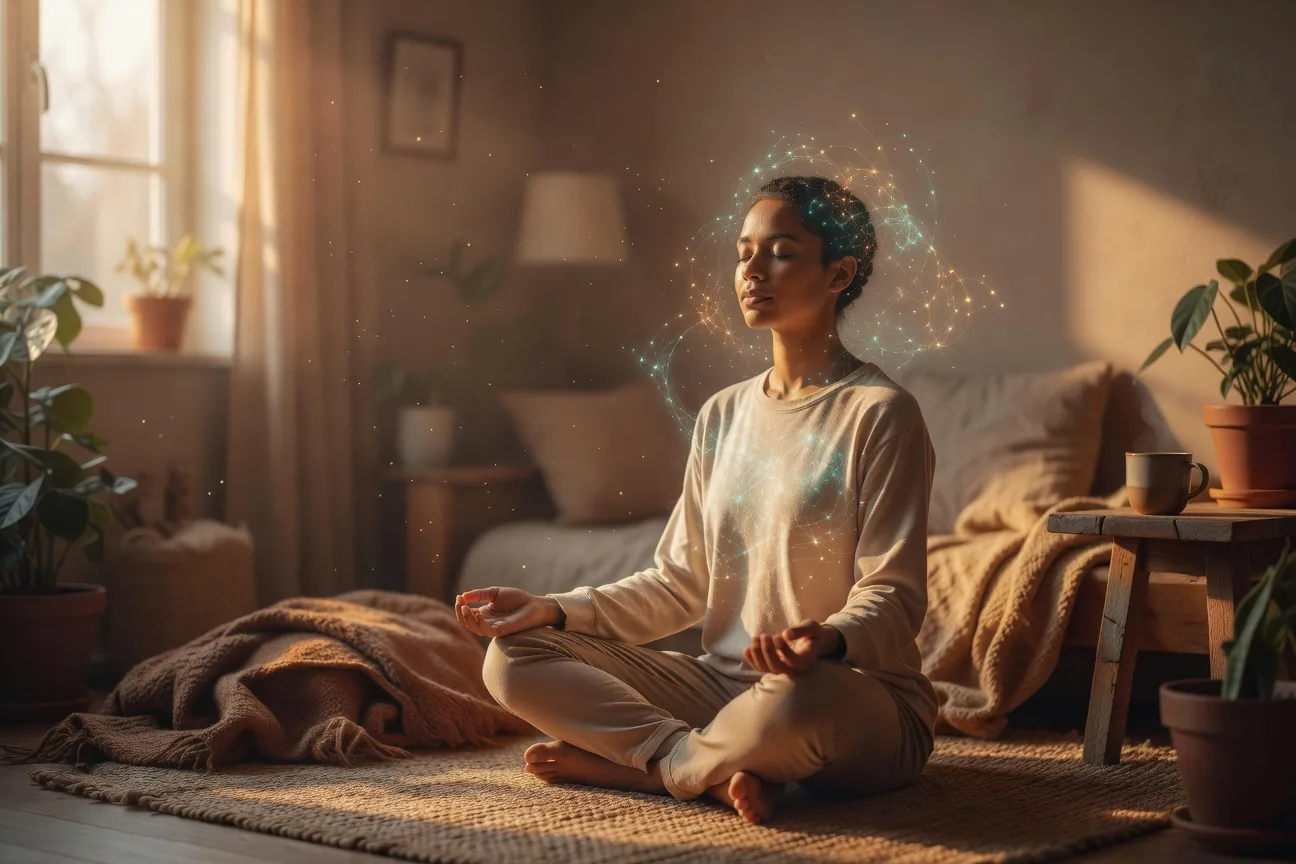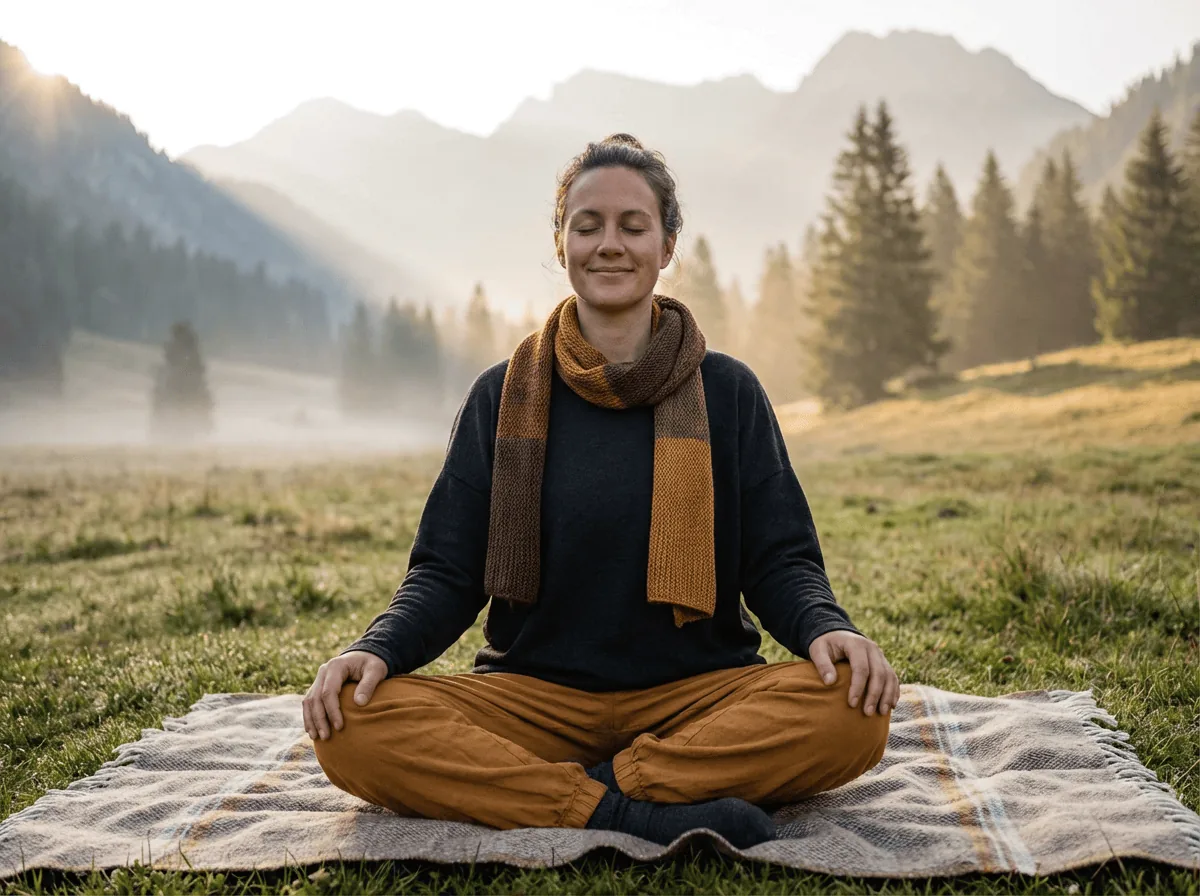
In breathwork you are always a beginner. That may sound strange, but it's exactly what makes this practice so powerful. There is always room for growth, for expansion, for deeper layers that want to reveal themselves. After years of daily practice, I still discover new dimensions of my breath – and that is precisely the beauty of it.
What Is Breath Coaching Exactly?
- What is breath coaching?
- Breath coaching is guided breathwork: consciously working with the breath to support physical, emotional, and mental change. Through the breath you gain direct access to your nervous system — not by trying harder, but by breathing more consciously.
Breath coaching, also known as breathwork, is an umbrella term for techniques that consciously work with the breath to bring about physical, emotional, and mental changes. It's not a new invention – for thousands of years, cultures around the world have used the breath as an instrument for healing and transformation.
What distinguishes breath coaching from ordinary breathing is conscious intention. We breathe an average of 20,000 times a day, but almost always unconsciously. By making the breath conscious and directing it, we open a direct line to our nervous system, our emotions, and our subconscious.
The Foundation: Connected Breathing
- What is connected breathing?
- Connected breathing — also called circular breathing — means inhaling and exhaling without a pause between them. That continuous wave opens a gateway to the nervous system, emotions, and subconscious; that is why connected breathing coaching sits at the centre of our breath practice.
The core of our breath coaching is connected breathing (also known as connected breathing or circular breathing). This is not just another breathing technique – it's a gateway to your subconscious, to stored emotions and patterns that have lived in your body for years.
In connected breathing, there is no pause between the inhale and exhale. The breath flows as a continuous wave through your body, without interruptions. This simple principle – no pause – has a profound effect on your nervous system and consciousness.
Scientifically speaking, this way of breathing activates the parasympathetic nervous system in a unique way. It lowers cortisol levels, increases oxygen uptake, and brings your brain into a state comparable to deep meditation – but more active and direct (see Zaccaro et al. (2018) on breathing & HRV and Porges (2007) for vagal tone).
"The breath is the bridge between the conscious and the unconscious. Those who learn to breathe, learn to live."
Twenty Ways, One Principle
What many people don't know: connected breathing can be performed in as many as twenty different ways. Each variation has its own effect and area of application:
- Slow and deep – for relaxation and grounding
- Fast and shallow – for energy and activation
- Through the nose – for subtler, meditative effects
- Through the mouth – for more intense emotional releases
- Belly breathing – for grounding and safety
- Chest breathing – for opening the heart
Each session can be different, depending on what is alive in you at that moment and wants to be seen. As a breath coach, I attune the technique to what you need – not the other way around.
The Science Behind Breathwork
Breathwork is not a woo-woo practice – it's grounded in neurobiology and physiology. When you breathe consciously, you directly influence your autonomic nervous system. This system regulates functions that are normally outside your conscious control: heart rate, blood pressure, digestion, and stress response.
By changing the breath, you can switch between the sympathetic mode (fight-or-flight) and the parasympathetic mode (rest-and-digest). This is why breathwork is so effective for stress, anxiety, and trauma – you're literally giving your body the signal that it's safe to relax (supported by van der Kolk (1994) and Zaccaro et al. (2018) on breathing and autonomic regulation).
Our Daily Practice: The Presence Process
Tessa and I practice connected breathing twice daily according to The Presence Process by Michael Brown. In the morning to start the day from presence, in the evening to integrate what the day has brought.
This discipline – yes, it is a discipline – has fundamentally changed our lives. Not by adding something, but by making space for what already is. Through the breath, we learn to know ourselves at a level that words cannot reach.
The Presence Process is a 10-week program that combines breathwork with consciousness work. It teaches you to integrate emotional charges from the past, so they no longer color your present experience. Highly recommended for anyone who wants to get serious about breathwork.
From Foundation to Rebirthing
- What is rebirthing breathwork?
- Rebirthing is a more intensive form of breathwork where rapid, deep breathing can open an altered state of consciousness. Old emotions and traumas — sometimes including birth trauma — can safely surface to be transformed.
After some experience with connected breathing, we often go further and deeper with rebirthing. This is a more intensive form of breathwork where the client can enter an altered state of consciousness through rapid, deep chest breathing.
The term 'rebirthing' refers to the idea that during these sessions we can relive and transform old traumas – including birth traumas. The body remembers everything, and the breath is the key to safely unlocking these memories.
During rebirthing, old emotions, memories, and even birth traumas can come to the surface. The body starts to tingle, sometimes shake. This is not danger – it's liberation. It's your body finally releasing what it has held onto for years.
What you might experience during breathwork:
- ✦ Tingling throughout your body (tetany)
- ✦ Emotional releases – laughing, crying, or both at once
- ✦ Images or memories that spontaneously arise
- ✦ A feeling of deep peace and connection
- ✦ Insights that your mind couldn't reach
- ✦ Physical sensations like warmth, cold, or vibrations
- ✦ A feeling of 'coming home' in your own body
Breathwork for Stress and Anxiety
One of the most direct applications of breathwork is for stress and anxiety. When we're stressed, we often breathe shallowly and quickly – this keeps the stress response going. By consciously breathing slower and deeper, we break this cycle.
The 4-7-8 technique is a good example: inhale for 4 counts, hold for 7 counts, exhale for 8 counts. But at Spiriators we go beyond techniques – we explore what causes the stress and help you transform the underlying patterns.
As Eckhart Tolle writes in his groundbreaking book The Power of Now: awareness of the breath brings you directly into the present moment. And in the present moment, there is no anxiety – anxiety only exists in thoughts about the future.
Why You Are Always a Beginner
Here's the beautiful part: even after years of daily practice, I am still a beginner. Not because I'm not growing, but because there are always deeper layers. Always new insights. Always more room for expansion.
This is not frustration – it's liberation. You don't have to get anywhere. You don't have to become an expert. You can just keep discovering, session after session, breath after breath. The journey is the destination.
In our achievement-oriented society, this is a radical idea. We're conditioned to reach goals, to be 'done'. But breathwork teaches us that the process itself is the value. Every breath is a new beginning.
"The expert has stopped learning. The beginner is open to everything. Choose wisely."
What Does a Breath Coaching Session Look Like?
A typical session at Spiriators lasts 60 minutes and follows a natural flow:
- Attunement (10 min) – We discuss how you're feeling and what's going on
- Preparation (5 min) – Relaxation exercises and setting intention
- Breathwork (30-35 min) – The actual breathing session with guidance
- Integration (10-15 min) – Coming back gently and sharing what was
Want to Experience It Yourself?
Real transformation happens in guided sessions, where I can safely lead you through the process and help you integrate what comes up. Online works surprisingly well – the breath makes no distinction between physical and digital.
Ready to begin? Or rather: ready to always remain a beginner?
🏠 Experience 30 Days of Breathwork + Yin Yoga
Reading about breathwork is valuable. But experiencing what it does to your body, your nervous system, your presence – that is transformative.
That's why we invite you to 30 Days Closing the Day at Home:
- Week 1 free — 7 daily evening sessions (15-30 min)
- Breath Journey + Yin Yoga — calm your nervous system, open your fascia
- At home on your mat — no studio, no travel, just you
- No shoulds — only surrender and presence
Within 30 minutes you'll receive your first session in your inbox. No obligation, just an invitation.
— Johannes
📖 Read More
Go deeper: Read our pillar pages on breathwork and yoga, explore breath coaching, or consider a retreat to integrate this work.