Why your mind stays 'on' while your body wants 'off'
You lie in bed. The room is dark, the pillows are soft, but in your mind, a storm of unfinished conversations and tomorrow's to-do lists rages. You feel the fatigue in your bones, but your mind refuses to capitulate. It is a frustrating contrast: a body begging for rest, and a brain that continues to spin like an engine that won't shut down.
Many of us know this feeling. We call it 'stress', but in reality, it is a neurological mismatch. Your nervous system is still in survival mode, even though the environment is safe. The modern world demands that we stay 'on' constantly — alert, productive, reactive. We are programmed to scan for danger, and in the 21st century, those dangers are not saber-toothed tigers, but unanswered emails and social expectations.
When we step into bed without a conscious transition, we take that active energy under the covers. We try to force ourselves to sleep, but 'trying' is an action. It is a form of effort. And effort is precisely what tells your nervous system that it still needs to be on guard. Here lies the paradox of the sleepless night: the harder you try to rest, the further rest slips through your fingers.
Sleep is not a switch that you simply flip. It is not a lamp that you turn off. Sleep is a process of landing. Just as an airplane does not come to a standstill on the runway in a single second, your nervous system needs a runway to safely return to a state of rest. Without that transition, you land with a crash, or you continue to circle tirelessly in the air.
The biology of rest: From Sympathetic to Parasympathetic
To understand why we sometimes cannot sleep, we must look at the architecture of our nervous system. We have roughly two modes: the sympathetic nervous system (the accelerator) and the parasympathetic nervous system (the brake). The sympathetic system prepares us for action: fight, flight, or freeze. It increases the heart rate, sharpens focus, and pumps cortisol through the blood.
For a deep, restorative sleep, the upper hand must shift to the parasympathetic system. This is the 'rest and digest' mode. Here, the heart rate slows, muscle tension decreases, and the body begins the process of tissue repair and emotional processing. The art of better sleep is not 'fighting' insomnia, but inviting the parasympathetic response.
Yin yoga is essentially a neurological intervention. Unlike active forms of yoga, where we tension muscles and move dynamically, Yin yoga is about surrender. By holding poses for longer periods (usually 3 to 5 minutes), we send a powerful signal to the brainstem: "It is safe. You no longer need to fight. You may descend."
When we land in a Yin pose and slow our breathing, we stimulate the vagus nerve — the primary nerve of our parasympathetic system. This immediately lowers heart rate variability and tells the body that survival is guaranteed. It is a biological reprogramming that clears the path for melatonin to do its work, without cortisol standing in the way.
If you find that you are often stuck in the 'on' position, it can help to explore breathwork coaching. The breath is, after all, the only place where we can consciously intervene in our autonomic nervous system. By extending the exhalation, you effectively force the body into the braking position, which is the ideal preparation for an evening Yin session.
Why Yin Yoga is more effective than a warm shower or tea
Many people reach for a warm shower, a cup of chamomile tea, or a book to fall asleep. While these rituals are pleasant, they often work on a superficial level. They create an atmosphere of calm, but they do not address the physical tension stored in our deepest tissues. This is where the power of Yin Yoga comes in: it targets the fascia.
Fascia is the connective tissue that wraps around every part of our body. It is not just a structural layer, but also a storage site for emotional stress and trauma. When we are chronically stressed, this tissue becomes stiff and tight. You often feel this tension as a restless feeling in your hips, a knot in your stomach, or a heavy pressure on your chest — even when you are physically doing nothing.
By holding poses in Yin Yoga for extended periods, we utilize mechanotransduction. This is the process by which physical pressure on the connective tissue is converted into cellular signals. Fibroblasts in the fascia begin to reorganize collagen and increase tissue hydration. This creates a deep, physical release that goes far beyond simple muscle relaxation.
When the fascia relaxes, the mind follows. There is a direct feedback loop between your tissue and your brain. Tight fascia communicates 'danger' or 'tension' to the brain. How this works exactly, you can also read in our article on how the nervous system remembers everything. Fluid, relaxed connective tissue communicates 'safety'. By activating this process, you remove the physical blockages that keep your nervous system in a state of alertness.
Furthermore, Yin Yoga works on three levels simultaneously: physical (fascia release), neurological (parasympathetic activation), and hormonal (cortisol reduction). A warm shower relaxes the skin and superficial muscles, but Yin Yoga reaches the core of your stress response. For those who want to know more about how this works on a cellular level, our article on Yin Yoga, fascia, and releasing emotions is a great starting point.
The 'Sleep-Ritual' Flow: 3 Poses for a Deep Night
You don't need to spend hours on your mat to see results. The key to a successful transition to sleep is consistency and surrender. Here are three poses specifically designed to calm your nervous system. Use pillows or blankets to fully support your body; the goal is that you don't have to engage a single muscle to hold the pose.
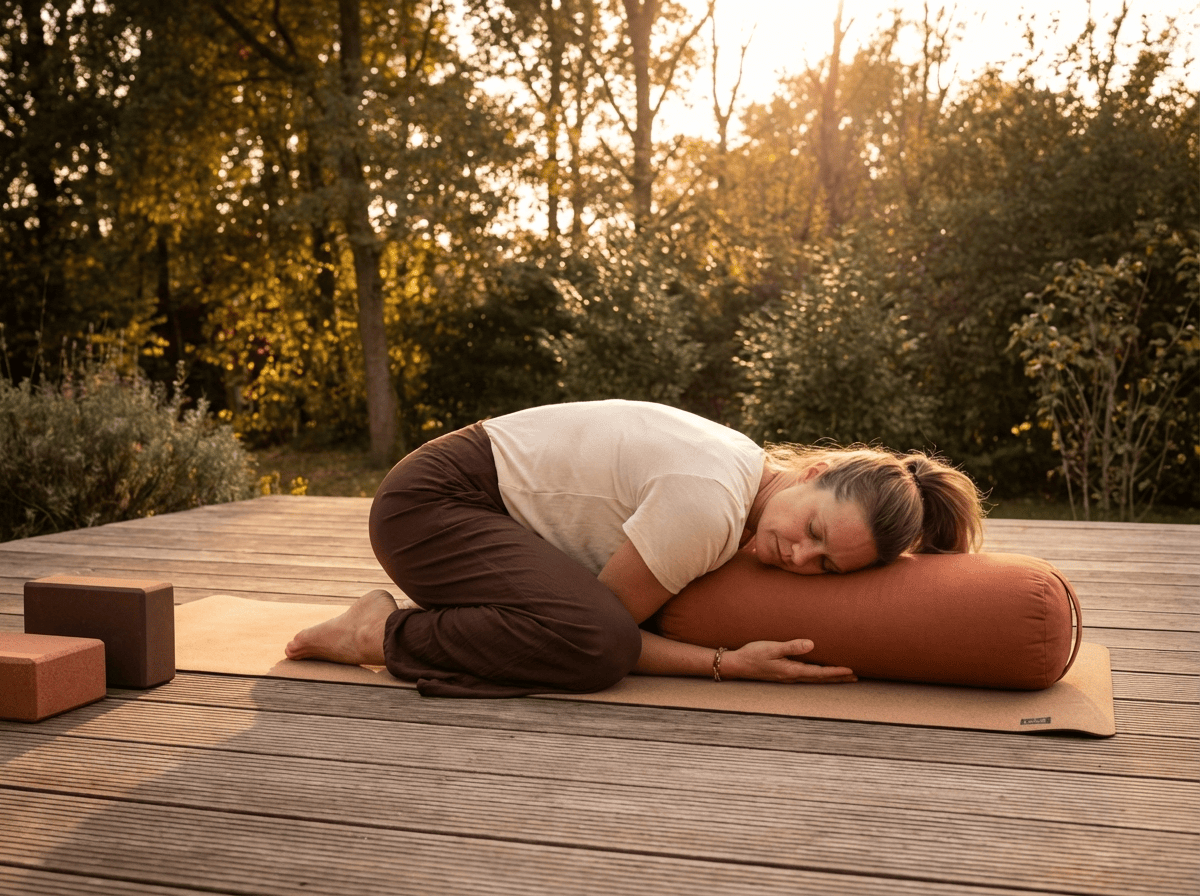
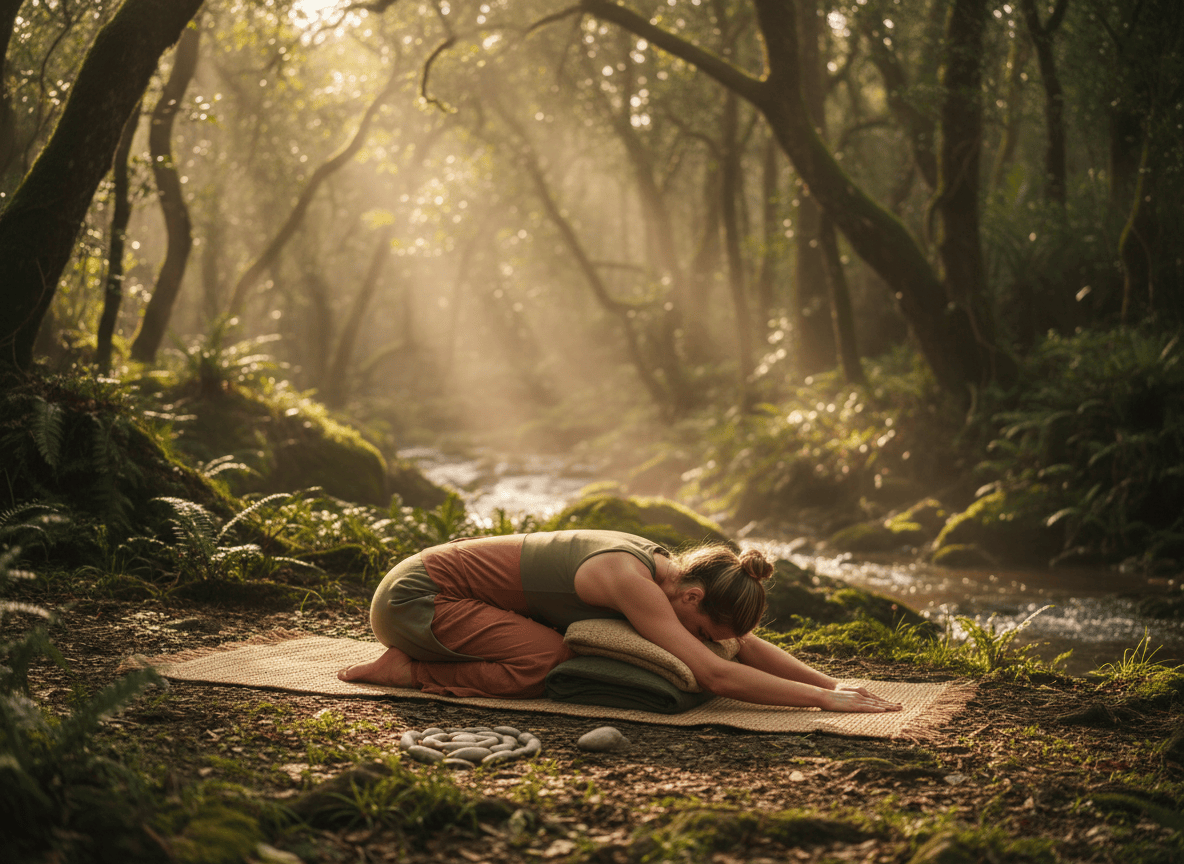
1. Supported Child's Pose (Balasana)
Place a firm pillow or folded blankets under your chest and abdomen. Let your knees fall wide and let your forehead rest on the mat or a small cushion. In this pose, you withdraw from the outside world. You shut off your senses and return to your inner core. Focus on the heaviness of your body sinking into the earth.
2. Reclined Bound Angle Pose (Supta Baddha Konasana)
Lie on your back and let your knees fall open to the sides, with the soles of your feet resting against each other. Support the outer sides of your legs with pillows. The hips are where we often unconsciously store tension and emotional baggage. By opening this space, you give the body permission to let go of the day's burden.
3. Legs Up the Wall (Viparita Karani)
Slide your hips as close to the wall as possible and let your legs rest vertically. This is one of the most powerful ways to calm the circulation and give the nervous system a signal of absolute rest. It lowers the pressure on the heart and directly stimulates the rest-and-digest mode.
Stay in each pose for 3 to 5 minutes. Breathe deeply into your lower abdomen and, with every exhalation, let go of a piece of the day. If you notice your thoughts wandering, observe them without judgment and bring your attention back to the feeling of the tissue softening. For a complete introduction to this practice, you can take our free Yin Check.
The pitfall of 'trying' to sleep
There is a strange paradox to insomnia: the more we focus on the fact that we aren't sleeping, the more awake we become. We start counting how many hours we have left before the alarm goes off. We become frustrated by the silence. We start 'fighting' the sleeplessness. But sleep is not an enemy to be defeated; it is a guest to be invited.
When we 'try' to sleep, we unconsciously activate our sympathetic nervous system. The frustration over not being able to sleep creates new stress, which in turn produces more cortisol, further blocking sleep. It is a vicious cycle of effort. The solution lies not in more effort, but in radical surrender.
Yin Yoga teaches us the art of 'non-doing'. In the poses, we practice accepting discomfort without fighting it. We learn that we don't have to force things to get results. When you bring this mindset into your bed, the dynamic changes. Instead of fighting the sleeplessness, you say: "Okay, I am awake right now. That's fine. I surrender to the rest of this moment."
By shifting the focus from the result (sleeping) to the experience (resting), you take the pressure off. Resting is already a win. Even if you don't fall asleep immediately, your body and mind recover when you are in a state of parasympathetic rest. Sleep often arrives only at the moment you truly stop searching for it.
This approach of surrender is a central theme in our work. Whether it's surrendering in trust during a Yin session or letting go of control during a breathwork session, it is always about returning to your natural state of wholeness.
From insomnia to surrender
Better sleep doesn't start in the bedroom, but in the hours before. It begins with the recognition that your body and mind need a transition. By weaving Yin Yoga into your evening ritual, you create a sacred space between the chaos of the day and the silence of the night.
Sleep is a form of trust. It is the moment where we completely surrender to the unknown, knowing that we are safe. By consciously working with your nervous system, your fascia, and your breath, you restore that fundamental trust in your own body. You learn that rest is not a luxury, but a biological necessity.
If you find that the storm in your head is too great to calm alone, know that there is support. Sometimes we need a guide to teach us how to land again. Whether you struggle with chronic insomnia or simply want more depth in your nightly rest, we invite you to explore together where the tension lives in your body and how we can transform it.
Discover how to reset your nervous system through Yin Yoga or schedule an introduction via our contact page. Give yourself the space to truly land. You are not broken because you cannot sleep; your nervous system is simply asking for a softer landing.
With love and rest,
Tessa & Johannes
For more scientific insights on sleep and recovery, you can also visit the Sleep Foundation.