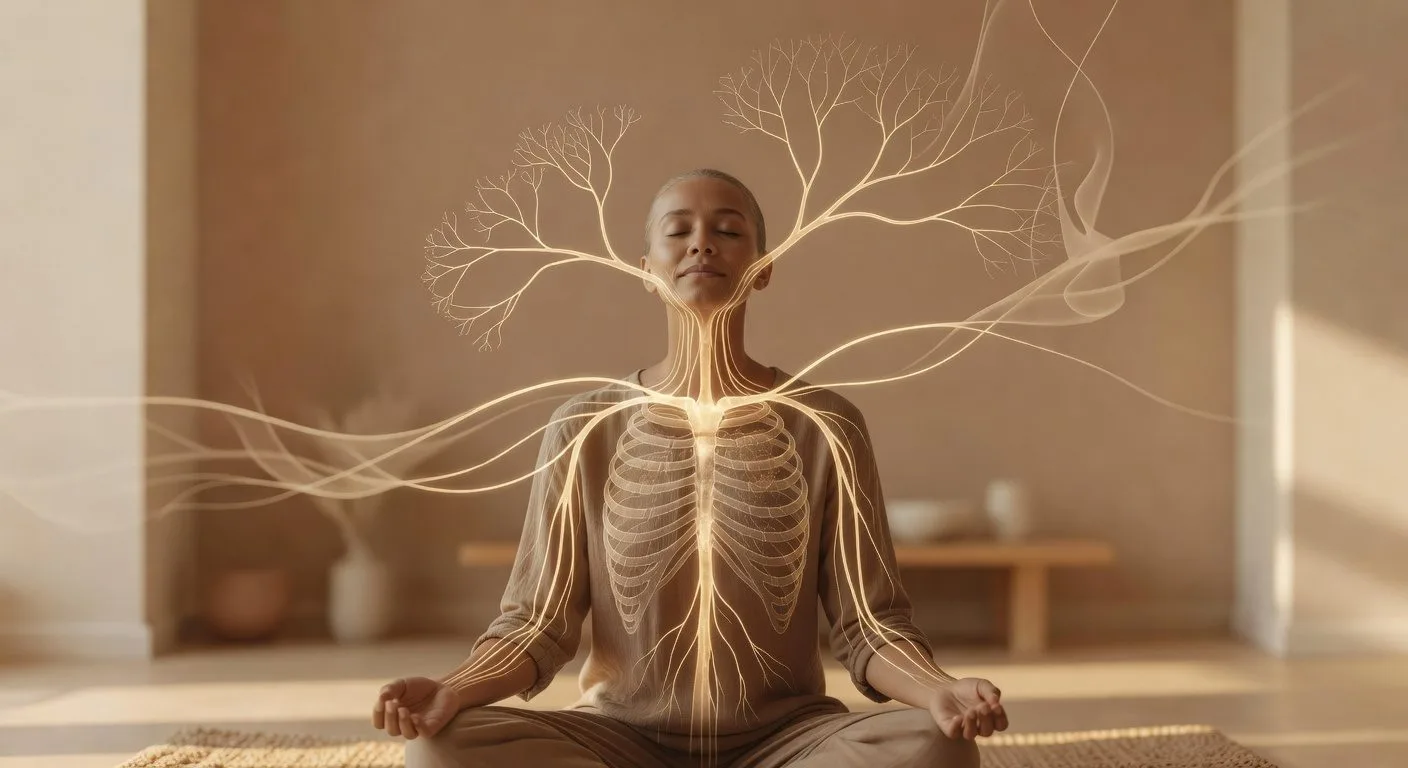
You eat healthy. You move. Maybe you even meditate. And yet — something feels stuck. Your body is stiff, your energy fluctuates, and that sugar craving keeps returning. What if the answer doesn't lie in your discipline, but in your connective tissue? In this article we explore the invisible connection between fascia, stored emotions and sugar — and how these hidden patterns can block your life.
What Is Connective Tissue — and Why Should You Care?
Fascia (connective tissue) is a continuous web of thin, sturdy tissue that surrounds every muscle, every organ, every nerve and every bone in your body. Think of it as a full-body suit just beneath your skin. It gives your body structure, flexibility and — crucially — it communicates.
Research on fascia shows that connective tissue contains more sensory nerve endings than muscles. Your connective tissue is literally a sensory organ — it feels, remembers and responds to stress, trauma and emotions (see Porges (2007) for nervous system links and van der Kolk (1994) for trauma storage in the body).
When you experience stress or emotional pain, your fascia contracts. Not temporarily — structurally. Over months and years, stiffness, pain and limited movement develop that no amount of stretching seems to fix.
- What is fascia in relation to emotions?
- Fascia is the continuous connective-tissue web under your skin that wraps muscles, organs and bones. In relation to emotions it acts as a storage and sensory organ: unprocessed tension can set structurally, so stiffness often maps emotional history.
How Stiff Is Your Body, Actually?
Most people think stiffness comes from aging or not stretching enough. But fascia research tells a different story. Your stiffness is often a map of your emotional history.
Tight shoulders? Often linked to carrying too much responsibility. Stiff hips? Regularly connected to stored anxiety, grief or unprocessed emotions. A rigid lower back? Can indicate a deep need for control or safety.
"Your body doesn't lie. It stores what your mind tries to forget."
This is not woo-woo speculation. Bessel van der Kolk, author of The Body Keeps the Score, has extensively documented how trauma lives in the body — not just in the head. Your fascia is one of the primary storage systems for these unprocessed experiences.
The Emotional Body: Where Feelings Reside
We tend to see emotions as something that happens in our head. A thought triggers a feeling, we process it, and it passes. But that's only half the story.
Every emotion has a physical signature. Anger tenses your jaw and fists. Anxiety tightens your belly and chest. Sadness presses your shoulders down. When these emotions aren't fully felt and released, they don't disappear — they nestle into your body. Into your fascia.
Michael Brown, author of The Presence Process (one of our key sources at Spiriators), calls this 'emotional charge.' These are unresolved emotional imprints from childhood that continue to drive our adult behavior on autopilot — often without us realizing it.
How Can I Feel What I Actually Want?
This is one of the most asked questions in our practice. And it's a courageous question, because it means you've noticed that you're living from your head instead of your heart.
The way back to feeling starts with the body. Not with more thinking, analyzing or journaling — but with physical sensation. When you learn to notice what your body tells you — the tension in your chest, the heaviness in your legs, the restlessness in your hands — you begin to decipher your emotional language.
Yin yoga is one of the most powerful tools for this. By holding a pose for minutes, you create space for sensations to surface. Not to fix them — but to feel them. And in that feeling lies the key to knowing what you truly want.
The Art of Reflection: From Head to Heart
True reflection isn't thinking harder about your problems. It's creating enough silence to hear what lies beneath the noise. Most people 'reflect' by analyzing — which keeps them trapped in the same mental loops.
At Spiriators we guide a different form of reflection. One that starts in the body. Through breathwork you calm the nervous system. Through yin yoga you open the fascia. Through presence you create space between stimulus and response. In that space, your true feelings can arise.
"You don't have to search for your feelings. You just have to stop running from them."
— Spiriators
Sugar: The Silent Saboteur
Now this is where it gets really interesting. What does sugar have to do with fascia and emotions? More than you think.
When you experience emotional discomfort — stress, loneliness, boredom, grief — your brain seeks the fastest way to feel better. Sugar gives an instant dopamine kick. It's not a weakness; it's neurobiology. As De Voedingsacademie explains in their work on periodic living: we've eliminated all old stressors like scarcity and cold, but we have more stress than ever — and sugar has become our default comfort.
But here's the vicious cycle: sugar causes inflammation in the body. Inflammation stiffens fascia. Stiff fascia holds more emotional charge. Held emotions create more discomfort. More discomfort drives more sugar cravings. And so it goes round and round.
- What is the link between connective tissue and sugar?
- Sugar triggers low-grade inflammation; inflammation makes fascia stickier and stiffer; stiff fascia holds emotional tension; that tension fuels sugar cravings again. Connective tissue and sugar form a physiological feedback loop — not a matter of willpower alone.
The Inflammation-Fascia-Emotion Triangle
Scientific research increasingly confirms what ancient healing traditions have known for centuries: body, mind and nutrition are one connected system.
🍬 Sugar & Inflammation
Excessive sugar triggers chronic low-grade inflammation. This inflammation damages your fascia, making it sticky and rigid.
🧬 Fascia & Stored Emotions
Inflamed, stiff fascia cannot release stored emotional charge. Tension accumulates, creating chronic pain and emotional numbness.
💔 Emotions & Sugar Cravings
Unfelt emotions create inner restlessness. Your brain seeks quick relief via sugar — and the cycle is complete.
- What are emotional sugar cravings?
- Emotional sugar cravings are the urge for sweets as fast dopamine relief during stress, loneliness or discomfort — not pure hunger. They numb what has not yet been felt; when you allow the underlying feeling, the craving often eases on its own.
A 2018 study published in Frontiers in Physiology showed that fascia responds directly to emotional states and that chronic stress leads to measurable changes in connective tissue density. Meanwhile, research from Harvard Medical School confirms that sugar consumption increases inflammation markers (CRP, IL-6) that directly affect tissue health.
The 'you-turn model' of De Voedingsacademie resonates strongly with our approach: they teach that a predictable, comfortable life doesn't give you the best results. True vitality comes from consciously seeking the edge — whether that's through cold exposure, fasting, or in our case: feeling what you've been avoiding. As they say: "If you always keep making the easy choices, life becomes difficult in the long run."
Yin Yoga: Opening the Fascia, Releasing the Emotions
This is where yin yoga becomes transformative. Unlike dynamic yoga that works the muscles, yin yoga focuses on the deep connective tissue. By holding gentle poses for 3 to 5 minutes, you apply sustained, moderate pressure to the fascia — allowing it to slowly release, rehydrate and reorganize.
And here's where it gets powerful: as the fascia physically releases, the stored emotional charge often surfaces. People cry in yin yoga. They feel sudden waves of anger, grief or relief. This isn't a problem — this is the healing. Your body is finally releasing what it's held for years.
Breaking the Sugar Pattern Through Body Awareness
When you start to feel your emotions directly — through the body, through the fascia — something remarkable happens: the craving for sugar naturally decreases. Not through willpower or strict diets, but because the underlying emotional driver loses its grip.
You don't have to fight the craving. You need to feel what the craving covers. That's the difference between discipline and awareness. Discipline says 'don't eat sugar.' Awareness says 'what am I actually hungry for?'
Practical: 3 Micro-Exercises for Today
- The Sugar Pause: Next time you want sugar, pause for 60 seconds. Place both hands on your belly. Breathe slowly. Ask yourself: 'What am I actually feeling right now?' Don't judge the answer — just notice it.
- The 3-Minute Butterfly: Sit on the floor, bring the soles of your feet together, let your knees fall open. Round your back forward. Stay for 3 minutes. Notice what comes up — physically and emotionally.
- The Body Scan Before Sleep: Lie down. Scan from feet to head. Where is tension? Breathe 5 times into that spot. Don't try to change anything — just be with it. This trains your ability to feel.
Recognize, Acknowledge and Change Patterns
Want to live more consciously? Start by recognizing your patterns. Not the obvious ones — the invisible ones. The patterns that live in your body, in your fascia, in your automatic reach for something sweet when life becomes uncomfortable.
The process is simple (not easy, but simple):
1. Recognize
'Oh, there it is again — I'm reaching for chocolate because I feel lonely.' Just seeing it is a breakthrough.
2. Acknowledge
'This pattern has protected me. It has helped me survive. And now I'm ready for something different.' Acknowledge it with compassion.
3. Choose Differently
Instead of the automatic reaction, choose a conscious one. Feel the emotion. Breathe into it. Move with it. Let it pass through you instead of numbing it.
Nomadisch Meeleven: The Ultimate Pattern Breaker
Sometimes the most powerful thing you can do is step completely out of your environment. Your home, your routines, your kitchen cupboard with the hidden chocolate — they're all part of the pattern.
That's why we offer nomadic living experiences. You travel with us for a period — days, weeks or months — and live in our rhythm. Between nature, breathwork, yoga and deep presence. No standard program, but fully attuned to what you need.
Receive coaching in the way that suits you: in conversations, walks, breath sessions, yoga classes or constellations. See these weeks as a retreat-vacation and return home enriched, balanced and with a dose of healthy motivation.
Feel always free to run away very hard again — and also always free to stay longer.
Don't want to leave home? Then consider online sessions. During a one-hour online session we can go deep. A combination with yin yoga is also possible — this strengthens the integration of your new insights.
Your Body Is Waiting for You
The stiffness in your body isn't random. The sugar craving isn't a weakness. The emotional numbness isn't permanent. They're all connected — and they're all invitations to come home to yourself.
At Spiriators we guide you through this process with warmth, presence and without judgment. Whether it's through online sessions, yin yoga, breathwork or nomadic living — we meet you where you are.
Because you're not broken. You don't need to be fixed. You just need to remember — and your body already knows the way.
🏠 Want to Experience This? Start Our 30-Day Challenge
This blog touches the core of what we do at Spiriators: connecting body, mind and consciousness. But reading is one thing — experiencing is something else.
That's why we invite you to 30 Days Home Closing the Day:
- Week 1 free — 7 daily evening sessions (15-30 min)
- Yin Yoga + Breath Journey — open your fascia, calm your nervous system
- Home on your mat — no studio, no travel, just you
- No must — only surrender and presence
You'll receive your first session in your inbox within 30 min. No obligation, just an invitation.
📖 Read More
- Yin Yoga at Spiriators
- Types of Yoga: Yin, Hatha & Vinyasa (pillar)
- Yin Yoga and fascia: releasing emotions
- Take the free Yin Check
Go deeper: Read our pillar pages on yoga and breathwork, explore yin yoga, or join a retreat to deepen your practice.