Intro
You've made the decision. You've quit. You truly want to change.
But weeks later — months later — you feel that same craving. That same restlessness. As if your body remembers something your consciousness has long let go of.
That's not weakness. That's biology.
Your nervous system remembers. It stores patterns. It creates highways of neural connections that persist even after you stop the behavior.
Do you recognize this? You stop drinking or using, but the restlessness remains. As if your body is still on the run, even though you've been clean for months. You're not broken — your nervous system is doing what it needs to do: survive. In this blog I'll explain what's happening, and how you can retrain your nervous system back to safety.
What Is The Autonomic Nervous System?
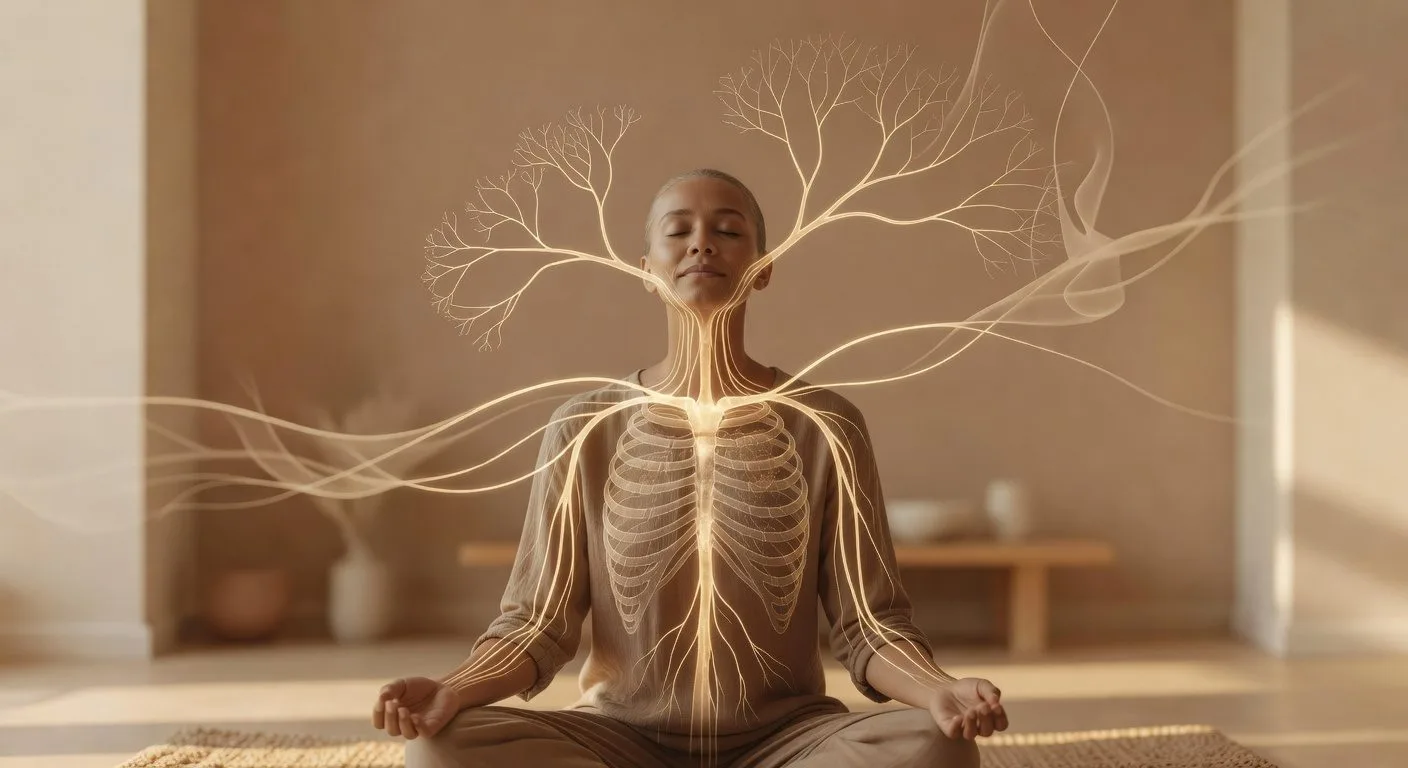
Your nervous system is your body's communication network. It regulates everything that happens automatically: heart rate, breathing, digestion, stress response.
It has two main branches:
Sympathetic nervous system — your accelerator. Activates during stress, danger, action. Heart rate up. Breathing speeds up. Muscles tense. Ready to fight or flee.
Parasympathetic nervous system — your brake. Activates during rest, safety, recovery. Heart rate down. Breathing slows. Digestion starts. Ready to rest and digest.
Normally these systems alternate smoothly. You wake up, your sympathetic system activates. You go to sleep, your parasympathetic system takes over.
In addiction, that balance is disrupted.
The Three States Of Your Nervous System (Polyvagal Theory)
Stephen Porges, founder of polyvagal theory, adds a third state to the traditional model. This explains why willpower alone doesn't work in addiction.
State 1: Ventral Vagal (Safe & Social)
Characteristics: calm, connected, creative, clear thinking
When: you feel safe, seen, heard
Physiology: normal heart rate, deep breathing, good digestion
This is your social nervous system. You can connect with others. You can play, create, love. You can listen AND be heard.
State 2: Sympathetic (Fight or Flight)
Characteristics: anxiety, anger, restlessness, worrying
When: threat, stress, overstimulation
Physiology: accelerated heart rate, shallow breathing, tense muscles
You sense danger. You're ready to fight or flee. Thinking becomes difficult. Reacting becomes automatic.
State 3: Dorsal Vagal (Freeze & Shutdown)
Characteristics: numb, flat, tired, hopeless, dissociation
When: overwhelming trauma, exhaustion, "no way out"
Physiology: low heart rate, shallow breathing, low energy
This is your emergency brake. When stress becomes too great, your system switches to "shutdown." You feel numb. Absent. Disconnected.
The Cycle of Addiction
- What is somatic addiction?
- Somatic addiction (or nervous-system addiction) is the bodily holding of craving: your autonomic system seeks a shortcut from shutdown to safety via substance or behavior. It isn’t only willpower or psychology — polyvagal states and neural highways keep the pattern alive.
Key insight: Addiction is often an attempt to move from dorsal (shutdown) to ventral (safe) — via a shortcut (substance, behavior).
When your nervous system is chronically in dorsal vagal state (shutdown, numb), that state feels unbearable. You reach for alcohol, drugs, food, scrolling, work — not because you're weak, but because your nervous system is desperately seeking relief. Seeking a glimpse of ventral vagal. Seeking safety.
The problem is the shortcut doesn't work. It doesn't bring you to safety. It takes you deeper into the cycle: dorsal → substance → brief ventral → dorsal → substance...
Want to learn more about how your nervous system works? Download our free Neurowellness Guide with explanation of vagus nerve, HRV, and daily exercises for nervous system regulation.
Why Your Body Remembers Addiction
- What does “the body remembers” mean?
- “The body remembers” means trauma and addiction patterns stay in your autonomic nervous system, fascia and breathing — even when explicit memories fade (van der Kolk). Triggers activate old survival pathways automatically; willpower fails because safety comes from body signals, not words.
Here's the hard part.
Your nervous system remembers everything. Every stressor. Every threat. Every time you reached for the addiction to survive.
Those memories aren't in your head. They're in your body. In your neural pathways. In your fascia. In your breathing.
Research shows that trauma is stored in the autonomic nervous system, even when explicit memories fade (van der Kolk, 1994). People in early recovery show chronic sympathetic overdrive (fight/flight), even after months of abstinence.
When a trigger appears — a feeling, a situation, a person — your nervous system activates the old pattern. Automatically. Unconsciously.
You think: "I want to quit." But your body says: "This is how we survive."
And your body almost always wins.
That's why willpower fails.
You can't "think" your way out of a dysregulated nervous system. Safety doesn't come from words. Safety comes from signals your body sends to your brain: "We're safe. You can rest."
As Bessel van der Kolk writes in The Body Keeps the Score (2024): "The body keeps the score — and until the body learns it's safe, the mind cannot fully heal."
5 Exercises To Restore Your Nervous System
- What is craving regulation via the nervous system?
- Craving regulation via the nervous system is calming acute urge through physiological safety signals — like the physiological sigh, long exhale or cold exposure — instead of willpower. You train vagal tone so craving is less likely to hijack survival mode.
Good news: your nervous system is plastic. It can change. It can learn. It can create new patterns.
But not through fighting. Not through forcing. Not through more willpower.
Through safety. Through repetition. Through compassion.
Every time you do one of these exercises, you send a signal to your nervous system: "We're safe. You can rest." That signal is new. Unknown. Maybe even scary.
But with repetition — day after day, week after week — your nervous system learns that safety is possible. Without substance. Without shortcut. Just through breathing. Through presence. Through your own body.
Exercise 1: Physiological Sigh
How: 2 short inhales through nose, 1 long exhale through mouth (3 seconds)
Why: activates vagus nerve within 60 seconds
When: during acute craving, panic, overstimulation
Frequency: 3-5x in a row, repeat after 2 minutes
Stanford/Huberman lab research (Balban et al., 2023) shows up to 40% stress reduction in 1 minute with the physiological sigh. This is one of the fastest ways to calm your nervous system.
Exercise 2: Long Exhale Breathing (4-6-8)
How: 4 seconds in, 6 seconds hold, 8 seconds out
Why: long exhale triggers parasympathetic response
When: morning, evening, before difficult moments
Frequency: 5-10 minutes, 2x per day
Research shows that daily slow breathing significantly increases HRV after several weeks (Laborde et al., 2022).
Exercise 3: Cold Exposure (Face)
How: cold water on face, or ice pack on cheeks 30 seconds
Why: dive reflex activates vagus nerve immediately
When: during acute panic, craving, dissociation
Frequency: 1-3x per day, as needed
Lowers heart rate by 10-15 bpm in 30 seconds. This is your emergency brake for overstimulation.
Exercise 4: Humming Exhale (Bhramari Pranayama)
How: inhale, hum slowly on exhale (like a bee) — 5-10 seconds
Why: vibration stimulates vagus nerve (runs along vocal cords)
When: evening, before sleep, during anxiety
Frequency: 5-10x in a row, 2x per day
Increases vagal tone measurably after 2 weeks of daily practice.
Exercise 5: Grounding Through Feet (Earthing)
How: stand barefoot on ground/floor, feel contact 2-3 minutes
Why: proprioception (body awareness) brings you to ventral vagal
When: during dissociation, "floaty" feeling, overthinking
Frequency: 3x per day, 2-3 minutes
Grounding reduces cortisol by 20-30% (pilot studies). This brings you back to your body. To the now.
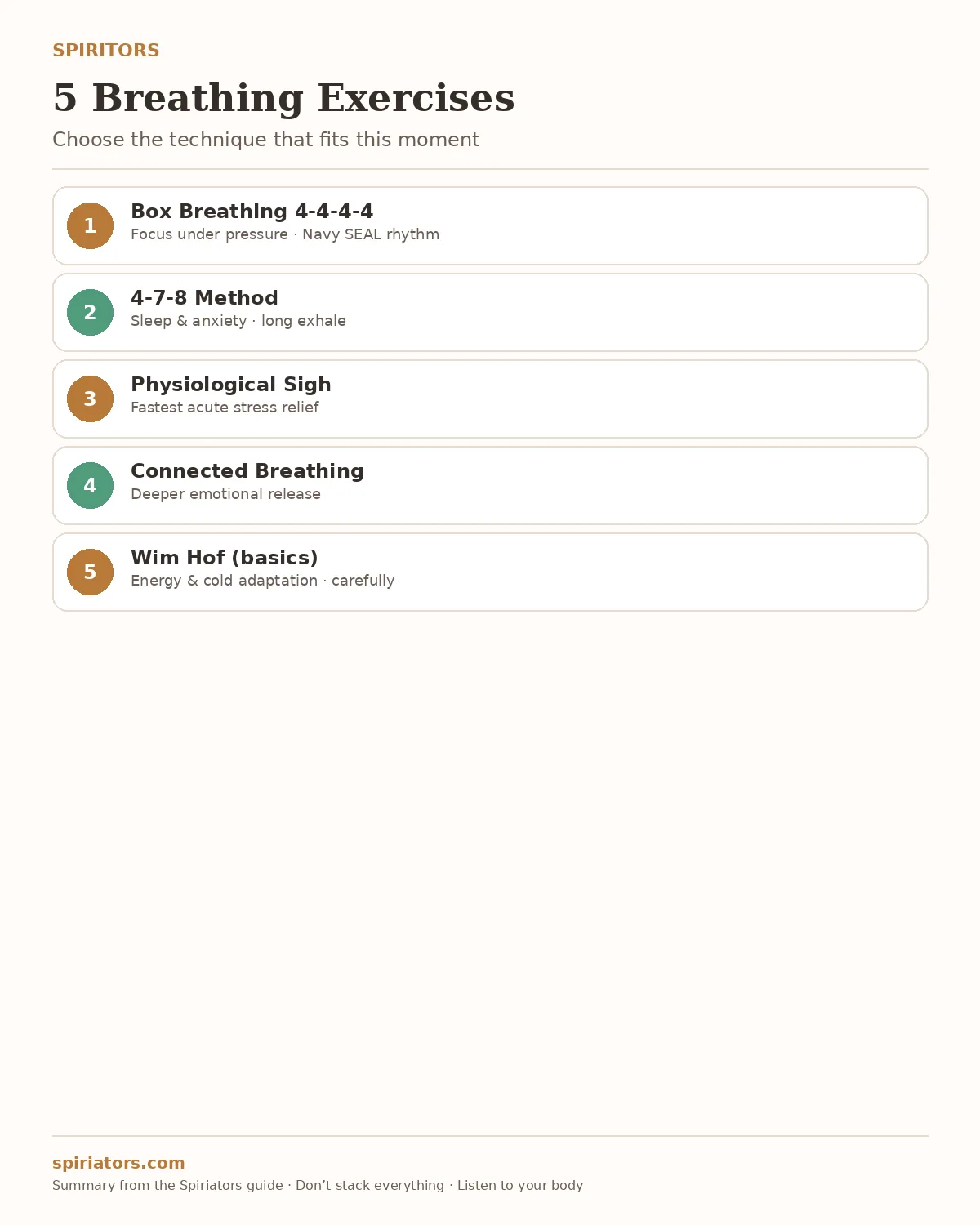
These 5 exercises are a beginning. For a deeper journey through your nervous system, trauma recovery and addiction recovery I invite you to the 30-Day Neurowellness Challenge — with daily breathwork, nervous system regulation and somatic practices.
Frequently Asked Questions
How long does it take to restore the nervous system?
Everyone is different. Some people feel a difference after one breathwork session. For others it takes 3-6 months of daily practice. Consistency is more important than intensity. Better 5 minutes per day than 60 minutes once per week.
Can this replace therapy?
No. This is a supplement to professional help, not a replacement. For severe addiction or trauma, medical and therapeutic support is essential. Breathwork and nervous system regulation can support that process.
What if exercises don't work?
Start smaller. Seek guidance. A trauma-informed therapist or breath coach can help you find the right exercises for your nervous system.
Is this suitable for everyone?
Yes, but adjust intensity for severe trauma. Some exercises (like cold exposure) can be intense. Listen to your body. Go slowly.
Difference between nervous system work and meditation?
Nervous system work is more active, more physiological. It specifically targets the autonomic nervous system (breathing, heart rate, vagus nerve). Meditation is broader — it can contain nervous system regulation, but isn't always focused on physiological change.
Summary
Addiction is not just psychological — it's in your nervous system. The nervous system remembers trauma and can maintain addiction long after the psychological trigger is gone.
Polyvagal theory helps us understand why: three states (safe, fight/flight, shutdown) and addiction as an attempt to move from shutdown to safety.
Willpower fails because your nervous system is still in survival mode. It doesn't listen to words. It listens to signals of safety.
You can retrain your nervous system. With breath. With cold exposure. With grounding. With compassion.
Do you feel there's more than just this blog? Do you recognize that your nervous system is still in survival mode? Let's discover together what your body needs to feel safe again. Book a free introduction for 1-on-1 breathwork coaching or nervous system restoration guidance.
With compassion, Johannes and Luna, on behalf of Spiriators
Breathwork Coaching (1:1 with Johannes) — Connected breathing, rebirthing and nervous system regulation. Online or during travel. More information
30 Days Closing the Day at Home — Week 1 free. Daily yin yoga + breath journey. At home on your mat. Start free
Free introduction — 30 minutes, no obligation. Just space for what is. Book now
Go deeper: Read our pillar pages on breathwork and yoga, explore breath coaching, or consider a retreat to integrate this work.