Connected Breathing: What It REALLY Does to Your Nervous System
You breathe 20,000 times a day. Mostly without thinking about it. But what if those 20,000 breaths could be your greatest superpower?
Imagine this: your body has a secret switch that takes you from survival mode to recovery mode. That switch is in your breath. And connected breathing is the key to finding it.
As a former naval officer, I learned that breathing is the difference between panic and focus. Now I guide others to find that same control back — not with discipline, but with gentleness. In this article, we dive deep into what connected breathing really does to your nervous system. No fluffy theory, but science you can feel.
What Is Connected Breathing?
- What is connected breathing?
- Connected breathing is a conscious breathing technique where you smoothly link inhalation and exhalation without pauses. That continuous circular breath activates your nervous system, helps release stress, and forms the core of both rebirthing and daily micro-practices.
Connected breathing is a conscious breathing technique where you smoothly link inhalation and exhalation without pauses. This creates a continuous circular breath that activates your nervous system and helps release stress.
The technique seems simple, but the effects are profound. By removing the pause between inhale and exhale, a unique physiological response occurs. Your body gets no moment to fall back into automatic patterns. Instead, you build a bridge between conscious and unconscious.
Many people think connected breathing is the same as rebirthing. That's partly true. Connected breathing is the core of rebirthing, but is also used independently. Rebirthing typically involves full sessions with emotional release, while connected breathing also works as a daily micro-practice to regulate your nervous system.
You can start simple connected breathing yourself, but for deep emotional layers or trauma, an experienced coach is recommended. A coach guides you through intense physical sensations and ensures a safe setting. More about this on our breathwork coaching page.
The Science Behind Your Nervous System
- What is the parasympathetic nervous system?
- The parasympathetic nervous system (PNS) is your rest-and-digest mode: it handles digestion, immune function, and regeneration. Via the vagus nerve it lowers heart rate and signals safety — the opposite of fight-or-flight.
Scientists call it 'vagal tone'. You might call it 'that feeling of relief after a deep sigh'. It's the same thing. And you can train it.
Your nervous system consists of two main components: the sympathetic nervous system (SNS) and the parasympathetic nervous system (PNS). The SNS is your fight-or-flight system — it activates during stress, danger, or challenge. The PNS is your rest-and-digest system — it handles digestion, immune function, and regeneration.
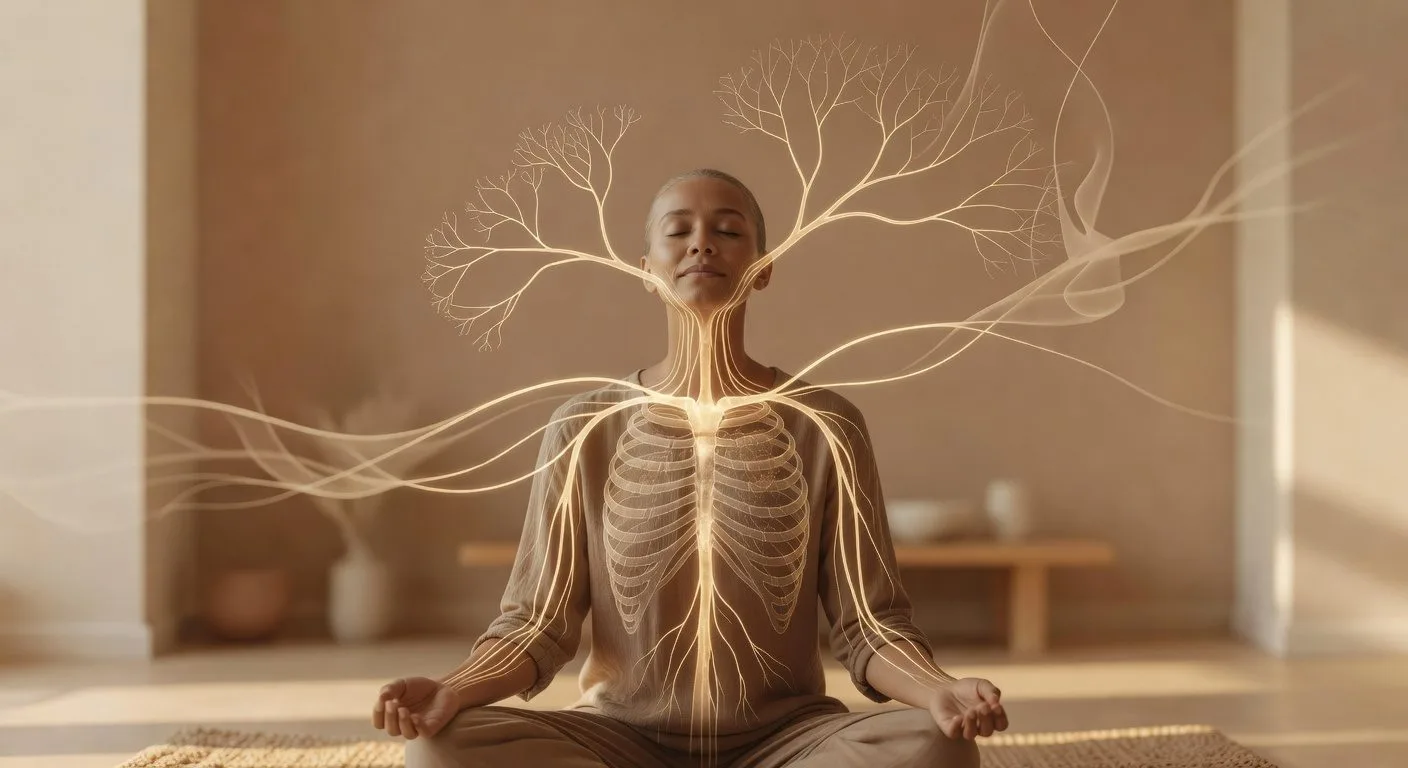
The vagus nerve is the most important nerve of your parasympathetic system. This nerve runs from your brainstem to your heart, lungs, and digestive system. When the vagus nerve is activated, your heart rate decreases, digestion improves, and you feel safety in your body.
Research shows even one 10-20 minute session improves vagal tone. For lasting nervous system effects, experts recommend 3-5 sessions per week combined with daily micro-practices.
Most people breathe on autopilot. But connected breathing is like switching from cruise control to conscious driving — and your nervous system notices immediately. Experimentally slowing breathing shifts the balance between SNS and PNS, as demonstrated in studies by Gerritsen & Band (2018).
Want to know more about the scientific basis of breathwork? Read our article on yin yoga, breathwork and science.
How Connected Breathing Changes Your Nervous System
- What does connected breathing do to the vagus nerve?
- The vagus nerve is the main nerve of your parasympathetic system. A slow, long exhale invites it (HRV research, e.g. Zaccaro/Fincham) — no guarantee, no switch. Connected breathing is more intensive; many people feel more rest after landing. Cortisol/HRV per session varies; not medical treatment.
A slow, long exhale invites your parasympathetic nervous system via the vagus nerve — support, not a switch. Connected breathing is more intensive; HRV and cortisol can move with it, but that varies by person and session. Many people shift toward rest after landing more than during the continuous breath itself.
Here's what happens at the cellular level:
- CO2/O2 balance shifts: Connected breathing changes the ratio of carbon dioxide to oxygen in your blood. This affects how oxygen is delivered to your tissues.
- Heart rate variability (HRV) improves: HRV is a measurable indicator of nervous system health. Higher HRV means more flexibility in your stress response.
- Cortisol decreases: Diaphragmatic breathing lowers cortisol and improves attention, as shown in research by Ma et al. (2017).
- GABA production increases: Breathwork increases GABA (calming neurotransmitter), which helps with anxiety and stress.
Stephen Porges' Polyvagal Theory describes three autonomic states: ventral vagal (safety and connection), sympathetic (action and mobilization), and dorsal vagal (freeze and shutdown). Connected breathing helps you return to ventral vagal — the state of safety and social connection.
The diaphragm has direct neurological connections to the autonomic nervous system, as researched by Bordoni & Zanier (2013). This explains why deep breathing is so powerful for emotional regulation.
Feel your nervous system wanting to relax? Try the 3-minute connected breathing practice below and notice the difference. Or start with our free 30 days challenge for daily breathing practices.
Practice: 3-Minute Connected Breathing Micro-Practice
Ready to experience it yourself? Here's a simple practice you can do anywhere:
- Sit or lie comfortably: Keep your back straight but not tense. Let your shoulders drop.
- Breathe through your nose: Without pause between inhale and exhale. Visualize a circle: inhale = up, exhale = around.
- Stay with your breath: Notice: where do you feel tension? Most people notice warmth, tingling, or emotions in chest or belly.
- After 3 minutes: Take 3 deep breaths with a long exhale and sigh. This extended exhale activates your parasympathetic nervous system directly.
Start with 3 minutes, build up to 10-20 minutes. Consistency is more important than intensity for nervous system effects.
Connect connected breathing to an existing habit: morning coffee, before sleep, or after work. This anchor practice makes it easier to maintain.
Want more practical exercises? Check our 5 breathing exercises for stress for extra tools.
When Should You Seek a Coach?
Not every connected breathing experience is soft and peaceful. Sometimes a lot comes up. That's normal — and it's why guidance can be valuable.
Seek a coach for:
- Intensive emotional release during self-practice
- Trauma history or dissociation
- Desire for deep transformation (rebirthing sessions)
- Confusion about what you're experiencing
At Spiriators, we guide you through the full connected breathing experience in a safe setting. We combine breathwork with coaching to support integration. More information on our courses page.
Want to meet us first? Send us a message via contact for a no-obligation conversation.
Frequently Asked Questions About Connected Breathing
What exactly is connected breathing?
Connected breathing is a conscious breathing technique where you smoothly link inhalation and exhalation without pauses. This creates a continuous circular breath that activates your nervous system and helps release stress. The technique is used in rebirthing, but also works as a daily practice.
How does connected breathing affect your nervous system?
A slow, long exhale invites your parasympathetic nervous system via the vagus nerve — support, not a switch. Connected breathing is more intensive; HRV and cortisol can move with it, but that varies. Research on slow breathing shows measurable HRV changes; that is not the same as guaranteeing one connected session.
Is connected breathing the same as rebirthing?
Connected breathing is the core of rebirthing, but is also used independently. Rebirthing typically involves full sessions with emotional release, while connected breathing also works as a daily micro-practice to regulate your nervous system. Both use the same breathing technique.
Can I do connected breathing myself or do I need a coach?
You can start simple connected breathing yourself, but for deep emotional layers or trauma, an experienced coach is recommended. A coach guides you through intense physical sensations and ensures a safe setting. For daily micro-practices, doing it yourself is fine.
How often should I do connected breathing for results?
Research shows even one 10-20 minute session improves vagal tone. For lasting nervous system effects, experts recommend 3-5 sessions per week combined with daily micro-practices. Consistency is more important than duration.
From Surviving to Living
Connected breathing is more than a technique. It's an invitation to return to your body. To the place where safety resides, where rest is possible, where you don't have to fight to be whole.
Your nervous system is made for recovery. Not for constant alertness. With connected breathing, you give yourself permission to settle. To feel. To be.
Most of us live in a state of mild stress. We think this is normal. But your body knows better. That deep sigh you sometimes give involuntarily? That's your nervous system asking for space.
Connected breathing gives that space. Not by forcing. Not by controlling. But by connecting. Inhale with exhale. Body with breath. You with yourself.
If this resonates with you, if you feel your nervous system wants to relax, then we invite you to go further. Our breathwork coaching sessions offer a safe space for deep transformation. Or start small with the free 30 days challenge.
Share your experience in the Spiriators community — how did your body feel after the first time doing connected breathing? We'd love to hear.
Sources: Zaccaro et al. (2018), Gerritsen & Band (2018), Ma et al. (2017), Lehrer & Gevirtz (2014), Streeter et al. (2012), Porges (2007/2011), Bordoni & Zanier (2013).
Warm regards, Johannes and Tessa — Spiriators
Go deeper: Read our pillar pages on breathwork and yoga, explore breath coaching, or consider a retreat to integrate this work.