Anatomy: What Is The Iliopsoas Actually?
- What is the iliopsoas (psoas)?
- The iliopsoas — also often called the psoas — is the deepest core muscle group of your body: psoas major connects lower back to thigh bone, and together with the iliacus it forms the primary hip flexor. Liz Koch calls this layer the “muscle of the soul” because it links breath, posture and autonomic stress response.
The iliopsoas is not just any muscle. It's the deepest core muscle group of your body. You can't feel it on the surface — it lies hidden, deep in your torso.
The iliopsoas is made of two cooperating muscles (plus sometimes a small third):
- Psoas major: Connects your lower back (vertebrae T12-L5) to your thigh bone (femur). This is the primary hip flexor.
- Iliacus: Lies in the iliac fossa of the pelvis and attaches with the psoas major on the thigh bone.
- Psoas minor: Not everyone has this. It's a smaller, more superficial muscle that's absent in about 40-60% of people.
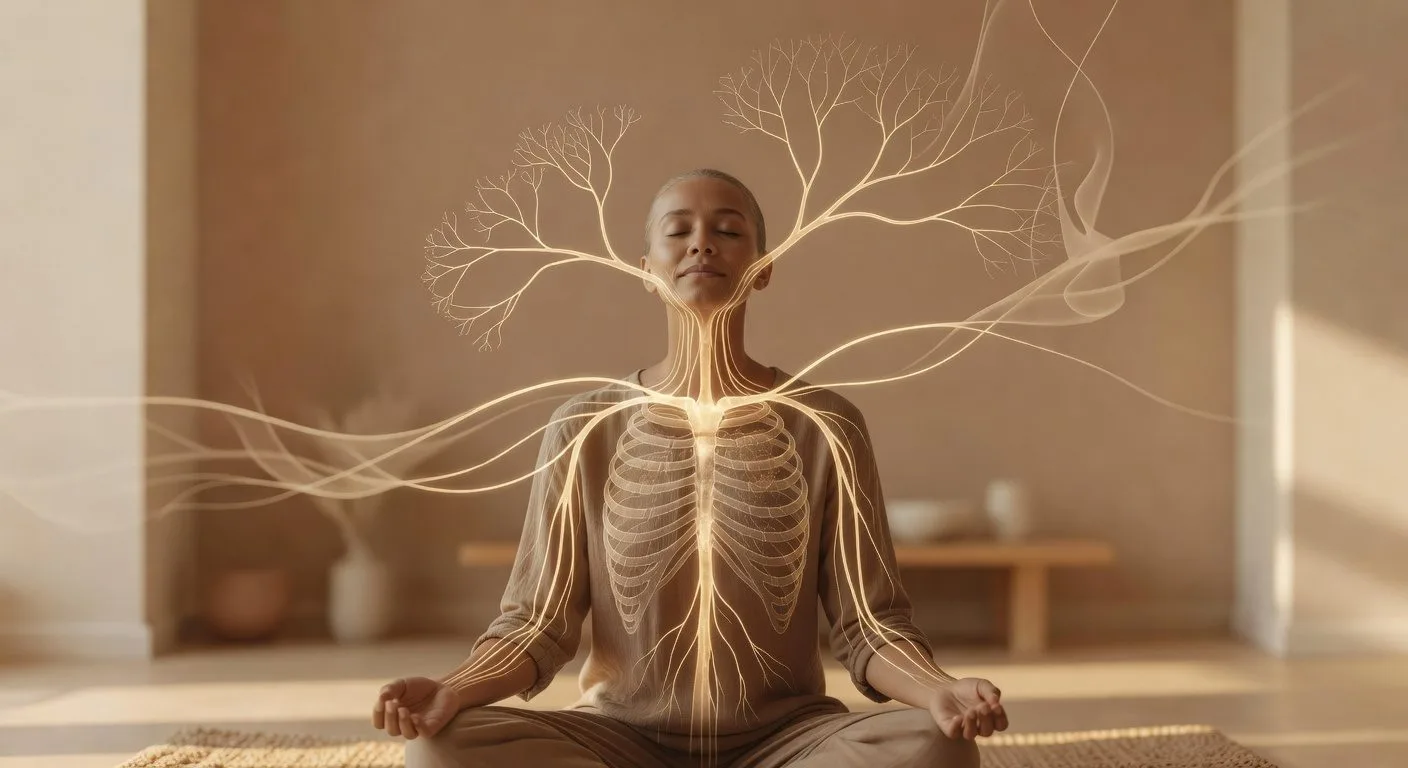
Together, psoas major and iliacus form the iliopsoas — the muscle group that connects your diaphragm to your hip joint. Literally: your breathing and your movement are intertwined.
Functions of the iliopsoas:
- Hip flexion (lifting leg)
- Torso stabilization
- Breathing support (via connection to diaphragm)
- Posture and balance
But here's where it gets interesting: the iliopsoas is also a primitive muscle group. It's one of the first layers that develops in the womb. And it's one of the few directly connected to your autonomic nervous system — the part that regulates fight/flight/freeze.
👉 Place your hand on your hip right now. Do you feel tension? Breathe toward it — not to change it, but to feel it. What do you notice?
Why Trauma Stores In Your Hips
- Why do hips hold trauma?
- Hips hold trauma because the iliopsoas is evolutionarily, anatomically and neurologically tied to fight/flight: chronic stress = chronic iliopsoas tension. Emotions from the limbic system land in this bridge between upper and lower body — which is why hip work often feels emotionally intense.
This is not a metaphor. This is physiology.
When trauma happens — an accident, abuse, loss, chronic stress — your body stores it. Not just in your "head". But in your tissues. In your muscles. In your nervous system. (van der Kolk, 1994)
The hips — and specifically the iliopsoas — are a storage facility for emotional tension. We know this now, thanks to neuroscience and somatics. (van der Kolk, 1994)
Why the hips specifically?
- Evolutionary: The iliopsoas is a primitive layer — active in embryos, essential for survival.
- Anatomical: The iliopsoas connects your upper body to your lower body. It's a bridge between your "thinking" and your "doing".
- Nervous system: The iliopsoas is directly connected to your sympathetic nervous system (fight/flight). Chronic stress = chronic iliopsoas tension. (Bordoni & Zanier, 2013)
- Limbic system: Emotions are processed in your limbic system → signals to your muscles → tension stores in the iliopsoas.
Liz Koch, pioneer in iliopsoas/psoas research, calls this muscle group the "muscle of the soul". Not because it literally contains your soul. But because deep emotions — fear, shame, sorrow, anger — are held here.
Taoist traditions have known this for thousands of years. The hips are the center of your life energy (chi, prana). When the hips are stuck, your energy is stuck.
And when you open the hips? Energy releases. And with energy… come emotions.
👉 Try Constructive Rest Position now (see exercises below). 5 minutes. Feel what happens — without judgment. What comes up?
- What is yin yoga for the iliopsoas/hips?
- Yin yoga for the iliopsoas/hips uses long, gentle poses — such as constructive rest, supported bridge or a mild iliopsoas stretch — where you don’t force a stretch but invite safety. That lets the iliopsoas relax and release what hip trauma held, without overwhelm.
Exercise 1: Constructive Rest Position (CRP)
Duration: 5-10 minutes
Safety: ✅ Safe for everyone
How:
- Lie on your back
- Knees bent, feet on floor (hip-width)
- Arms relaxed beside body
- Let gravity work — don't force
- Breathe naturally, feel your hips sinking
Why it works: Neutral position, iliopsoas can relax without stretch, nervous system calms.
Exercise 3: Supported Bridge
Duration: 3-5 minutes
Safety: ✅ Safe with support
How:
- Lie on your back, knees bent
- Place block/cushion under your sacrum (not under lower back!)
- Feet hip-width, arms relaxed
- Let hips sink onto support
- Breathe into your chest → iliopsoas relaxes
Why it works: Gentle hip opening + vagus nerve stimulation (chest breathing).
Exercise 5: Gentle Iliopsoas Stretch
Duration: 2-3 minutes per side
Safety: ⚠️ Don't force, stop if emotions arise
How:
- Standing, step left foot back
- Right knee bent (90 degrees)
- Hands on hips or above right thigh
- Gently push left hip forward (not too deep!)
- Exhale: gently deepen, inhale: length
Why it works: Direct iliopsoas release + grounding (standing).
Healing The Iliopsoas: A Journey, Not A Destination
The iliopsoas is not something you "fix". It's something you get to know. A friend. A guide. A mirror of your nervous system.
When you release the iliopsoas, you don't just release tension. You release your history. Your survival patterns. Your old stories. (Kuhfuß et al., 2021)
And that's not a one-time thing. It's a journey. A journey of feeling. Of breathing. Of trusting.
Your nervous system learns: I am safe. I may relax. I may be.
And the iliopsoas? It follows. Slowly. Gently. Step by step.
👉 Next week: a blog about nervous system regulation after iliopsoas release — how to integrate what comes up. Do you want to read it? Sign up for our newsletter.
Warm regards,
Tessa and Luna, on behalf of Spiriators
📖 Read More
- Yin Yoga at Spiriators
- Types of Yoga: Yin, Hatha & Vinyasa (pillar)
- Yin Yoga and fascia
- Breathwork for trauma processing
- The 30-Day Psoas Reset Protocol — paid Interactive PDF + App, not this blog essay
Go deeper: Read our pillar pages on yoga and breathwork, explore yin yoga, or join a retreat to deepen your practice.