
Setting boundaries without guilt — it feels like an impossible task. You open your mouth to say "yes," but somewhere deep in your belly everything tightens. You hear the words falling while your body whispers: "This doesn't feel right." Do you recognize that? That moment when you know you actually want to say "no," but the word "yes" comes out — because it's easier, because you don't want to disappoint the other person, because you're afraid of the tension that will follow?
I know this feeling. For years, I said "yes" to requests that exhausted me, to appointments that drained me, to situations that conflicted with what I truly wanted. And every time afterward, I felt that same aftertaste: a mixture of irritation, shame, and a simmering resentment that slowly ate away at my energy.
What I didn't know then: this wasn't a character flaw. This was a fawn response — a survival pattern that my nervous system had learned to stay safe by being nice. Setting boundaries is not a talent you're born with. It's a muscle you can train.
Why does setting boundaries feel so scary?
- Fawn response
- The fawn response is a survival pattern of staying safe by being nice: saying yes while thinking no. Your nervous system learned that pleasing equals safety — so saying “no” feels bodily like a threat, not like an ordinary choice.
As a child, saying "no" often meant: tension, rejection, love withdrawing. Your body learned: being nice = being safe. And that's not in your head — it's in your nervous system. Research by Stephen Porges shows that our nervous system works in three circuits: safe and social, fight/flight, or freeze/fawn. If saying "yes" was your survival strategy, saying "no" feels like an existential threat.
That explains why setting boundaries can feel so physically intense. Your heart rate accelerates. Your breathing becomes shallow. Your muscles tense up. As if your body is saying: "If I say no now, I'm no longer safe."
But here's the good news: that system can relearn. Research shows that self-compassion literally lowers your heart rate response to stress — your nervous system rewires itself. And other research confirms that when you build self-compassion, submissive behavior measurably decreases. Setting boundaries without guilt is not a spiritual ideal. It's biologically possible.
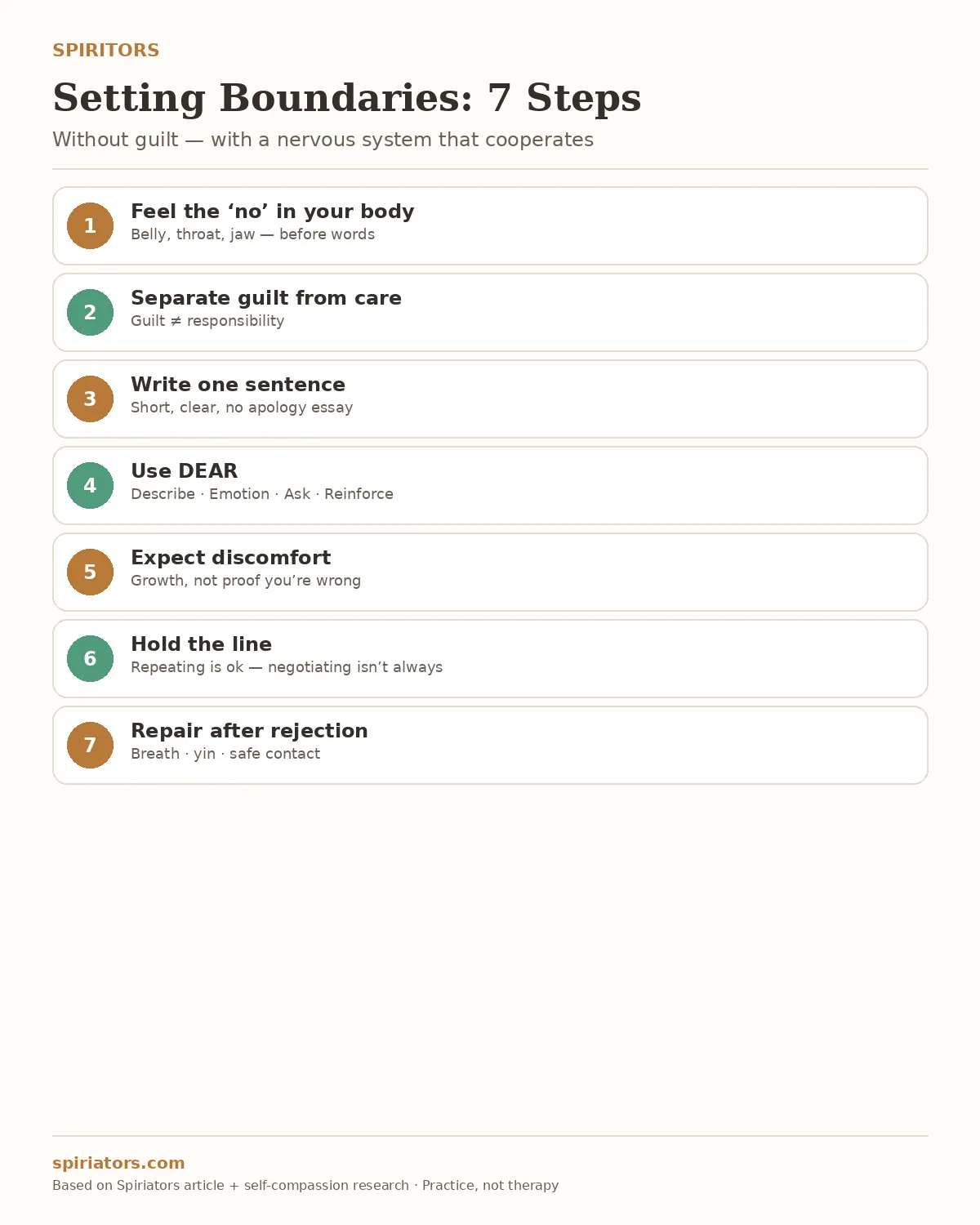
The 7 steps to setting boundaries without guilt
Step 1: Recognize the fawn response without judgment
The first step is not action, but awareness. When do you feel that belly tightening? When do you say "yes" while thinking "no"? When you notice it, don't immediately say something to the other person. Say to yourself: "Ah, there's my fawn part again. It's trying to keep me safe." No judgment. Just recognition.
Step 2: The Body-Scan Reset (2 minutes)
Before you respond to a request, breathe deeply into your belly three times and scan: does this feel like a "yes" from your whole body, or like a "yes" from your head while your abdominal muscles tense up? That difference is the difference between a genuine yes and a fawn-yes.
Practice this at home, in low-stakes situations. Someone asks if you want to do the dishes. Instead of automatically saying "sure," you breathe first. You feel: yes, I can do this. Or: no, I'm tired. Both answers are good.
Step 3: Use the DEAR structure for the conversation
- DEAR method
- DEAR is a conversation structure for stating a boundary clearly: Describe the situation, Express how you feel, Assert what you need, Reinforce the mutual benefit. It prevents apology essays and keeps your message short and clear.
When you're about to set a boundary, a structure helps. DEAR works like this:
Describe — Describe factually what's happening
Express — Express your feeling in I-form
Assert — Make a concrete request
Reinforce — Outline the positive consequence
Example: "I notice that I've been traveling the past three weekends (D). I feel exhausted (E). I'd like to stay home this weekend (A), so I can meet up with energy on Monday (R)."
No blame, no apology. Just facts, feeling, request, consequence.
Step 4: The Compassionate Reframe (3 minutes)
Guilt when setting boundaries is no coincidence — it's learned. Try this: write on paper the sentence "I'm selfish if I say no." Look at it for 30 seconds. Turn the paper over and write: "I protect my energy so I can keep giving from abundance, not from emptiness."
That's not positive thinking. It's a reframe that gives your brain different work to do. Every time you practice this exercise, you give your nervous system a new pathway. And over time, that pathway becomes the path of least resistance. Self-compassion and guilt can't be active at the same time — research shows that when self-compassion grows, submissive behavior decreases. They're not compatible quantities.
Step 5: The "Parts" conversation (10 minutes)
Put two chairs down. On one chair: the part of you that always says "yes" and takes care of everyone. On the other: your current adult self who knows you need space.
Have a brief inner conversation: "Fawn part, when did you protect me the most? What do you need now?" Sometimes that part says: "I'm afraid they won't like you anymore." Then you can answer: "I hear you. And I'm choosing to take care of myself now. You can rest."
Step 6: The Polyvagal Landing before the conversation (5 minutes)
Before the difficult conversation: five minutes of slow exhalation. Longer out than in, for example 4-7-8 breathing. This activates your ventral vagus — the part of your nervous system that says: "I'm safe." Your voice becomes calmer. Your words come clearer. And the other person feels that difference — because nervous systems are contagious.
Step 7: Practice in low-stakes situations
Start small. Say "no" to an extra cup of coffee. Say "I need to think about it" instead of immediately "yes." Say "this doesn't work for me" to an appointment that doesn't fit. Every small boundary is a signal to your nervous system: "I'm safe to speak my truth."
Is it selfish to put my own boundaries above someone else's wishes?
No. Imagine a spring. If you constantly draw water without replenishing, the spring dries up. Boundaries are not the wall around the spring — they are the edge that protects the spring so it keeps flowing. Who takes care of themselves can more sustainably take care of others. That's not selfishness. That's energy ecology.
What if I'm a "people pleaser" — can I really unlearn that?
- People pleasing
- People pleasing is learned behaviour that puts others’ wishes above your own boundaries to stay safe or loved. Neurologically it is often a fawn state of your autonomic nervous system — and what is learned can be unlearned through secure attachment to yourself.
Yes. The fawn response is neurologically nothing more than a learned state of your autonomic nervous system. And what is learned can be unlearned — not by pushing harder, but through secure attachment to yourself. By repeating that inner voice that says "you're allowed to exist, you're allowed to take up space, you're allowed to say no" — over and over, until your body believes it.
It's not about willpower. It's about repetition in safety. Every time you set a small boundary — a "no" to a coffee appointment, an "I need to think about it" instead of an automatic "yes" — you give your nervous system a new experience. And each new experience strengthens the pathway to authentic connection.
From theory to practice: three gentle invitations
Boundaries are not a wall around you — they are the gate that only opens for those you truly want to let in. In our 1-on-1 breathwork coaching sessions, we work precisely on that: ventral vagal landing, learning to distinguish your inner "yes" from your "fawn-yes," and developing gentle strength.
The 5 exercises above are not a one-time reset, they are a 21-day ritual. In the Spiriators community, we do them together every morning — no performance, no schedule, just showing up for yourself.
Do you recognize the "people-pleasing" especially in relationships (partner, family, work)? The blog Breaking Relationship Patterns goes deeper into the 5 love languages as a key to reciprocity.
Further reading for those who want to go deeper
If this article touches you, there are more blogs in the same vein. Disarming the Inner Critic helps you recognize that judging voice as a protective part — just like the fawn response. And Breaking Family Patterns shows how setting boundaries often means: breaking old family dynamics.
Want to understand your nervous system better? The Yin Yoga practice teaches you to stay in stillness — even when it becomes uncomfortable. And our yoga classes offer a safe space to practice presence, without performance pressure.
Finally: an invitation to honesty
If you already feel guilt at the idea of saying "no," then you are exactly the target audience of this blog. That feeling is not a mistake. It's a signal that there's something to heal — not by pushing it away, but by recognizing it, understanding it, and relearning it step by step.
This community is a practice space for honesty. Share in the comments: which "yes" from the past week might actually have been a "no"? We read everything and don't judge.
Because setting boundaries without guilt is not a destination. It's a practice. And every time you choose your own truth — even if your voice trembles — you train your nervous system in a new state of being: safe enough to be honest.
That's not selfishness. That's self-love in action.