Your heart beats faster. Your breathing gets shallow. And somewhere deep down, you know: this doesn't have to continue.
The vagus nerve is the longest cranial nerve, connecting your brain to your heart, lungs and gut, where it regulates your rest-and-recover response. When you learn to activate this nerve — through breathing, cold, sound, or conscious movement — you give your body a direct pathway out of the stress response. No hype. No miracle cure. Just seven breathing exercises that actually work, backed by research from 2024 and 2025.
In this blog, you'll walk through seven evidence-based techniques that raise your vagal tone. For each exercise, you'll learn how to do it, how long to practice, what you'll feel — and what the science says. By the end, you'll have a routine you can start today. And if you want to compare these with familiar breathing exercises for stress relief, read our 5 breathing exercises against stress.
What is the vagus nerve, really?
The vagus nerve is the tenth cranial nerve and the longest nerve of your parasympathetic nervous system, running from your brainstem through your neck, chest, and abdomen to your gut, where it regulates unconscious processes like heart rate, breathing, and digestion.
Most people hear "vagus nerve" and think of that nerve behind the ear. That's partially true — the auricular branch does run along your ear shell. But the vagus is far more than that. It influences your heart rate, your breathing, your digestion, and your inflammatory response. High vagal tone means your body switches out of stress mode quickly. Low vagal tone keeps you in vigilance mode — even when there's no real threat.
You measure vagal tone through heart rate variability (HRV). The higher your HRV, the more flexible your nervous system. That's not just theory — it's measurable with a simple heart rate monitor. For a deeper understanding of how your nervous system works, read our blog on polyvagal theory explained.
Why breathing is the fastest vagus activator
Breathing is the only autonomic function you can also consciously control. That makes it the fastest gateway into your parasympathetic nervous system. When you slow your breathing — specifically, when you extend your exhale — you directly activate the vagus nerve. Your heart rate drops. Your blood pressure follows. Your body receives the signal: it's safe.
Research from 2025 confirms this. A scoping review by Giorgi and colleagues shows that slow breathing and HRV biofeedback significantly increase high-frequency HRV and improve baroreflex sensitivity. Giorgi et al. (2025) analyzed six studies and concluded that resonance-frequency breathing — approximately five to six breaths per minute — is the most effective technique for raising vagal tone.
But here's the point: you don't need to understand how it works to feel it. Try exhaling for six seconds right now. Can you feel your heart rate settling? That's your vagus taking over.
7 Breathing exercises to stimulate your vagus nerve
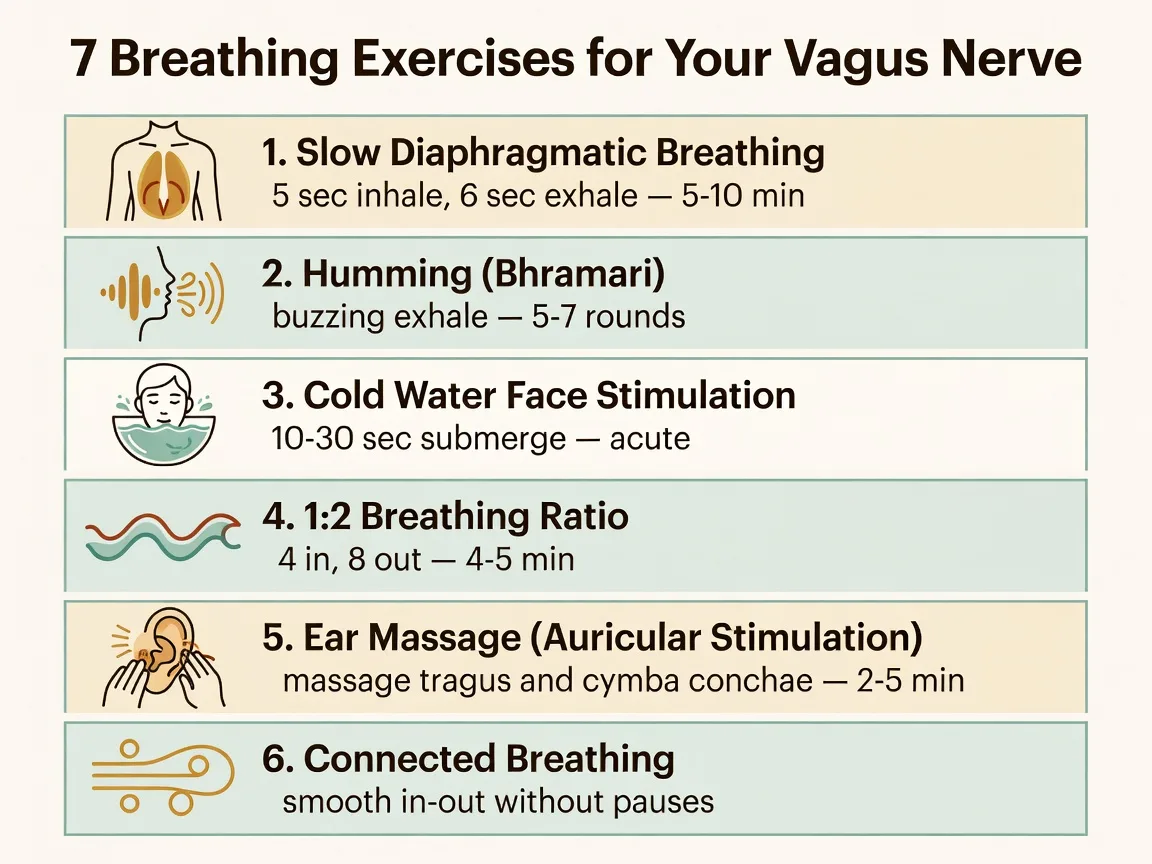
1. Slow diaphragmatic breathing (5-second breath)
This is the most researched technique and the foundation for everything that follows. Inhale for 5 seconds through your nose — fill your belly first, then your chest — and exhale for 6 seconds through pursed lips. Practice for 5 to 10 minutes, twice daily.
Resonance-frequency breathing synchronizes heart rate, blood pressure, and breathing, significantly increasing your baroreflex sensitivity and HRV. You'll feel a direct heart rate reduction and a calmer state within 2 to 3 minutes. No complicated technique needed — just time and attention.
Learn more about breathwork and what it can do for you
2. Humming (Bhramari Pranayama)
Close your eyes, place your fingers lightly on your tragus — that small flap in front of your ear canal — inhale deeply through your nose, then exhale while making a steady buzzing tone like a bee. Do 5 to 7 rounds. You'll feel subtle vibrations in your face and chest, with an immediate calming effect.
A 2025 pilot study found that humming is equally effective as slow-paced breathing for raising HRV — without requiring any equipment. Woo et al. (2025) measured significant increases in SDNN, total power, and LF across sixteen healthy adults. The vibration from humming directly stimulates the auricular branch of the vagus nerve behind your ear. It's the most portable vagus activator that exists — you can do it anywhere, anytime.
Pro-tip: Place your fingertips gently on the tragus while humming. The vibration amplifies stimulation of the auricular vagus branch. Feel the difference? That's your nervous system responding.
3. Cold water face stimulation (Cold Face Test)
Fill a bowl with cold water (10-15°C), inhale, and submerge your face for 10 to 30 seconds — especially your forehead, cheeks, and the area around your eyes. The trigeminal nerve registers the cold, activates the dive reflex, and the vagus nerve follows.
A systematic review of twelve RCTs from 2025 shows that cold water immersion measurably accelerates parasympathetic reactivation after stress or exercise. Galvez-Rodriguez et al. (2025) report that eight of the twelve studies showed moderate-to-large effect sizes.
What you feel: a sharp shock followed by a wave of calm alertness. Use this for acute stress — an important meeting, an argument, a panic moment. It works fast, but it's not a replacement for daily breathing training. Want to build a structured practice? Our breathwork coaching helps you establish a routine.
4. Extended exhale breathing (1:2 ratio)
Inhale for 4 seconds through your nose, exhale for 8 seconds through your nose or pursed lips. Practice for 4 to 5 minutes as an acute reset — before a meeting, after a conflict, or before sleep.
Exhalation is the parasympathetic phase. The longer your exhale compared to your inhale, the stronger the vagal signal. Research emphasizes that the ratio between inhale and exhale is the key — not the absolute length. A 1:2 ratio (4 in, 8 out) is a safe starting point that works immediately.
What you feel: your heart rate visibly drops, your shoulders release, your thoughts slow down. It's the fastest of all seven techniques — ideal when you have no time but need calm.
5. Auricular vagus stimulation (ear massage)
Gently massage the outside of your ear for 2 to 3 minutes. Focus on the tragus and the area around the auricle — the cymba conchae. These are the superficial branches of the auricular branch of the vagus nerve.
A 2025 narrative review describes how transcutaneous auricular vagus nerve stimulation (taVNS) combined with slow breathing is a promising hybrid approach for autonomic balance. Gitler et al. (2025) cover both HRV biofeedback and the Safe and Sound Protocol, outlining the mechanisms behind non-invasive vagal neuromodulation.
What you feel: tingling in your ear and jaw, a subtle wave of relaxation. Combine this technique with humming for a doubled effect — the vibration plus the massage reach the same nerve through two pathways.
6. Connected breathing
Breathe smoothly in and out through your mouth without pause — no silence between inhale and exhale. Natural pace, about one breath per second. Practice for 10 to 20 minutes in a safe setting, preferably lying down.
Connected breathing activates both sympathetic and parasympathetic tone. It moves you through accumulated tension — physical, emotional, energetic — and often leads to a deep nervous system reset. This is not a beginner's exercise. If you're new to it, practice with guidance. Learn more about this method in our blog on connected breathing and your nervous system.
What you feel: tingling in your hands and face, emotional waves, sometimes mild dizziness (normal — it's your nervous system shifting), often a deep calm afterwards.
7. Orienting and social signaling (polyvagal exercise)
Take 3 to 5 minutes to slowly scan your environment. Subtly turn your head left and right. Let your eyes rest on what you notice — a plant, a window, a color. Combine this with a soft smile and eye contact if you see another person.
This exercise comes from polyvagal theory. Orienting activates the ventral vagal complex — the part of your nervous system that signals connection and safety. It's the oldest form of vagus stimulation: your ancestors did nothing but scan their environment to determine if it was safe. In a world of screens and notifications, you've largely lost that skill.
What you feel: openness, space in your chest, less defensiveness. It sounds simple — and it is. But simplicity is not proof of weakness. Sometimes the most powerful exercise is the one you least expect.
Pro-tip: Combine orienting with your breathing. While scanning your environment, exhale slowly. The combination of safety signaling (orienting) and parasympathetic activation (exhalation) amplifies each effect. Three minutes is enough for a noticeable difference.
Which exercise do you choose when?
Not every exercise fits every moment. Here's an overview to help you choose:
| Moment | Best exercise | Duration | Why |
|---|---|---|---|
| Acute stress or panic | Cold water face stimulation | 10-30 sec | Fastest vagal reset via dive reflex |
| Meeting or tense moment | 1:2 breathing ratio (4 in, 8 out) | 4-5 min | Subtle, immediate heart rate reduction |
| Morning routine | Slow diaphragmatic breathing | 5-10 min | Structural vagal tone throughout the day |
| Sleep difficulties | 1:2 breathing ratio + humming | 5-7 min | Parasympathetic activation + relaxation |
| Emotional blockage | Connected breathing | 10-20 min | Deep nervous system reset (with guidance) |
| In between on a busy day | Ear massage + orienting | 3-5 min | Subtle, doable anywhere, no equipment |
How long before you notice results?
Acute effects — lower heart rate, more calm, less tension — are measurable within 2 to 5 minutes of slow breathing or humming. That's the good news: you don't have to wait. Your vagus responds immediately.
Structural changes in HRV and vagal tone become visible after 4 to 8 weeks of consistent daily practice. That's the important news: consistency beats intensity. Five minutes a day is more effective than one hour a week. Your body learns through repetition, not endurance.
Combine 2 to 3 exercises in a fixed morning or evening routine. Start with slow diaphragmatic breathing as your foundation. Add humming or ear massage when you need a quick reset after a stressful moment. And save connected breathing for times when you need deeper release.
Ready to start with a guided routine? A breathwork coaching session helps you learn the techniques safely and build a routine that fits your life.
The science behind vagus stimulation: what we really know
Stephen Porges' polyvagal theory is an influential framework that explains how your nervous system navigates between safety, danger, and life threat. It provides a logical model for why breathing, social connection, and safety signaling influence your autonomic balance. But the theory isn't without criticism. A 2025 review by Porges himself confirms clinical applicability, while a 2026 international expert evaluation places caveats on the neuroanatomical assumptions.
What we do know with certainty: slow breathing, cold water stimulation, humming, and auricular stimulation measurably raise vagal tone. The HRV data is clear. The clinical results are consistent. The mechanisms are understandable — you don't need to fully embrace the theory for the exercises to work.
For the deeper theoretical background, we refer you to our blog on polyvagal theory explained. But remember: theory is a map. The exercises are the terrain. Walk the terrain.
Don't forget: a 30-day challenge is one way to build consistency — and consistency is exactly what your vagus needs.
Key takeaways
- The vagus nerve is your rest-and-recover nerve — you can activate it through breathing, cold, sound, and conscious movement
- Slow diaphragmatic breathing (5-6 breaths/min) is the most researched and effective technique for vagal tone
- Acute effects are measurable within 2-5 minutes; structural HRV improvement after 4-8 weeks of daily practice
- Consistency beats intensity: 5 minutes a day is more effective than 1 hour a week
- Combine 2-3 exercises in a routine — cold water for acute stress, breathing for structure, connected breathing for deep reset
- Polyvagal theory is a useful framework, not a hard law — the exercises work without fully understanding the theory
Start today: pick one exercise, practice for 5 minutes, and notice what you feel. Change begins with attention. And if you want to deepen these exercises in a safe, guided setting — book a free trial session. We'd love to walk with you.