
Your body reacts before your mind catches up. Your heartbeat quickens, your breathing goes shallow, and you have no idea why. That's your nervous system at work — not your rational mind, not your willpower, but an underground system that already decided before your consciousness got a vote. Stephen Porges' polyvagal theory gives language to what you've been feeling all along: your body chooses, not you. And once you understand how those three states work, you can finally stop fighting yourself — and start listening to what your body is trying to tell you.
Three states, one nervous system
Picture this: you're sitting in a meeting. Something gets said and you feel your throat tighten. Your face flushes, your hands go cold. Later, when you get home, you sink into the couch and feel nothing at all. Just tired. Empty. Numb.
Those aren't choices. Those are three states of your autonomic nervous system — and polyvagal theory gives them a name:
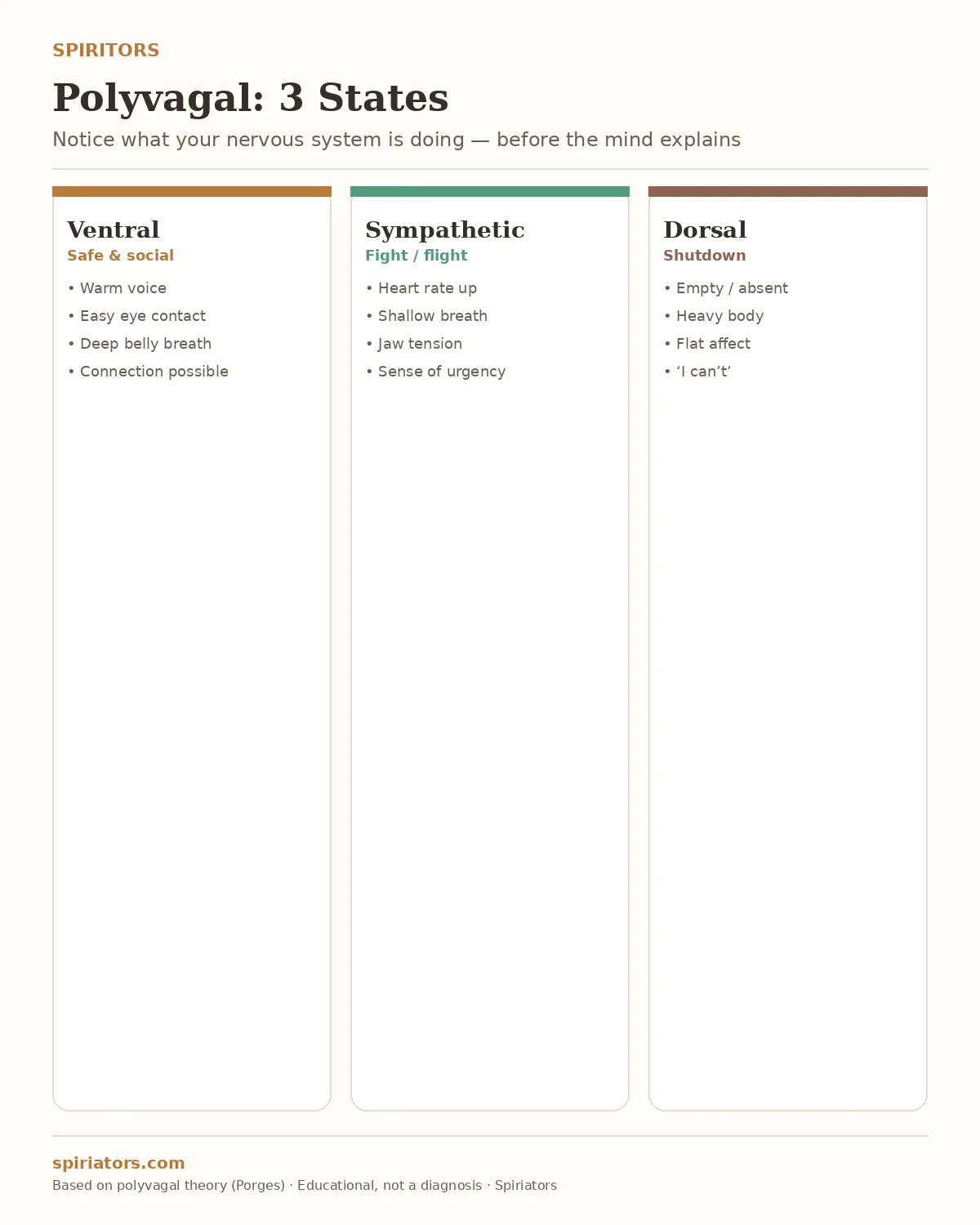
- Ventral vagal — safe and connected. You can think, feel, form relationships. This is the state where growth becomes possible.
- Sympathetic — fight or flight. Your body goes into survival mode: racing heart, muscle tension, restless thinking. Useful when there's actual danger. Exhausting when it stays switched on.
- Dorsal vagal — freeze or shutdown. Energy drains away, you feel numb, disconnected from your body. This is your nervous system's oldest survival strategy: when fighting and fleeing don't work, you shut down.
Porges discovered that these states operate hierarchically. Your nervous system always tries safety first (ventral vagal). Can't find it? It shifts to fight-flight (sympathetic). That doesn't work either? It pulls the plug (dorsal vagal). Research shows that this process — called neuroception — works faster than conscious thought. Your body scans the environment, faces, voices, and decides whether you're safe before you even realize it.
What exactly is neuroception?
- Neuroception
- Neuroception is your nervous system’s unconscious detection system that continuously scans: am I safe here? It registers micro-signals — a look, a tone, a silence — faster than conscious thought, and decides whether you move into safety, fight-flight or freeze.
Neuroception is the word Porges gives to something you've been doing your whole life but never named. It's the unconscious detection system of your nervous system that constantly scans: am I safe here?
Think of that one look from someone you didn't trust. You knew it before you could name it. That's neuroception. Your nervous system registers micro-signals — a frown, an intonation, a silence that lasts just a beat too long — and draws a conclusion. Fast. Sometimes too fast, especially if you've experienced a lot of stress. But always with one purpose: protection.
The problem? Neuroception can't distinguish between real danger and the memory of danger. When your nervous system has been through trauma, it detects threat everywhere — even where none exists. That explains why you might explode at an innocent comment, or why you sometimes shut down without any apparent trigger. Not because you're weak. Because your nervous system is trying to protect you with a system that was built for a different time. If you want to go deeper into this mechanism, our article on how your nervous system remembers addiction explores how stored survival responses keep looping long after the original threat is gone.
The good news is that conscious breathing is one of the most powerful ways to recalibrate neuroception. On our breathwork guide, we explain exactly how this works — and which techniques fit which state.
How do you recognize which state you're in?
You don't need a brain scan to know where your nervous system is. Your body tells you — if you learn to listen.
Ventral vagal — safe and connected
- Ventral vagal
- Ventral vagal is the polyvagal state of safety and connection: open, relaxed, warm voice, calm belly breath. In this state healing, growth and real contact become possible — not because everything is perfect, but because your nervous system says you may stay.
You feel open. Relaxed. You can hold eye contact, your voice is warm, you can listen without needing to formulate a reply. Your breath is calm, deep in your belly. This is the state where healing, growth, and genuine connection become possible. Not because everything is perfect, but because your nervous system says: "It's okay. You're allowed to be here."
Sympathetic — fight or flight
Your heart rate goes up. Muscles tense — jaw, shoulders, fists. Your breathing gets faster, shallower, higher in your chest. Your thoughts race, you can't sit still, everything feels more urgent than it actually is. This isn't weakness — this is your body saying: "I need to get out of here" or "I need to handle this." The problem only starts when this state stays switched on, day after day. Many people recognize this pattern from our blog on vagus nerve stimulation exercises — because the vagus nerve is exactly the pivot of the ventral vagal system.
Dorsal vagal — freeze or shutdown
- Dorsal vagal
- Dorsal vagal is the polyvagal freeze or shutdown state: emptiness, numbness, heavy body, barely noticeable breath. It switches systems off to protect you from what feels unbearable — not because you “feel nothing”, but because feeling is temporarily too much.
This is the least understood state — and perhaps the most painful one. You feel empty. Numb. As if you're watching the world through a pane of glass. Your breathing is barely noticeable, your body feels heavy, and thinking takes effort. People in this state often say: "I feel nothing" — but that's not true. They feel the absence of feeling. And that's exactly what dorsal vagal does: it shuts everything down to protect you from what feels unbearable.
Research shows that your vagal tone — the degree to which your ventral vagal system is active — is measurable and clinically relevant. People with higher resting vagal tone respond better to therapy, recover faster from stress, and return to safety more often. This isn't just theory — it's what your body demonstrates.
Why breathing is the key
This is where it gets practical. You can't directly steer your autonomic nervous system — you can't just tell your heart to slow down. But you can influence your breathing. And that's the bridge.
Slow, extended exhalation directly stimulates the ventral vagal complex. This isn't a trick — it's biology. When your exhale is longer than your inhale, you activate the vagus nerve and shift from sympathetic activation toward ventral vagal safety. Porges himself points to breathwork as one of the most powerful applications of his theory.
But — and this matters — not all breathing helps. Too-rapid, forced breathing (like hyperventilation) can actually increase sympathetic activation. The difference between breath that helps and breath that revs you up is subtle but crucial. That's why in breathwork coaching, we always look at where your nervous system is in that moment — and only then choose the technique. Want to understand how that works first? Our blog on Connected Breathing & Your Nervous System explains how conscious breathing helps you shift from fight-flight to safety.
In yin yoga, we work with the same principle. The long holds keep you in what we call the "window of tolerance" — long enough to feel, without becoming overwhelmed. It's precisely that balance your nervous system needs to practice feeling safe.
Five ways to apply polyvagal theory starting today
1. The three-state scan
Three times a day, sixty seconds. Stop and ask yourself: "Am I in safe, fight-flight, or freeze?" Say it out loud. Not to solve it — just to see it. Porges calls this "naming," and it's one of the most powerful interventions there is. Why? Because naming a state already activates part of your ventral vagal system. You step out of autopilot and become an observer. That alone creates space.
2. Extended exhale
Two to five minutes. Breathe in through your nose (count 4), breathe out through your mouth (count 6 to 8). The exhale is longer than the inhale. This is the fastest route to ventral vagal. Do it before a stressful conversation, after a conflict, or when going to sleep. You don't need to force anything — just make the exhale slightly longer than the inhale. That's it. And that's all you need.
3. Social engagement
Five minutes. Make eye contact with another human — or your pet. Use your voice: hum, sing, or say something with a warm, descending tone. The ventral vagal complex connects your vocal cords, facial muscles, and hearing. That's why we calm down around a warm human voice. That's why co-regulation works faster than self-regulation. Your nervous system is built for connection, not isolation.
4. The orientation response
Thirty seconds. Slowly turn your head. Let your eyes wander. Name 5 things you see, 4 you hear, 3 you feel, 2 you smell, 1 you taste. This interrupts both dorsal vagal "freeze" and sympathetic hyper-alertness. It tells your nervous system: "I'm here. I'm safe." It sounds simple — and it is simple. But simple isn't the same as easy. Especially when you're used to shutting down or sprinting away.
5. Co-regulation before self-regulation
When you notice you're in a stress state, don't go straight to meditation. First, seek physical proximity with a safe person, a pet, or a warm blanket. An umbrella review of 71 meta-analyses confirms that social connectedness is directly linked to healthier vagal tone. Porges' research shows that co-regulation — being with a calm other — works faster than isolated breathing exercises. It's also why our nomadic retreats work intentionally in small groups: your nervous system learns safety fastest through another person's nervous system. That's not weakness. That's how we're built.
But is the theory actually correct?
Honest picture: polyvagal theory is widely applied in therapy and coaching — and it works. People experience relief, more agency, better connection with their bodies. That's real, and it matters.
But the scientific foundation isn't without debate. In 2026, 39 international experts published a peer-reviewed critique calling the anatomical and evolutionary claims of Porges "untenable." They argue that some of the biological mechanisms Porges describes haven't been conclusively proven. At the same time, Porges himself published a 2025 update of his theory with objective biomarkers like respiratory sinus arrhythmia and vagal efficiency.
What does that mean for you? The clinical applications are valuable — recognizing the three states, using breathwork, practicing co-regulation — even as the exact biological underpinnings are still debated. You don't have to embrace the theory completely to benefit from it. It's not about being right. It's about understanding what's happening in your body — and treating that with compassion.
What now?
Polyvagal theory isn't a diagnosis. It's a lens. A way to understand why you sometimes react the way you do — and to bring more compassion to yourself when it happens. Your body isn't choosing against you. It's choosing for you. Sometimes with outdated information. Sometimes too fast. But always with one purpose: to protect you.
If you recognize something here — that you keep getting stuck in fight-flight, that you sometimes shut down without reason, that you long for more calm in your body — you're not alone. And it's not your fault. It's your nervous system that's been running overtime for years.
At Spiriators, we work exactly at this intersection. During a breathwork session, you learn to feel which state you're in — and how to return to safety. Not as theory, but as a guided experience. And if you'd like to understand first how conscious breathing helps you shift from fight-flight to safe, read our blog on Connected Breathing & Your Nervous System.
You don't have to do this alone. Your nervous system is built for connection — and that's exactly what we work with. Want to practice step by step? Our 30-day nervous system reset gives you a short daily breath or yin practice to recalibrate your system. Prefer direct contact? Book a free introduction if you want to experience what it means when your body finally gets to say "safe."