Retreat vs Vacation: The Real Difference (+ 5 Forms Briefly)
"I'm going on retreat" — you hear it more and more. But is that the same as a spiritual vacation? A week of silence? A yoga trip to Bali? The short answer: no, a retreat is fundamentally different from a vacation. And that difference determines whether you return with more clarity — or only with beautiful photos.
Want the complete guide first? For what is a retreat — meaning, 5 forms, costs, aftercare and how to choose — see our canonical retreat page. This article stays with retreat vs vacation, plus a short sketch of the forms.
The Word 'Retreat' — Where Does It Come From?
- What is a retreat?
- A retreat is a conscious period of withdrawal from daily life — usually 3 to 10 days — in which silence, meditation, yoga, or breathwork bring you closer to yourself. Under guidance you make room for reflection and inner work. That is the core of what a retreat is: contact and depth, not distraction.
The word retreat comes from the Latin retrahere: to withdraw. A retreat is literally a conscious withdrawal from your daily life. No work, no agenda, no stimulation. Instead: space, silence and a specific practice that guides you inward.
According to the international definition, retreats have existed for thousands of years within virtually every spiritual tradition — from Buddhist silent periods and Christian monastic weeks to modern breathwork and yoga retreats. The common thread is always the same: you step out of the normal rhythm to touch a deeper layer in yourself that ordinary life never reaches.
What sets retreats apart from other forms of self-care is the combination of time, place and guidance. An evening of yoga or a forest walk is healing, but temporary. A retreat creates enough duration and seclusion to move past the surface — into layers normally hidden behind your daily roles.
For the full guide — what is a retreat, types, costs, aftercare — go to the pillar. Below, first the difference with vacation.
Retreat Versus Vacation: The Crucial Difference
- What is the difference between a retreat and a vacation?
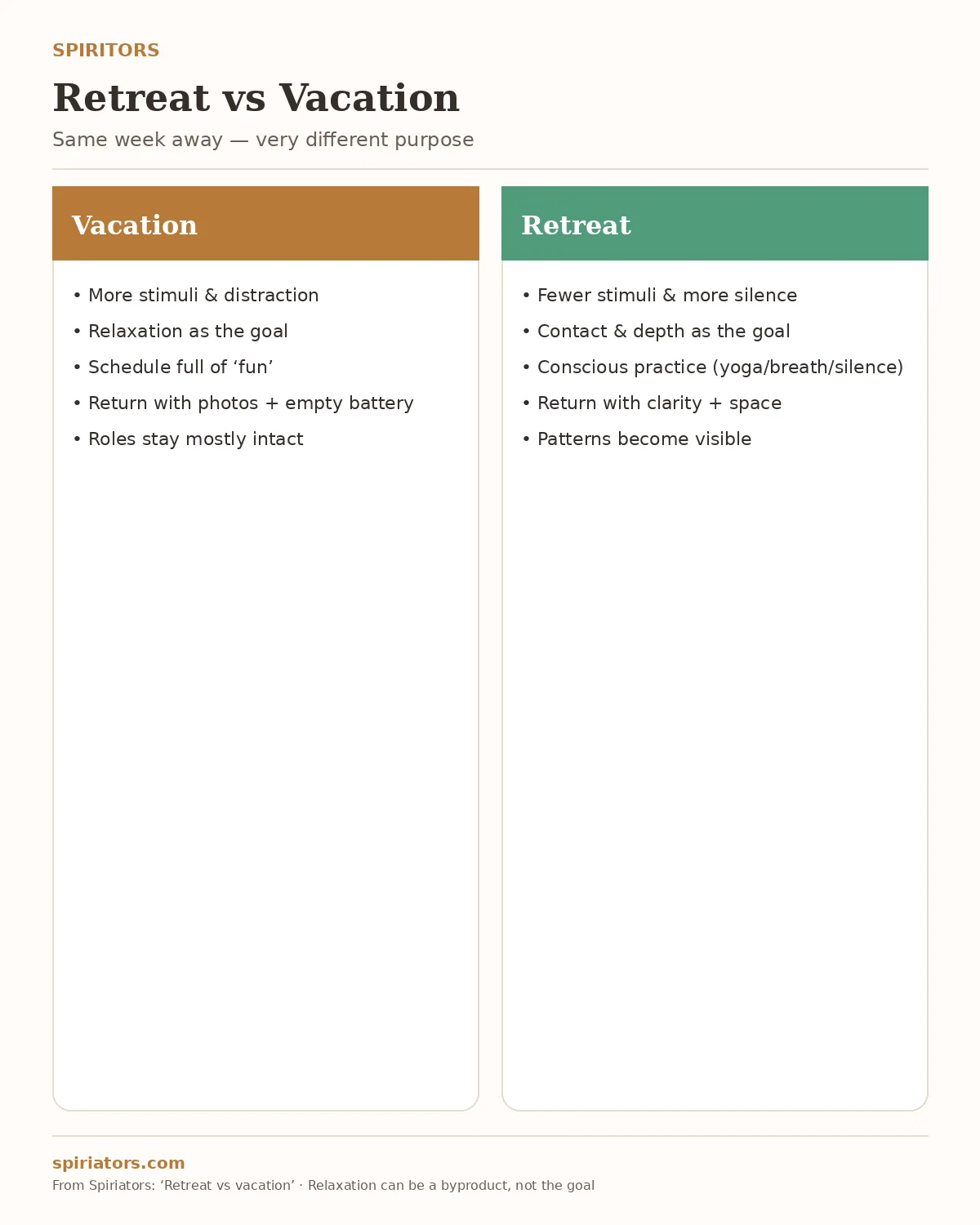
- The difference between a retreat and a vacation is the purpose: a vacation seeks relaxation and distraction through more stimulation; a retreat seeks connection and depth through fewer stimuli and more silence. Relaxation can be a byproduct, but it is not the goal. After a retreat you take clarity home — not only photos.
Many people think a retreat is a kind of spiritual vacation. It isn't. A vacation focuses on relaxation and distraction — a retreat focuses on connection and depth.
- Vacation: more stimulation, more entertainment, return with an empty battery and beautiful photos.
- Retreat: less stimulation, more silence, return with more clarity and inner space.
A good retreat can be relaxing, but relaxation is a byproduct — not the goal. The goal is to come closer to yourself. And that sometimes requires discomfort: silence that creaks, emotions that surface, or patterns becoming visible without your usual distractions.
The 5 Most Common Types Of Retreats
Not every retreat is the same. Below are the five main types, each with its own flavor and purpose. Further down you'll find a comparison table to help you choose.
1. Silent Retreat
- What is a silent retreat?
- A silent retreat is a retreat format lasting typically 5 to 10 days without words, eye contact, or phone, centered on meditation. The first days can feel uncomfortable; afterward deep peace often emerges. Vipassana is the best-known variant — intensive, not for everyone, but powerful for de-stimulation.
No words, no eye contact, no phone. Sometimes not even a book. A silent retreat typically lasts 5 to 10 days and revolves around meditation. The first days are uncomfortable — your mind creaks, your thoughts race — but afterward a deep peace emerges that you rarely experience in ordinary life.
The best-known form is Vipassana: ten days fully silent, donation-based, with a fixed schedule of 10 hours of meditation per day. Not for everyone, but for those who truly want to de-stimulate and are willing to walk through a wall of resistance, it can yield a fundamentally new relationship with your own mind.
2. Yoga Retreat
Two to three times a day yoga, usually in a beautiful setting (Bali, Portugal, Spain). The combination of movement, healthy food and nature makes this form accessible — a good first retreat if you're still unsure. Especially yin yoga retreats are gaining popularity because they can release deep emotions from the fascia — see also our article on connected breathing and the nervous system.
Watch out: not every yoga retreat goes deeper than an active vacation. Ask in advance about the program. Is there silence? Reflection? Or is it mostly asana and smoothies?
3. Breathwork Retreat
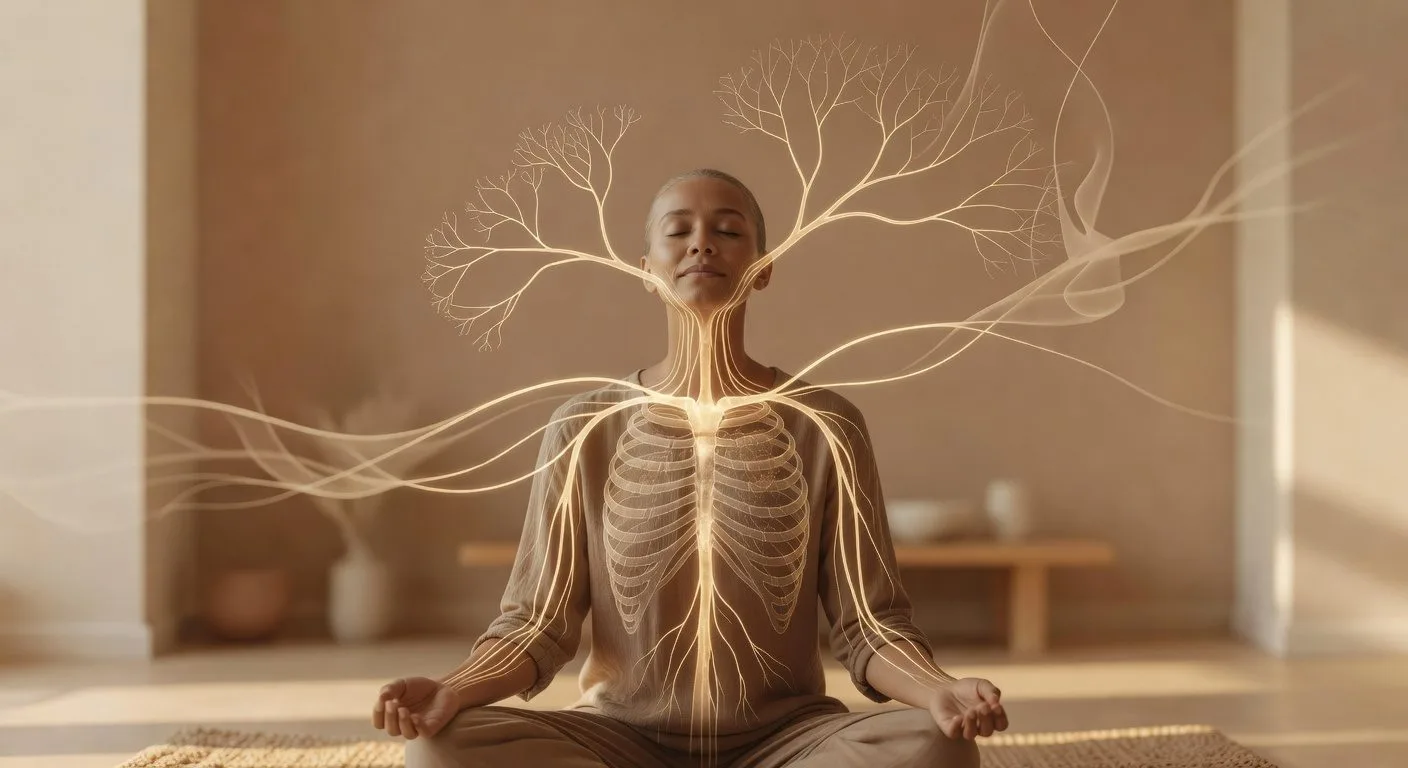
A breathwork or breath coaching retreat uses specific breathing techniques (such as connected breathing or holotropic breathing) to discharge stored emotions and traumas. Shorter in duration (often 3-5 days) but very intense. Research shows that conscious breathwork sessions can significantly lower stress markers.
This form is powerful, but requires experienced guidance. During a session, old emotions — grief, anger, panic — can surface unexpectedly. Only work with a trauma-informed facilitator.
4. Spiritual Or Religious Retreat
Classic forms in monasteries, ashrams or meditation centers. Fixed structure, fixed rituals, often cheap or free. Suitable for those seeking grounding in tradition and community. Think a week in a Benedictine monastery, a sesshin at a zen center, or a stay at an ashram in India.
The advantage: centuries-old wisdom and a clear framework. The downside: the framework can also feel restrictive if you're not at home in the tradition.
5. Nomadic Retreat (Traveling Along)
The youngest and perhaps most far-reaching form. Instead of a few days in one location, you travel for several weeks or months with guides through special places — think Bali, Thailand, India or Portugal. A nomadic retreat combines two things normally separated: the deep inner work of a classic retreat and the change of environment that loosens patterns.
Why does it work differently? Because your old patterns are strongly tied to your old environment. A week on retreat and then back to the same alarm clock, the same inbox and the same kitchen table: your system often snaps back rapidly. With a nomadic retreat, transformation occurs during life itself, in new places, in a new rhythm. The practice isn't a pause button — it becomes your lifestyle.
This form is suitable for people wanting more than a reset: a fundamental reorientation. For those who can work remotely or have a transitional period. Not suitable for those primarily seeking rest — there's movement, literally and figuratively. With Spiriators nomadic traveling we build this experience around breathwork, yin yoga and conscious connection.
Which Type Fits Which Need?
A quick help in choosing:
| Your need | Best matching type | Typical duration |
|---|---|---|
| Fully de-stimulate, calm the mind | Silent retreat (Vipassana) | 7–10 days |
| Open the body, first introduction | Yoga retreat | 3–7 days |
| Discharge stuck emotions | Breathwork retreat | 3–5 days |
| Grounding, tradition, community | Spiritual / monastic retreat | 3–7 days |
| Real lifestyle shift, new direction | Nomadic retreat | 2 weeks – months |
In doubt? Don't start with the heaviest form. A weekend of yoga or a 3-day breath retreat gives you an honest picture of whether this kind of work suits you — without having to take ten days off right away.
How Long Should A Retreat Ideally Last?
Many people underestimate how much time their nervous system needs to truly calm down. A rough guideline:
- Weekend (2-3 days): introduction. You taste it, but rarely go deep.
- Week (7 days): classic duration. Only after day 3-4 does your system begin to discharge.
- 10 days to 3 weeks: here real transformations occur.
- Months (nomadic): for those who don't only want to see their patterns, but reprogram them.
A common problem after a short retreat: you come home full of energy and insights, but within two weeks you're back in the old patterns. This isn't failure — it's biology. Your old environment calls forth your old reactions. That's why more and more people choose longer trajectories, or remote work from special places, to soften the transition.
What Does A Retreat Cost?
Prices vary enormously:
- Vipassana (silent): often donation-based.
- Yoga retreat week: € 800 – € 2,500 (depending on location and luxury).
- Breathwork weekend: € 350 – € 800.
- Nomadic retreat 2-4 weeks: € 2,000 – € 5,000 (including accommodation and guidance).
More important than price: who guides you? An experienced guide you feel safe with is worth more than a luxurious location. Always ask about training background, years of experience, and approach to intense emotions or a panic response. A good guide answers these questions calmly and concretely — not vaguely or defensively.
3 Common Misconceptions About Retreats
- "A retreat is only for spiritual people." Not true. Most participants are down-to-earth professionals stuck in work, relationships or themselves. A retreat is a practical tool for mental and physical health — not a spiritual exam.
- "I have to meditate or do yoga first." False. Good guidance builds up from zero. In fact, an unbiased beginner often goes deeper than a seasoned practitioner stuck in patterns.
- "I can also just do this at home." Theoretically yes, practically rarely. Your old environment calls forth your old reflexes. The physical distance and presence of guidance are precisely why a retreat works where self-study often fails.
When A Retreat Is (Temporarily) Not The Right Fit
Being honest helps more than selling. A retreat is not the right choice if you:
- Are in acute crisis — suicidal thoughts, severe psychiatric complaints, or psychosis. A retreat amplifies what's already there.
- Are just after a major loss (death, divorce, job loss). The first weeks call for familiar support, not seclusion.
- Are fleeing a concrete problem — work, relationship, debt. The retreat won't solve it, and the return becomes harder.
- Have no aftercare arranged. The days after a deep retreat are vulnerable. A coach, therapist or trusted person on standby is essential.
In these situations, therapeutic guidance comes first. A good guide will tell you so honestly — and refer you onward if needed.
How Do You Choose The Right Retreat?
Ask yourself four questions, in this order:
- What do I need now? Rest, movement, emotional healing or a complete course change? The table above helps you.
- Who do I want to do this with? Read about the guides. Their tone, their story, their experience. Does it feel safe? A first intake conversation says more than a beautiful website.
- How much time can I realistically free up? Less than 5 days usually gives too little depth. New to this? Start with a weekend — not with ten days of silence.
- What do I do afterward? Plan your return. A half-day buffer, a conversation with a coach the following week, or a light agenda. The value of a retreat disappears rapidly if you dive straight into 80 unread emails.
Want to look deeper per type — including practical examples, who it's for, and how to recognize a trustworthy provider — check our guide on retreat meaning. And if the nomadic form appeals to you: read about the current traveling-along journeys or start gently with our 30-day challenge.
The Most Important Question After A Retreat
Almost everyone experiences a kind of post-retreat dip: back in old life everything feels flat. That's normal. The question isn't how do I prevent this?, but which small piece of that space do I take with me?
Five minutes of breathing before sleep. One day a week without phone after 20:00. A weekly yin yoga session. The retreat is not the goal — it is the gateway. What happens afterward, in the structure of your daily life, is where real change takes place.
Want to dive deeper into what a retreat can be and which form fits you? Discover how feeling at home in your own body is ultimately the real retreat — one that always travels with you.
Go deeper: For the canonical retreat meaning see the pillar. Also explore nomadic travel, yoga or breathwork to support your inner journey.