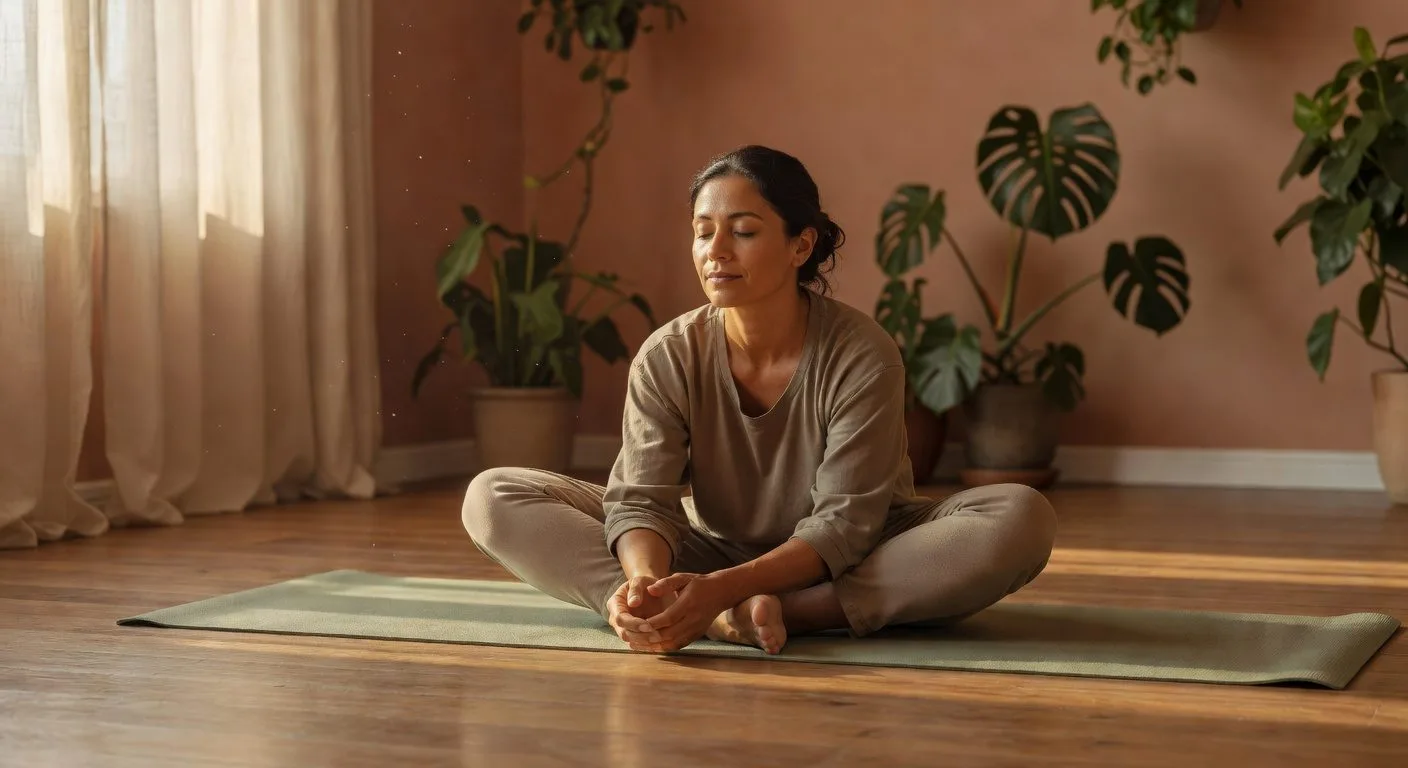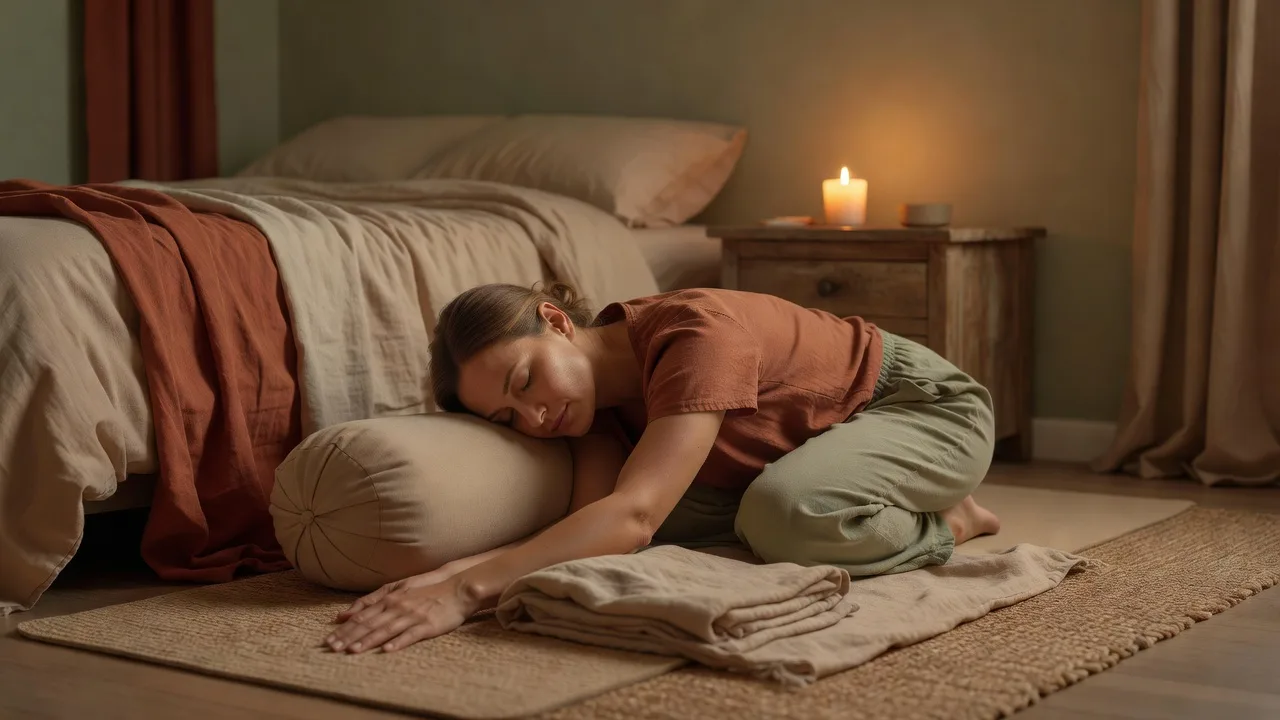
Yin yoga for better sleep is one of the most effective ways to calm your nervous system and help your body shift from "on" to "off." No pills, no gadgets — just your mat, your breath, and six poses that are backed by science.
You've been tossing for an hour already
It's 11:47 PM. Your body is exhausted, but your mind won't shut off. Thoughts tumble over each other — tomorrow's to-do list, that conversation you keep replaying, the vague sense that you forgot something important. You try to relax, but the harder you try, the more awake you become. Sound familiar?
If poor sleep runs your life, you're far from alone. Yin yoga for better sleep is one of the most effective ways to calm your nervous system and help your body shift from "on" to "off." No pills, no gadgets — just your mat, your breath, and six poses that are backed by science.
In this blog, I'll walk you through a complete yin yoga evening routine that takes 20 to 30 minutes. Six poses, with exact hold times, breathing instructions, and an explanation of why they work on your parasympathetic nervous system. So the next time you're staring at the ceiling at 3 AM, you have something that actually helps.
Why yin yoga — not just "a yoga video"
- Sleep latency
- Sleep latency is the time it takes you to fall asleep. Yoga-based interventions — and yin in particular — measurably improve sleep latency and total sleep time, because long-held poses help shift your nervous system out of fight-or-flight.
Yin yoga isn't just yoga. It's the quiet, slow counterpoint to everything you do all day. No power poses, no sweat, no performance metrics. In yin, you hold a single pose for minutes — long enough for your fascia to release, your muscles to truly let go, and your nervous system to cool down.
And that's exactly what you need when you can't sleep. Research shows that yoga-based interventions are among the most effective movement modalities for sleep quality — with significant improvements in both sleep onset time and total sleep duration. The network meta-analysis by Bu et al. (2026) compared 22 RCTs with 1348 participants and concluded that yoga demonstrably improves sleep latency and total sleep time in people with insomnia.
What makes yin different from other styles? The long holds activate your parasympathetic nervous system — your rest-and-restore mode. Where vinyasa or strength training raise your heart rate, yin lowers it. And that's the key: your body can't sleep when it's in fight-or-flight mode. It needs to feel safe first.
Want to understand more about how yin affects body and mind? Read our blog on yin yoga, fascia and releasing emotions.
How this routine calms your nervous system
- Sympathetic vs parasympathetic
- Your nervous system has two main modes: sympathetic (action, stress, fight-or-flight) and parasympathetic (rest, recovery, sleep). When you cannot unwind at night, you are often stuck in sympathetic mode — yin helps you return to parasympathetic.
Your nervous system has two main modes: sympathetic (action, stress, fight-or-flight) and parasympathetic (rest, recovery, sleep). When you can't unwind at night, you're often stuck in sympathetic mode. Your body thinks it needs to fight, even though you're safely in bed.
Yin yoga helps you shift through three mechanisms:
- Deep belly breathing — stimulates the vagus nerve, the main nerve of your parasympathetic system. Every exhale is a signal to your body: you're safe.
- Long-held poses — activate the stretch reflex in your fascia, triggering cortisol reduction and muscle release. The scoping review by Alimoradi et al. (2024) found an 8.88% improvement in sleep efficiency and a 14.70% improvement in total sleep time through chronic stretch training.
- Gentle organ compression — poses like Sphinx and Butterfly apply soft pressure to your abdominal cavity, which increases vagal tone and lowers your heart rate.
The combination of these three mechanisms is why yin yoga is so effective for sleep. It's not just relaxation — it's a biological signal to your body that it's safe to let go.
If you want to go deeper on the science behind the vagus nerve, check out our blog on vagus nerve stimulation exercises.
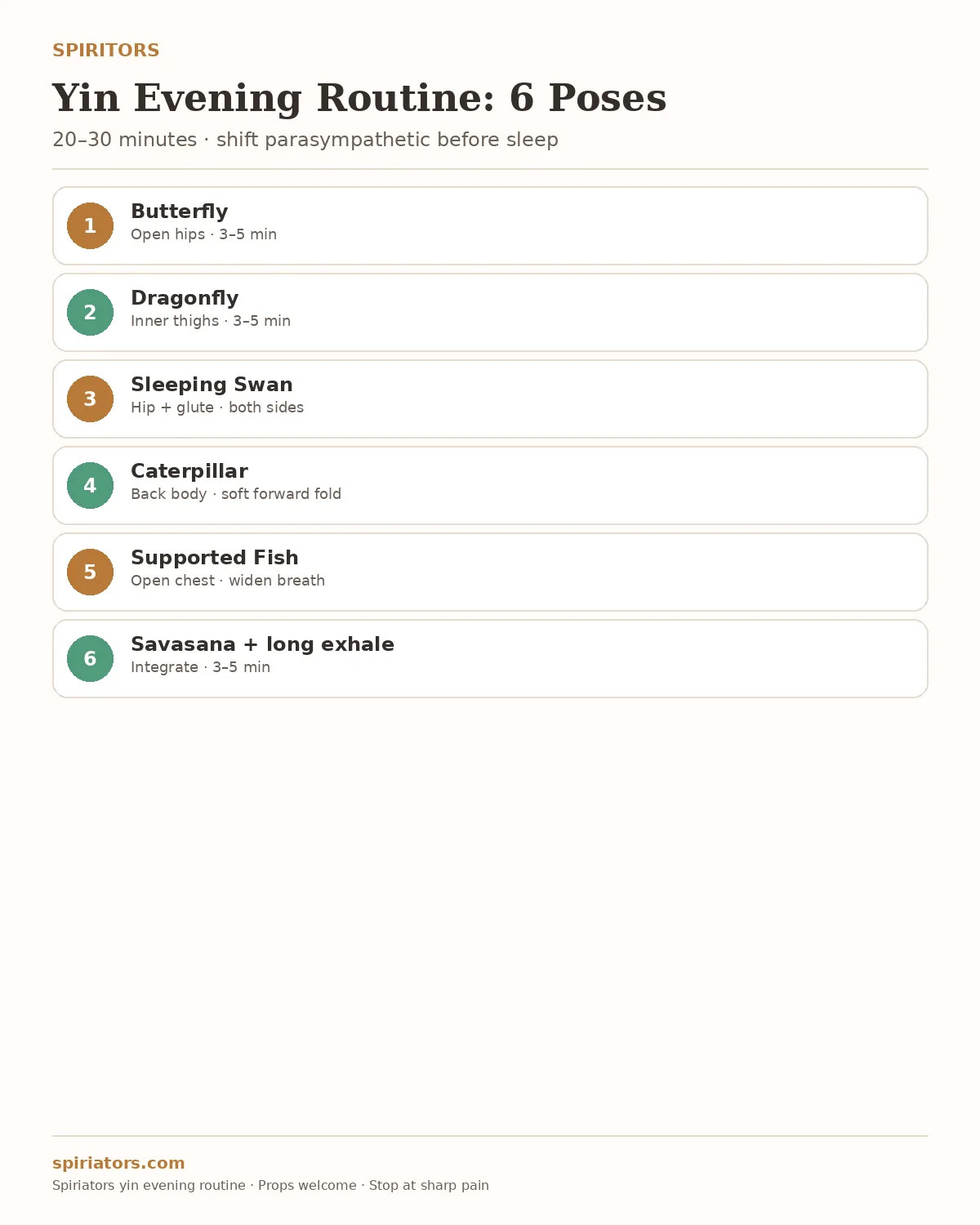
The 6 yin poses for your evening routine
This routine is sequenced to gradually deepen parasympathetic activation. You start with grounding, then open the hips and pelvis, stretch the back of your body, and finish with poses that lower your heart rate and prepare your body for sleep.
Important: always use props. A bolster, a folded blanket, a cushion — yin is about support, not stretching. The more support you give yourself, the deeper you can relax.
1. Child's Pose (Balasana) — 3-4 minutes
This is your starting point. Kneel on your mat with your big toes touching, knees wider than your hips. Fold forward and let your torso sink between your thighs. Rest your forehead on the mat. Arms stretched out in front of you, or alongside your body — whichever feels better.
Breathe deeply into your belly. Feel how your lower back opens a little more with each exhale. This pose calms your breath, opens your lower back, and gives an immediate sense of safety. It's the pose that tells your body: we've arrived, there's nowhere else we need to be.
2. Reclined Butterfly (Supta Baddha Konasana) — 5-7 minutes
From here, lie on your back. Soles of your feet together, knees falling open to the sides. Support each knee with a cushion or bolster — this isn't a stretch, this is surrender. Arms relaxed alongside your body, palms facing up. Close your eyes.
This pose opens your hips and pelvic floor — an area where many of us hold tension and unprocessed emotion. The reclined position combines opening with gravity, allowing your parasympathetic nervous system to engage through belly breathing. You can feel it: each breath becomes a little deeper, a little quieter.
3. Supported Dragonfly — 5-7 minutes
Sit with your legs wide open — not forced, just comfortable. Place a bolster horizontally in front of you and fold over it. Turn your head to one side, supported by a folded blanket. Let your arms drape alongside the bolster.
This stretches your hamstrings, inner thighs, and lower back — often the places where emotional tension gets stored. It's no coincidence that people sometimes feel emotion rising in this pose. That's okay. Let it be there. Yin yoga is not just physical — it's a gradual release of what already lives in your body.
4. Sphinx (Salabhasana) — 3-5 minutes
Roll onto your belly. Prop yourself up on your forearms, elbows under your shoulders, legs slightly apart. Press your pubic bone gently into the mat and lengthen your neck. Breathe into your belly, feel the gentle curve of your lower back.
The Sphinx is a soft backbend that opens your solar plexus and stimulates the vagus nerve. It's the pose that closes the cycle of the day — as if your body is gathering the day's energy and slowly releasing it. If you notice your breath deepening here, you know it's working.
5. Legs-Up-the-Wall (Viparita Karani) — 7-10 minutes
- What is Viparita Karani?
- Viparita Karani (Legs-Up-the-Wall) is an inverted restorative pose: legs vertical against the wall, hips close, head supported. Gravity aids venous return, heart rate drops and the parasympathetic system activates — often the strongest vagal stimulator in an evening routine.
This is the most powerful pose in the entire routine. Sit with your hips as close to a wall as possible, then swing your legs up and lie on your back with your legs vertical against the wall. Support your head with a cushion. Arms relaxed at your sides.
The gravity effect stimulates venous return — blood flows more easily back to your heart, your heart rate drops, your blood pressure decreases. It's the most powerful vagal stimulator in this routine. Research confirms that this type of restorative pose effectively lowers heart rate and activates the parasympathetic system — exactly what you need before sleep. The systematic review by Dutta et al. (2026) found significant improvements in sleep latency, total sleep time, and sleep efficiency from yoga-based relaxation interventions.
Stay here. This is the moment your body truly lets go.
6. Reclined Twist (Supta Matsyendrasana) — 3-4 minutes per side
Slide your legs down from the wall and roll onto your back. Draw your knees toward your chest, then gently let them fall to the left while you turn your head to the right. Right arm stretched out to the side. Breathe into your back, feel the twist releasing tension you didn't even know you were holding.
After 3-4 minutes, switch sides. Left, right — it doesn't matter which you start with. The twist closes the routine with a gentle spinal movement that balances your nervous system. It's the final sigh before you close your eyes.
When and how long? The practical setup
The complete routine takes 20 to 30 minutes. Ideal timing is 30 to 60 minutes before bed — not right before sleep, because your body needs time to transition from the poses back to lying rest. Alimoradi et al. (2024) found that chronic stretch training produced a substantial 14.70% improvement in total sleep time — but the effect builds over time. One evening helps; two weeks of every evening changes something.
Some practical tips:
- Always use props — bolster, blocks, blankets, cushions. Yin is about support, not stretching.
- Breathe through your nose — slowly and deeply. Mouth breathing activates the sympathetic system.
- If a pose doesn't work for you — skip it or shorten the hold time. No pose is mandatory.
- Do it daily for at least two weeks — for measurable effect.
- Dim the lights — a soft environment strengthens the parasympathetic signal.
Curious how breathwork can deepen your yin practice? Our 5 breathing exercises against stress work synergistically with this routine.
Specifically for women in menopause
If you're in perimenopause or postmenopause and your sleep has changed — you're not the only one. Sleep problems are among the most commonly reported complaints during menopause, and most solutions focus on hormones. But there's another path.
The meta-analysis by Fan et al. (2025) pooled 18 RCTs with 1572 women and concluded that mind-body therapies — including yoga — are significantly more effective than usual care for sleep, depression and anxiety in menopausal women. Without the side effects of hormone therapy.
This means this routine doesn't just work for "regular" poor sleep — it's especially powerful for the women who need it most. The long, gentle holds help your body navigate hormonal fluctuations without forcing anything.
Yin yoga is also one of the most accessible forms of yoga — no experience needed, no flexibility required, just a mat and the willingness to lie down.
What if it's not enough?
Sometimes poor sleep is a signal of something deeper. If you've been sleeping badly for more than three months and self-help isn't cutting it, there's nothing wrong with asking for support. In fact, it's a sign of strength.
At breathwork coaching, we look at what's underneath the sleep problems. Often it's not the sleeping itself that's the issue — it's the nervous system stuck in a pattern of hypervigilance. Breathwork can break that pattern in a way that words alone can't reach.
And if you'd like to experience what yin feels like with guidance first: start a free 24h trial. No obligations, no judgment — just you, your body, and the space to discover what relaxation means for you.
Three ways to get started
1. Try the routine tonight. Lay out your mat, gather your props, and follow the six poses. Even if you only do three of them, you'll notice the difference. Yin yoga works cumulatively — every session counts.
2. Combine yin with breathwork. The 5 breathing exercises against stress work synergistically with this routine. Do 5 minutes of breathwork first, then the yin routine. Double the calm.
3. Experience it in a real session. Yin only truly works when you feel it — with guidance, in a safe space. Try a yin yoga class with Tessa and experience what it means to let your body truly sink. No performance, no judgment, just you and your breath.