Your heart is racing. Your breathing becomes shallow. Your body is in alarm mode — but there's no danger. This is the moment when your vagus nerve, your main brake on stress, goes silent. And this is exactly where the key lies: vagus nerve exercises are not mystical — they are a scientifically backed way to stimulate and activate your vagus, often within minutes.
In this article, you'll discover five vagus nerve exercises clinically tested in 2024-2026. No woo-woo theory, but concrete tools that calm your nervous system immediately. From 4-7-8 breathing to cold water — every exercise has peer-reviewed research behind it. You'll also learn when dorsal vagus exercises fit better than intense stimulation.
What Is the Vagus Nerve and Why Is It So Important?
- What is the vagus nerve?
- The vagus nerve is the longest and most versatile cranial nerve — a superhighway between brain, heart, lungs, and gut. It is the main brake of your parasympathetic nervous system: slowing heart rate, calming digestion, and sending the “safe” signal to your brain. Vagus nerve exercises actively train that brake.
The vagus nerve is the longest and most versatile cranial nerve in your body — a superhighway between brain, heart, lungs, and gut. It forms the main brake of your parasympathetic nervous system: it slows your heart rate, calms digestion, and sends the "safety" signal to your brain.
When your vagus nerve functions well, you're in the ventral vagal state: calm, social, present. But with chronic stress, trauma, or burnout, your system switches to sympathetic dominance — constantly alert, never truly relaxed.
The polyvagal theory, developed by Stephen Porges, describes how this nerve regulates three layers of safety: ventral (safe & social), sympathetic (fight/flight) and dorsal (shutdown). The good news: you can actively train this nerve. A randomized controlled trial by Ozen & Demircioglu (2026, PMID 41704158) showed that both deep breathing and transcutaneous vagus stimulation significantly improved depression, sleep quality, and caregiver burden within three weeks.
In other words: stimulating the vagus nerve isn't a "maybe it works." It works. And you can do it yourself.
Dorsal vagus exercises: when you should not push hard
- What are dorsal vagus exercises?
- Dorsal vagus exercises are gentle regulation practices for when you feel empty, frozen, or “checked out”: warm grounding, slow belly breathing, soft yin poses, and brief co-regulation. They differ from intense vagus stimulation (cold, long breathwork), which can deepen shutdown. Safety first, then stronger activation.
Not every stress state needs the same vagus nerve exercise. Panic or overstimulation often responds to stronger stimulation (cold, resonance breathing, humming). But if you feel empty, frozen, absent or checked out, you are likely in dorsal vagal shutdown — the oldest survival layer.
Dorsal vagus exercises are milder then: warm grounding (feet on the floor, a blanket, safe contact), slow belly breathing without forcing, gentle yin poses and short social co-regulation. Intense cold plunges or long breathwork sessions can deepen that shutdown. Safety first, then stronger vagus activation.
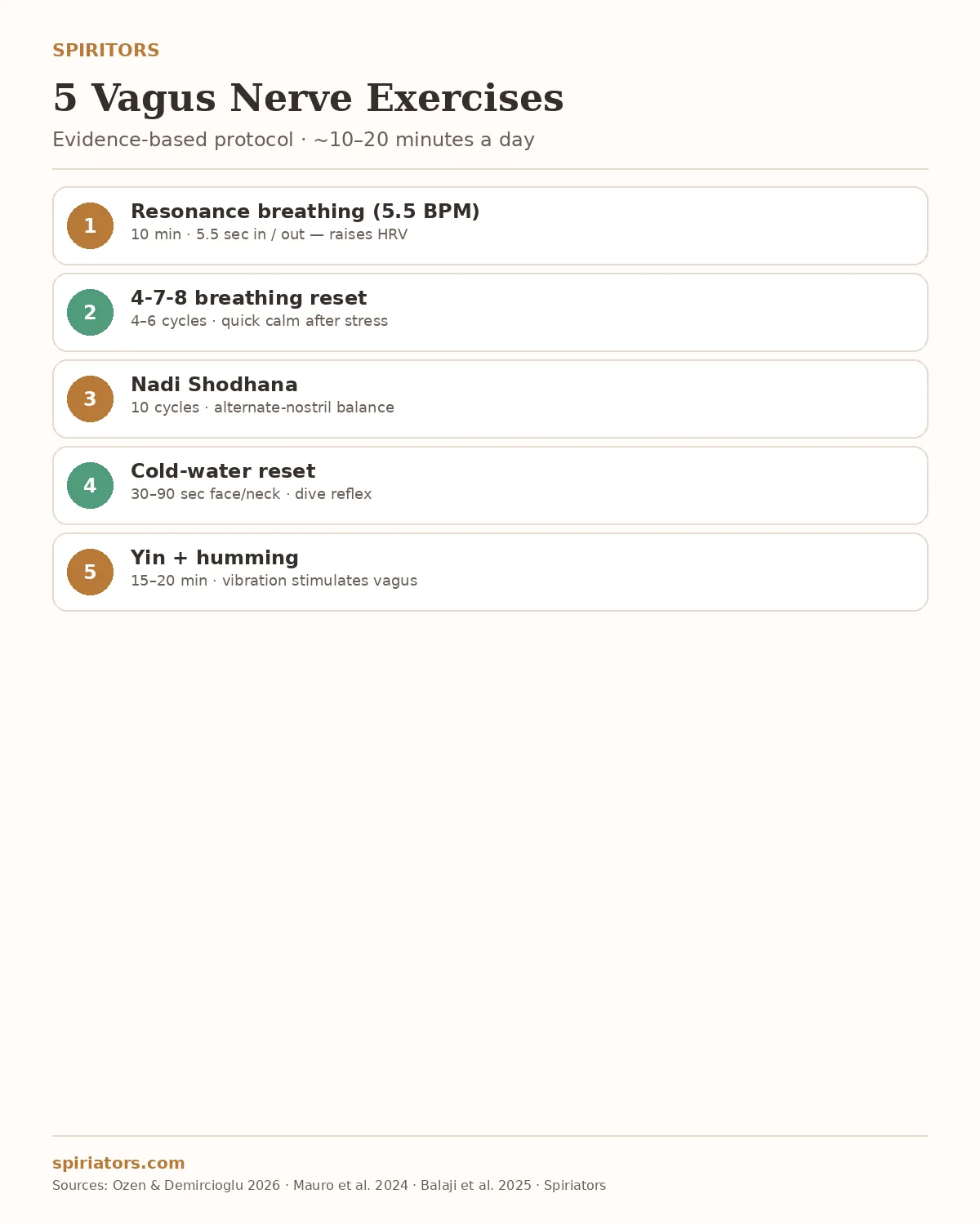
5 Evidence-Based Vagus Nerve Exercises That Work Immediately
- What is HRV (heart rate variability)?
- HRV (heart rate variability) is the natural variation in time between consecutive heartbeats. Higher HRV often signals a more resilient parasympathetic nervous system. Vagus nerve exercises such as resonance breathing aim to improve HRV measurably — a concrete marker of vagus stimulation.
These five exercises come directly from the latest scientific literature. Each protocol has been tested in clinical studies and has measurable effects on heart rate variability (HRV), stress scores, and autonomic balance.
1. Resonance Breathing at 5.5 BPM (10 minutes)
This is the core of any vagus protocol. Breathe in through your nose for 5.5 seconds, out through your mouth for 5.5 seconds. Repeat for 10 minutes, preferably 2x per day.
Why 5.5 seconds? Because this equals about 5.5 breaths per minute — the resonance frequency where your heart rate variability becomes maximal. A worldwide study by Balaji et al. (2025) confirmed that 0.1 Hz coherence breathing is the most common resonance frequency for self-regulation. Your heartbeat literally gets phased in.
How to do it:
- Sit comfortably with a straight spine
- Breathe in calmly through your nose (count to 5.5)
- Exhale slowly through your mouth (count to 5.5)
- Use a metronome app or the Elite HRV app as a tool
- Build up from 5 to 10 minutes
This exercise is the foundation of our breathwork coaching sessions and forms the first step in the Neurowellness Upstream journey.
2. 4-7-8 Breathing Reset (3-5 minutes)
This exercise is perfect as a stepping stone to resonance breathing, or as a quick reset in acute stress. Breathe in through your nose for 4 counts, hold for 7 counts, exhale through your mouth for 8 counts. Repeat 4-6 cycles.
An acute study by Ertürk & Özden (2025) with 60 healthy adults showed that one session of deep breathing immediately lowered stress scale, heart rate, and blood pressure, and increased parasympathetic activity (RMSSD, pNN50). Deep breathing was slightly superior in parasympathetic increase compared to auricular VNS.
When to use:
- Directly after a stressful meeting
- Before sleep (works calming)
- During panic or anxiety symptoms
- When you notice your breathing becoming shallow
The 4-7-8 exercise above only truly works if you do it for 21 days in a row. In our newsletter, you'll get one short reminder each morning — no course, no pressure.
3. Alternate Nostril Breathing / Nadi Shodhana (5-10 minutes)
This yogic pranayama technique, also called Anulom Vilom, is more powerful than you think. Close your right nostril, breathe in for 4 counts through the left, close the left, open the right, breathe out for 4 counts. Repeat 10 cycles.
An RCT by Dhanaradja et al. (2025) with 86 Parkinson's patients showed that 12 weeks of Anulom Vilom Pranayama significantly increased parasympathetic HRV, lowered sympathetic tone, and clearly reduced depression, anxiety, and stress. A second RCT by Mittal et al. (2025) confirmed reduction in systolic and diastolic blood pressure in hypertensives.
Step-by-step:
- Use your right thumb to close your right nostril
- Breathe in calmly through the left (4 counts)
- Close the left with your ring finger, open the right
- Exhale through the right (4 counts)
- Breathe in through the right (4 counts)
- Close the right, open the left, exhale (4 counts)
- This is one cycle — repeat 10x
This technique connects beautifully with our yin yoga sessions, where we combine pranayama with long holds for deep autonomic regulation.
4. Cold Water Reset (30-90 seconds)
Cold water exposure triggers the dive reflex and immediately activates the vagus. The most robust 2025 research on HRV biofeedback confirms that 0.1 Hz coherence breathing is the most common resonance frequency worldwide — heartbeat is literally phased in.
How to do it:
- End your shower with 30-90 seconds of the coldest possible water on your face and neck
- Don't hold your breath — breathe calmly
- Combine with slow belly exhalation for optimal effect
- Build up from 10 seconds to 90 seconds over 2-3 weeks
Combine short cold water (30-90 seconds) afterward with deep belly exhalation for "vagal stacking" — multiple inputs at once. This is a powerful method we also use in our breathwork guide sessions.
Note: Start carefully if you have heart problems or are pregnant. Listen to your body.
5. Yin Yoga + Humming Exercise (15-20 minutes)
The vagus nerve runs through your throat — and vibration stimulates it directly. Combine yin yoga poses (child's pose, butterfly, dragonfly) with slow belly breathing PLUS soft "mmmm" or "ommmm" vibrating on the exhalation.
Bhargav et al. (2026) published a review showing that pranayama works through vagus stimulation, autonomic regulation, and hemispheric shifts — comparable to TMS, tDCS, and VNS, but self-applicable and without equipment.
Evening ritual:
- Child's pose (2 minutes) — breathe deeply into your back
- Butterfly (3 minutes) — open hips, let go
- Dragonfly (3 minutes) — forward fold, relax neck
- On each exhalation: softly hum "mmmm"
- Feel the vibration in your throat, chest, belly
Want to learn more about the connection between fascia, emotions, and the nervous system? Read our article on yin yoga and fascia.
Scientific Backing
These five exercises aren't just made up. They come from peer-reviewed studies published between 2024 and 2026:
Ozen & Demircioglu (2026) — Three weeks of deep breathing vs. transcutaneous auricular vagus stimulation in 39 mothers: both significantly improved sleep, depression (BDI), and caregiver burden. VNS had stronger antidepressive effects (d=0.74), but deep breathing proved a low-threshold, scalable alternative.
Mauro et al. (2024) — One month of home practice with resonance breathing (3x/day) in 33 long-COVID healthcare workers: significant reduction in cognitive complaints, chest pain, asthenia, headache, and dizziness.
Cavanagh et al. (2024) — Crossover study (n=18): 6 breaths/min for 5 minutes significantly affected high-frequency HRV between groups (p=0.004), confirms 6 BPM as threshold for parasympathetic response.
Your Daily 10-Minute Protocol
You don't need to practice for hours. Consistency beats intensity. Here's a feasible daily protocol:
Morning (5 minutes):
- 3 minutes resonance breathing (5.5 BPM)
- 2 minutes 4-7-8 breathing
Evening (5 minutes):
- 3 minutes alternate nostril breathing
- 2 minutes humming exercise in child's pose
For an extra boost: end your morning shower with 30 seconds of cold water on your face and neck. This is the minimum effective protocol — more is fine, but this is the foundation.
Don't just want the theory, but want to see the polyvagal shifts in your own HRV? Our 1-on-1 sessions combine breathwork with biofeedback, so you feel when your ventral vagus turns "on."
The Next Step: From Knowing to Doing
Your nervous system doesn't lie — if you notice you're constantly in fight/flight, recovery starts with the vagus. Our Neurowellness Upstream journeys begin exactly here: measure, breathe, land.
But know this: you don't need to be perfect. One breath at the right moment can shift your entire day. One cold shower can pull you out of a panic spiral. One minute of humming can relax your throat and let your voice sound as it's meant to.
Share in the comments which of the 5 exercises you're going to try today — or which one your body "recognizes" most strongly. We read everything and learn along with you.
And if you want to learn more about how breathing brings rest, read our article on 5 breathing exercises against stress. Or discover how yin yoga helps with better sleep.
You're already whole. It's about re-remembering. And your vagus nerve? It's ready to help you land.
Go deeper: Read our pillar pages on breathwork and yoga, explore breath coaching, or consider a retreat to integrate this work.