In a world that revolves around performance, productivity and always being "on", stress and anxiety are increasingly part of our daily lives. But what if two thousand-year-old practices — Yin Yoga and Breathwork — are not only complementary, but together form a powerful, scientifically backed method to reduce stress and anxiety?
This article dives into the neurobiology and fascial connections between these practices, and shows why their combination is more effective than either alone.
Yin Yoga — Addressing the Deep Connective Tissue
Yin Yoga is a slow, meditative form of yoga where poses are held for 3-5 minutes. Unlike dynamic yoga (such as Vinyasa or Hatha) that activates the muscles, Yin focuses on the deep connective tissue (fascia, tendons, joints).
- What is yin yoga + breathwork?
- Yin yoga + breathwork combines long-held poses (opening fascia) with conscious breathing techniques (calming the nervous system). Together they create space to feel and integrate tension — often more powerful than yin or breath alone.
Why Does It Work for Anxiety?
Scientific backing:
- Fascial release + emotional release
Research shows that fascia is not only structural tissue, but can also store emotional charge. When we experience stress or trauma, connective tissue tenses — as a protective mechanism.
Study: Fascia research shows it can store mechanical and emotional tension (see e.g. Schleip et al. on fascial mechanotransduction). Sustained pressure and movement can help release it. - Parasympathetic activation
Holding poses for longer activates the parasympathetic nervous system (rest & digest). This lowers cortisol, slows heart rate and creates a physiological state of relaxation.
Study: NIH (2021) — "Yoga increases parasympathetic tone, reducing anxiety and improving emotional regulation." - Mindfulness + interoception
Yin Yoga trains body awareness (interoception). By noticing sensations without reacting, you learn to see anxiety as a passing experience — not as identity.
- How does yin yoga lower cortisol?
- Yin yoga lowers cortisol through parasympathetic activation: long, passive poses signal safety to the nervous system, slowing heart rate and reducing the stress hormone. Combined with slow exhales, that strengthens the rest-and-digest response.
Breathwork — Recalibrating the Nervous System
Breathwork encompasses conscious breathing techniques that directly influence the nervous system. At Spiriators, we primarily use physiological sigh, 4-7-8 breathing and diaphragmatic breathing.
Why Does It Work for Stress?
Scientific backing:
- Vagus nerve stimulation
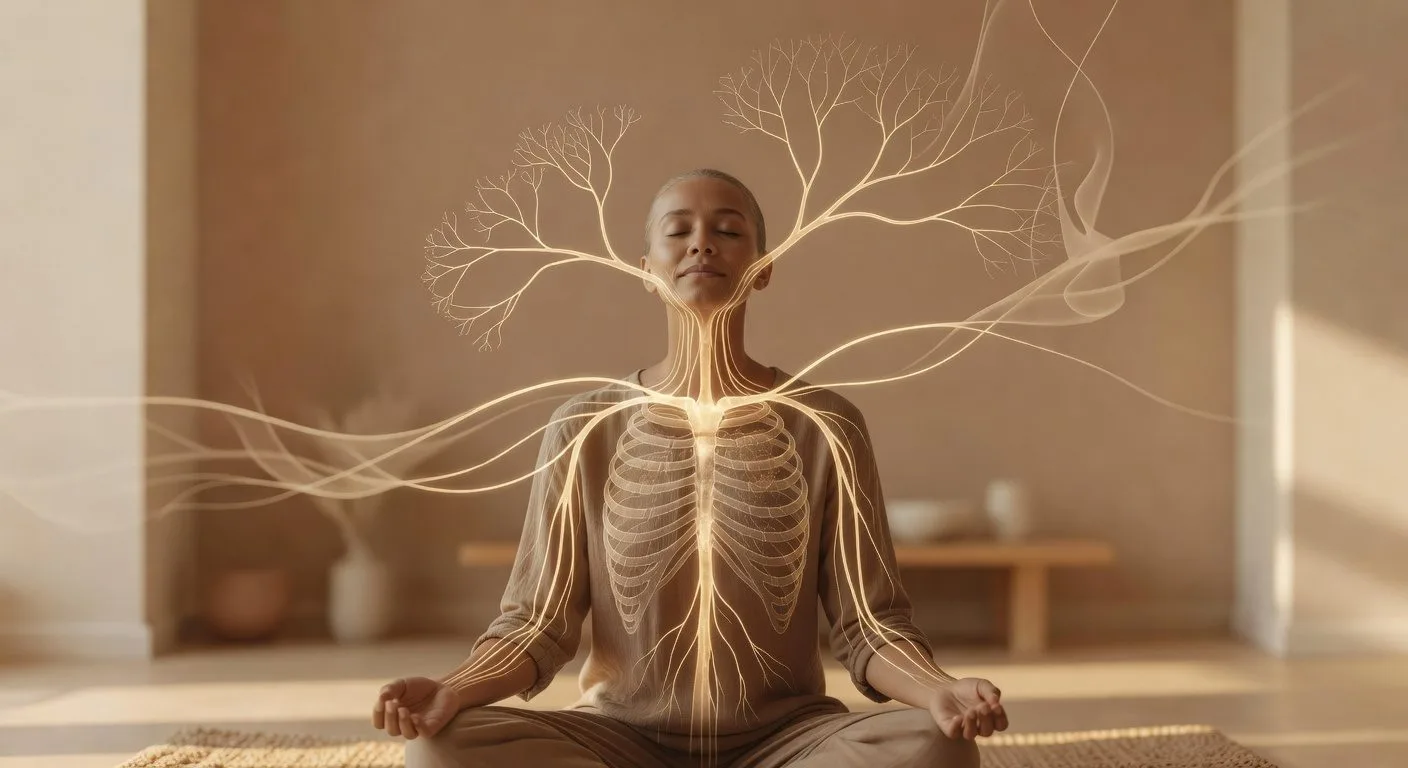
Slow, deep breathing activates the vagus nerve — the primary nerve of the parasympathetic system. This sends a signal to your brain: "We are safe."
Study: "Polyvagal Theory: A Science of Safety" (Porges, 2022) and related research on vagal tone as a biomarker for stress resilience. - CO₂ balance restoration
Under stress we unconsciously hyperventilate — this lowers CO₂ and raises anxiety. Conscious breathing restores balance, so blood delivers oxygen to tissues more efficiently.
Study: Gerritsen & Band (2018) on respiratory vagal stimulation, and related Nature research on CO₂ regulation and breathing. - Amygdala calming
The amygdala (fear center) responds directly to breathing patterns. Slow exhalation dampens amygdala activity — measurable via fMRI.
Study: Research in Cell (2019) showing respiration directly modulates amygdala and fear-related neural activity.
- What is HRV and why does it matter in yin?
- HRV (heart rate variability) measures how flexibly your heartbeat varies between beats — a marker of nervous-system resilience. With yin + breathwork, parasympathetic tone often rises; higher HRV shows your system can switch more smoothly between stress and recovery.
The Synergy — Why the Combination Is More Powerful
"1 + 1 = 3"
Yin Yoga opens the fascia and creates space for sensations. Breathwork calms the nervous system so you can integrate those sensations without being overwhelmed.
Practical example:
- You hold a Yin pose (e.g. Child's Pose / Balasana) for 5 minutes.
- Tension rises in hips or shoulders (fascial release).
- Without breathwork: you tense, resist, or break the pose.
- With breathwork: you stay with the sensation, breathe through it, and let go.
Scientific connection:
Study: "Mind-body practices for stress reduction" (PMC, 2023) — combining posture + breathing shows 2-3x higher cortisol reduction than either alone.
Practical Integration — A Mini-Flow
3-Step Yin + Breath Flow (10 minutes)
Step 1: Child's Pose (Balasana) — 3 minutes
- Knees on the mat, buttocks toward heels, forehead on ground
- Breath: 4-7-8 technique (4 sec in, 7 sec hold, 8 sec out)
- Focus: "Let gravity carry you"
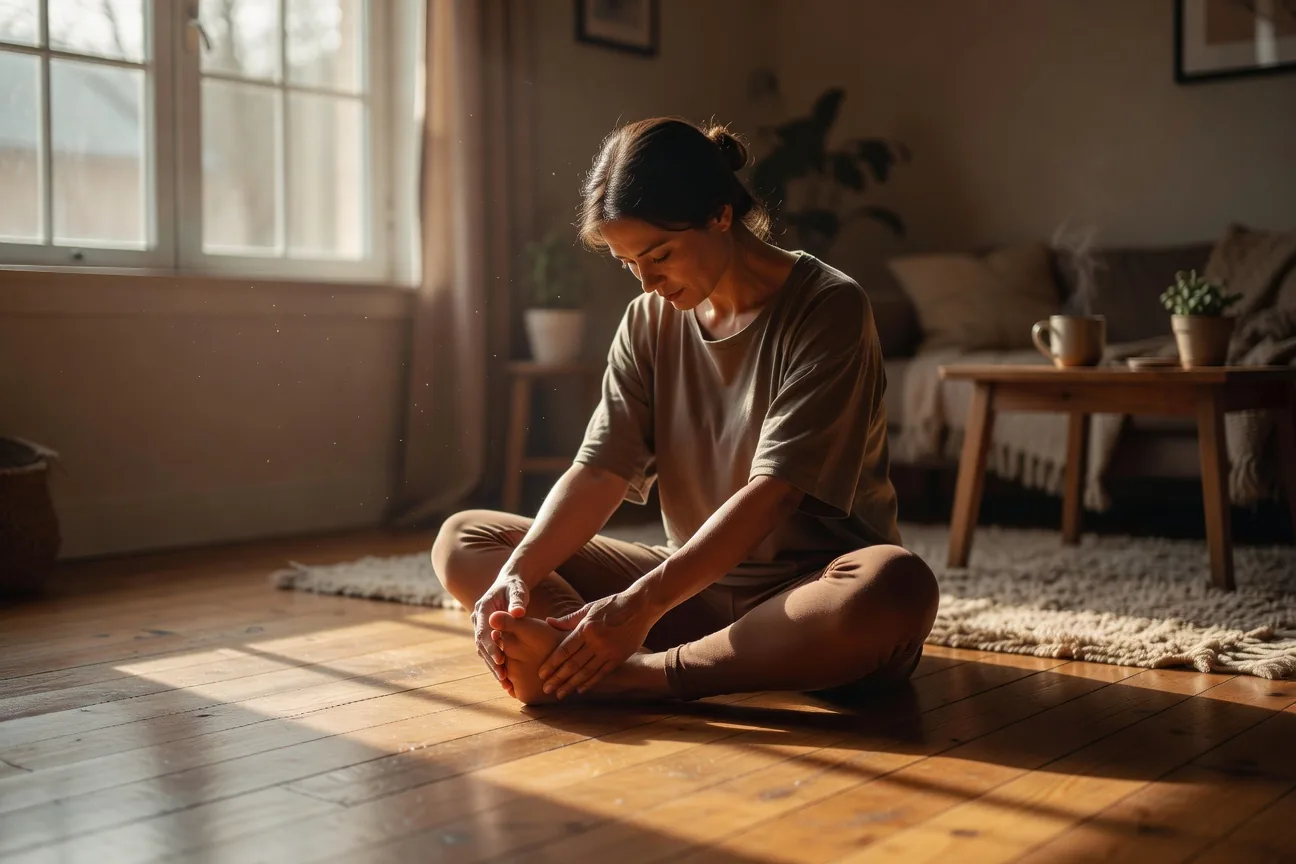
Step 2: Butterfly (Baddha Konasana) — 4 minutes
- Sit, soles of feet together, knees toward floor
- Breath: Diaphragmatic (belly breathing)
- Focus: "Breathe into your hips — create space"
Step 3: Savasana — 3 minutes
- Lying on your back, arms alongside the body, palms up
- Breath: Physiological sigh (2 short inhales, 1 long exhale)
- Focus: "Integration — let everything be as it is"
Part 5: 30 Days Home Ending the Day — Live Now
A Deeper Experience For Your Body
Reading about Yin Yoga and Breathwork is valuable. But experiencing what it does with your body, your breath, your presence — that is transformative.
That's why you can start now with:
🎯 30 Days Home Ending the Day
A daily Yin Yoga + Breathwork journey — right at home on your mat.
What you get:
- 30 days of daily sessions (15-30 minutes)
- At home on your mat — no studio, no travel, no pressure
- Daily email + WhatsApp — your session delivered to you
- Affirmations per session — find the right resonance for your day
- Week 1 free — experience before you invest
The Journey:
- Week 1: Coming home to yourself — Awareness of your breath
- Week 2: Opening and relaxing — Making space throughout your body
- Week 3: Strength and balance — Feeling your body in its power
- Week 4: Integration and celebration — Fully sensing your wholeness
Each session: 15-30 minutes Yin Yoga flow, breathwork guidance, affirmation for the day, right at home, without distraction.
Start Free Week 1
"Do you want to experience this?"
We invite you to start Week 1 free. No credit card needed, just your name and email.
You'll receive:
- 7 daily sessions (email + WhatsApp)
- Yin Yoga flows (video)
- Breathwork guidance
- Affirmations per day
When Do You Seek Deeper Guidance?
This 30-day journey is a powerful foundation, but sometimes life asks for more:
Consider guidance if:
- Anxiety or stress affect your daily functioning
- You recognize patterns (anxiety, avoidance, or overstimulation)
- You're ready for embodied coaching (body + mind integration)
At Spiriators we offer:
- 1-on-1 sessions (online or in person)
- Quarterly breathwork evenings (Q2 2026 pilot)
- Relationship guidance with a body-based focus
Conclusion
Yin Yoga and Breathwork are not only thousands of years old practices — they are modern, scientifically backed and powerful in combination.
By releasing fascia (Yin) and calming the nervous system (Breath), you create space for what truly is: sensations, emotions, and the wisdom of your body.
Start today:
- Try the 10-minute flow above
- Start Free Week 1 of "30 Days Home Ending the Day" — live now
- Consider guidance when you're ready for the next step
📖 Read More
- Breathwork at Spiriators
- Yin Yoga at Spiriators
- Types of Yoga: Yin, Hatha & Vinyasa (pillar)
- 5 breathing exercises against stress
Go deeper: Read our pillar pages on breathwork and yoga, explore breath coaching, or consider a retreat to integrate this work.