Nine out of ten people who lie down on a yoga mat for the first time breathe incorrectly — and don't know it. They breathe through the mouth, from the top of the chest, and hold their breath during the difficult poses. The result? A yoga class that creates more stress than rest. Because breathing in yoga is not a side note you "add a bit of" — it is literally the engine of the entire practice. Without conscious breath, you're doing gymnastics with a spiritual soundtrack.
In this article we'll explain exactly how you should breathe on the mat, why most people get it wrong, and which three techniques — pranayama, ujjayi and 4-7-8 — are scientifically proven to deeply calm your nervous system. No vague spiritual promises, just concrete anatomy and peer-reviewed studies.
What is breathing in yoga really?
- What is pranayama / breathing in yoga?
- Pranayama — breathing in yoga — is consciously directing the breath to regulate mind and nervous system. Via the vagus nerve, yoga breathing is the only autonomic function you can consciously influence, and thus the engine of every serious yoga practice.
The Sanskrit term for yogic breathing is pranayama — literally "the extension of life force". For those who don't need ancient words: it's a set of breathing techniques developed some 5,000 years ago to calm the mind through the body. The fascinating thing is that modern neuroscience is only now beginning to understand why those old techniques work — and it all comes down to one nerve: the vagus nerve.
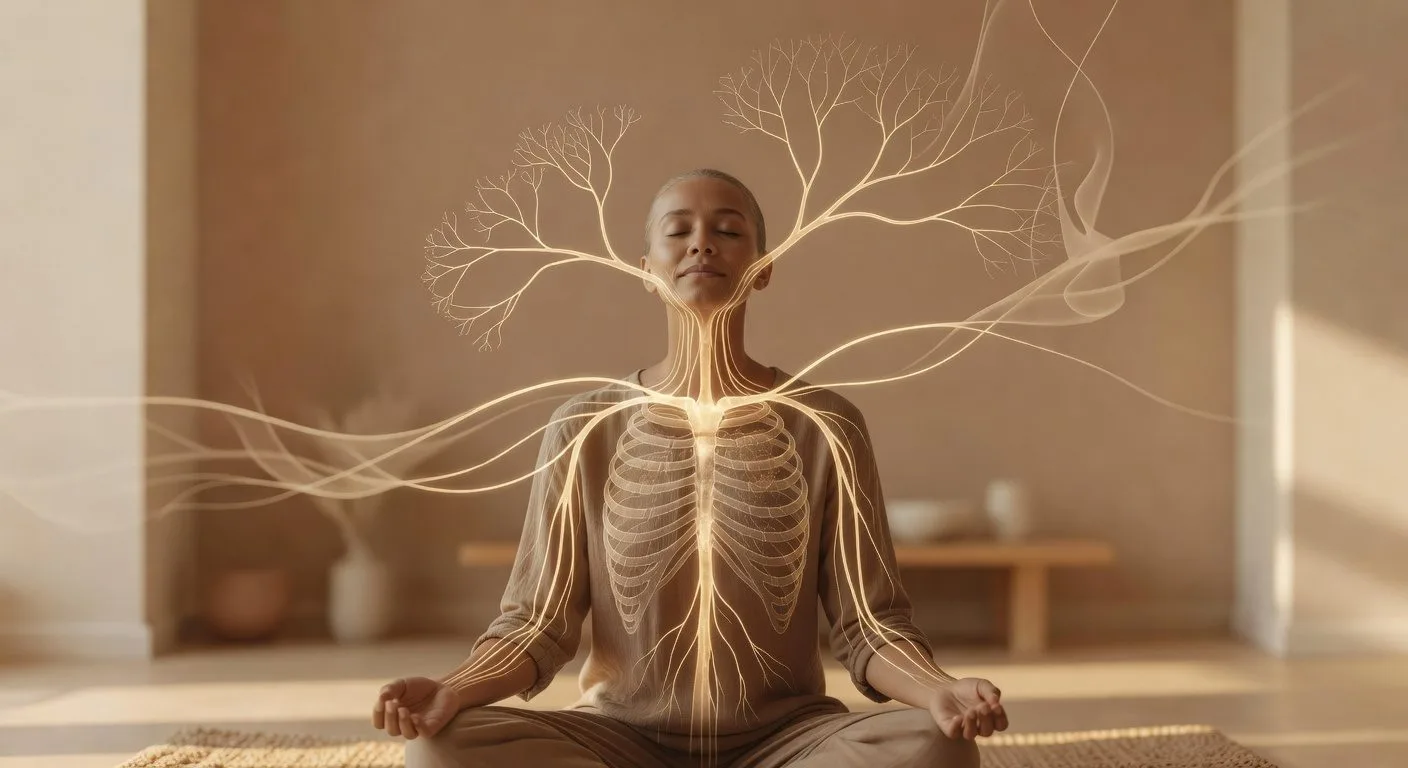
The vagus nerve is the longest nerve in your body. It runs from the brainstem to your heart, lungs, stomach and intestines, and is the master switch of your parasympathetic nervous system — the "rest-and-digest" mode. The catch: in daily life we have almost no control over this nerve. Except via one route: the breath. Breathing is the only autonomic body function we can consciously override, making it the only direct access to our autonomic nervous system.
Good breathing in yoga therefore does three things at once: it synchronises movement with attention, it oxygenates your tissue optimally, and it shifts your nervous system from survival to recovery mode. Once you feel this, you understand why in every serious yoga tradition the breath is more important than the pose.
Why most people breathe wrong on the mat
Walk into any random yoga class and watch chest cavities for five minutes. What you see: shoulders rising with every inhale, jaws slightly open, and bellies not moving. This is chest breathing — a shallow, fast breathing pattern we've unconsciously learned through years of stress, bad sitting posture, and holding in the belly for the mirror.
Chest breathing mainly uses the accessory breathing muscles in neck and shoulders. It delivers less oxygen, stimulates the sympathetic nervous system (fight-or-flight), and locks your diaphragm like a tight vice. In someone at rest, the belly should move — not the chest. The diaphragm descends 1 to 2 centimetres on a calm inhale and gently pushes the belly forward. Anyone who doesn't do this exhales only one third of their lung volume and primarily uses the stress-wiring of the nervous system.
The three most common mistakes
- Mouth breathing during effort — Nasal breathing filters, humidifies and warms the air, and triggers nitric oxide (NO) production in the nasal cavities. NO dilates blood vessels and increases lung oxygen uptake by 10-25%. Mouth breathing misses this entirely and activates the stress response.
- Holding breath in difficult poses — Under resistance or effort we unconsciously hold the breath. This is a deeply rooted survival reflex (the "vasovagal freeze"), but in yoga it actually blocks the release you're trying to achieve. Rule: the more uncomfortable the pose, the more consciously you must keep breathing.
- Inhale longer than exhale — The inhale is the sympathetic phase (speeds heart rate), the exhale is the parasympathetic phase (slows heart rate). Anyone exhaling shorter than they inhale stays in stress mode. In yoga the exhale is always at least as long as the inhale — often twice as long.
The diaphragm: the muscle that decides everything
- What is diaphragmatic breathing?
- Diaphragmatic breathing is deep breathing where the diaphragm descends and the belly softly expands — not the shoulders. It delivers more oxygen, calms the nervous system, and is the core of healthy breathing in yoga; under chronic stress this pattern often gets stuck.
If one muscle is central to breathing in yoga, it's the diaphragm. This dome-shaped muscle separates your chest cavity from your abdominal cavity and is responsible for about 70% of your breathing volume at rest. The problem: under chronic stress the diaphragm becomes stuck and shortened. You feel it as a knot just below your ribs, a sense of "not being able to breathe deeply enough", or a constant slight pressure on your sternum.
A stuck diaphragm has direct consequences: it limits your lung capacity, restricts blood flow through the abdominal organs (worse digestion), and — fascinatingly — affects your emotions. The vagus nerve runs straight through the diaphragm. A tense diaphragm literally pinches this nerve, meaning your parasympathetic response is physically blocked. This is exactly why people with chronic stress have such a hard time calming down: their anatomy is in the way.
Yoga breathing is essentially diaphragm training. By consciously breathing deeply into the belly, you re-train the muscle to move fully again. This is not metaphor — it's physical rehabilitation. After 2-4 weeks of daily practice most people notice measurably less chest pressure, better digestion and — surprisingly — fewer back complaints. For those wanting to dive deeper, our article on the link between breathing and the nervous system explains exactly how this feedback loop works.
The 3 essential pranayama techniques
There are more than forty documented pranayama techniques in classical yoga. But for 95% of what you need on the mat — and in daily life — you can get by with three. These three also have the most scientific research behind them.
1. Dirgha pranayama — the complete yogic breath
This is the foundation of everything. You breathe through the nose in three phases: first expand your lower belly (diaphragm descends), then your mid ribs (intercostal muscles widen), then your upper chest. Exhale in reverse order: chest drops first, then ribs, then belly gently pulls inward. One full cycle takes 8-12 seconds. This is how a baby breathes — before life put stress into it.
Practice this for 5 minutes a day, lying on your back with one hand on the belly and one on the chest. After a week you'll notice the "belly hand" automatically moves first — a sign that your diaphragm is waking up again.
2. Ujjayi pranayama — the ocean breath
- What is ujjayi breathing?
- Ujjayi breathing is the “ocean breath”: you slightly constrict the glottis so each nasal breath makes a soft sound. Ujjayi lengthens the breath, gives acoustic focus and warmth — classic in vinyasa and ashtanga, and proven calming for heart rate and blood pressure.
Ujjayi (oo-jai-ee) is the breath you hear in a vinyasa or ashtanga class: that soft, ocean-like sound that fills the room. You create it by slightly constricting the glottis (epiglottis) with every inhale and exhale — as if you're fogging up a mirror, but with a closed mouth. The sound should only be audible to yourself, not to your neighbour.
Ujjayi has three effects: it lengthens the breath (a ujjayi breath lasts 6-10 seconds), it creates an acoustic focus that calms thoughts, and it generates mild warmth in the body — useful in dynamic styles. Bernardi et al. (2001) published in The Lancet that breathing at 6 breaths per minute (precisely the frequency of calm ujjayi) maximises baroreflex sensitivity and measurably lowers blood pressure.
3. The 4-7-8 breath — for acute stress
This technique was popularised by Dr Andrew Weil and is one of the fastest ways to reset your nervous system in 60 seconds. You inhale through the nose for 4 counts, hold for 7 counts, and exhale through the mouth for 8 counts (with pursed lips, like a long sigh). Do four rounds — no more at first, because the extended exhalation can cause dizziness.
The science behind it: an exhale-to-inhale ratio of 2:1 maximises vagal activation. The 7-count hold raises CO₂ tolerance and strengthens the chemoreflex. A meta-analysis by Zaccaro et al. (2018) in Frontiers in Human Neuroscience confirmed that slow breathing techniques with extended exhalation produce significant improvements on measured anxiety, depression, stress and heart rate variability. Want more practical techniques? Our article on 5 breathing exercises against stress offers four more you can use immediately.
What science says about yogic breathing
The last fifteen years have seen an explosion of research on the effects of pranayama. The key findings:
- Heart rate variability (HRV): Yoga breathing increases HRV — a direct biomarker of vagal tone and stress resilience. Higher HRV correlates with lower mortality, better immune function and better emotion regulation.
- Cortisol: Brown & Gerbarg (2005) showed that 20 minutes of daily Sudarshan Kriya (a pranayama protocol) after 8 weeks significantly lowered cortisol and reduced depression scores by 73%.
- Brain waves: EEG research shows that pranayama increases alpha waves (relaxed alertness) and theta waves (deep meditation) — comparable to advanced meditators.
- Blood pressure: Slow breathing (6 breaths/minute) lowers systolic blood pressure by an average of 4-5 mmHg — comparable to some medications.
This is not small beer. For topics where Western medicine is still searching for solutions — chronic stress, insomnia, mild depression, high blood pressure — pranayama offers a free, side-effect-free intervention you can do anywhere. This is precisely the angle we work from in breathwork coaching and our 30-day practice.
How to build it up — starting small works
The most common mistake of enthusiasts: too long, too intense, too fast. Pranayama is not a sport where more is by definition better. For most techniques: 5-10 minutes per day, every day, yields more results in four weeks than two one-hour sessions per week.
Recommendation for beginners: pick one technique (start with dirgha) and do it every morning before getting up, while still lying down. No mat, no cushions, no preparation. Five minutes. After two weeks add five minutes of ujjayi in the evening (seated in bed). Only after a month introduce 4-7-8, and only during acute stress. This way you build a breathing practice that sticks.
Those wanting to go deeper can look at our chakra journey course which connects breathing per energy centre, or explore our broader course library with breathwork integrated throughout. And if you feel your breath is stuck in trauma or chronic stress, read our article on the science behind yin yoga and breathwork — it explains why sometimes the body must relax first before the breath can be released at all.
Making the shift
Good breathing in yoga changes not only your yoga practice — it changes how you stand in the world. Anyone who learns to breathe consciously, learns to live consciously. You notice that you automatically breathe deeper in a meeting, that you instinctively exhale before a difficult conversation, that you fall asleep faster at night. The yoga mat becomes a training ground for real life.
Start small. Five minutes tomorrow. One technique. Thirty days. After that you'll naturally speak the language of your nervous system — and that is the real yoga.
Go deeper: Read our pillar pages on breathwork and yoga, explore breath coaching, or consider a retreat to integrate this work.