You open your mouth. The words are ready. But something tightens. You know you want to go on a retreat — deep down you feel the need to step away, to pause, to create space. But which one? There are so many. Silence retreats, yoga retreats, nomadic journeys, breathwork intensives. How do you know which one truly fits you?
Choosing wrong costs you more than money. It costs you time, energy, and sometimes trust in the whole idea of a retreat. The right choice, however — that can become a turning point. A moment where you finally hear what you've been trying to ignore for years.
In this article, I'll guide you through seven questions that help you choose the retreat that fits where you are now. No generalities. No marketing talk. Just clarity.
In this article I give you seven concrete questions that help choose the retreat that fits where you are now. Looking mainly for the difference with a holiday, or a short overview of the forms? Read Retreat vs vacation: the real difference first. For the full guide (costs, aftercare, comparison) go to our retreat page.
For a complete overview of all forms, you can also go directly to our complete retreat guide.
How to Choose a Retreat That Truly Fits You
- What does choosing a retreat that fits you mean?
- Choosing a retreat that fits you means matching your current life phase — not what sounds good or what others expect. You compare silence, movement, guidance, duration, and aftercare with what your nervous system can handle now. That way a beginners retreat or a deeper format becomes a conscious match, not an impulse booking.
I regularly see people book a retreat because it "sounds good". A week of silence in France. Beautiful. But that person can barely be alone with themselves. After two days, panic sets in. Or someone chooses a busy group trip when they actually need space and depth.
The retreat that fits you aligns with your current life phase. Not the version of you that you show on Instagram. Not what your partner wants. You.
Ask yourself the following seven questions. Write down your answers. Be honest — no one else is reading this.
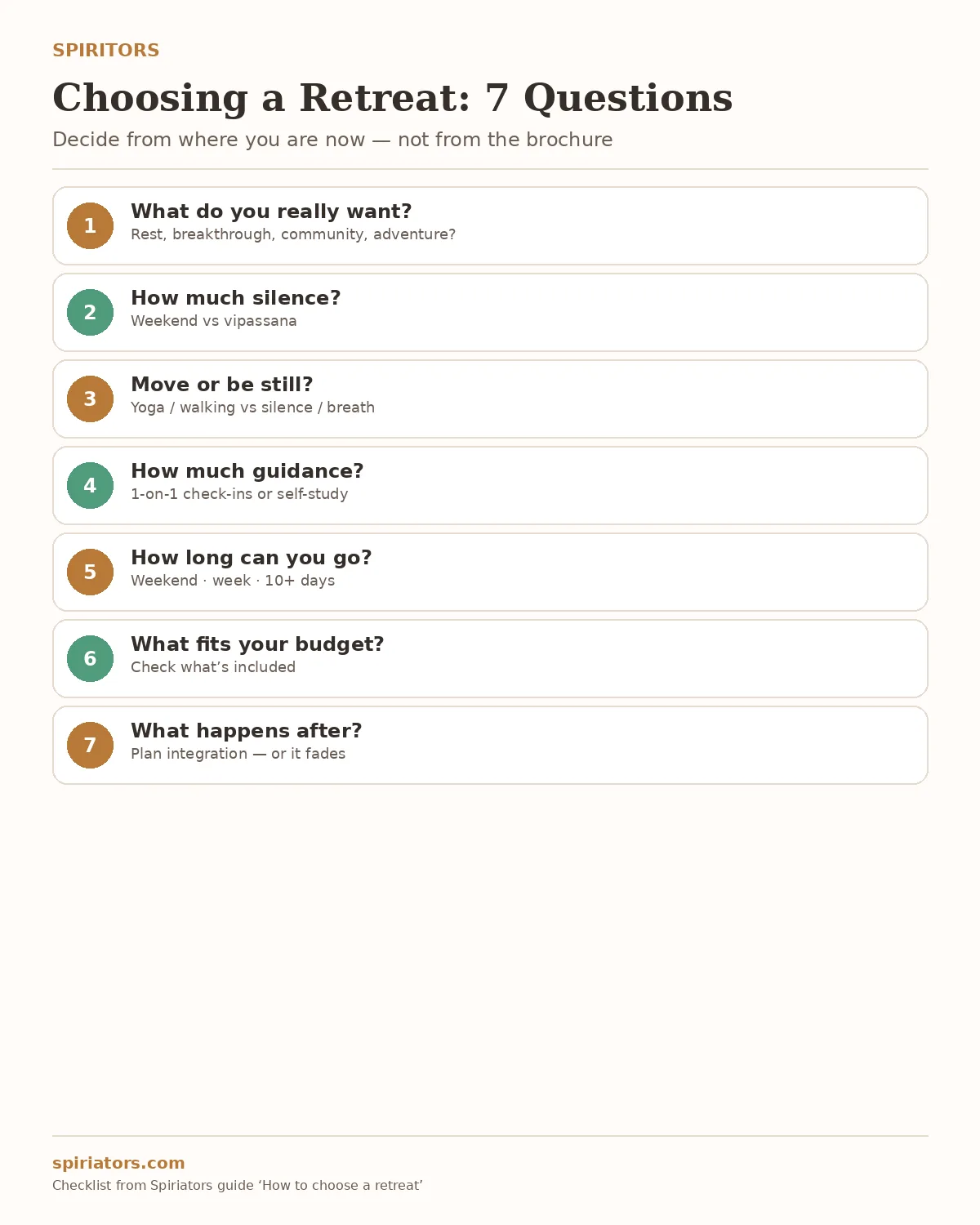
Question 1: What do you really want?
Not what you should want. Not what sounds good in conversation. What do you want?
Rest. You're depleted. Your nervous system is constantly on. You haven't heard silence in weeks. You don't need a retreat with workshops and activities. You need space. Air. Quiet.
Insight. You keep running into the same patterns. You don't understand them. You want to see through them. Then you need guidance — someone to help you look, without judgment.
Change. You know something needs to be different. But what? Sometimes an intensive experience helps flip the switch. Breathwork. Deep bodywork. A breakthrough.
Connection. You feel alone. You want to meet people who experience the same things. A small group, safe atmosphere, shared intention.
Be specific. "I want to grow" is not an answer. "I want to understand why I keep saying yes when I mean no" — that's a start.
Question 2: How much silence can you handle?
- What is a silent retreat?
- A silent retreat is a retreat format where speaking — and often phone and stimuli — temporarily fall away so you can go inward more deeply. It is active listening to yourself, not passive “doing nothing.” For beginners, a gentler yin yoga retreat is often a better entry than days without words.
This isn't a moral question. It's a practical one. Some people thrive in complete silence. Others get restless — and that's okay.
If you've never done a retreat before, start soft. A yin yoga retreat is a great entry point. You move, you breathe, you get into your body — but there's no pressure to "perform". It's gentle, accessible, and still deep.
Already have experience? Then a silence retreat with several days without speaking can be a powerful deepening. But don't underestimate it. Silence isn't passive. It's active listening — to yourself. Research shows that even short periods of silence calm the nervous system and increase cognitive clarity.
Check in with yourself: when was the last time you were truly alone? No phone, no podcast, no music. Just you. How did that feel?
Question 3: Do you want to keep moving or stay still?
This distinction is crucial. There are two main directions:
Staying still. You go somewhere and stay there. One location, one week, the same space. You deepen. You don't go out much. The world comes to you — in the form of what arises within you.
Keeping moving. You travel. From place to place. You sleep here, you work there. The outside world changes continuously, and that helps you move inside as well. This is the core of what we call nomadic travel.
Both forms are retreats. Both can transform. But they address different needs.
If you're stuck in a pattern, movement can help. New environments force you to practice new ways of being. If you're overstimulated, staying still can help. One place, no choices, no distractions.
What energy do you have right now? Which form aligns with that?
Question 4: How much guidance do you need?
This is about safety. About how much structure you need to feel free.
Solo. You go alone. You choose your own rhythm. You decide when to eat, sleep, move. This works if you have self-discipline and know what you need. But it can also get lonely — and then you miss the depth.
Small group. You're with 6-12 people. There's a facilitator, a structure, a daily schedule. You have company, but not a crowd. For many, this is the sweet spot.
1-on-1. You work intensively with one facilitator. Breath coaching at this level is deeply personal. Everything that comes up can be guided immediately. No group dynamics, no distractions. Just you and the other person holding space. As we describe in breath coaching: always a beginner — it's not about performing, but about being present.
There's no "better". Only "fitting". If you're just starting, a group may feel safer. If you have specific questions, 1-on-1 may yield more.
Be honest: do you need someone to hold you? Or do you need space to discover on your own?
Question 5: How long can you be away?
This is a practical question with emotional weight.
A weekend. Feasible for most. You leave Friday evening, return Sunday afternoon. It's a taste. Enough to sample, not enough to fully land.
A week. This is the minimum for real depth. The first two days you're landing. Day three to five: the depth comes. Day six and seven: integration. A week gives you time to truly arrive.
Several weeks. This is for those ready to let go of daily life. A nomadic retreat of several weeks — like our travel with us options — gives you space to fully unfold. You forget who you "should be". You remember who you are.
Look at your life. What's feasible? And more importantly: what's needed? Sometimes a weekend is enough. Sometimes you need weeks to peel back the layers.
Question 6: What fits your budget — and what do you get for it?
Money is energy. It's not moral, it's practical. And it's okay to be honest about this.
Budget retreats. Often group-based, less individual attention. Sometimes fine — if you're mainly seeking company. But check what's included. Sometimes meals, accommodation, or guidance are extra.
Mid-range. This is often the sweet spot. Good guidance, comfortable accommodation, small groups. You pay for quality, not luxury.
Premium. 1-on-1 guidance, exclusive locations, full service. This isn't "better" — it's different. If you have specific questions and want intensive guidance, this can be worth the investment.
Ask yourself: what is it worth to me? Not to be "fixed" — you're not broken. But to make space for what's already there?
Also check our retreat options — there you can see what we offer and at what investment.
Question 7: What happens AFTER the retreat?
This is the question most people forget. And it's the most important.
A retreat isn't an endpoint. It's a beginning. What you experience there — the rest, the clarity, the connection — you need to bring it home. To your work. To your relationships. To your daily life.
Some retreats end with a group process. Beautiful. But then what? Do you go back to work on Monday and everything is "normal"? Or is there aftercare?
Aftercare can be:
- A return meeting
- Individual sessions afterwards
- An online community
- Follow-up materials (exercises, audios, writing prompts)
This distinguishes a "nice experience" from a "turning point". The experience itself is valuable. But the integration — that's where it sticks.
Ask at every retreat: what do they offer afterwards? And if there's nothing — what are you going to arrange yourself?
Comparison table: 4 retreat types vs. 4 life phases
Below is an overview to help you choose. This isn't a hard rule — use it as a compass, not as law.
| Life phase | Need | Retreat type | Example |
|---|---|---|---|
| Transitioning | Rest, transition | Silence retreat (weekend) | Being alone somewhere, no stimuli |
| Stuck | Insight, breakthrough | Breathwork intensive (week) | Deep bodywork, guidance |
| Rediscovering | Connection, inspiration | Nomadic journey (several weeks) | Traveling, moving, new environments |
| Deepening | Integration, practice | Yin yoga + meditation (week) | Gentle form, daily practice |
Where do you recognize yourself? Which phase are you in now?
When a retreat is (not yet) the right choice
I want to be honest. A retreat isn't always the answer.
If you're in an acute crisis — recent divorce, loss, trauma — an intensive retreat can be too much. Then individual guidance is safer first. Someone who supports you personally, at your own pace.
If you expect a retreat to "fix" you — that you'll never have anxiety, doubt, or insecurity afterwards — then you're going with the wrong expectation. A retreat shows you what's there. It doesn't remove anything.
And if you're going because someone else wants it — your partner, your friend, your therapist — then you're likely to build resistance. A retreat only works if you want it.
Sometimes the right choice is: wait. Do a few sessions of breath coaching first. Create stability first. Then the deepening. More about how your body remembers, read nervous system & addiction: the body remembers.
When nomadic travel can be a good fit
- What is nomadic travel as a retreat alternative?
- Nomadic travel is a retreat alternative where you journey longer with guides: deep inner work combined with changing environments. Instead of one week in one place, breathwork and yoga become part of your daily rhythm. It asks more commitment than a classic retreat, but can work better when a short reset is not enough.
For many people reading this, a traditional stationary retreat is a great choice. For others, a format where you are in movement fits better.
Nomadic travel (as we practice it) can be interesting if:
- You notice that one week in one place does not give enough space for real change
- You are open to combining deep inner work with literally changing your environment
- You want breathwork and yoga to become part of your daily rhythm, rather than a one-time experience
It does ask more from you (you are away longer, the group is small, the rhythm is more flexible) and is therefore not suitable for everyone.
If you are curious about this specific format, you can read more on the page about nomadic travel with us.
In closing: trust what you feel
After all these questions — after all the considerations, tables, checks — one thing remains: what do you feel?
You can weigh everything rationally. But your body already knows. When you think about a certain retreat — what happens in your body then? Does it become light? Or heavy? Do you get energy? Or do you tighten up?
That's your compass. Not the price. Not the location. Not what others say.
The retreat that fits you feels like coming home. Even if you've never been to that place before.
If you have questions after reading this article, or if you want to spar about what fits you — send us a message via contact. No sales pitch. Just a conversation.
Want to go deeper into the difference between retreat and vacation, or the 5 forms briefly? Read Retreat vs vacation: the real difference. For costs, aftercare and how to choose: go to the complete retreat guide.
Good luck choosing. And remember: there's no perfect choice. There's only the choice you make now. And that's enough.
— Johannes
Go deeper: Read our pillar pages on retreats and nomadic travel, and explore yoga or breathwork to support your inner journey.