
You're sitting by a pool in Bali, laptop open, coconut beside you — and you feel nothing.
Not the sun on your skin. Not the freedom you once chased. Just a kind of grey haze between you and the world. As if you're watching your own life through a window. This isn't travel fatigue. This is something else. This is digital nomad burnout — and it starts long before you recognise it.
Digital nomad burnout is a slow-draining form of exhaustion that grows from a lack of structure, boundaries and community in location-independent work. It's not the classic overworked office burnout. It's subtler. You seemed to choose freedom, but that same freedom has slowly pushed your nervous system into a state of permanent alert — without you noticing.
The Dream That Slowly Drains You
Why Nomads Are Extra Vulnerable
A fixed office gives you structure, even if it felt like a cage. A set workday gives you a beginning and an end. Colleagues give you faces you see every day. The digital nomad has let all of that go — and that's exactly where the power and the risk both live.
Research shows that the combination of blurred work-life boundaries and the lack of a recovery rhythm directly leads to emotional, mental and physical exhaustion in remote workers. It's not that you work harder than you would in an office. It's that you never stop — and never really arrive.
The numbers are stark: social isolation raises mortality risk by 35% — comparable to obesity and physical inactivity. Nomads move through this risk zone permanently. No fixed office, no daily faces, no rhythm your body can trust. A large-scale meta-analysis confirms that loneliness and isolation take a measurable toll on body and mind.
And then there's the paradox: you chose all of this. The freedom, the sunshine, the laptop lifestyle. So when it doesn't feel the way it should — who are you to complain? That's exactly why nomad burnout lurks for so long. Guilt masks the signals.
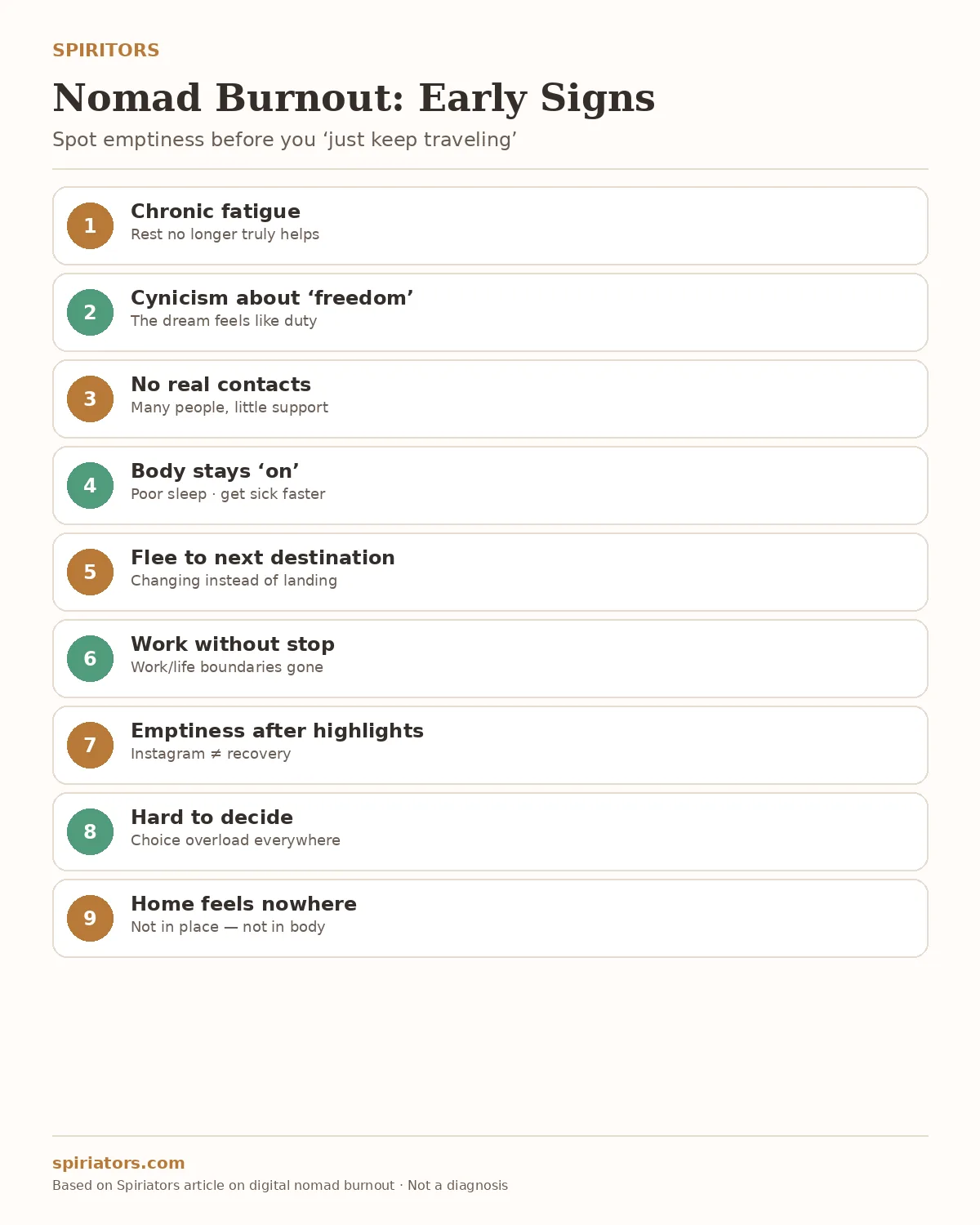
9 Early Warning Signs — What Your Body, Head and Heart Are Trying to Tell You
The signs fall into four categories. Recognise one? You're in time. Recognise three or more? Your nervous system is already screaming.
Physical — Your Body Speaks First
1. Chronic Fatigue That Won't Lift
Not the kind of tiredness that clears after a good weekend or a few days in one place. This is a body stuck in a low-energy alarm state. You sleep for hours but wake up unrefreshed. You take a rest day and feel just as empty that evening. This is your nervous system saying: I can't keep up this pace.
First step: plan seven days anchored in one place. No travel. No new impressions. Just sleep, eat, walk. Your body doesn't need a new destination — it needs stillness.
2. Sleep That No Longer Restores
You lie in bed in a new Airbnb, your mind racing, and even when you do sleep — you wake tired. Falling asleep is a struggle. Staying asleep is a struggle. Every new time zone makes it worse. This isn't jet lag. This is a nervous system stuck in sympathetic overdrive that has forgotten how to power down.
First step: a fixed evening shut-down at 21:00 local time. No more screens. No work email. Dim the lights. Ten minutes of slow belly breathing — four seconds in, six seconds out. More on how breathwork resets your nervous system.
3. Getting Sick More Often or Staying Sick Longer
Colds that won't clear. Gut issues that keep coming back. Headaches with no clear cause. Muscle tension without exertion. This is your immune system saying: I've been in survival mode for months. Not recovering. Surviving.
First step: stop "being productive while sick". Being sick means stopping now, not pushing through with paracetamol. Breathwork coaching can help calm your nervous system before it escalates further.
Mental — When Your Mind Runs Out of Fuel
4. Focus Loss and Indecision
- Cognitive exhaustion
- Cognitive exhaustion is when your brain has no fuel left for focus: constant tab-switching, small decisions feel like mountains, and you no longer know where to start. It is an early mental warning sign of digital nomad burnout.
You open your laptop and don't know where to start. You switch between seventeen tabs a day. Small decisions feel like mountains. Which coffee, which task first, which flight — everything becomes a struggle. This is cognitive exhaustion. Your brain has no fuel left for focus.
First step: one priority per day. Maximum three. Everything else waits. Plan ninety-minute deep-work blocks with no multitasking. Try the Nomad Reset Tool to map your own risk profile.
5. Cynicism About the Lifestyle
You look at your own feed, your own destination, your own work — and think: is this it? That question is dangerous, because it means your original motivation has eroded. Freedom, autonomy, meaning — it all feels like an empty shell. Not because you're dissatisfied. Because your nervous system has been on high alert for too long.
First step: write for ten minutes about what originally drove you in this direction — and what's left of it. The gap between your dream and your reality is your compass. More on the shadow side of location-independent work.
Emotional — When Feeling Disappears
6. Emptiness and Dull Emotion
- Emotional flattening
- Emotional flattening is a classic burnout signal: you are in a beautiful place doing work you once dreamed of, but you feel little — no joy, no sadness, only a grey neutral fog. Your brain dampens feeling as protection against chronic overload.
This might be the most unsettling sign. You're in a beautiful place. You're doing the work you once dreamed of. But you feel nothing. No joy. No sadness. Just a grey neutral fog. This is emotional flattening — a classic burnout sign your brain activates as protection against chronic overload.
First step: stop searching for the next destination. Instead, find one person for a real conversation. Not functional. Not about work. Just human to human. Connection heals faster than any destination. Discover how travelling together can be an anchor.
7. Irritability and a Short Fuse
Slow wifi enrages you. A friendly question from a friend feels like an attack. A wrong food order makes you furious. Not because you're an unkind person — but because your nervous system is at the edge of its tolerance. One more stimulus is one too many.
First step: twenty minutes daily of something that unloads your nervous system. Walking. Swimming. Yin yoga. Breathwork. No screen. No input. Just being and moving.
Behavioural — When Your Actions Betray You
8. Escaping Into Work or Travel
You feel empty, so you work harder. Set up the next project faster. Book the next destination. This is the opposite of what you need — and it's exactly what your nervous system is asking you to stop. Research shows that working from home is a double-edged sword: more freedom, but without conscious structure, exhaustion wins.
Burnout doesn't disappear by doing more of the same. It disappears through space — and space feels like the last thing you want at first.
First step: cancel one thing. Pause one project. Postpone one trip. Space is not a luxury. It's medicine.
9. Losing the Sense of "Home"
- Nomad alienation
- Nomad alienation is the existential sense of never truly being home — not in a building, but in your body. Friends in many countries, endless Airbnbs, yet nobody who calls on a Monday evening. It is a deeper layer beneath nomad burnout.
Your fourteenth Airbnb in four months. Friends in eight countries but nobody who calls you on a Monday evening. Nowhere feels truly home. Not in a building — in your body. This is nomad alienation. An existential layer beneath the burnout. Systematic research confirms that remote work without structural boundaries leads to emotional and physical exhaustion — precisely because the line between "home" and "work" has vanished.
First step: choose one anchor place for the next six months. A physical base. A community. A home where your body can land. A retreat can be that anchor — four days of landing, breathing, starting over.
What Now — Three First Steps You Can Take Today
You don't have to change everything at once. Nomad burnout didn't start in one day — and it won't resolve in one day either. But there are three things you can do today that give you a direction:
- One fixed daily rhythm. Regardless of time zone, regardless of location. A fifteen-minute morning ritual. Set working hours. An evening shut-down. Your nervous system needs structure, not freedom — it's had enough freedom.
- Two real conversations per week. Not a surface-level co-working chat. A real conversation with someone who knows your name. Online or offline. Connection isn't a luxury for nomads — it's a basic need.
- An anchor place every six to eight weeks. At least two weeks in the same spot. So your body can land. So your nervous system can step out of alarm mode. So you can actually feel what's beneath the exhaustion.
And what doesn't work: travelling even faster to outrun the feeling. That's often the escape behaviour that deepens the burnout. More on building a sense of home, wherever you are.
You Don't Have to Carry This Alone
Burnout among nomads isn't a sign of weakness. It's a logical consequence of a lifestyle that promises freedom but removes structure. It doesn't mean you chose wrong. It means your nervous system is asking for a new balance.
If you recognise these signs — even one — you're not too late. You're exactly at the point where recovery is still relatively simple. Your nervous system remembers everything — including how it feels to be calm again.
Discover how breathwork designed for digital nomads can reset your nervous system — five days, ten minutes a day, from wherever you are.
Or schedule a no-obligation conversation if you feel that self-help isn't enough. One seventy-five minute session via Zoom. No programme. No commitments. Just a moment where you don't have to perform.