
Things are going well. And that is exactly when it goes wrong.
You finally have the opportunity you worked toward for months. The conversation went perfectly, the contract is there, your relationship feels lighter than it has in years. And then something creeps in. A vague restlessness. A voice whispering: this cannot be real. That is the upper limit problem — what Gay Hendricks describes in The Big Leap as the unconscious mechanism that pulls you back at the very moment things go well.
In this blog I take you into our coaching sessions. Into the moment a client pulls back right before a breakthrough. And into what we do next — because the answer is not thinking harder. The answer is breathing.
The moment things go too well
She sat across from me, tears in her eyes, and said: "It's going too well." Not as gratitude. As a warning. For three sessions we had worked on her relationship with her father, and for the first time in years she felt space in her chest. And her mind immediately did what minds do with unfamiliar space: sound the alarm.
The following week she cancelled. Busy. Too much work. An appointment she could not move. Sound familiar? The client who disappears right before the breakthrough. The student who never returns after a deep experience. This is not sabotage in the sense of "she does not want to". It is something far more fundamental: a nervous system defending its familiar level.
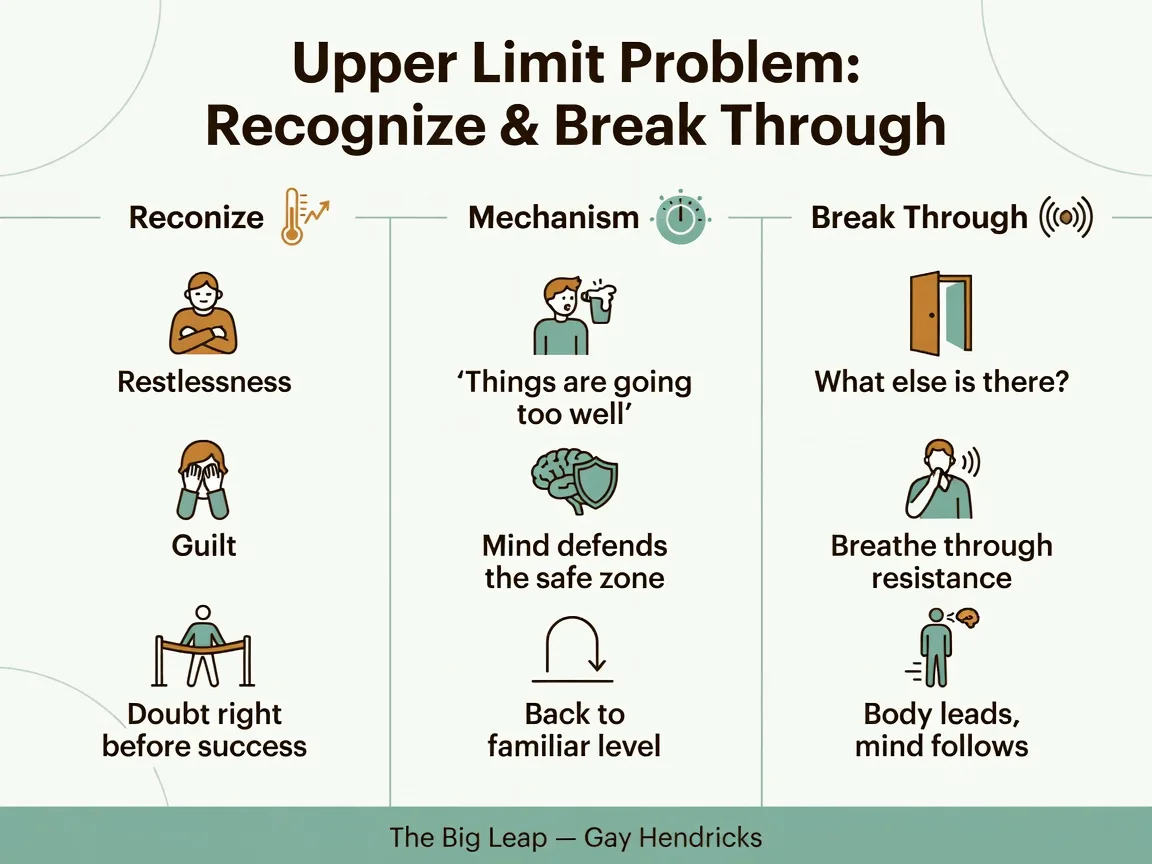
In The Big Leap, Gay Hendricks describes this as the inner thermostat. You carry a set level of success, love and abundance that you have unconsciously marked as "safe". When you rise above it — when life genuinely goes well — your mind hits the brakes until you are back at the familiar setting. Not a character flaw. A protective mechanism. And that is exactly why it matters to treat it as a signal, not a diagnosis. Learning to read that signal is the same skill we describe in our blog on turning your inner critic from enemy into ally — same voice, different disguise.
- What is an upper limit problem?
- An upper limit problem is the unconscious mechanism Gay Hendricks describes in The Big Leap: the moment life goes well, your mind pulls the brakes. Restlessness, guilt or self-doubt surface precisely then — right before a breakthrough. Hendricks compares it to a thermostat that resets you to a familiar level of success. It is not weakness, but a protective mechanism that can be recognized and broken through.
What self-sabotage at success looks like
Self-sabotage at success is the pattern of undermining your own progress exactly when things are going well — not out of unwillingness, but because your nervous system has not yet marked the new level as safe. Its most treacherous feature is timing. During hardship you persevere. Right before or just after a breakthrough, you fall out.
In our sessions we keep seeing the same five signals return:
| Signal | What it actually is | First step |
|---|---|---|
| Restlessness when things go well | The thermostat alarms: "we do not know this level" | Name it out loud: this is my upper limit |
| Guilt about your own happiness | Inner protest against success you feel you may not claim | Ask: who taught me this is not allowed? |
| Picking fights with those closest to you | The mind creates familiar chaos to drop back down | Pause before reacting, feel your breath |
| Suddenly busy with distractions | Backing out of an opportunity that just opened | Breathe for five minutes before you cancel |
| Vague complaints: poor sleep, feeling off | The body defending its safe zone | Check your breathing pattern — the first answer lives there |
The timing is the tell. Not the complaint itself. If you read this and think: but I have no success at all — still. The upper limit problem operates at every scale: a good conversation, a moment of relaxation, a day without worry.
And it is not imagination. Research shows that guilt over success and the impostor phenomenon genuinely predict self-sabotaging behavior. Your mind is not protesting out of spite — it is protecting an old balance. Recent research goes further: working against yourself turns out to be a signaling strategy. Unconsciously, you create obstacles to protect your competence — for others and for yourself. Pulling back right before success is therefore not weakness; it is a calculated mechanism. And what is calculated can be broken. As a starting point, discover where your breathing stands right now with the free breath check — because your breath often reveals your upper limit first.
The three zones: competence, excellence and genius
In The Big Leap, Hendricks describes three zones in which you can work and live. In the zone of competence you do things you can do, but that give you little energy. In the zone of excellence you perform strongly — you are good at it, you receive recognition for it — but it costs effort and depends on external validation. And then there is the zone of genius: the territory where you do not merely excel, but where the work feels effortless and energizing. It feeds you instead of draining you.
- What is the zone of genius?
- The zone of genius is the area where you not only excel, but where your work also feels effortless and energizing — the opposite of the zone of excellence, where you perform with effort and tension. Gay Hendricks argues that many people stay stuck in excellence because the zone of genius is unfamiliar territory. The upper limit sits exactly at the boundary where excellence turns into genius.
This is where we most often see the upper limit problem in practice. Not in people who fail — in people who perform too well in their zone of excellence. They are successful, appreciated, busy. And they feel empty. Because excellence is safe: you know what you get. Genius is unfamiliar territory, and that is exactly where your thermostat is set to "this far and no further".
In our coaching this is the moment people often say: "But I cannot just stop doing what I am good at." No. You do not have to. This is not about giving up — it is about allowing. About not defending the boundary between excellence and genius, but moving through it. The same pattern, by the way, plays out in relationships and family systems: patterns you pass on without knowing it. We wrote about that in breaking family patterns — because the upper limit is inherited too.
Breathe through the resistance: the body leads, the mind follows
This is where our work comes in. Because you cannot think an upper limit problem away — thinking is what keeps it in place. The mind that hits the brakes is the same mind you ask why it is braking. Endless analysis, zero movement. What does work: breathing through the resistance.
Connected breathing — the inhalation flowing seamlessly into the exhalation, without pause — moves your nervous system at the exact moment it wants to freeze. The resistance becomes felt: tension in your chest, a knot in your belly, restlessness in your legs. And instead of fixing those signals, you stay with them. Breathing. The body leads, the mind follows.
The specific technique matters less than you might think. Research on breathwork shows that different techniques work through shared neurophysiological mechanisms — the key is consistency, not perfection. Breathing through resistance works not because you choose the right method, but because you keep breathing at the moment it gets intense. Which is precisely the moment you would normally pull out.
Distilled, it works in three movements: recognize, understand, break through.
Pro-tip: Name the pattern out loud. Say to yourself or your partner: "this is my upper limit problem." Naming breaks the trance and creates space between you and the mechanism. What you can name no longer runs you invisibly.
Breaking the upper limit: 5 steps
In our sessions we work with five steps you can also do at home. Allow about ten minutes.
- Recognize the moment. When things go well and you become restless, guilty or doubtful, name it out loud: this is my upper limit problem. Recognition pulls the pattern out of the shadows.
- Ask the first upper-limit question. Ask yourself, softer than you are used to: what else is there? Not analytical, not explanatory — let the question simply hang in the space while you breathe. In The Big Leap, Hendricks uses four questions like this one; in our practice we distill them to this single one.
- Breathe through the resistance. Switch to connected breathing: inhalation and exhalation flowing seamlessly into each other. Stay with the discomfort without fixing it. The body leads, the mind follows. More background in our blog on setting boundaries without guilt — the same resistance, different terrain.
- Ask what wants to be born. After a few minutes of breathing, ask: what wants to emerge now? Let the answer come without forcing it. Often it is quieter and simpler than you think.
- Celebrate the shift. Acknowledge what has changed, however small. Celebrating anchors the new upper limit in your nervous system and makes the next step far more natural.
Pro-tip: Notice yourself about to cancel or postpone an opportunity? Breathe connectedly for five minutes first, then decide. The mind wants to return to the familiar level; the breath keeps you in the unknown long enough to see what is really going on.
If you want to do this with guidance, breathwork coaching is the fastest route — you learn to recognize the resistance the moment it arises, instead of analyzing it afterwards. And if you want to understand the bigger picture of breathwork, start with our breathwork guide.
Key takeaways
- An upper limit problem is not a character flaw but a protective mechanism: your mind hits the brakes the moment life goes better than the familiar level.
- Timing is the tell: self-sabotage appears right before or just after a breakthrough, not during hardship.
- Guilt over success and the impostor phenomenon are the psychological core — research shows they predict self-sabotaging behavior.
- The zone of genius feels effortless and energizing; the upper limit sits exactly at the boundary where excellence turns into genius.
- You break an upper limit not by thinking harder, but by breathing through the resistance — the body leads, the mind follows.
- Celebrate every shift, however small: celebrating anchors the new level in your nervous system.
Next step
If you are reading this and feel: this is about me — that is no coincidence. Recognition is already the first step through the limit.
Want to explore together where your upper limit sits and how to breathe through it? In a free 30-minute introduction we look at the moment you tend to pull back — no obligations. Book your introduction.
The upper limit problem can't be seen apart from the rest of our method: it belongs to the psychology-as-insight pillar, alongside breath as daily practice and presence as a compass. Three pillars, one thread — depth comes from living it, not from knowing it.
And if you want to read the source work yourself: The Big Leap by Gay Hendricks is not a theory book but a practical framework you can apply immediately. The Big Leap — Gay Hendricks.
Your thermostat is not fixed. You are allowed to turn it up. Breath by breath.