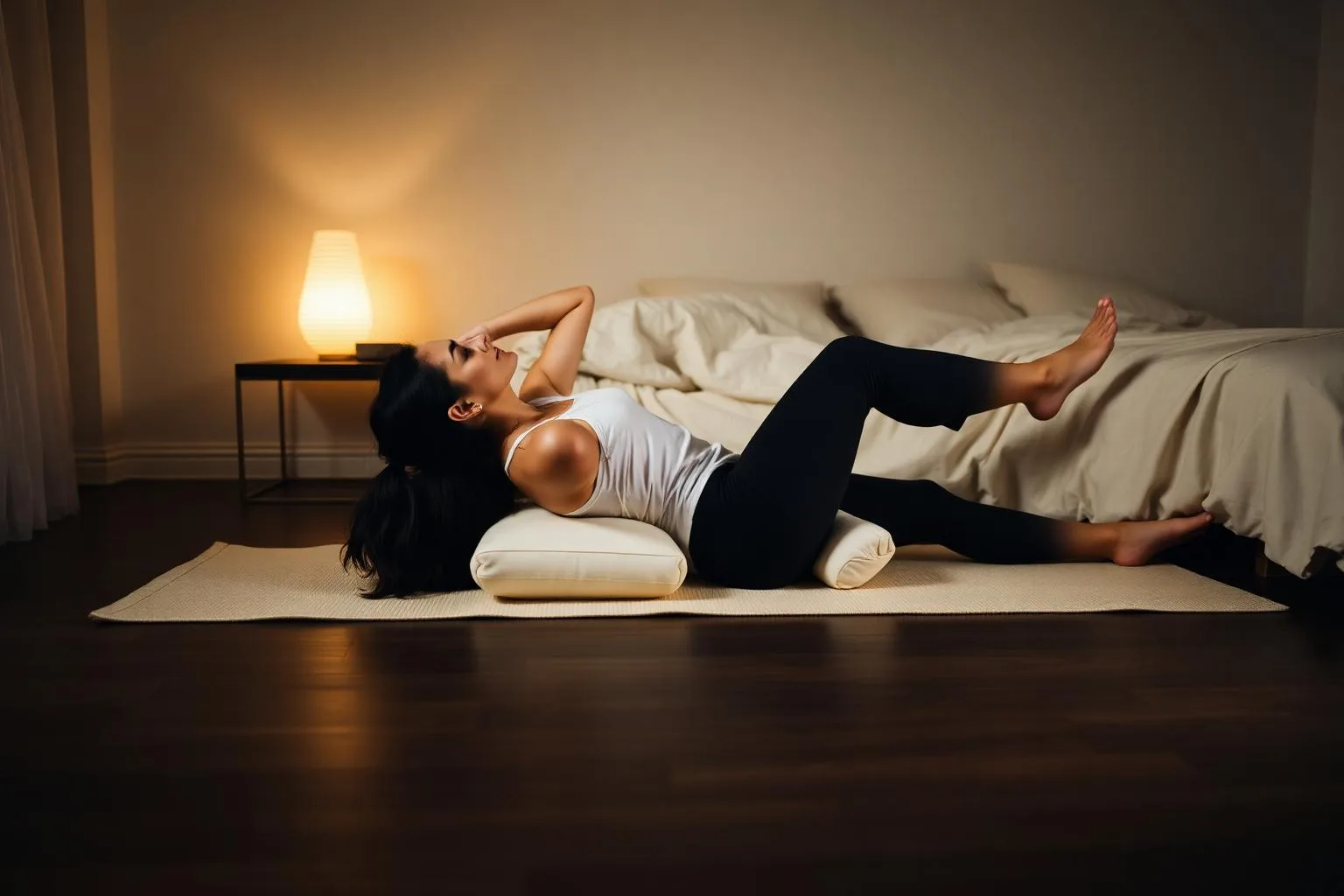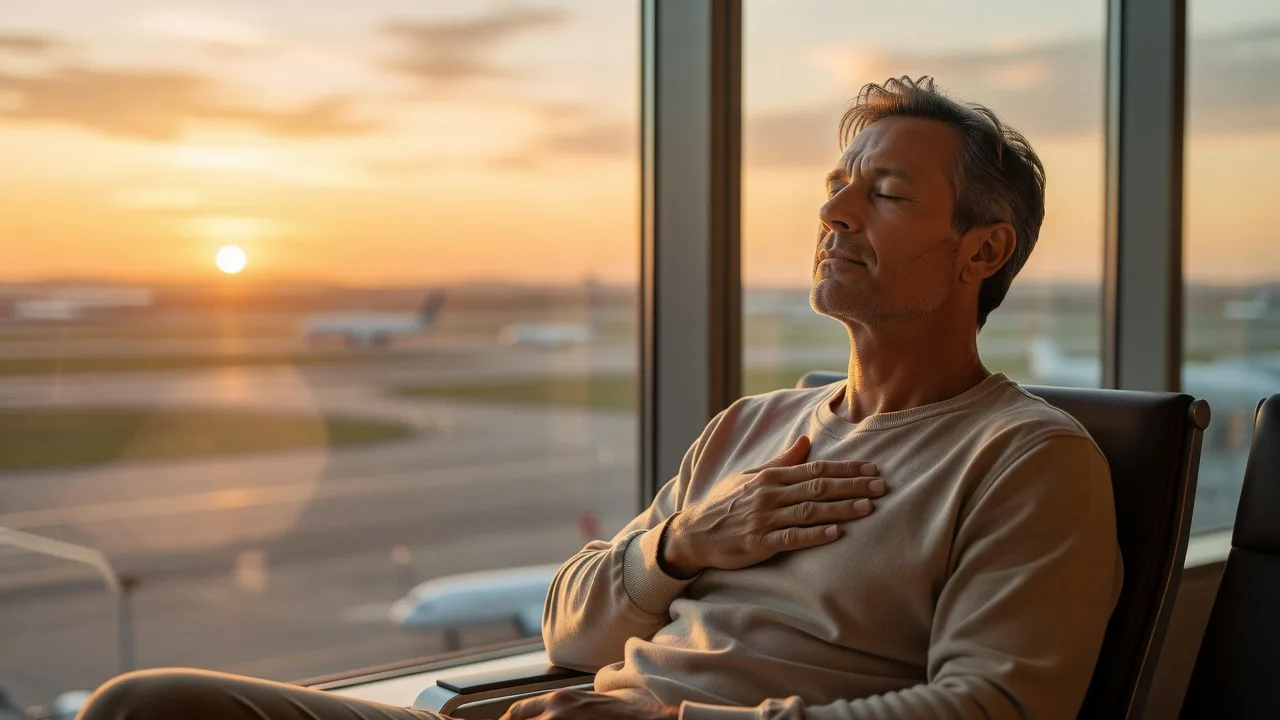
Beating jet lag faster starts with understanding what is really happening: your circadian rhythm is shifted, not your energy level. This blog combines the strongest scientific evidence on light, breath, and sleep to halve your recovery time.
Jet lag is not tiredness — it is a rhythm that lost its way
- What is the circadian rhythm?
- The circadian rhythm is your ~24-hour body clock, driven by the suprachiasmatic nucleus in the hypothalamus. It governs melatonin, cortisol, core temperature and sleep — and synchronises mainly through light.
You step off the plane. The daylight stings your eyes. Your body thinks it is midnight.
You did what everyone says: drank water, put on an eye mask, popped in earbuds. But at three in the morning you are wide awake in a hotel room in a time zone that does not belong to you. Your head pounds. Your stomach churns. And tomorrow you have to function as if nothing happened.
That is not travel fatigue. That is your circadian rhythm completely out of sync with the clock on the wall. And once you understand that, you can beat jet lag faster — not with a miracle pill, but with light, breath, and timing. Research from 2024 and 2025 shows you can roughly halve your recovery time if you give your body the right signals at the right moments. This blog gives you the protocol.
What jet lag actually is — and why you cannot just "get used to it"
- What is jet lag?
- Jet lag is a temporary biological desynchronisation: your internal clock (circadian rhythm) is still on the old time zone while your body is already in a new one. It is not ordinary tiredness, but a shifted sleep-wake, hormone and digestion rhythm.
Jet lag happens when your suprachiasmatic nucleus — the tiny master clock in your hypothalamus — is still running on Amsterdam time while your body is in Bangkok. That clock controls everything: when you produce melatonin, when cortisol peaks, when your digestion is active, when your core temperature drops for sleep.
Every cell in your body has its own clock. Those clocks synchronise through light, food, movement, and temperature. Cross six time zones in twelve hours and every single one of them suddenly loses its reference point. The result? You lie awake when you should be asleep. You feel groggy when you need to be alert. Your digestive system protests at the wrong moments.
Research shows that even small circadian shifts — like the transition to daylight saving time — increase the risk of a heart attack by 4%. If one hour has that kind of impact, imagine what six or eight hours do. Jet lag is not discomfort. It is a full biological desynchronisation.
How long does jet lag actually last?
The rule of thumb: one day of recovery per time zone crossed. But there is an important nuance. Eastward travel — against the clock — takes on average 30 to 50 percent longer to recover from than westward. Why? Because your biological clock naturally runs slightly longer than 24 hours. Delaying it (westward) is easier than advancing it (eastward).
That means a flight from Amsterdam to Bangkok? Expect at least 5-6 days of full adaptation. Without intervention. With targeted light, melatonin, and breathwork interventions, you can bring that down to 2-3 days. That difference is not small — it is the difference between surviving a week and actually living it.
| Direction | Time zones | Recovery without intervention | Recovery with intervention |
|---|---|---|---|
| Westward (e.g. NL → NYC) | 6 | 4-5 days | 2-3 days |
| Eastward (e.g. NL → Bangkok) | 6 | 6-8 days | 3-4 days |
| Westward (e.g. NL → LA) | 9 | 5-7 days | 2-4 days |
| Eastward (e.g. NL → Tokyo) | 8 | 8-10 days | 4-5 days |
The 3-phase protocol: before, during, and after the flight
You cannot reset your rhythm with one trick. You need a combined approach that gives your body the right signals at the right time. The protocol below combines light, melatonin, caffeine, and breathwork across three phases.
Phase 1: Before the flight — shift your anchor
- What does melatonin do for jet lag?
- Melatonin is the sleep hormone that marks biological evening. For jet lag, a low dose (0.5–3 mg) at the right moment — just before target bedtime at your destination — helps shift your rhythm faster. Timing matters more than dose.
Start two to three days before departure. The goal: gradually shift your sleep-wake rhythm towards your destination time zone.
Eastward travel (e.g. Netherlands → Thailand): go to bed 30-60 minutes earlier each night. Wake up earlier too. Set your alarm. It feels unnatural, but you are building a head start your body will thank you for after arrival.
Westward travel (e.g. Netherlands → New York): stay up 30-60 minutes later each night. Leverage your clock's natural tendency to delay.
From the evening before departure, take 0.5 to 3 mg of melatonin, 30-60 minutes before the target bedtime at your destination. Low dose, consistent timing — more is not better. A systematic review of 26 RCTs confirms that timing matters more than dose when it comes to melatonin for sleep promotion.
Pro-tip: Change your phone to your destination time zone the moment you board. Not when you arrive — right now. Every moment you check the old time, your brain receives the wrong signal.
Phase 2: During the flight — water and caffeine as strategy
The flight itself is not the moment to perform. It is the moment to give your body what it needs.
Hydration: Drink 250 ml of water per flight hour. Cabin air has less than 20% humidity — drier than the Sahara. Dehydration worsens sleep quality and cognitive function. Avoid alcohol. Yes, that free wine is tempting, but alcohol disrupts REM sleep and slows circadian adaptation by one to two days.
Caffeine: Use caffeine only in the morning and early afternoon local time at your destination. After 14:00 local time? Skip it. Caffeine blocks adenosine receptors and prolongs sleep onset, exactly when your body is trying to shift.
Sleep on the flight: Try to sleep according to the night at your destination. Earplugs, eye mask, neck support. This is not a luxury — this is part of your protocol.
Phase 3: After arrival — morning light and breathwork
This is where it really begins. The first three days after arrival determine how fast you recover.
Morning light is your strongest signal. Get 20-30 minutes of bright daylight within 30-60 minutes of waking up. For eastward travel: seek direct morning sun. For westward travel: avoid early morning sun and seek evening light instead. Research shows that light therapy improves total sleep time by 32.5 minutes and sleep efficiency by 2.9% in shift workers — comparable circadian shifts to jet lag.
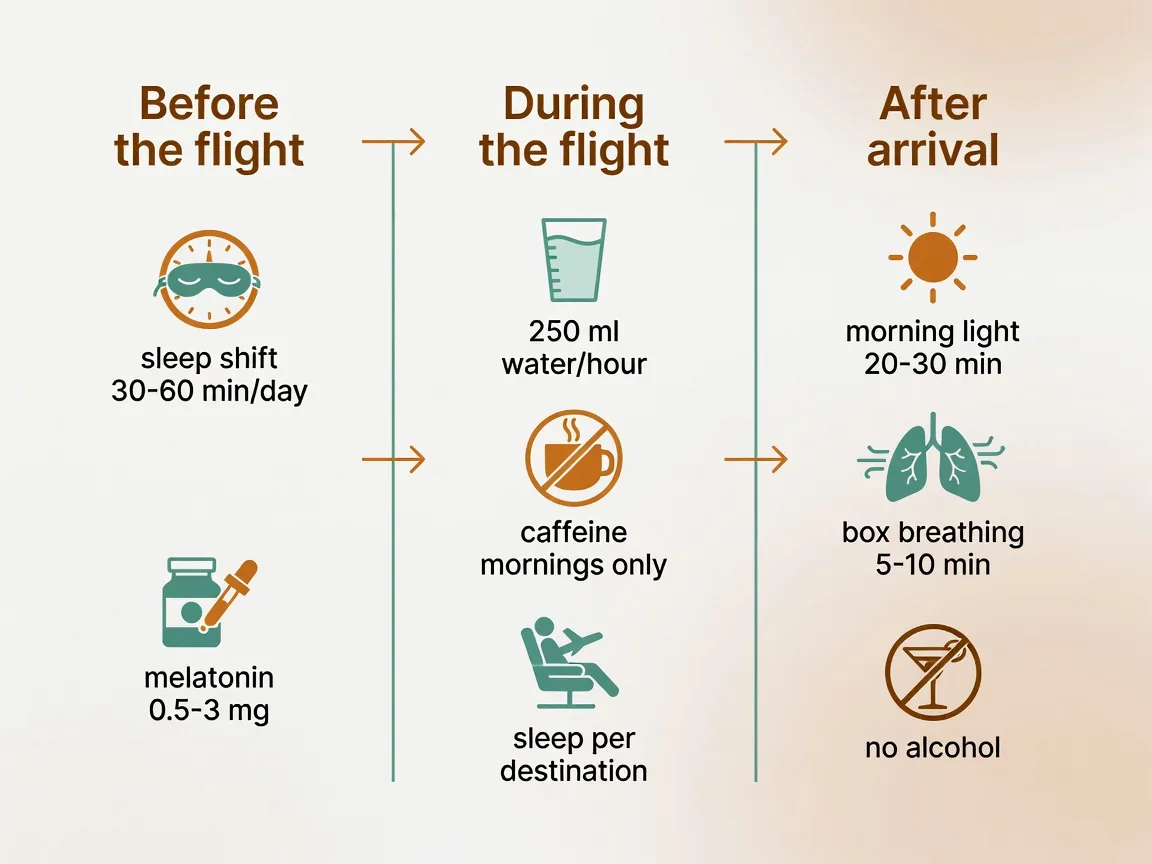
Breathwork before bed: When you are lying awake at 2 AM with a heart rate that refuses to drop, your sympathetic nervous system is still running full throttle. Box breathing — 4 seconds in, 4 seconds hold, 4 seconds out, 4 seconds hold — shifts your autonomic nervous system towards parasympathetic. 5 to 10 minutes is enough. A review of 7 trials from 2020-2024 confirms that consistent breathing exercises significantly improve sleep quality.
Want to learn more about resetting your nervous system as a digital nomad? Our 5-day Reset On The Road programme gives you 10 minutes of breathwork per day that helps your nervous system switch between time zones faster.
The pitfalls — what makes jet lag worse
Not every "solution" helps. Some habits actively slow your recovery.
| Pitfall | Why it is a problem | What to do instead |
|---|---|---|
| Alcohol with dinner | Disrupts REM sleep, delays adaptation 1-2 days | Chamomile tea or warm water with lemon |
| Naps after 14:00 local time | Makes falling asleep that evening harder | Breathing exercise or a short walk outside |
| Screen light after 22:00 | Suppresses melatonin, shifts rhythm the wrong way | A book, dim lamp, or breathwork |
| High-dose melatonin (10mg+) | No extra benefit, but side effects (vivid dreams, grogginess) | 0.5-3 mg at the right time |
| Intense exercise on arrival | Raises cortisol, disrupts falling asleep | Yin yoga, walking, or breathwork coaching |
Pro-tip: The biggest jet lag killer is not what you do — it is what you fail to do. Seeking morning light is the most powerful non-pharmacological intervention there is. Skipping it = 1-2 extra days of recovery. Even if it rains: get outside.
Box breathing for jet lag — step by step
This is the breathing exercise you can use immediately after arrival. It takes 5-10 minutes, and you need nothing but yourself and a chair or bed.
Step 1: Sit or lie down. Close your eyes. Feel your feet on the ground.
Step 2: Inhale for 4 seconds through your nose. Slow, even. Count in your head: 1-2-3-4.
Step 3: Hold for 4 seconds. No straining — just stillness. No breath in, no breath out.
Step 4: Exhale for 4 seconds through your nose or mouth. Let the air flow gently.
Step 5: Hold for 4 seconds. Empty. Still. This is the moment your nervous system shifts.
Repeat for 5-10 minutes. You will feel it: your heart rate drops, your breathing deepens, your body receives the signal — it is safe to let go. This is not woo-woo. This is neurobiology. The vagus nerve is the switch, and your breath is the button.
Why digital nomads get hit harder
If you switch time zones every month, your body never fully recovers. You learn to compensate — caffeine, naps, late nights — but beneath the surface the desynchronisation builds up. Sleep problems, digestive issues, irritability, reduced focus. It is not a sign of weakness. It is your biology asking for help.
The good news: with a protocol you stop being entirely dependent on your environment. You take back control. Morning light at the right moments. Melatonin at the right dose. Breathwork when your nervous system is overstimulated. It is not magic — it is timing that respects your rhythm, not the clock on the wall.
Does this sound familiar? Read more about how other nomads deal with this in our article on working from anywhere: freedom and fear.
Jet lag and your nervous system — why breathwork helps
When you are lying awake at three in the morning in a foreign time zone, it is not just your clock that is lost. Your vagus nerve — the main nerve of your parasympathetic nervous system — is not receiving the "safe" signal. Instead, your adrenal glands pump cortisol, your heart rate stays elevated, and your brain runs on overdrive.
That is exactly where breathwork comes in. Slow breathing at around six breaths per minute activates the parasympathetic branch of your nervous system. Within 10 to 20 minutes your heart rate drops, cardiac coherence improves, and cortisol decreases. It is not magic — it is a physiological switch you can operate yourself.
Want more exercises to reset your nervous system through the vagus nerve? Our guide gives you 7 exercises you can do anywhere — no equipment needed.
Struggling with sleep — not just after a flight?
Jet lag is an acute disruption. But if you already sleep poorly at home, there is more going on than a time zone. Your nervous system is stuck in the "on" position. Yin yoga before bed can help: five poses that bring your nervous system down in 20 minutes.
And if you want more guidance — not just for jet lag, but for how your breath shapes your entire rhythm — try a 1-on-1 breathwork coaching session. No app, no generic plan. Just you and your breath, with someone who listens.
Key takeaways
- Jet lag is not tiredness — it is a circadian desynchronisation you can influence with the right signals at the right time
- Eastward travel costs 30-50% more recovery time than westward — start your protocol earlier
- Morning light is your most powerful tool: 20-30 minutes within 1 hour of waking can halve your recovery time
- Melatonin works — but timing matters more than dose: 0.5-3 mg at the right moment
- Box breathing (4-4-4-4) shifts your nervous system towards parasympathetic within 5-10 minutes
- Avoid alcohol, late naps, and screen light — they actively make jet lag worse
Jet lag does not have to cost you a week. With the right protocol — light at the right moments, melatonin with the right timing, and breathwork when your nervous system is overstimulated — you can halve your recovery time. And when your next flight comes around: travel with us on one of our nomadic journeys. Experience how breathwork, light, and rhythm come together in practice.