Chronic insomnia isn't tiredness — it's hyperarousal. You're exhausted, but the moment you switch off the light, your system flips to alert. Your heart thumps softly, your thoughts race, and the simple instruction "fall asleep now" becomes impossible. Anyone struggling with sleep problems for months or years knows this rhythm: it's not a question of low melatonin or a bad mattress. It's a nervous system that has literally unlearned how to apply the brakes.
Yin yoga is one of the few interventions that targets exactly this mechanism. Not by relaxing you — that's an outcome, not a technique — but by training the parasympathetic nervous system. In this article: how yin yoga for sleep problems works at a clinical level, which four poses form the core protocol, and what current science says about it. No quick fix, but a route that works for those who actually stick with it.
Why chronic insomnia is a nervous system problem
- What is chronic insomnia as a nervous system problem?
- Chronic insomnia is often hyperarousal: an autonomic nervous system permanently on mild alert. Not a shortage of “sleep tips,” but a system that has unlearned how to apply the brakes — exactly what yin yoga for sleep problems targets.
The hyperarousal model by Bonnet and Arand, published in Sleep Medicine Reviews (2010), is now the dominant explanatory model for chronic insomnia. It shows that people with long-term sleep problems are not "too awake" — they have an autonomic nervous system permanently in mild standby. 24 hours a day, measured in heart rate, cortisol, body temperature and brain activity. Their sympathetic system is on; their parasympathetic system is suspiciously quiet.
This explains why sleep hygiene, melatonin or warm tea often work disappointingly weakly in chronic insomnia. Those interventions ask a healthy system for a bit more relaxation. With hyperarousal you're asking a system that has been on alert for years to suddenly flip a switch it has nearly forgotten. That doesn't just happen. The system must re-learn how to relax — and that's exactly what yin yoga does.
The trick is in the duration. Holding a pose for 30 seconds is stretching. Holding a pose for 5-7 minutes is fundamentally different: it's a signal to the nervous system that there's no acute danger, that the muscle may release, that fascia may hydrate, and — crucially — that the vagus nerve may activate. For a deeper dive, our article on connected breathing and the nervous system explains how this feedback loop works physiologically.
- What is yin yoga for insomnia?
- Yin yoga for insomnia is a slow evening practice that trains the parasympathetic nervous system — not just “relaxes” it. For chronic insomnia yoga and insomnia yin yoga, the long hold (5–7 minutes) is neurological retraining: the system relearns how to apply the brakes.
Yin yoga versus general evening yoga: the difference
- What is the difference between yin yoga and general evening yoga?
- General evening yoga is often short stretching or mild flow; yin yoga holds poses for a standard 3–7 minutes. That difference is physiology: only from minute 4–5 does the autonomic nervous system tip — exactly what distinguishes yin yoga for sleep problems from a random evening routine.
Many people think yin yoga is "calm yoga". That's half true. Yin is calm in movement but intense in duration. Where average restorative classes hold poses 1-3 minutes, yin goes standard to 3-7 minutes — and in a sleep protocol to 5-7. That difference isn't taste, it's physiology.
In the first minute you stretch muscle. In minutes 2-3 connective tissue (fascia) starts responding via mechanotransduction: fibroblasts in the fascia receive the signal to reorganise collagen and retain water. Only from minute 4-5 does the autonomic nervous system start to tip. Before that moment you're stretching; after it you're really doing yin. That's exactly what distinguishes yin yoga for sleep problems from a random evening routine.
For anyone wondering whether yin does anything with the breath at all: see our article on the science behind yin yoga and breathwork. Yin without conscious breathing is static stretching. Yin with deep diaphragmatic breathing is a neurological intervention.
The core protocol: 4 poses that work for insomnia
Based on the randomised studies of Halpern et al. (2014), Khalsa (2004) and Mustian et al. (2013), a fairly consistent protocol can be derived. These four poses together form a 25-30 minute session that you do 60-90 minutes before bed — not right before bed, because in the first 30 minutes after practice your core temperature drops, and that drop is itself the physical trigger for sleep onset.
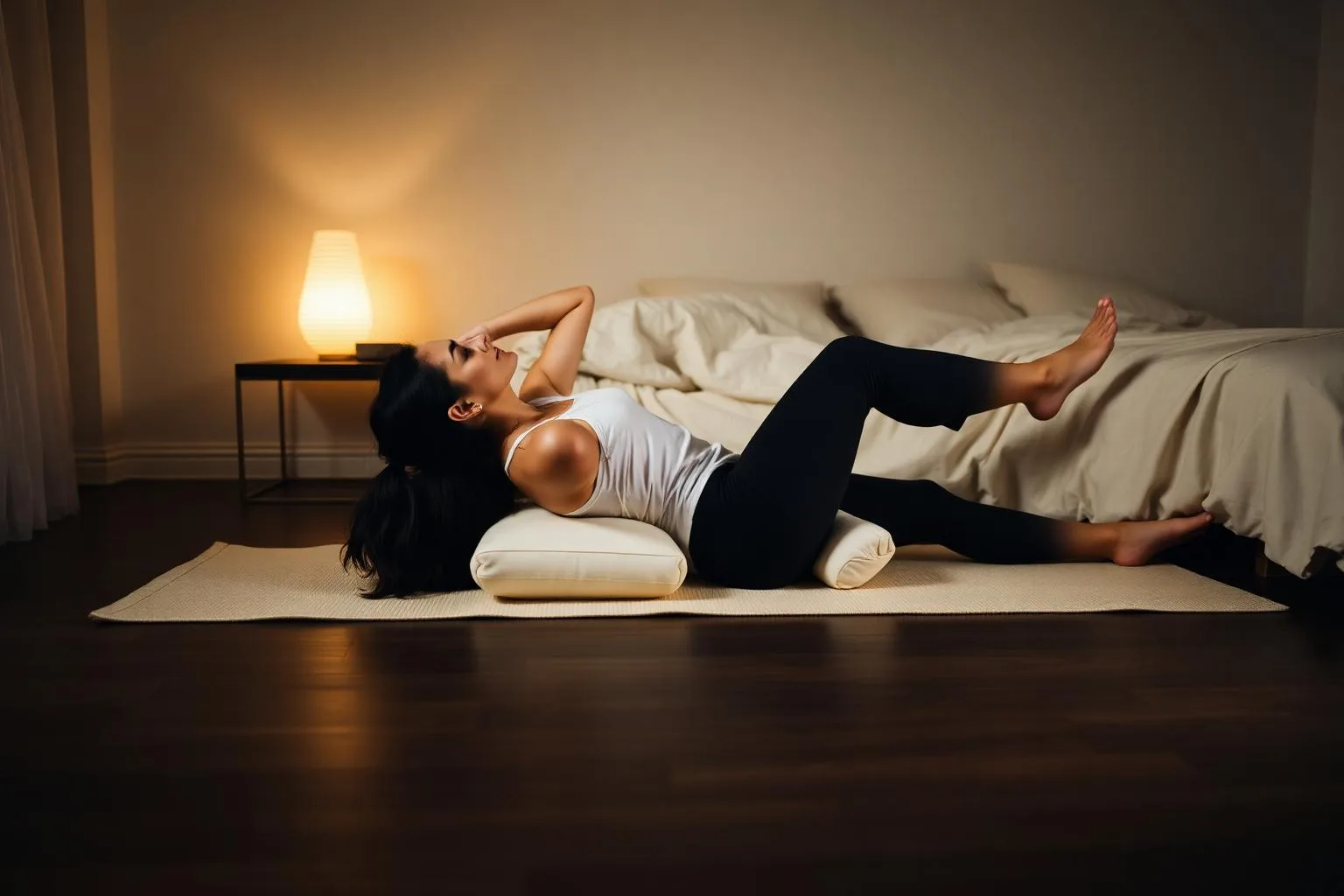
1. Supported reclined butterfly (supta baddha konasana) — 5-7 minutes
Lying on your back, soles of feet together, knees fallen out onto cushions or rolled blankets. One cushion under your head, one under each knee. This pose opens the hips — where, according to trauma-informed research (Levine, 1997), much chronic tension is stored — and stimulates the abdominal region directly, where most vagal receptors live. Breathe slowly: 4 counts in, 6 counts out.
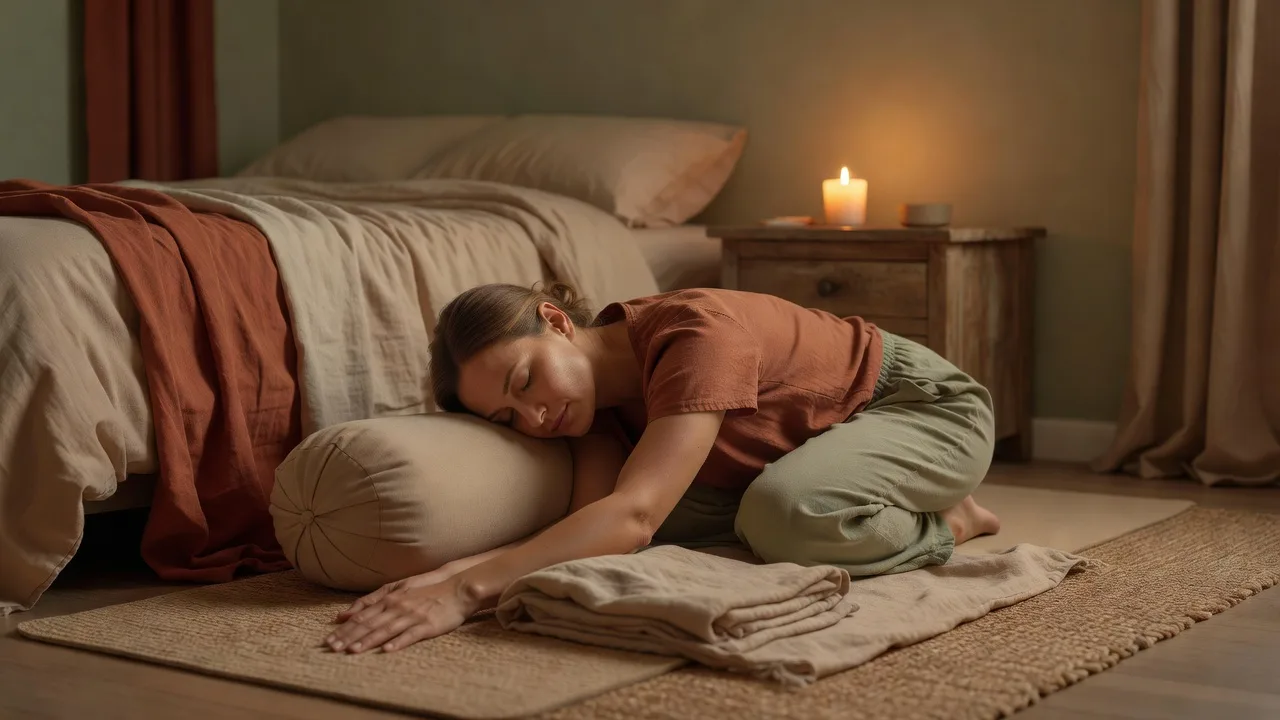
2. Child's pose (balasana) — 5 minutes
Kneeling on the mat, knees apart, hips to heels, torso forward, forehead on a cushion or folded blanket. The forehead contact is essential: pressure on the prefrontal cortex via the skin directly stimulates parasympathetic response (an effect also used to calm infants). Arms can rest alongside the body or stretched forward, whichever feels most comfortable.
3. Legs-up-the-wall (viparita karani) — 7 minutes
Hips against or close to the wall, legs vertical, arms relaxed beside you. This is the pose for sleep problems: by reversing gravity, blood pressure drops measurably within 4-5 minutes and the baroreflex is strongly activated — exactly the reflex that slows your heart rate. Research by Bertisch et al. (2009) showed that vertical legs for 5+ minutes shifts ANS balance toward parasympathetic dominance within a single session.
4. Savasana with blanket — 8-10 minutes
Lying on your back, blanket over the body (proprioceptive safety via weight — same principle as a weighted blanket), eye pillow or cloth over the eyes. Don't stretch, don't "do" breathing — just be present with the body that has just tipped. This is the integration moment where the neurological shift consolidates.
What science says — not vague, but concrete
The evidence base for yoga in chronic insomnia has grown significantly in the last ten years. The key studies:
- Halpern et al. (2014) — RCT with 67 older adults, 12 weeks yoga. Results: 36% shorter sleep onset latency, 28 minutes more total sleep time, 5% higher sleep efficiency. Effect held at 3-month follow-up.
- Khalsa (2004) — Pilot RCT with 20 participants, 8 weeks. Pittsburgh Sleep Quality Index improved from 11.5 to 6.8 (clinical significance threshold: <5).
- Mustian et al. (2013) — Large RCT (n=410) in cancer survivors with insomnia. Yoga produced 22% better sleep quality versus standard care.
- Dutta et al. (2026) — Recent systematic review in Journal of Integrative and Complementary Medicine confirms: yoga is non-inferior to CBT-I for chronic insomnia.
These are not small effects. CBT-I, the gold standard, typically has an effect size (Cohen's d) of 0.7-0.9. Yoga reaches 0.5-0.8 in comparable studies — significant and clinically relevant, with the bonus that it requires no waiting list, insurance or therapist.
How to build it up: the first 30 days
Realism is everything here. Anyone who's ever had chronic sleep problems knows: keeping a new routine in week one is easy; week three is where 70% drops off. So: don't build big. Start with the first two poses (supta baddha konasana + viparita karani) — 12 minutes total. Do just that, every evening, for two weeks. Then add child's pose. Only in week 4 do the full 30-minute protocol.
Don't expect instant results. In chronic insomnia most people see the first measurable change in week 2-3: usually not faster sleep onset, but fewer night-time awakenings. That's the first sign your parasympathetic nervous system is waking up again. Follow it consistently for 4-8 weeks and the sleep-onset improvement comes by itself.
Anyone who wants to take this seriously within a structured framework can consider our 30-day practice — a drip system delivering a daily short yin or breath session. Or explore our broader course library where sleep and nervous system regulation are central themes. And if you suspect your sleep problems are linked to deeper stress or trauma, also read our article on how the nervous system remembers what the body experiences.
When yin yoga is not enough
Honesty matters: yin yoga is not a miracle cure. For serious sleep disorders (sleep apnoea, restless legs, diagnosed primary insomnia with depression) you need medical diagnostics. Yin yoga is a powerful complement — sometimes sufficient on its own, sometimes part of a broader trajectory with CBT-I, light therapy or supervised medication tapering.
But for the bulk of what we call "sleep problems" — trouble falling asleep, frequent awakening, waking unrefreshed despite 8 hours in bed — yin yoga is one of the most effective, accessible and proven interventions available. No prescription needed, no side effects, no waiting list. Just a mat, a few cushions, and the willingness to claim 25 minutes a night for your nervous system for 30 days.
Start tonight. Butterfly pose. Legs-up-the-wall. 12 minutes. And repeat it tomorrow.
Go deeper: Read our pillar pages on yoga and breathwork, explore yin yoga, or join a retreat to deepen your practice.