You're considering a breathwork retreat. You've heard the stories — people crying, trembling, or entering another world. And now you wonder: what if it happens to me?
A breathwork retreat is not a wellness weekend with a little breathing at the start. It is a multi-day dive into your nervous system, where you breathe consciously, deeply, and connected with a small group under guidance. In this honest account I share what you can really expect — the beautiful sides, the difficult moments, and when you should wait.
If you're unsure whether a breathwork retreat is right for you, keep reading. No sales pitch — just the honest story I wish I had read before my first time.
What exactly is a breathwork retreat?
A breathwork retreat is a multi-day setting, usually two to five days, in which you breathe consciously, deeply, and continuously with a small group under the guidance of a trained facilitator. The difference with a single workshop is the duration, the depth, and above all: the time for integration in between.
- Connected breathing
- A breathing technique where inhalation and exhalation flow seamlessly into each other without pause, creating a continuous stream of breath that invites the nervous system to release stored tension.
You don't come to perform. You come to feel. The days are built from breath sessions, silence, group sharing, and rest. Nothing is asked of you except presence — and the willingness to breathe, even when it gets uncomfortable.
Compare it to a regular retreat: those focus on silence, meditation, or yoga. A breathwork retreat is more specific — the breath is the vehicle, the nervous system is the destination. To understand how that works, read about connected breathing and the nervous system.
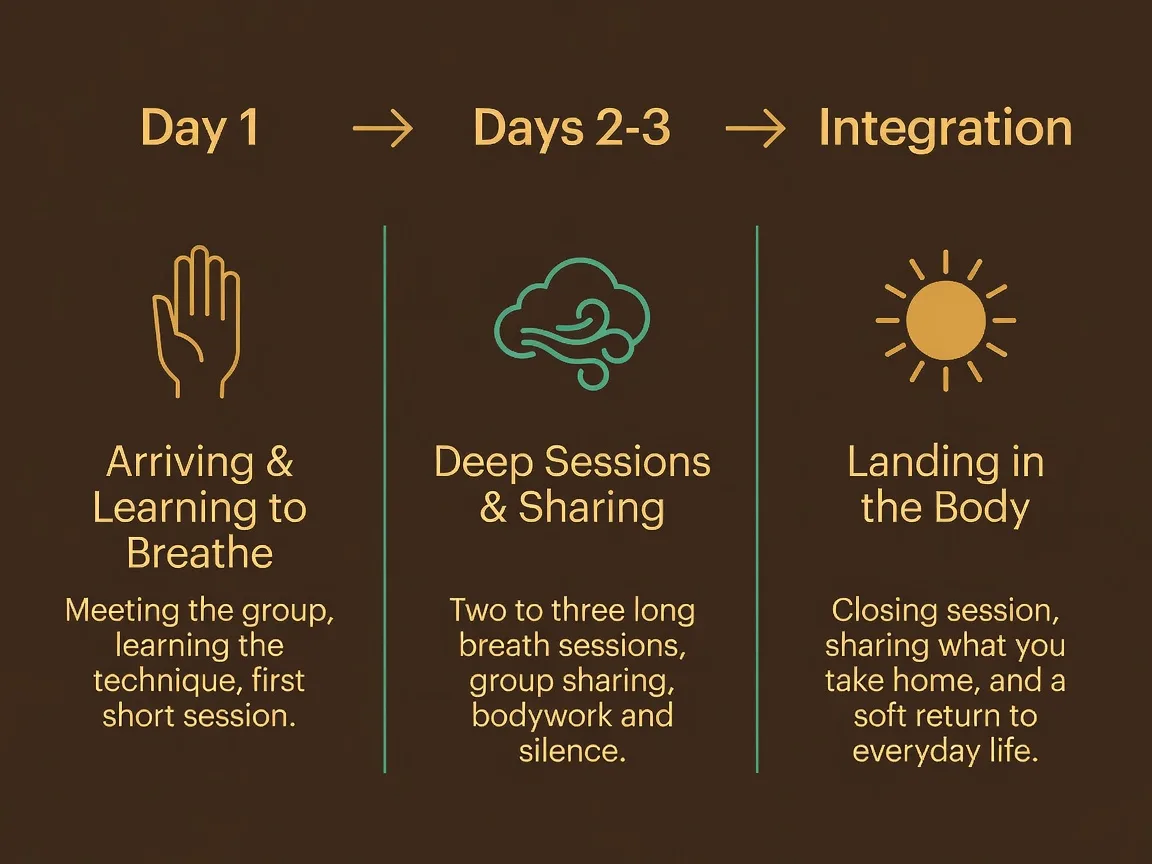
What does a day at a breathwork retreat look like?
No day is the same, but the structure is recognizable. Below is a typical daily schedule, so you know what to expect — not as a rigid timetable, but as a rhythm your body recognizes.
| Time | Activity | What it does |
|---|---|---|
| 07:00 — 08:00 | Silence and waking up | Body waking without stimuli |
| 08:00 — 09:00 | Light breakfast | Energy without a heavy meal |
| 09:30 — 11:00 | First breath session (60-90 min) | Deep connected breathing, eyes closed |
| 11:00 — 12:00 | Group sharing | Putting words to what was |
| 12:00 — 13:00 | Lunch and rest | Integration, walking, napping |
| 14:00 — 15:30 | Yin Yoga or bodywork | Gently releasing tension |
| 16:00 — 17:30 | Second breath session | Deeper layer, often softer than the first |
| 18:00 — 19:00 | Dinner | Warm, light, together |
| 20:00 — 21:00 | Closing circle or silence | Letting the day land |
This rhythm is not accidental. The morning session often goes deeper — your body is rested and the nervous system can go further. The afternoon session is often softer, more integrating. In between there is space to walk, write, or just lie down. During the breathwork sessions themselves you lie on a mattress with your eyes closed.
What you feel physically during a breath session
A breath session is a period of sixty to ninety minutes in which you breathe connected with your eyes closed, while a facilitator guides the pace and music to invite your nervous system to go deeper.
Within ten to twenty minutes the sensations begin. Tingling in your hands and face. Warmth moving through your body. Sometimes cold shivers. Your muscles may tremble or twitch — not because something is wrong, but because stored tension is releasing. Your heart rate increases, your breath becomes shallower, and then: something releases. As if a door opens.
Research shows that these physical reactions are not "all in your head." A study on conscious connected breathing found that decreased CO2 saturation during the session correlates with altered states of consciousness — measurable, physiological, real. This study helps explain why a breath session can feel so intense: your nervous system is responding to an actual chemical change, not to imagination.
Pro-tip: Your body temperature fluctuates significantly during a session. Wear layers you can put on and take off — a scarf, a vest, thick socks. This sounds trivial, but it can make the difference between staying comfortable or being distracted by cold.
And note: not everyone experiences tingling, trembling, or visions. Some people just feel rest. Or nothing in particular — and that is just as valid an experience. The beautiful stories of others are not a promise of what you will feel. Every nervous system responds differently, and the breath goes where it needs to go, not where you expect it. Come without expectations and let your body do what it does.
What emotions may surface
This is the part most people find unexpected. During a breath session, emotions can well up that you had buried long ago. Grief you didn't know was still there. Anger that suddenly rises. Or a deep, quiet joy.
You may also see images — memories, colors, or visions you can't place. This is normal. It is what happens when your nervous system finally gets the space to process what was already there.
A study on weekly group breath sessions showed that anxiety scores dropped significantly after six ninety-minute sessions — a large effect, bigger than what you see in many established therapeutic interventions. This study suggests that it doesn't always take years of therapy to experience emotional shifts — sometimes the breathing itself is enough to open the door.
But — and this is important — it doesn't mean everything resolves in one session. Sometimes something comes up and it feels incomplete. That's fine too. The retreat gives you multiple days. What doesn't come today may come tomorrow. To understand how yin yoga supports this process, read about yin yoga and breathwork science.
When a breathwork retreat is not for you
Honesty also means saying when something doesn't fit. A breathwork retreat is not for everyone, and it's good to know before you book.
| Situation | Why not now |
|---|---|
| Pregnancy | Intensive breathing raises heart rate and changes the oxygen-CO2 balance — not safe for unborn child |
| Serious heart conditions | Breathing significantly increases heart rate — medical supervision needed |
| Recent psychosis | Altered states of consciousness can be disorienting — stability first |
| Heavy nervous system medication | Combined with intensive breathing can be unpredictable — consult your doctor |
If you're unsure, contact the facilitator before booking. A good retreat leader wants to know where you stand — not to turn you away, but to guide you safely. With breathwork coaching you can also meet one-on-one first if a group setting feels too big. Or consider a introductory conversation to ask your questions.
How to prepare — practical and mental
Preparation is not optional. The better you arrive, the deeper you can go. Here are the things that truly make a difference:
- Avoid caffeine 24 hours beforehand. Caffeine makes your nervous system jumpy. Switch to herbal tea and water the night before.
- Eat light the morning of the session. An empty but not starved stomach feels most comfortable. Heavy meals pull energy toward digestion.
- Wear layers in natural fabrics. Your body temperature fluctuates significantly. Cotton, linen, wool — no synthetic fabrics.
- Bring a notebook. Right after a session, images, sentences, or insights arise. Write them down before they fade.
- Plan the day after with no obligations. Integration begins when you get home. No meetings, no birthdays, no deadlines.
Research on a 29-day breathing intervention showed that effects are cumulative — the more consecutive days, the deeper the impact. This study supports what many participants feel: a multi-day retreat goes deeper than a single workshop because the nervous system gets time to open layer by layer.
After the retreat — integration
Integration is the process by which your body and mind process the tension released during a retreat and find a new, more stable balance in the days and weeks following.
Everyone focuses on the breath sessions, but the days afterward are where the work truly lands. Your nervous system has been given space, tension has released, and now your body needs to find its new state. This means: take it easy. Drink plenty of water. Walk. Don't dive straight into a full schedule.
Sometimes you feel fantastic — clear, light, connected. Sometimes you feel tired, emotional, or even empty. Both are normal. Your body is processing what has been released. If after a retreat you find yourself wanting more depth — a follow-up, a community, or guidance with what came up — you can travel with us on a next journey.
Pro-tip: On the last evening of the retreat, write down three things you want to take with you. Not goals — but sensations, insights, or promises to yourself. Read them again a week later. This is how integration becomes visible.
Three days of breathwork — what it brings you
A breathwork retreat is not a miracle cure. It is a controlled, safe space in which your nervous system gets the chance to process what was already there. For some it is a breakthrough. For others it is a beginning. And for a few it is a confirmation that they are on the right path.
What it is not: a guarantee. A large-scale study on breathwork found that both the intervention group and the placebo group improved — suggesting that the intention to care for yourself already has an effect. This research shows that breathwork works, but not exclusively through the technique. That is not a disappointment. It is an invitation to come without expectations, and to trust what arises.
Want to know which retreat fits you? Read our guide to choosing a retreat. And if you just want to get a taste of how it feels, you can start with an introductory session or meet us through a short conversation.
Key takeaways
- A breathwork retreat is a multi-day setting where you breathe consciously and connected with a small group under guidance — not a wellness weekend, but a deep dive into your nervous system.
- During a session you may experience tingling, trembling, emotions, and visions. This is a normal physiological response, not imagination.
- Not everyone can safely participate: pregnancy, heart conditions, recent psychosis, or heavy medication are contraindications.
- Preparation makes the difference: no caffeine, light meals, layered clothing, and a notebook are essential.
- Integration after the retreat is where the work lands — plan quiet days afterward and don't force anything.
- Effects are cumulative: the more consecutive days, the deeper the impact on the nervous system.