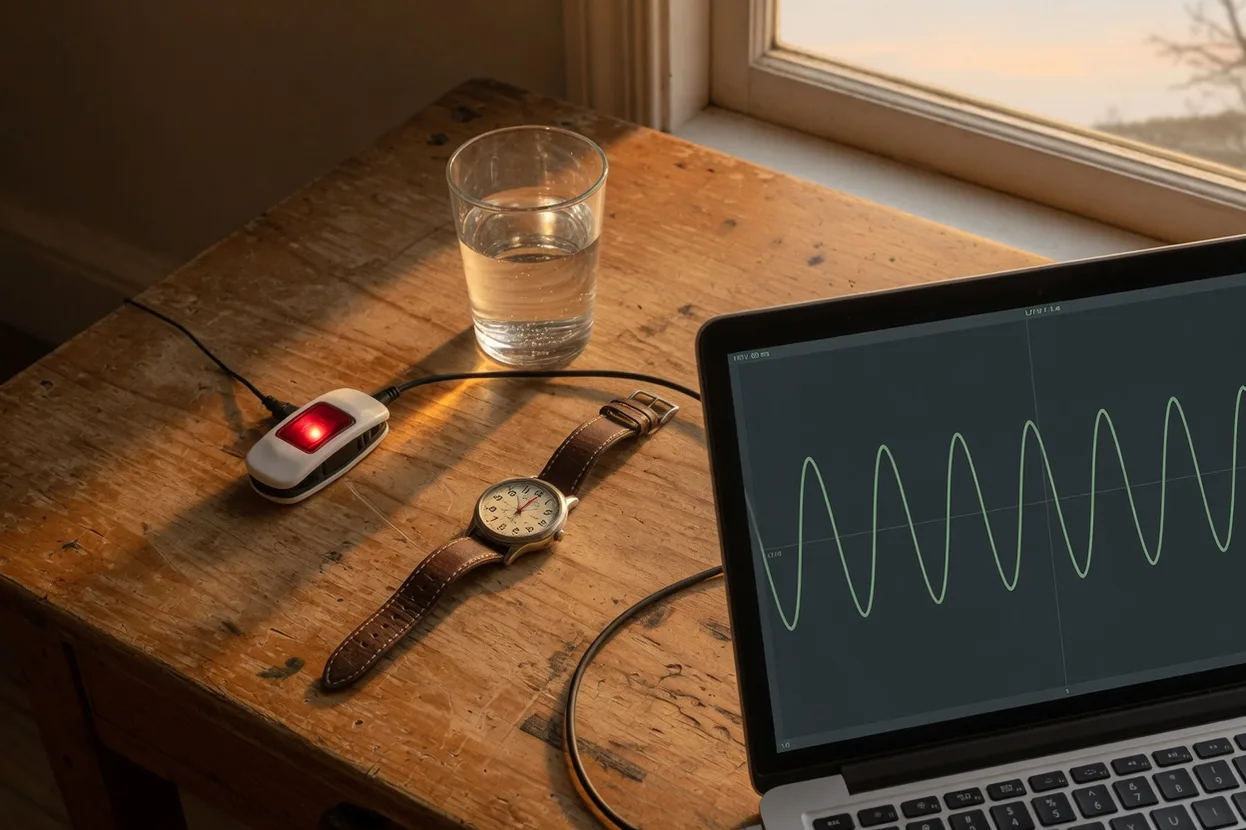
A line wriggles across the screen. Sharp up, deep down, no pattern anywhere. Then, after a minute or so, something shifts: the peaks round off, the valleys soften, and the line starts to wave. Like someone turning a tuner until music comes through instead of static.
That line is a heart rhythm. Straight from a sensor, live on a screen. The wave that emerges is called heart coherence: a measurable pattern, not a relaxation slogan. You can see it. You can train it. And you can read it, often on a device you already own.
Heart coherence training sounds more complicated than it is. I am a certified HeartMath practitioner and have worked with these measurements for years, but my first session was just me at a desk, one sensor and a laptop. What convinced me back then was not the number. It was that the line turned out to be more honest than I was: I felt calm, my heart rhythm did not.
What is heart coherence?
Heart coherence is a measurable state of your heart rhythm in which the heartbeat follows a smooth sine wave, usually at around five to six breaths per minute.
Left alone, your heart rhythm is messy. The gap between two consecutive beats keeps shifting, steered by your breath, your blood pressure regulation and your nervous system. In coherence, all of it falls into the same cadence. Your breathing, your baroreflex (the system that stabilises your blood pressure) and your vagal control start marching in step, and your heart rhythm takes the shape of a wave.
- What is heart coherence?
- Heart coherence is a measurable state of your heart rhythm in which the heartbeat follows a smooth sine wave instead of a jagged line. That wave appears when breath, baroreflex and vagal control fall into the same cadence, usually at around five to six breaths per minute. You read it as a coherence score on an HRV sensor, app or watch.
- What is heart rate variability (HRV)?
- Heart rate variability is the difference in time between consecutive heartbeats. A flexible nervous system lets those intervals move with breath and recovery. Heart coherence is not the same as a high HRV score: it is the pattern of that variation, the sine shape, not just the average.
Think of tuning a musical instrument. One string can vibrate hard without making music. Only when the strings are tuned to each other does it start to sound right. Your heartbeat works the same way: plenty of variation is not automatically coherence. It is the ordering that counts.
HRV and coherence are not the same thing
Heart rate variability is the difference in time between consecutive heartbeats, and that variation says something about how flexibly your nervous system shifts between effort and recovery.
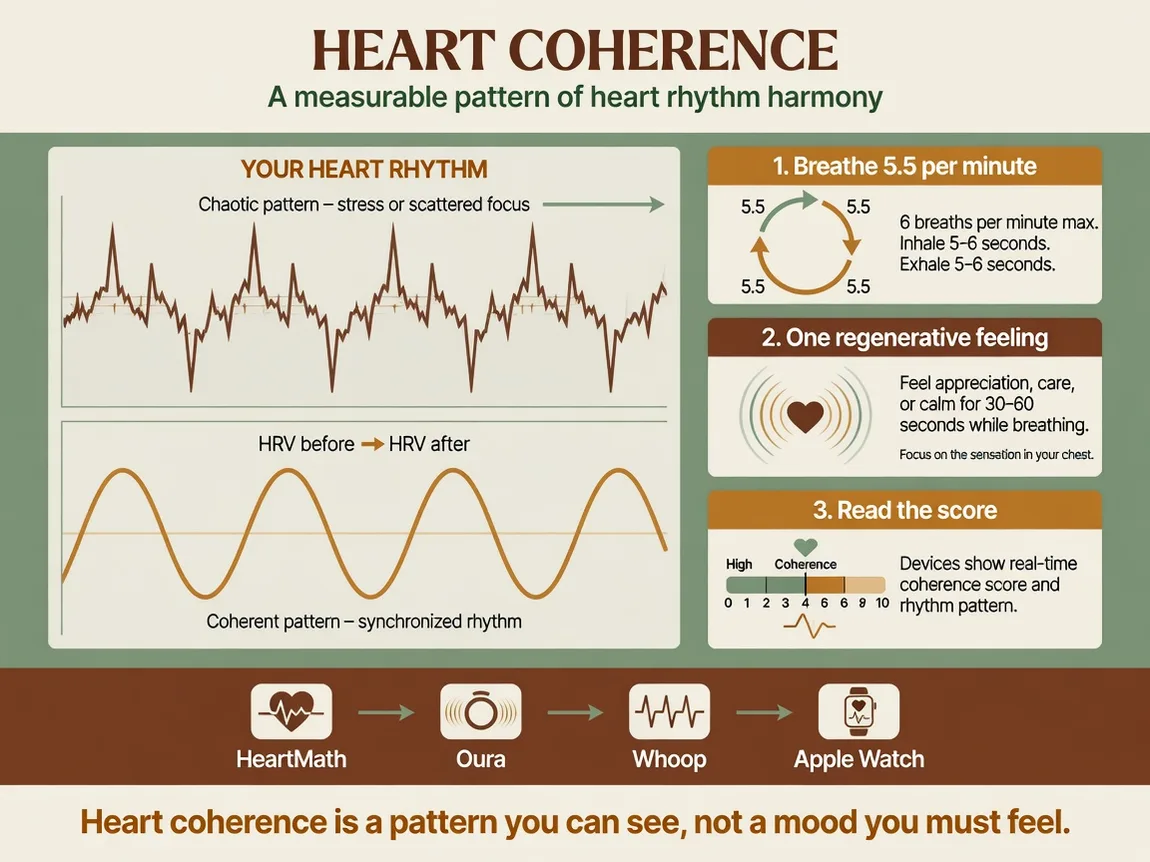
The distinction matters, because many people stare at their HRV number as if it were a report card. A high HRV means your beat-to-beat intervals keep changing, and that is healthy. But a high HRV can look like a jagged mountain ridge: lots of movement, little order. Coherence is the opposite picture. The intervals still vary, but they follow one steady wave.
You can have a perfectly fine HRV without being coherent. And the reverse is true too. That is why we look at the shape, not just the average. The vagal brake that slows your heartbeat on the exhale is the driving force here. If you want to understand how that nerve works, read our piece on what the vagus nerve actually does.
For the bigger picture of what breath does to your nervous system, without any gadgets involved, the fundamentals are explained on the breathwork guide page.
How do you measure heart coherence (and what are you actually measuring?)
A coherence score is a number that shows how strongly your heart rhythm resembles a sine wave, calculated from the shape of your heart rate variability.
I did my first real measurement at my own desk. Sensor on the chest, app open, breathing the way I always breathe. The line was chaotic. I had just finished lunch, felt relaxed and expected a tidy graph. The screen said otherwise. That stung a little, and it is exactly why I made this my work: you can lie to yourself, your heart rhythm cannot.
When I slowed my breathing for a few minutes, around five and a half breaths per minute, the line tilted. The peaks rounded. A score appeared. Not because I was trying hard, but because the wave locked in. Like a tuner finally finding a station.
Then the devices, because not everything that claims to measure HRV also measures coherence. The honest overview:
| Device | What it measures | True coherence score? |
|---|---|---|
| HeartMath Inner Balance | Live HRV via chest or earlobe sensor, with direct feedback | Yes, that is exactly what the score shows |
| Oura ring | HRV trend, mostly overnight | No, but a useful recovery trend |
| Whoop | HRV and recovery score | No, trend over days |
| Apple Watch | Estimate of HRV and breath rate | No, no sine-wave analysis |
That honesty matters, because an analysis of almost 1.8 million Inner Balance sessions shows that coherence is a real, measurable pattern. Most people land on a frequency around five to six breaths per minute, and the score rises with feelings like appreciation and drops with anger and anxiety. One caveat: it is observational research, one of the authors is affiliated with HeartMath, and the score from their app is not the same as the HRV number on your ring or watch.
So use your watch or ring as a diary of your recovery, not as a coherence meter. Compare days with each other, at the same time of day, and do not fixate on a single spike.
Heart coherence training in five minutes
Training works because you show the wave where to go: breath sets the tempo, feeling sets the depth. The protocol I use myself and with clients takes five minutes.
Step 1: look at your starting image (60 seconds). Switch on the sensor or app and breathe the way you always breathe. The line is jagged. Jagged is normal: it is the zero point you will later compare the wave against.
Step 2: breathe toward your heart (3 minutes). Put your attention on your sternum. Breathe a little slower and deeper, toward five to six breaths per minute: roughly five seconds in, five seconds out. Do not force it. Find a rhythm you can hold without getting dizzy.
Step 3: add a regenerative feeling (90 seconds). Stay in that rhythm and call up one real feeling: appreciation for a person, a place, an animal. Or simply ease. Heart coherence is breath plus pattern, not counting alone. If the feeling feels fake, stay with the breath. A forced smile helps nobody.
Step 4: read the score (60 seconds). Check whether the line gets smoother. On HeartMath a coherence score appears; on a ring or watch you may only see your breath rate or HRV dip. Write down one number. One session proves nothing; the pattern over days does.
Research shows that heart-focused breathing measurably shifts your HRV and your cardiorespiratory coherence within a single session. A good result, but the participants were young, healthy people. It is not a trial in panic complaints and no proof that a watch measures the same thing.
Pro-tip: Start without counting. With the free breathing timer you practice at 5.5 breaths per minute while all you have to do is follow along. The rhythm settles in within two minutes, even without a sensor.
Repeat this for five minutes a day, preferably at a fixed moment. People who start with a high resting HRV often see the sine wave appear sooner. People who start lower need more repetition, not more force. You do not force the wave; you tune it.
If you find it hard to practice alone, or want to know where your line actually sits? In breathwork coaching I train heart coherence one-to-one: sixty minutes, sixty euros, with live biofeedback so you see the wave tilt yourself.
Want to compare more breathing techniques? Our overview of five breathing exercises against stress helps you choose. And in box breathing versus 4-7-8 versus Wim Hof we explain why slow coherence breathing serves a different purpose than those techniques.
What the studies do not prove
Now the other direction, because this topic deserves honesty. A randomised study with 55 students with anxiety complaints showed that ten sessions of HRV biofeedback raised resting vagal HRV more than an active control exercise. But at group level the anxiety questionnaires and EEG brain activity did not change along with it. And participants who started with high resting HRV reached more coherence than those who started low.
In plain language: training builds something in your physiology, reliable and measurable. It is just no guarantee that everyone will feel less anxious, and it does not replace treatment for real complaints. The big session database above is observational: associations, not cause and effect. And as with any training, the gains flatten out over time; after that it is about maintenance, not scoring higher.
With ongoing panic or heart symptoms the order is simple: see a doctor first, practice afterwards. Breathwork often helps in that phase, but as support. For acute moments we previously wrote about three breathing exercises that help immediately during a panic attack.
Key takeaways
- Heart coherence is a pattern, not a feeling. Your heart rhythm follows a smooth sine wave once breath, baroreflex and vagal control fall into the same cadence, usually at around five to six breaths per minute.
- A high HRV is not yet coherence. HRV measures how much your beat intervals vary; coherence measures how ordered that variation is.
- Not every device measures the same thing. HeartMath gives a true coherence score. Oura, Whoop and Apple Watch show HRV trends, not sine-wave analysis.
- Five minutes a day is enough to start. Heart-focused breathing around 5.5 per minute plus one real feeling. You tune the wave, you do not force it.
- Studies show a build-up of vagal HRV, not automatic anxiety relief. Treat the measurement as a gauge, not a promise.
That first jagged line at my desk never went away. It returns every session, and every time it takes a moment before the wave locks in. That is exactly the point. The line on the screen is not a report card; it is a tuner for your nervous system. Sometimes you hear music right away. Sometimes you just keep turning.
Not sure whether measuring suits you, or want to try it without a gadget first? Book a free intro call of thirty minutes. We will look together at where your line sits, and whether practicing on your own is enough or guidance works faster. 🌿