Your heart is pounding, your breath is racing, your hands are tingling and there is that sudden conviction: I am going to die or I am losing control.
This is a panic attack. Not "just stress". Not "overthinking". An acute physical storm that takes over your entire system within seconds. Here are exactly three breathing exercises you can do in that moment. No menu of five or seven options. Three clear tools that work directly on hyperventilation, CO2 balance and your vagus nerve.
- What is a panic attack?
- A panic attack is a sudden wave of intense fear with physical alarm signs: rapid heartbeat, hyperventilation, sweating, tingling or the feeling of losing control. It is not weakness. It is a nervous system switching on fight-or-flight without a visible danger.
A panic attack is that wave. Not a character flaw. A body sounding an alarm with no danger in the room.
- What is hyperventilation in panic?
- Hyperventilation in panic is breathing too fast or too deep, so you exhale too much CO2. That low CO2 gives dizziness, tingling and breathlessness, which feeds the panic. A longer, soft exhale restores that balance.
What exactly happens in your body during a panic attack
During a panic attack your sympathetic nervous system shifts into top gear. Your breathing becomes fast and shallow (hyperventilation). As a result the carbon dioxide (CO2) in your blood drops. Low CO2 causes blood vessels in the brain to constrict, leading to tingling, dizziness and the feeling that you are about to faint or suffocate. At the same time the vagus nerve, your main "rest-and-digest" nerve, stays suppressed. The result is a self-reinforcing loop: fast breathing, lower CO2, more panic symptoms, then even faster breathing.
The three exercises below break that loop in three different ways. The first slows and lengthens the exhale. The second specifically restores CO2 balance. The third brings your breath into resonance with your heart-rate variability. They were chosen because they are simple, require no tools and produce noticeable effects within 60 to 180 seconds.
Pro-tip: Practice these three exercises once a day when you are calm. That way they become automatically available when panic strikes. Your nervous system learns to switch faster.
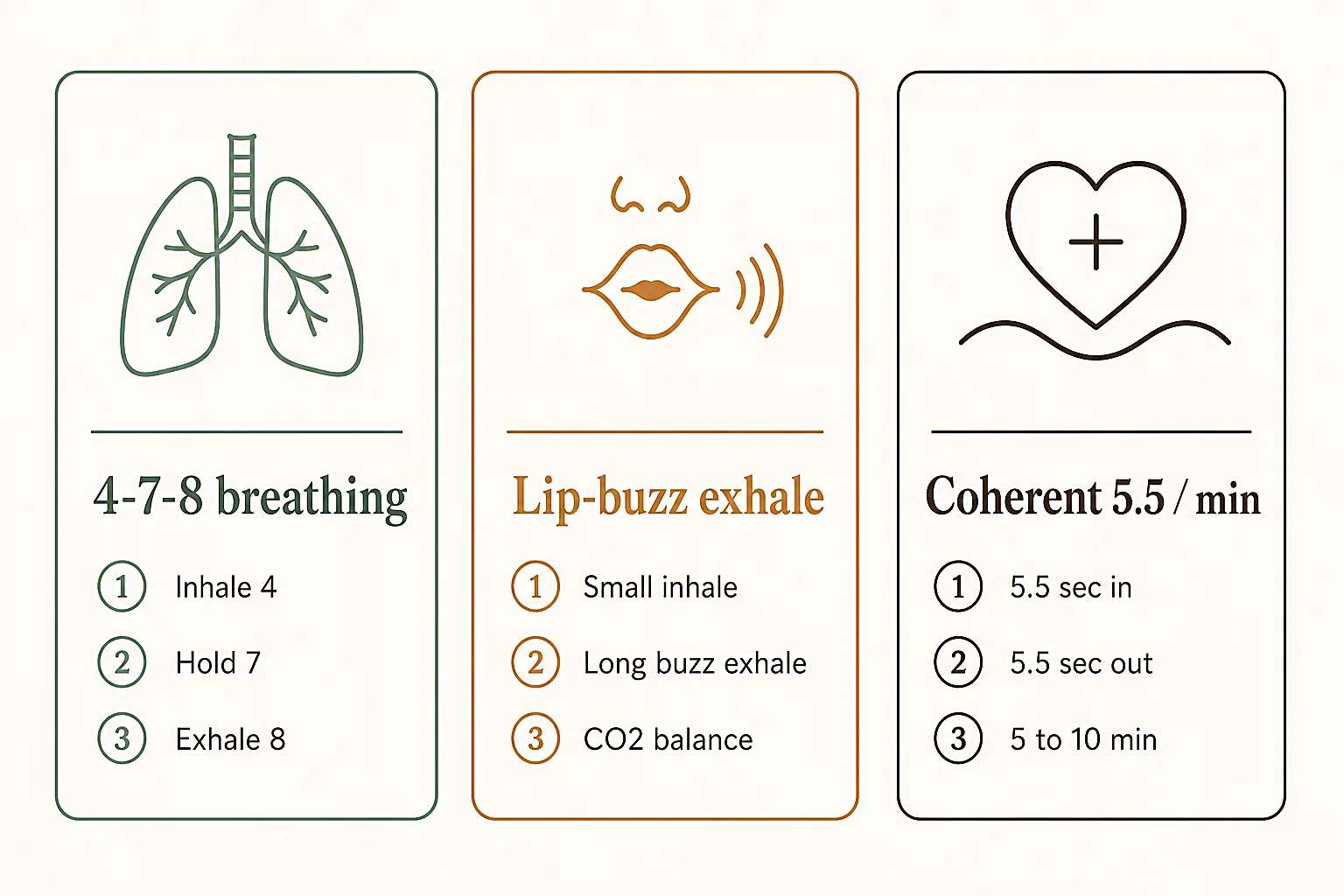
Exercise 1: 4-7-8 breathing for acute calming
The 4-7-8 technique was popularised by Dr. Andrew Weil and works through a longer exhale that directly stimulates the vagus nerve. During panic this is often the fastest way to bring the heart rate down.
Steps:
- Sit or stand. Feet on the ground. Tongue lightly against the palate, behind the upper front teeth.
- First exhale fully through your mouth with a soft "whoosh" sound.
- Close your mouth and inhale through your nose while silently counting to 4.
- Hold your breath while counting to 7.
- Exhale through your mouth while counting to 8, again with a soft whoosh sound.
- Repeat 4 rounds. Stop earlier if the hold drives the panic up.
What you feel: after the second or third round the heart rate often drops noticeably. Tingling in hands or lips lessens. The urge to "escape" becomes less urgent. Focusing on the counts also pulls you out of catastrophic thoughts.
When to use: in the middle of the attack, when you can still count. If counting feels too hard, move straight to exercise 2.
Pro-tip: Do a maximum of four cycles of 4-7-8 in a row during acute panic. More can cause dizziness at first. Later you can build up to eight cycles when practising preventively.
Scientifically the longer exhale activates the parasympathetic branch of your nervous system. Research from the Salk Institute in 2024 showed that voluntary slowing of breathing via a specific brain circuit reduces anxiety and negative emotions. That is exactly what happens here. You can read it in the Nature Neuroscience study on slow breathing and affect. It is a mouse study. It explains the circuit. It is not a human panic trial.
Exercise 2: Lip-buzz or pursed-lip exhalation for CO2 regulation
In hyperventilation the core issue is the CO2 deficit. This exercise forces a slow, controlled exhalation so that CO2 levels rise again. The "buzz" or "pursed-lip" effect creates mild resistance and additionally activates vagal receptors in the throat.
Steps:
- Inhale calmly through your nose, small, not deep. Let your belly move with it.
- Purse your lips as if you want to blow out a candle or make a soft "mmm" or "zzz" sound.
- Exhale slowly through the pursed lips for at least 6 to 8 seconds. Keep the sound soft and steady.
- Let the next inhale come by itself. Do not force anything.
- 8 to 12 breaths, or until the tingling and the "I cannot breathe" sensation decrease. Skip counting if counting is too much. Only: small in, long out.
What you feel: the resistance on the exhale prevents you from losing too much air. CO2 rises, blood vessels in the brain widen again, dizziness and tingling decrease. Many people notice within 60 seconds that the "panic wave" becomes less high.
When to use: as soon as you notice that your breath is too fast and too high in the chest, or when 4-7-8 feels too complex. This is the most direct CO2 tool.
A 2025 systematic review and meta-analysis confirmed that breathing training in panic disorder significantly raises partial carbon dioxide levels and lowers respiratory rate. Panic Disorder Severity Scale scores dropped with it. This is the mechanism the lip-buzz activates. It supports the CO2 path, not one named exercise.
Exercise 3: Coherent breathing at 5.5 breaths per minute
Coherent or resonance breathing brings your breath into the rhythm at which your heart-rate variability (HRV) is maximal. That is usually around 5 to 6 breaths per minute. During panic this is the exercise that brings your nervous system back into balance after the acute peak has been broken, or as preventive training.
Steps:
- Sit comfortably with a straight but relaxed back.
- Inhale through your nose for 5 to 5.5 seconds. Let your belly expand gently.
- Exhale through your nose or mouth for 5 to 5.5 seconds. No pause needed, flowing.
- Keep this rhythm for 5 to 10 minutes. Use a timer or count silently.
- If 5.5 seconds feels too long, start with 4 seconds in and 6 seconds out.
What you feel: after 2 to 3 minutes general alertness drops. The breath becomes deeper without forcing. Space appears in the chest. Mental noise decreases. This is the exercise that restores your "baseline" calm.
When to use: after the acute phase (when 4-7-8 or lip-buzz has broken the peak), or daily for 5 to 10 minutes as training. Also ideal when you feel panic rising but it is not yet full-blown.
Research on coherent breathing around 5.5 breaths per minute consistently shows that it maximises heart-rate variability and supports autonomic regulation. In a global observation of 1.8 million sessions 0.10 Hz showed up most often, about six breaths per minute. 5.5 sits in that resonance band. Observation, not a panic trial. Still one of the best-studied breathing rhythms for anxiety regulation.
Why the exhale is the key
In panic the exhale is the most important part of the breath. During the exhale the vagus nerve fires more strongly. Heart rate slows, muscles let go and the brain gets the signal that there is no acute threat. That is why all three exercises lean on a longer or controlled exhale. The inhale may stay short and quiet. The exhale may be longer and more deliberate. This is not a theoretical tip. It is a physiological mechanism you can use in seconds.
Hyperventilation is, in essence, exhaling too much in too little time. By slowing and lengthening the exhale you restore the CO2 level without having to "stop breathing". That is safer and more effective than the old paper-bag method, which can raise panic in some people.
How to combine the three exercises in practice
During an acute panic attack start with exercise 1 or 2. Choose whatever feels easiest in the moment. Once intensity has dropped by 30 to 50 percent, switch to exercise 3 to let the rest of the wave subside and stabilise your system.
For partners or friends who are present: do not talk too much. Say calmly: "I am breathing with you. Follow my count." And do the lip-buzz or 4-7-8 softly out loud yourself. Co-regulation through breath works faster than reassuring words.
| Exercise | Primary action | Best moment | Duration acute phase |
|---|---|---|---|
| 4-7-8 | Vagus activation via long exhale | Middle of the attack | 3-4 cycles (±1-2 min) |
| Lip-buzz / pursed lip | CO2 restoration | When hyperventilation symptoms appear | 5-10 breaths (±1-2 min) |
| Coherent 5.5/min | HRV and autonomic balance | After the peak or preventively | 5-10 minutes |
When breathing alone is not enough
These three exercises are powerful acute tools. They are not a replacement for therapy or medical guidance in the case of frequent or severe panic attacks. If panic occurs more than once a week, or if you develop agoraphobia, one-to-one support is useful. At Spiriators we work in breathwork coaching precisely with people who feel panic and anxiety in their body. We combine connected breathing with regulation techniques so that you can not only calm in the moment but also lower the underlying sensitivity.
Yin yoga can be a strong complement. Tessa Frunt holds that part: slow postures with attention to the breath, no flexibility test. They calm the same system. Read more about how yin yoga resets your nervous system, or look at the related articles on 5 breathing exercises for stress, vagus nerve exercises and yin yoga for stress.
For those who want to go deeper: a retreat or travelling with us gives the space to integrate these tools in a safe environment. More info via travel.
Key takeaways
- A panic attack is an acute hyperventilation loop: fast breathing, low CO2, more panic symptoms.
- Three exercises without a menu: 4-7-8 (vagus), lip-buzz (CO2), coherent 5.5/min (HRV).
- During acute panic start with 4-7-8 or lip-buzz. Switch to coherent once the peak drops.
- Practice daily for 5-10 minutes so the tools become automatically available.
- Breathing is an acute tool, not a replacement for professional help with frequent attacks.
- Partners can co-regulate by breathing along instead of talking.
What comes next
You do not have to "win" against the panic. You only need to take your breath back, one cycle at a time. That is enough to let the wave subside.
Practice the rhythm while you are still calm, with the breathing timer. Want to know how your breath is now? Do the breath check. For recurring panic we look, in a one-to-one breath session, at how your nervous system switches, sixty minutes, €60. After the peak, yin yoga helps the system stay in rest longer. And if you only want to test whether this fits? Send a message.