
You've done it: taken a deep breath because your heart was pounding, and had no idea whether to choose box breathing, 4-7-8, or the Wim Hof method.
Comparing breathwork techniques feels like standing in a restaurant with three menus that all look delicious — but you don't know which one will actually satisfy your hunger. Box breathing, 4-7-8, Wim Hof: all three promise calm, power, recovery. But they work fundamentally differently on your nervous system. One calms, another activates, the third balances. And if you pick the wrong one at the wrong moment, you won't feel better — you'll feel worse.
In this blog, I'm putting the three most popular breathing techniques side by side. No hype, no dogma — just an honest comparison based on recent peer-reviewed studies, my own experience as a breathwork coach, and one simple question: which one fits you, right now?
Why breathing techniques are not the same
We call them all "breathing exercises" as if they're one category. That's like lumping yoga and crossfit under "movement" — technically true, practically misleading. Each breathing technique activates a different part of your autonomic nervous system.
Your nervous system has two main modes: the sympathetic system (gas pedal — fight, flight, action) and the parasympathetic system (brake pedal — rest, recovery, safety). The art of breathwork isn't "breathing calmly." It's using the right pedal at the right moment.
Box breathing balances. It brings your nervous system to a neutral, focused state — not too active, not too passive. Perfect for moments when you need to stay sharp under pressure.
The 4-7-8 technique slams the brake. The long exhale (8 seconds) stimulates the vagus nerve and shifts your nervous system fully into parasympathetic mode. Ideal when you need to sleep, or when anxiety has your body in a chokehold.
The Wim Hof method does the opposite: it floors the gas pedal. Rapid hyperventilation, deliberate stress response, cold shock. Not to calm you — but to train your nervous system to handle stress, so that stress outside your control has less power over you.
Three techniques, three goals, three effects on your body. Let's look at each one.
Box Breathing: the Navy SEAL protocol for focus under pressure
- Box breathing
- Box breathing (square breathing) is a pattern of 4 seconds in, 4 hold, 4 out, 4 hold. It balances your nervous system into a neutral, focused state — ideal when you need to stay sharp under pressure, as Navy SEALs use it.
Box breathing — also called square breathing — is the protocol Navy SEALs use to stay calm in life-threatening situations. The pattern is simple: 4 seconds in, 4 seconds hold, 4 seconds out, 4 seconds hold. An equal-sided square. No phase longer than any other.
This isn't accidental. Equal phases mean your nervous system gets no signal to either floor it or let go completely. It balances sympathetic and parasympathetic activity. You stay alert, but not wired. Calm, but not drowsy.
I use box breathing myself before presentations, difficult conversations, and moments when I need to think clearly while my body would rather fight or flee. Five minutes is often enough to go from chaos to clarity.
A study by Kasap and Aydin (2025) compared box breathing with slow breathing at 6 breaths per minute in athletes after intense training. The finding was striking: box breathing increased heart rate significantly more than the 6-bpm technique — which makes sense, because box breathing imposes more physiological stress through the retention phases. But that doesn't mean box breathing is worse. It means box breathing is a training tool, not a relaxation technique. You use it to keep functioning under pressure, not to chill out. Kasap & Aydin (2025)
When box breathing works
- Before a presentation, meeting, or difficult conversation
- During acute stress when you need to keep functioning (not hide)
- When you need focus, not sleep
- While working under time pressure
How to do it
Inhale for 4 seconds through your nose. Hold for 4 seconds. Exhale for 4 seconds through your mouth. Hold for 4 seconds. Repeat for 5-10 minutes. Start with 4 cycles and build up to 8-10.
Pro tip: if 4 seconds feels too long, start with 3-3-3-3. The rhythm matters more than the duration. You can always increase later.
Practice along: open the free box breathing timer — 4-4-4-4 pre-selected, visual circle, round counter and voice cues. Works offline, no account needed.
4-7-8: the sleep and anxiety regulator from Andrew Weil
- 4-7-8 breathing
- The 4-7-8 technique (Andrew Weil) means 4 seconds in, 7 hold, 8 out. The long exhale stimulates the vagus nerve and pushes your nervous system toward parasympathetic — especially useful for insomnia and rising anxiety.
If box breathing is the technique for "I need to stay sharp," then 4-7-8 is the technique for "I need to let go." Developed by Dr. Andrew Weil, based on the yogic pranayama tradition, with one clear purpose: push your nervous system firmly toward parasympathetic.
The pattern: 4 seconds in, 7 seconds hold, 8 seconds out. The exhale is twice as long as the inhale. That's deliberate: long exhales activate the vagus nerve, the main highway of your parasympathetic system. The longer you exhale, the more your body receives the signal: "we're safe, we can relax."
I recommend 4-7-8 to anyone who lies in bed at night with a mind that won't shut off. Or to people who feel an anxiety attack coming on — the extended exhale is like a brake on a train that's going too fast. It doesn't stop it immediately, but it does slow it down.
Research backs this up. Buxton et al. (2024) investigated the effect of 4-7-8 breathing between sets during barbell squats. Result: the 4-7-8 group recovered significantly faster from elevated heart rate without losing power output. The study demonstrates what athletes and breathwork coaches already know: 4-7-8 isn't just a relaxation technique, it's a recovery technique. Buxton et al. (2024)
Even more compelling: Eskimez et al. (2026) showed that 4-7-8 breathing produced significant pain reduction in patients after knee replacement surgery. Pain and anxiety share the same nervous system circuit. If 4-7-8 can reduce postoperative pain, imagine what it can do for the chronic, low-grade pain of everyday stress and tension. Eskimez et al. (2026)
When 4-7-8 works
- Before sleep — 4-6 cycles in bed
- During acute anxiety or panic
- After intense exertion (recovery)
- For chronic pain (as a complementary technique)
- When your body is "fighting" but there's no real threat
How to do it
Inhale for 4 seconds through your nose. Hold for 7 seconds. Exhale for 8 seconds through your mouth, with an audible sigh if that helps. Repeat for 4-6 cycles. Do this lying down, sitting, or standing — but not while driving.
Important: start with 4 cycles. More is not better. Your body needs to adapt to the increased carbon dioxide from the long holds. After a week, you can build up to 6-8 cycles.
Practice along: open the free 4-7-8 breathing timer — rhythm pre-selected, visual circle keeps the counts so you can fully let go.
For more techniques to calm your nervous system, read our breathwork guide or try the Breath Check to discover which technique fits your stress profile.
Wim Hof Method: deliberately jumping into stress
- Wim Hof method
- The Wim Hof method combines rapid hyperventilation, breath holds and cold exposure to deliberately activate your sympathetic nervous system. The goal is not relaxation but stress resilience: learning to stay calm while intentionally seeking stress.
And then there's Wim Hof. The Iceman. The man who broke 26 world records, including a nearly 2-hour ice bath and a half marathon on the Arctic Circle barefoot. His method is controversial, fascinating, and — when done correctly — remarkably effective.
The protocol: 30-40 rapid deep breaths (hyperventilation), followed by breath retention (holding your breath after an exhale, 1-1.5 minutes), then a deep inhale and hold for 15 seconds. Repeat 3-4 rounds. Often followed by a cold shower or ice bath.
What happens here is the opposite of calm. You're deliberately activating your sympathetic nervous system. Adrenaline rises. Heart rate goes up. Your body thinks: "we're fighting." And then — in that state of intentional stress — you learn to stay calm. That's the core of the Wim Hof method: not relaxation, but stress resilience. You train your nervous system to handle stress by seeking it out on purpose.
A systematic review by Almahayni and Hammond (2024) analyzed 9 studies following PRISMA guidelines and concluded that the Wim Hof method can reduce inflammatory markers via increased epinephrine and interleukin-10, and lower subjective stress and anxiety. The evidence base is moderate — more large-scale RCTs are needed — but the physiological mechanisms are consistent: deliberate sympathetic activation followed by anti-inflammatory rebound. Almahayni & Hammond (2024)
When Wim Hof works
- In the morning, when you want energy — never right before bed
- 2-3 times per week, not daily
- For immune modulation and inflammation reduction
- When you want to train stress resilience (not when you're already burnt out)
- In combination with cold exposure (shower, bath)
Important warnings
The Wim Hof method is powerful. That also means: not without risk. Never in water (drowning risk from hypoxia). Never while driving. Not with heart or lung conditions without medical guidance. Not if you're already in sympathetic overdrive (burnout, acute anxiety) — you can't floor the gas pedal on an engine that's already in the red zone.
Always start with guidance. A breathwork coach can help you learn the technique safely and determine whether your body is ready for it.
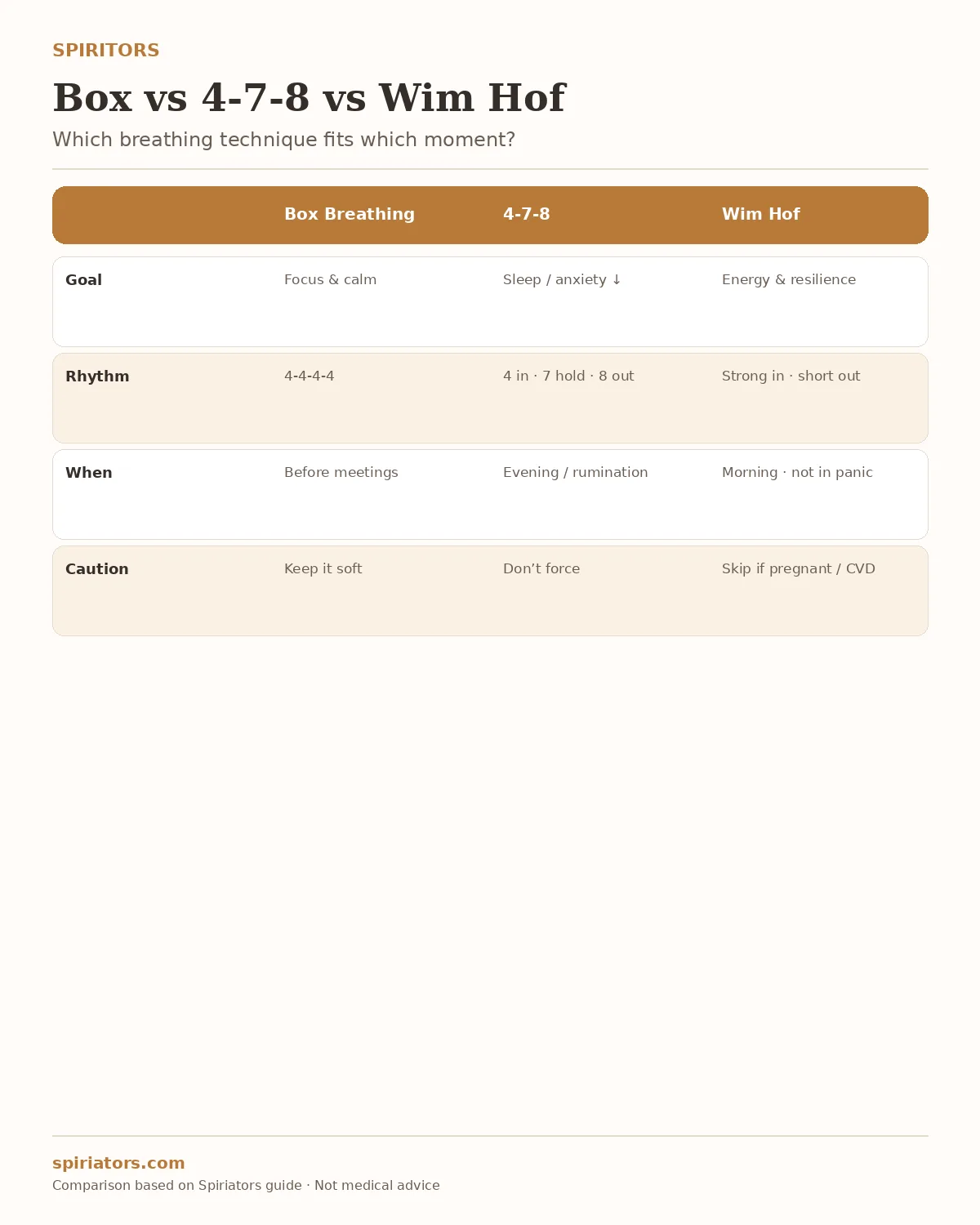
The comparison: which technique for which moment?
Let's make it clear. Three techniques, three goals, three moments:
Box Breathing — Focus under pressure
Goal: Balance the nervous system. Stay alert, not overwhelmed.
Mechanism: Sympathetic and parasympathetic in equilibrium.
Best moment: During the day, before presentations, during stress when you need to perform.
Duration: 5-10 minutes.
Evidence: Good — military protocol, recent HRV research (Kasap 2025).
4-7-8 — Let go and recover
Goal: Deep parasympathetic activation. Release, sleep, recover.
Mechanism: Strong vagal stimulation through extended exhale.
Best moment: Evening, before sleep, during acute anxiety, after exertion.
Duration: 4-6 cycles (3-5 minutes).
Evidence: Strong — HRV recovery, pain reduction, sleep quality (Buxton 2024, Eskimez 2026).
Wim Hof — Train stress resilience
Goal: Deliberate stress response training. Immune modulation. Adrenaline control.
Mechanism: Sympathetic overdrive followed by anti-inflammatory rebound.
Best moment: Morning, 2-3x per week, never right before bed.
Duration: 15-20 minutes (including cold exposure).
Evidence: Moderate — consistent mechanism, more large RCTs needed (Almahayni 2024).
Can you combine them?
Yes — and that's probably smarter than picking one and using it for everything. Your nervous system shifts throughout the day. Morning needs are different from evening needs. After a workout, your body is different than after a conflict with your partner.
A practical combination I recommend to people in my breathwork coaching:
- Morning: 5 minutes box breathing — bring your nervous system into balance, start the day focused.
- Evening: 4-6 cycles 4-7-8 — shift to parasympathetic, prepare for sleep.
- 2-3x per week: Wim Hof + cold shower — train stress resilience, boost your immune system.
The key isn't which technique is "the best." The key is: which one fits this moment? You can't solve every situation with the same breath. That's like using the same key for every door in your house — sometimes it fits, often it doesn't.
For a deeper guide on how breathwork affects your nervous system, read our blog on connected breathing and the nervous system.
The six-bpm baseline: why 5-5 breathing is the universal option
There's a fourth option that often gets overlooked: simply breathing slowly at about 6 breaths per minute. 5 seconds in, 5 seconds out. No holding, no retention, no hyperventilation.
This breathing rate — around 0.1 Hz — maximizes your heart rate variability (HRV) and baroreflex sensitivity. It's the "sweet spot" where your heart and nervous system communicate most efficiently. Like the resonance point on a guitar: exactly the right spot where all the strings ring together.
This technique is ideal when you don't know which of the three to choose. It's safe, it always works, and it demands nothing from your body that it can't handle. Start here as a beginner. Build up to box breathing, 4-7-8, or Wim Hof once you've mastered the basics.
Five minutes of 5-5 breathing per day — that's all you need to reset your nervous system. Use the free coherent breathing timer to follow along visually. Want more exercises? Our blog on 5 breathing exercises against stress gives you a wide range of techniques for different situations.
What your nervous system needs (that the techniques won't tell you)
Here's something most comparisons won't say: the best breathing technique is the one your nervous system needs right now. Not the one that's most popular on Instagram. Not the one Wim Hof does. Not the one your neighbor recommends.
Your nervous system is unique. Your stress profile is unique. Your life stage is unique. The technique that worked yesterday might not work today — because today you're standing differently, feeling differently, breathing differently.
That's exactly why I don't recommend one technique to people, but a personal breathwork journey. In a 1-on-1 session, we look together at what your body needs right now. Not what a protocol says. Not what an app suggests. But what your breath, your heart rate, your nervous system tells you.
Breathwork isn't one-size-fits-all. It's a conversation with your body. And just like any conversation, it changes. That's not weakness — that's intelligence.
If this resonates and you want to discover which breathing technique truly fits you, book a free trial session. No obligations, no hard sell — just a conversation about your breath.
Practical starter guide: begin today
Enough theory. Here's your starter guide, based on what you need today:
Day 1-7: Build the foundation
Start with 5 minutes of 5-5 breathing (6 bpm), every morning after waking up. This teaches your nervous system what slow breathing feels like. No retention, no hyperventilation. Just slow, even, consistent.
Day 8-14: Choose your path
After a week of basics, you have enough body awareness to choose:
- Often feel tense, alert, "on"? → Box breathing (5-10 min, during the day)
- Sleepless, anxious, "on" but exhausted? → 4-7-8 (4-6 cycles, evening)
- Energy seeker, want challenge, want to push boundaries? → Wim Hof (3 rounds, 2-3x per week, morning)
Day 15+: Combine
After two weeks, start combining. Morning box breathing, evening 4-7-8, and 2x per week a Wim Hof session. Listen to your body. If a technique doesn't feel right, switch. If you want to learn more about the science behind yin yoga and breathwork, read our blog on yin yoga, breathwork and science.
And remember: breathwork is a practice, not a performance. The goal isn't to do it "right." The goal is to listen to what your body tells you. That whisper — it's been there all along. You just need to hear it.