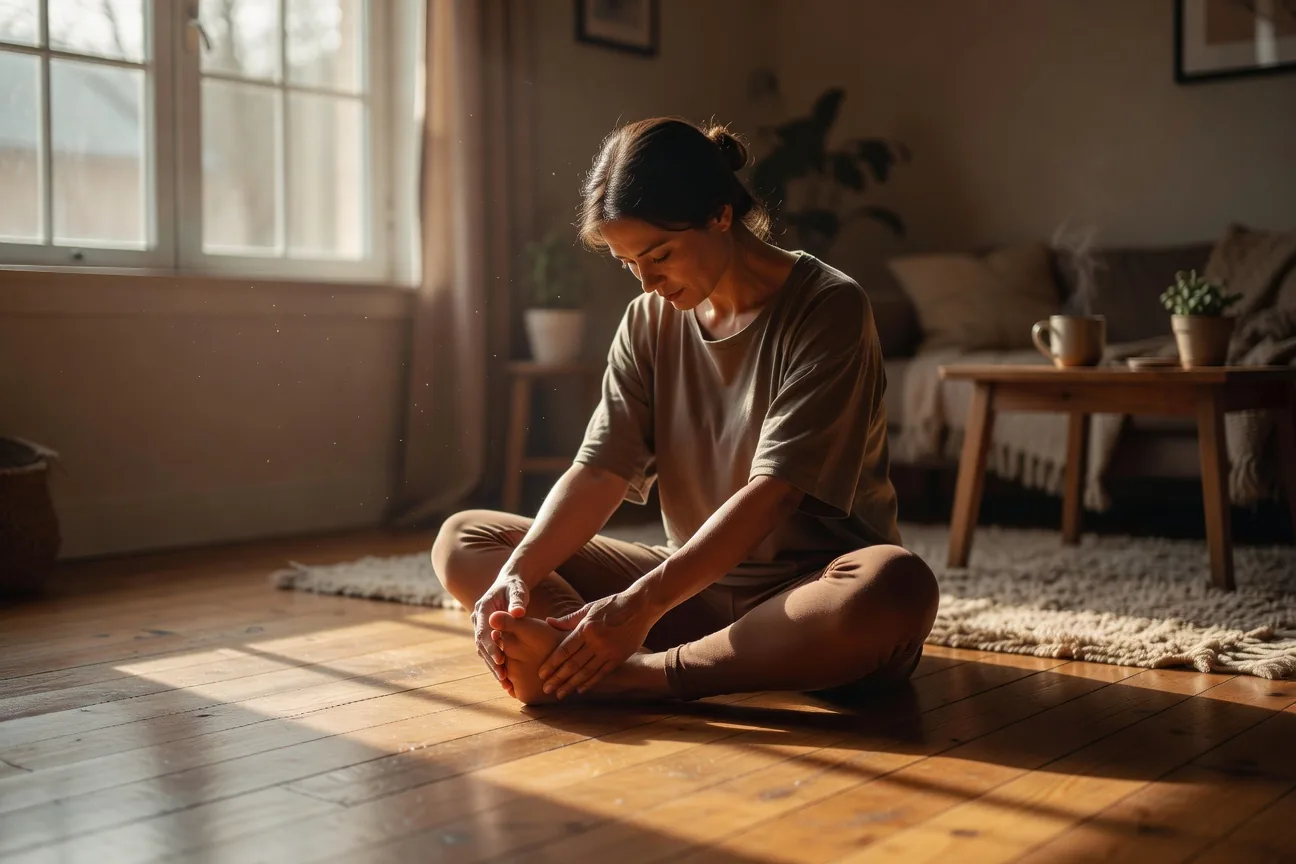
Living in the now — three words repeated so often they have almost lost their weight. Yet we keep returning to them. Not because it's a trend, but because it is the only place where life actually unfolds. This is an invitation to look beyond the cliché — toward the temporary body, the breath that arrives and leaves, and the silent intelligence that waits the moment you stop grasping.
Why we so rarely inhabit the now
- Default Mode Network (DMN)
- The Default Mode Network is the brain network that switches on when we are not doing anything specific: self-reference, memory and worry about the future. Killingsworth & Gilbert (2010) showed we wander nearly 47% of our waking hours — and that wandering itself makes us less happy.
It's not a character flaw. It's biology. Our brain is a future-machine: calculating, planning, anticipating, comparing. The Default Mode Network (DMN) — the network that switches on whenever we're not doing anything specific — busies itself uninvited with self-reference, memory and worry about what's next.
How often are we truly here? In a large-scale study in Science, Killingsworth and Gilbert (2010) collected iPhone data from 2,250 people at random moments throughout the day. The result: we are mind-wandering 46.9% of our waking hours. Almost half of life is not lived, it is thought. And crucially: the wandering itself causes unhappiness, even when the content of the mind-wandering is pleasant.
"A human mind is a wandering mind, and a wandering mind is an unhappy mind." — Killingsworth & Gilbert, 2010
The temporary body as a gateway
We carry this body around as if it were obvious. One breath. Another. Another. Until one day, the last. That is not a gloomy thought — it is the most clarifying one. The body is a temporary form, a borrowed shape through which life expresses itself. As a wave does not own the ocean, we do not own this body. We are simply present through it for a while.
Awareness of that impermanence does not lead to despair, but to intimacy with this moment. Yaden et al. (2017) reviewed decades of psychological research on what they call self-transcendent experiences: moments in which the small, defined self briefly dissolves — through nature, meditation, breathwork, or an honest contact with mortality. These experiences are consistently linked to greater wellbeing, sense of meaning, compassion and social connection. The ego melts a little, and what remains is connection.
Yin and yang: not choosing, but dancing
Modern culture is soaked in yang: doing, achieving, optimizing, moving forward. Yin is the other half we have collectively forgotten — stillness, receiving, softness, darkness, slowness. Neither is better. Both are necessary. But when yang chronically dominates, the nervous system loses its default state.
Living in the now does not ask for more yang ("I must meditate better!"). It asks for yin: stop grasping, make space, let the body tell what the mind cannot know. Yin yoga is a direct doorway — not because it produces something, but precisely because it demands nothing.
What happens physically when you return
When Brewer et al. (2011) placed experienced meditators and beginners under fMRI, they found something striking: advanced practitioners had significantly lower activity in the Default Mode Network — particularly the medial prefrontal and posterior cingulate cortex — both during meditation and at rest. The self-referential chatter of the brain quieted. And the areas that remained active were those for self-regulation and cognitive control.
A second breakthrough came from Hölzel et al. (2011): after just eight weeks of Mindfulness-Based Stress Reduction, MRI scans revealed measurable increases in gray matter in the hippocampus (memory, emotional regulation) and posterior cingulate (self-awareness, perspective-taking). The brain changes. Not over years — over weeks.
Yin yoga combines that meditative attention with a physical anchor. Gravity does the work. You breathe. For anyone whose mind speeds up the moment they sit in silence, this is often the more accessible way in. See also the science behind yin yoga and breathwork for the deeper grounding.
A reflection — by Tessa
When you truly realize, to the deepest core of your being, that this body is temporary — that your real Home is not here on earth but in an infinite field of energetic consciousness — everything changes. This life is a short, precious little play. In the end, you cannot take anything Home with you. What you own, what you achieve, what you say: it matters less than we think.
Your primary purpose here is to experience. Suffering, fear, sadness — and bliss, love, pure joy. We are here to live yin and yang in all their forms. Just as sound only exists because silence exists, we can only truly know the full richness of life by embracing both sides. Only on earth, in a body with senses, can this full polarity be experienced.
When you realize this deeply, a state arises in which you can experience your soul fully inside your body. You are here and Home at the same time. The veil of thoughts and emotions that separated you from this direct knowing dissolves. The chronic feeling of incompleteness, and the constant "what am I actually supposed to do here?", disappears.
In that realization, only love remains. Love in its purest form — without judgment, without attachment, without conditions. It is no longer "what would love do?" Love simply is. You don't have to do anything. You only have to be.
Never confuse "having an experience" with "doing something". An experience is the direct, vivid contact with what is: the experience of your senses, on a cellular level. The ever-changing stream of sensations, feelings and energy in your body. That is why you can have a far deeper experience on a park bench than during a whole day at an amusement park. At the amusement park it seems like a lot is happening, but you stay mental — the ego wants to "take in the ride", while the constant stimuli make it almost impossible to truly be present.
That is why "doing nothing" is so valuable. Boredom is healing. In that space, feelings in the undercurrent can be felt through and processed — what would otherwise be locked into your connective tissue by constant distraction.
And that is where yin yoga does its work. It brings you out of your head, back into your body. The moment you notice tension and stay with it with full, non-judgmental attention, you acknowledge the stored emotion — Energy in Motion. When that emotion is acknowledged, felt through, and the connective tissue is given time to lengthen, the energy can flow freely again. The old attachment falls away. Triggers no longer hit you in the same way. You can respond from stillness instead of from reactive emotion.
Do yin yoga. Let the tension awaken. Acknowledge the feeling. Let the emotions flow. Be the witness of energy in motion — not the victim who gets carried away by it. ♥️
Three practices for today
1. The 4-6 breath (3 minutes)
Inhale through the nose for four counts. Exhale through the nose for six. A longer exhale activates the vagus nerve and the parasympathetic nervous system. No added technique needed.
2. The threshold pause (10 seconds)
Pause at every threshold you cross today — literally: doorways between rooms. Three breaths. Feel your feet. Only walk through once you know your feet are there. The body catches up with the mind.
3. The evening review without judgment
Before sleep: one moment of today when you were truly there. No "I should have", no plan for tomorrow. Just remembering what it felt like to be present. The brain learns what it repeats.
When "being in the now" doesn't work — and that's okay
Sometimes wandering is a form of protection. A nervous system that has carried too much seeks distraction not from weakness but from wisdom. Forcing yourself to be present only fights yourself harder. Presence blooms in softness, not in force. If you recognize that this moment is too much, then that recognition itself is the now. Not the silence you hoped to reach — the honesty of what is here.
Finally
Living in the now is not an achievement. It's not a technique you can get better at. It is a return — again and again, with a smile at the fact that you only now noticed you were gone. The temporary body asks for no perfection. Only presence. And then, sometimes, what was always there opens of its own accord: love, not as an emotion, but as the fabric everything is made of.
Go deeper: Read our pillar pages on yoga and breathwork, explore yin yoga, or consider a retreat to embody presence.