You open your mouth. The words are ready. But something tightens.
Not in your throat. Not in your chest. Higher. At the crown of your head, as if a door gently closes there. You don't even feel it consciously — until you learn to listen. The crown chakra, Sahasrara, is the quietest of all energy centers. And paradoxically: the most powerful.
Where the first six chakras are about grounding, creating, acting, loving, expressing, and seeing — the crown is about something beyond all effort: surrender. Not giving up. Not losing. But releasing what you thought you had to control. And making space for connection with something greater.
What is the crown chakra and why does your brain resist?
- What is the crown chakra (sahasrara)?
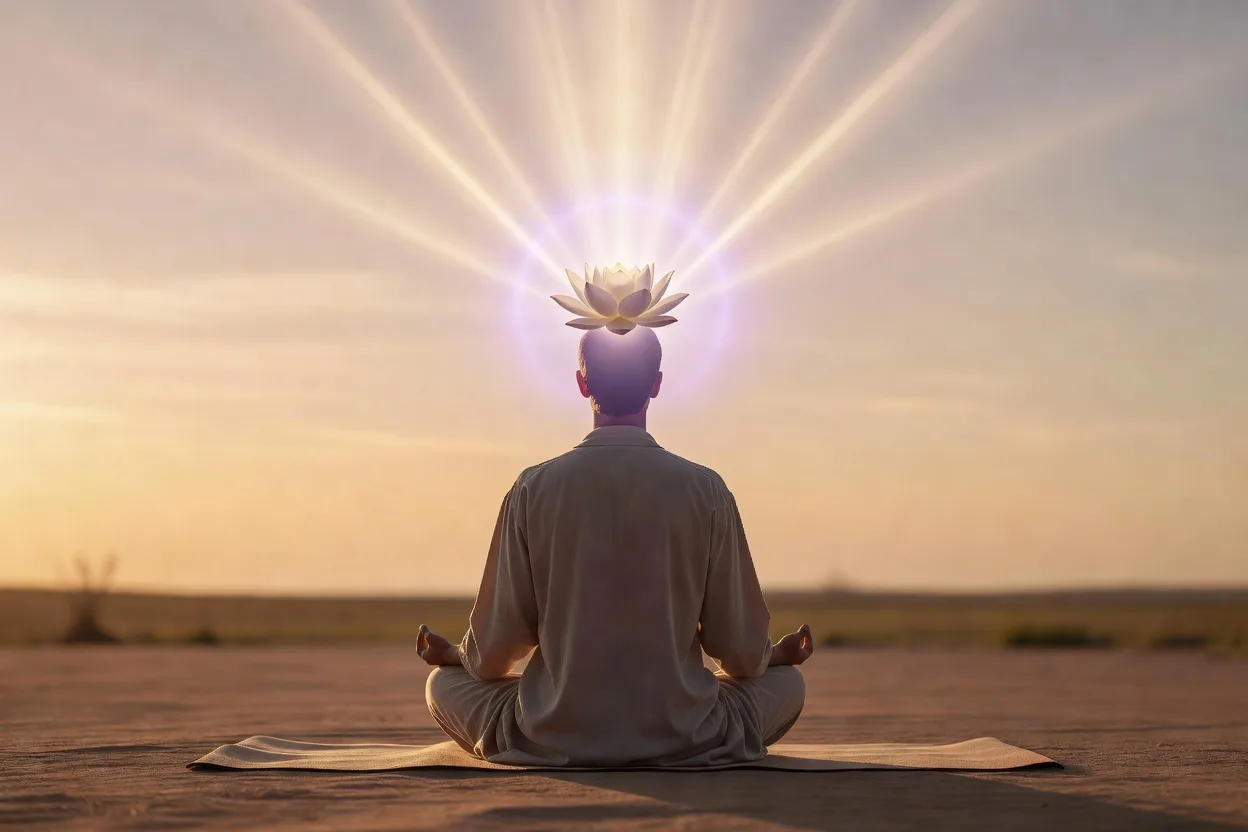
- The crown chakra (sahasrara) is the seventh and highest energy center, at the top of the head. Sahasrara means “thousandfold” and points to connection with consciousness, wisdom, and something greater than the self — not religion, but inner knowing. Opening the crown chakra is practiced through surrender and silence, not force.
The crown chakra (Sahasrara) is the seventh and highest chakra, located at the top of the head. Sahasrara means 'thousandfold' and symbolizes connection to consciousness, wisdom and something larger than the self. It is not religion, but an inner knowing.
But here's what's fascinating: your brain resists. Not from sabotage. From protection. The default mode network — the neural network active when you're not focused on a task — holds you to familiar patterns. It's the voice that says: "Stay with what you know. Safety first."
Recent research shows that meditation literally rewrites this network. A 2024 systematic review confirms that regular meditation induces neuroplasticity, reduces amygdala reactivity, and strengthens connectivity in the default mode network Calderone et al. (2024). In other words: by practicing silence, you teach your brain to let go.
And that's exactly what Sahasrara asks: not do even more. Not become even better. But stop. Breathe. And trust that there is something carrying you — even if you can't name it.
Crown chakra symptoms: how to recognize a block
A closed or blocked crown chakra doesn't always express itself dramatically. Sometimes it's subtle. A feeling of being disconnected. Doubt about meaning. Rigidity in thinking. Depressive feelings that don't seem to fade, even with all the self-help books in the world.
The body speaks more clearly than the mind. Headaches — especially at the top of the head. Numbness at the crown. Chronic fatigue that sleeping doesn't resolve. Or conversely: an excessive urge to control everything, to plan, to predict.
Scientifically, this relates to autonomic dysregulation. A 2025 intervention based on polyvagal theory shows that somatic practices — such as breathwork and yin yoga — increase oxytocin (ηp² = 0.46) and reduce autonomic reactivity Dale et al. (2025). Your nervous system learns: it is safe to let go. Read more about how vagus nerve stimulation exercises activate your parasympathetic system in our earlier post.
If you recognize this, know this: it's not failure. It's an invitation. Your crown doesn't ask for perfection. It asks for presence.
Yin yoga for the crown: surrender instead of force
- What is yin yoga for the crown?
- Yin yoga for the crown is a gentle practice of holding poses for 3–5 minutes so surrender — not effort — creates space around the crown chakra. Gravity does the work; you breathe and feel. This supports spiritual awakening without forcing an opening.
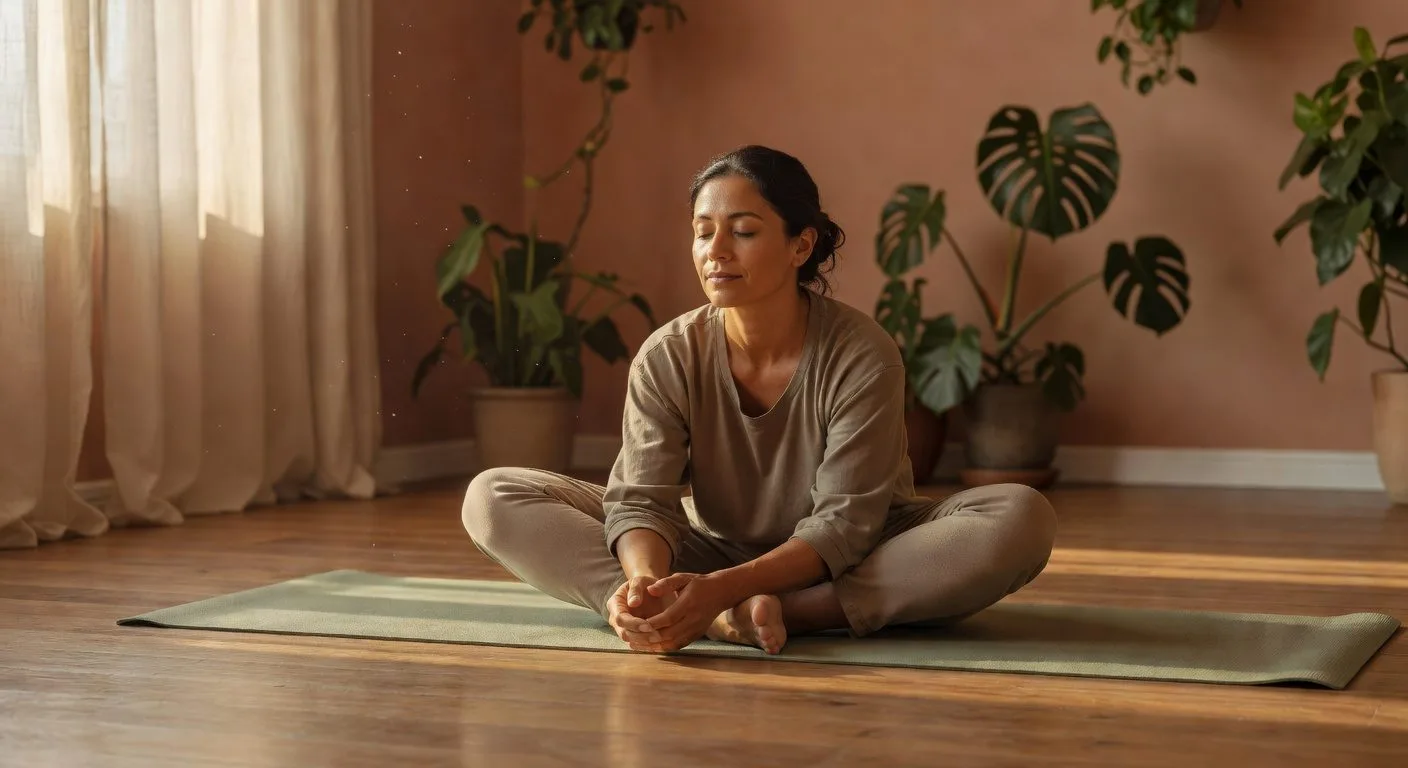
Yin yoga opens the crown chakra not through force, but through surrender. Where yang styles (like vinyasa or ashtanga) ask for doing, yin asks for being. Poses are held for 3-5 minutes. Gravity does the work. You? You breathe. And feel. Learn more about the science behind yin yoga and breathwork.
Three poses that specifically open the crown:
- Puppy pose (Uttana Shishosana) — With chin to the ground. 3-5 minutes. Opens the soft palate and upper back. Breathe into the top of the head.
- Child's pose with arms along the body — Palms facing up, forehead on the mat. The crown literally rests on the ground. Symbol of surrender: "I'm letting go for a moment."
- Reclining hero (Supta Virasana) — Back against a wall or block, legs bent. Opens the upper back and lets the crown fall backward — a vulnerable, trusting position.
These practices aren't mysticism. They're neuroscience in motion. Research on chakra-informed yoga shows promising effects on stress regulation and autonomic balance Lekach et al. (2026). The body knows the way — even if the mind doubts.
Want to explore these poses more deeply? In Spiriators' Chakra Journey, Johannes and Tessa guide you personally through all seven gates — including the silence of Sahasrara.
Breath as a bridge to the universal
Breath is the only function that can be both autonomous and consciously controlled. That makes it the perfect bridge between doing and being. Between control and surrender.
For the crown chakra, one ratio works particularly well: 4:6. Inhale through the nose (count 4). Exhale, slower (count 6). The long exhale activates the parasympathetic — the "rest and digest" system. It lowers amygdala reactivity and literally opens space around the crown.
Practice this 5-10 minutes per session. Not to get somewhere. To be here. Want more variety? Our 5 breathing exercises against stress also include the 4:6 technique.
Interestingly, changes in functional connectivity — after 8 weeks of mindfulness-based stress reduction — predict improvements in physical health. such as asthma control Laubacher et al. (2024). The bridge between meditation, brain networks and physical well-being is real.
The difference between spiritual awakening and dissociation
- What is spiritual awakening vs dissociation?
- Spiritual awakening means coming home in your body with open eyes for life. Dissociation means detaching, alienation, or feeling “out of your body.” When in doubt, work with breath, grounding, and a trauma-informed teacher — spiritual awakening without grounding is not enlightenment.
This is crucial. And too rarely discussed.
Spiritual awakening feels like coming home in your body with open eyes for life. Dissociation feels like detaching, alienation or being "out of your body". When in doubt: always work with breath, grounding and a trauma-informed teacher.
Neuroscience supports this distinction. Self-transcendence — the feeling of being connected to something greater — is seen as a natural, highest layer in Maslow's hierarchy of needs Indius (2024). It's not an escape. It's coming home.
If you notice your practice makes you more agitated, isolated or "spacy": stop. Breathe. Touch the ground. Feel your feet. Spiritual work without grounding isn't enlightenment — it's escapism.
How long does it take to open your crown chakra?
There is no fixed timeframe. Some people experience an opening in a single meditation. Others work at it for months or years. What counts is regularity, not speed. Five minutes of conscious breathing in silence each day is already an act of connection.
It's not about the one big experience. It's about the thousands of small moments where you choose presence.
So: how long does it take? As long as it takes. And every step counts.
How do you open your crown chakra?
You don't open your crown chakra with force or by “trying to be more spiritual.” You open it through surrender: silence, gentle yin, and a longer exhale that tells your nervous system it is safe. Start small — five to ten minutes is enough — and build from there. Below are five concrete steps you can take today.
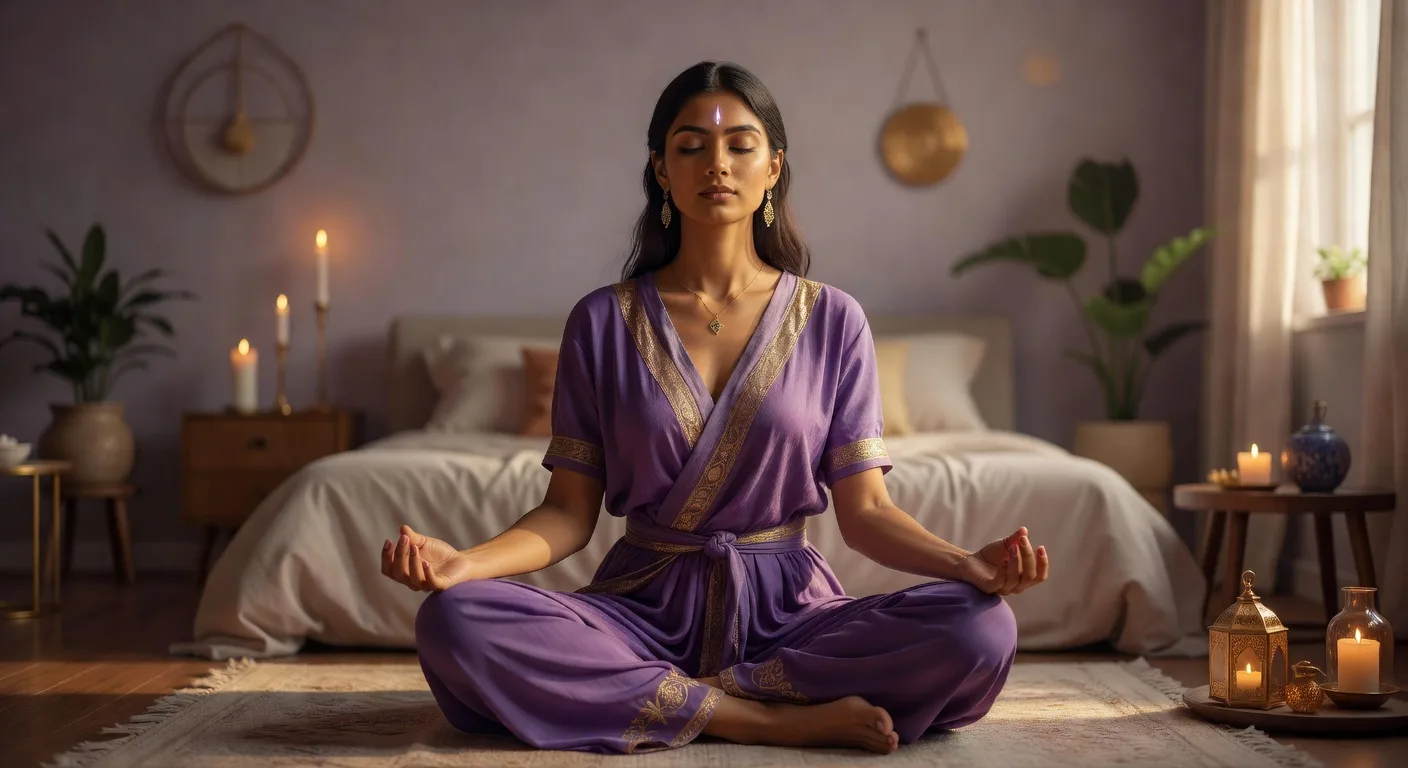
- Silence sit (10 min) — Sit with eyes closed, hands open on your knees. Follow your breath to the crown. Each exhale a soft "let go". When the mind wanders: return without judgment.
- Breathwork: long exhale — Ratio 4:6 (in:out). 5-10 minutes per session.
- Daydream pause (3x per day, 1 minute) — Stop 3 times a day. Close eyes. Feel your crown. Exhale slowly three times. No app, no mantra — just this.
- Puppy pose — 3-5 minutes, chin to the ground. Let gravity work.
- Child's pose with arms along the body — Palms up, forehead on the mat. 2-3 minutes after waking, or when feeling overwhelmed.
Regularity over length. Consistency over intensity. That is how you open your crown chakra: not in one breakthrough, but in repeated moments of presence.
From control to connection
The crown chakra doesn't ask you to know everything. It asks you to be open to what you don't know.
In a world revolving around productivity, optimization and control, surrender is a radical act. Not because it's easy. But because it brings you back to what truly matters: connection. With yourself. With life. With something greater than you — and yet deeply within you.
Feel the urge to become quiet today? Start tomorrow with the 10-minute silence sit from this blog. Small steps, big connection.
Curious how yin yoga, breathwork and nervous system wisdom come together in our retreats? Check current dates at spiriators.com/retreat — limited spots, FLOW-based groups.
Share this blog with someone ready for a moment of surrender. Sometimes one shared link is the beginning of someone's opening.
And if you notice you're stuck at the crown — or any chakra — know that you're not alone. In the Chakra Journey, we guide you personally through all seven gates. With breath. With silence. With trust.
Because ultimately it's not about opening the crown. It's about remembering you're already connected. Always. Unconditionally. Now.
Continue the chakra series: Heart chakra opening · Third eye chakra opening · or the full Chakra Journey.
Go deeper: Read our pillar pages on yoga and breathwork, explore yin yoga, or join a retreat to deepen your practice.