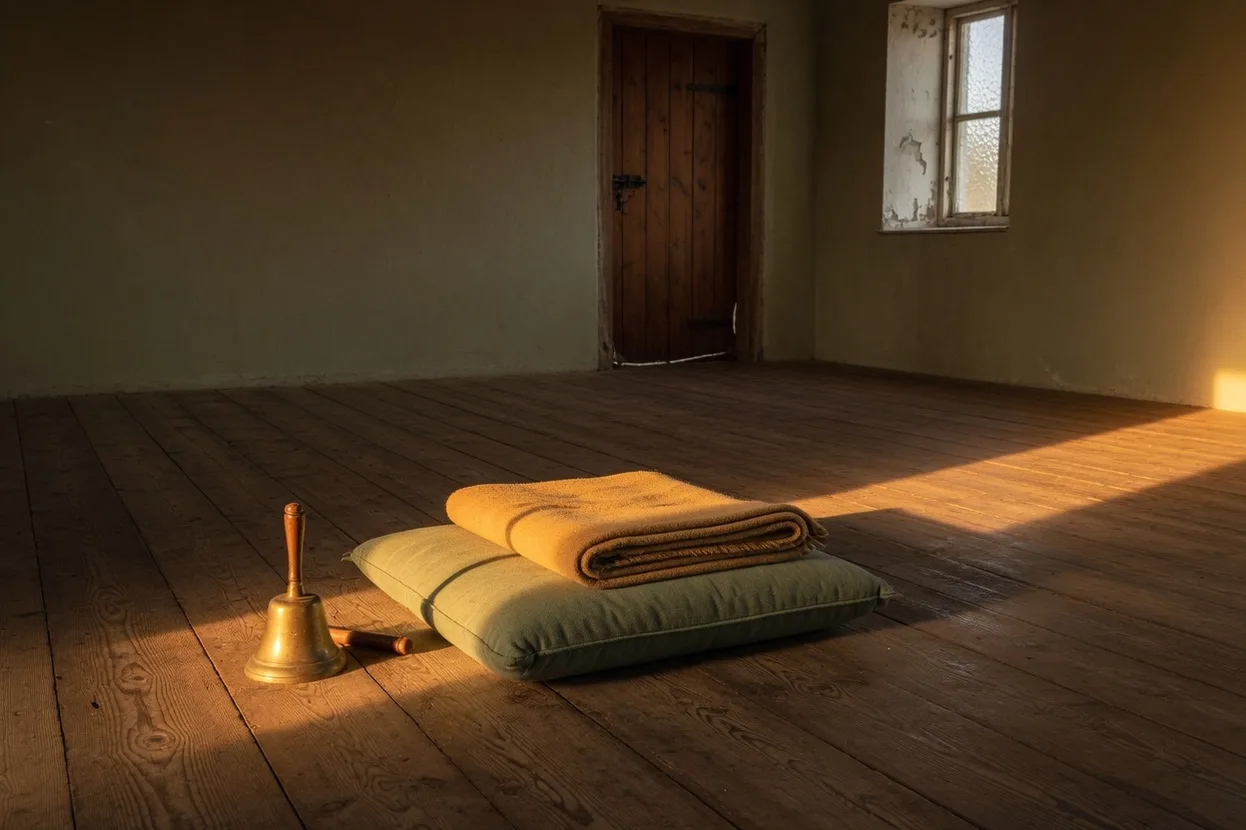
At the back of the hall a bell sits on the wooden floor, next to a blanket folded into a neat rectangle. The cushion is low. The door at the far end is shut. Late light comes through a narrow window and turns the boards amber. Nobody is sitting there. The room is still not empty. Two ways of practicing hang in the same threshold, and they ask different things of the body.
Vipassana breathwork is that threshold. Vipassana is silent watching of sensation. Breathwork is a chosen rhythm in the chest and belly. They reinforce each other without one becoming a technique of the other, and without this piece turning into a second retreat checklist.
I know vipassana. That is a fact, not a scene I am going to act out here. What I want to show is simpler. Silence sees. Breath sets the tempo. Two doors. One threshold. You do not have to pick one as if the other were then forbidden.
Silence sees, rhythm carries
Vipassana is a silent meditation in which you notice body sensations without pushing them, labeling them good or bad, or trying to clear them away.
You sit. Or you walk slowly. The instruction is plain and hard: notice pressure, warmth, tingling, movement. Do not steer the breath. Do not make a project of it. The mind wants a score at once. Deeper. Longer. Better than yesterday. That is the moment silence gets honest. You see the urge to perform instead of obeying it.
- Vipassana
- Vipassana is a silent meditation in which you notice body sensations without pushing them, labeling them good or bad, or trying to clear them away.
- Breathwork
- Breathwork is a conscious breath with a repeatable rhythm, so the body has a tempo attention can rest on.
Breathwork looks like the opposite on the surface. You choose a tempo. In and out, soft and even, so attention has a place to land. Here the breath is a tool, not only an object. If you already know breathwork, you know the feeling: rhythm pulls you out of the commentary in your head and back into chest and belly.
You can feel the difference in one minute. First, only watch, without changing the rhythm. Then the same minute with a soft, even tempo. Do not correct it at once. Only notice what shifted. A free breathing timer helps if you would otherwise count in your head instead of feeling. Keep it quiet. The timer is a clock, not a coach.
Sometimes watching never lands. Attention stays stuck in sentences. Then a rhythm is not a betrayal of silence. It is a place to stand. Sometimes a rhythm turns into a performance. Harder, longer, cleaner. Then silence is not a luxury. Silence is the correction. You notice the push, because for a moment there is nothing to achieve.
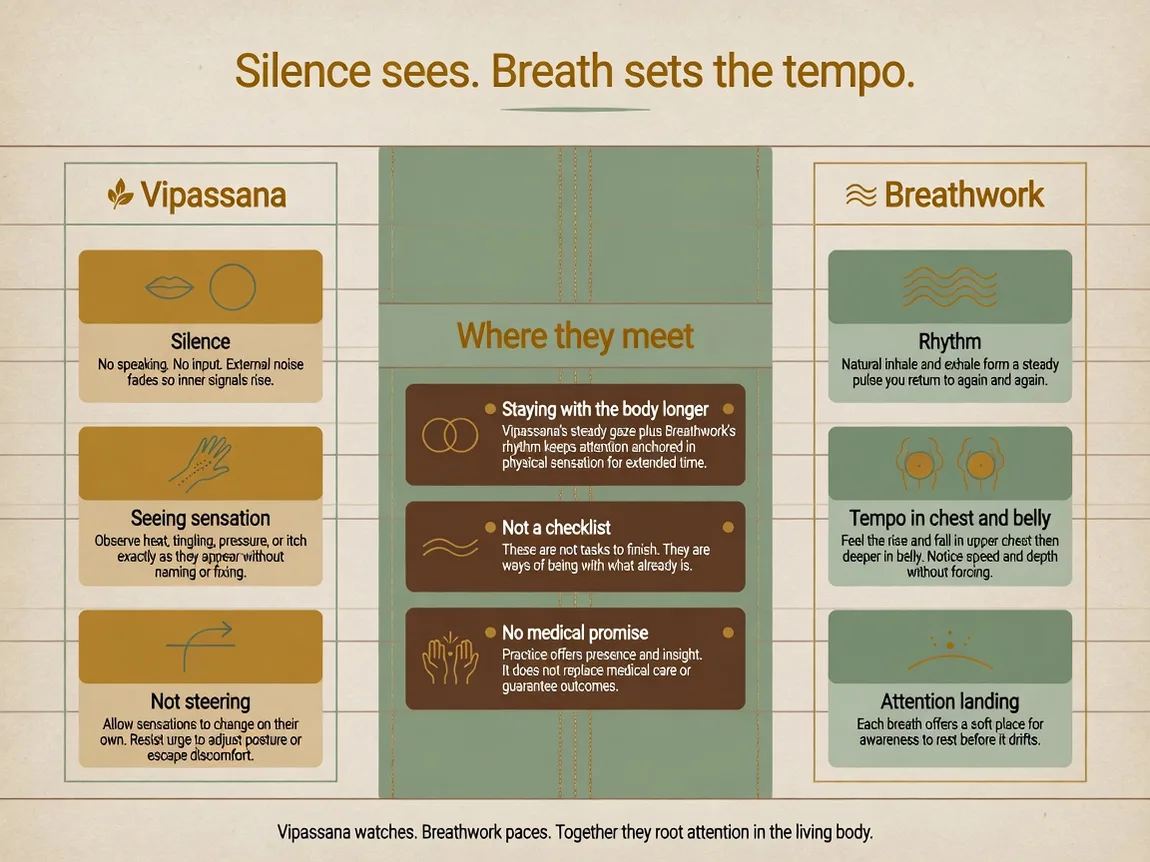
Vipassana breathwork: two doors in one threshold
A vipassana retreat is usually days of silence, sitting and walking, with the instruction to observe sensation. Breathwork is shorter and more active. The rhythm itself is the tool. A retreat is not a one-hour breath session. A breath session is not a ten-day course. If you want one and book the other, you meet a different contract with the body.
The pairing is not a blend that turns vipassana into a breathing trick. Vipassana does not steer the breath. Breathwork does not fill the silence with a hack. They meet in one place: staying with the body a little longer.
| What you do | Vipassana | Breathwork |
|---|---|---|
| Attention | See sensation, drop the name | Tempo in chest and belly |
| Steering | No. Watching is the practice | Yes, soft and repeatable |
| Time | Often long, sometimes days | Often short, minutes to an hour |
| Honest test | You notice the urge to score | You notice when you push |
Do not read the table as a contest. The middle column does not beat the right one. They keep an eye on each other. Silence makes the rhythm honest. Rhythm makes the silence workable, because attention has something concrete: movement under the ribs, warmth in the hands, the pressure of the cushion.
Pro-tip: Name one sensation in silence, pressure or warmth or movement, and drop the name at once. The practice is noticing, not collecting a tidy list.
If sitting meditation feels too sharp, you do not have to book a ten-day hall first. Yin yoga is a softer bodily door beside the silence: longer shapes, less scoring, still contact with the tissue. It does not replace vipassana. It gives a body that already wants to stay a little, before the bell on the floor is the only instruction.
What the studies do and do not say
A review of eleven studies through 2025 found moderate evidence for less stress and anxiety, more mindfulness, and in some measures higher heart-rate variability, stronger in intensive retreats. That sounds comforting if you already like silence. Read the edge. Samples were small. Risk of bias was moderate to high. Nobody was blinded. And nobody tested vipassana plus breathwork as its own method. The review says something about vipassana. It does not say that your pairing tonight will do the same.
A 2024 review of brief interventions for state anxiety found that breathing alone had mixed effects, while combinations with passive attention to body or breath were more consistently moderate. That is a clue, not proof for this threshold. Twelve trials, state anxiety, no vipassana retreat. Mixed means sometimes yes, sometimes no. That is why I will not staple a promise to a tempo.
A meta-analysis of 29 trials found a small to moderate effect of mindfulness training on how people report their own body sense. Mindfulness programs came out a little higher. There was no evidence that people become more accurate at feeling their heartbeat. The questionnaires are not vipassana, and not this breath. Self-report is what you think you feel. That matters, and it is not the same as a meter on the chest.
Three papers, three limits. None of them proves that silence plus rhythm makes anxiety or pain disappear. They do support the modest part of the story: watching without interfering, and a tempo in the body, belong with ways people stay with sensation a little longer. Staying longer is not a cure. It is a skill, and it has a ceiling.
When this threshold is too much
Not as a replacement for medical care. Not with acute pain, a recent operation, or a hernia before a doctor has looked. Also not if silence or a strong breath currently feels overwhelming. Then a shorter, guided introduction fits better than a retreat or a deep session.
Overwhelming shows up in the body. The jaw clamps. Vision narrows. You want out of the hall, or you want to perform until the feeling is gone. Stop there. The bell on the floor is not an exam. Breathwork coaching is the door when rhythm or silence is too big right now: someone beside you, a tempo that fits, no invented length and no score.
If you want to understand the quiet form before a retreat gets a date, read first what a retreat asks. Days without talking is a different contract from an hour of breath on a mat. The honest account of a breathwork retreat shows what a multi-day stay does with the nervous system, including the hard hours. That is a different door from vipassana. Useful not to book them as if they were the same.
Pro-tip: Afterward write one sentence: what the silence saw, and what the rhythm carried. No number. If the sentence turns into a performance, you were scoring again.
One minute of seeing, one minute of tempo
This is not a menu of five exercises. It is one comparison you can repeat.
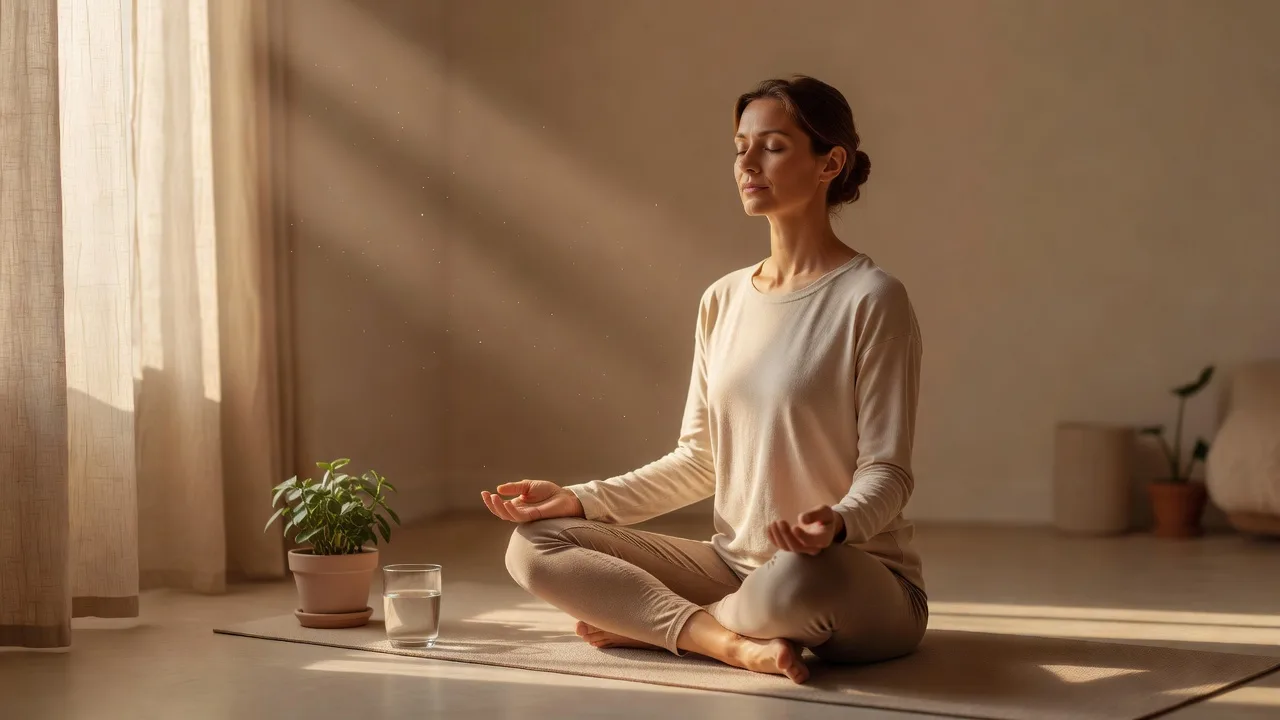
Sit the way you sit when nobody is watching. Feet on the floor, or legs crossed if that does not pull. One minute of only watching the breath, without changing the rhythm. Do not count. Do not improve it. If the breath is high and short, that is the sensation. That is the vipassana side.
Then the same minute with a soft, even tempo. In about as long as out. Do not force depth. Do not turn the belly into an assignment. Only a tempo attention can rest on. That is the breathwork side. Notice the difference. Do not immediately steer toward whatever feels prettier.
Breathwork is the conscious steering of your breathing so your nervous system and your attention get a repeatable tempo, without the sensation itself becoming a task.
If you do not yet know connected breathing and you are curious about a rhythm that lets the inhale run into the exhale, start with the beginner's guide to connected breathing. That is a different technique from vipassana. Do not sneak it into the silent minute. Feel the difference first. Later, if you want, open the door to a longer rhythm.
Naming sensations without fixing them is close to a body scan. Body scan and feeling emotions is about staying with what is already in the tissue. Here the scan is shorter: one word, then quiet again. Pressure. Warmth. Movement. The name is a pointer, not a diagnosis.
Stop when the body insists on performing. You notice it in shoulders creeping up, in a breath that suddenly becomes a project, in the thought that one minute is too small to count. Then stopping is the practice. Not stretching it into a neat ending.
Repeat this for a few days if you want, those two minutes each time. No series. No app drawing a streak. The bell on the floor does nothing either. It lies there. You notice whether you want to ring it to prove the session was real.
Key takeaways
- Vipassana breathwork is silence plus a conscious tempo, not a second retreat checklist.
- Vipassana does not steer the breath. Breathwork gives chest and belly a rhythm where attention can land.
- They reinforce each other because silence shows the push and rhythm makes the silence workable.
- Studies on vipassana, brief breath interventions, and self-reported body sense are small or not this pairing. Read them as a boundary.
- With acute pain, a recent operation, or a hernia: see a doctor first. If it feels overwhelming: shorter and guided, not deeper.
- One minute of watching, one minute of soft tempo, one sentence afterward. No score.
If the bell on the floor reaches you, you do not have to fill the hall at once. Try the two minutes. Or step toward guidance if silence or rhythm is too big right now. The threshold stays. You choose which door can open today.