
You lie in bed, eyes closed, and yet there is no silence. Your mind keeps rattling on about today's conversation, about tomorrow, about everything still left to do. While your body has been trying to tell you something all along — in a language you have forgotten how to understand.
Perhaps you recognize it: something is going on, but you cannot name it. Not sadness, not anger — just a vague unease with no address. The body scan exercise is the simplest way to learn understanding your body again. No meditation experience needed, no app, no special posture. Just your attention, your body, and a quiet place.
This article walks you through the practice itself: what happens when your attention travels through your body, why it works, and how to do it tonight — step by step, from your feet to the crown of your head.
What is a body scan?
A body scan is a mindfulness exercise in which your attention travels slowly and without judgment through your body, from feet to head, so that you consciously feel what is alive in each part of you.
The idea is simple enough to almost overlook. You lie down, close your eyes and visit each part of your body, one by one. Not to fix anything. Not to relax — although that often happens on its own. You visit your body the way you visit a friend: to hear how it is doing.
- What is a body scan?
- A body scan is a mindfulness exercise in which your attention travels slowly and without judgment through your body — from feet to head — consciously feeling what arises in each body part: tension, warmth, cold, tingling, pressure, or emptiness. It is a form of self-inquiry that teaches you to notice your body's signals before your mind turns them into a story.
This makes the scan different from thinking about yourself. Self-inquiry usually starts in the head: why do I feel this, where does it come from, what should I do with it? The body scan reverses that direction. First feel, then — perhaps — understand. Where emotions show up physically is covered in our article on feeling emotions in your body. The body scan is the tool with which you explore that map yourself.
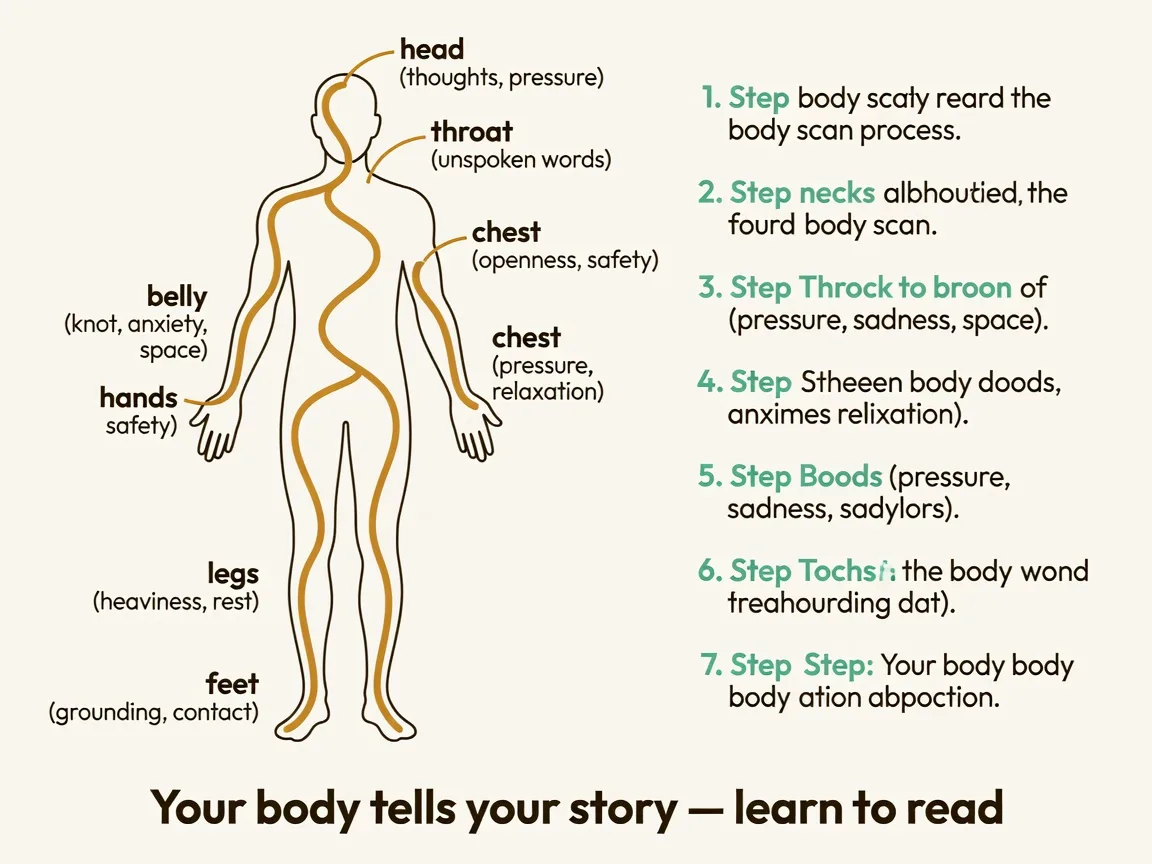
Interoception: the language your body speaks
Interoception is your inner sense of touch: the ability to perceive signals from inside your body, from heartbeat to muscle tension, and to give them meaning.
- What is interoception?
- Interoception is the ability to perceive signals from within your body — heartbeat, breathing, muscle tension, sensations in belly and chest. It is your inner sense of touch that makes emotions physically felt: a knot in your stomach with fear, pressure on your chest with sadness. Body scans train exactly this capacity to perceive.
Every emotion announces itself first as sensation, through the vagus nerve — the great nerve pathway connecting your brain with your heart, lungs and gut. Your heart rate speeds up before you know why you are startled. Your belly tightens before you realize something excites you. Your shoulders creep up before you notice you feel responsible. More about this information highway in our article on the vagus nerve.
The point is this: these signals are always there. The question is not whether your body speaks, but whether anyone is listening. A body scan is nothing other than learning to listen on purpose — twenty minutes at a time, without judgment, without agenda.
Why feeling begins where thinking stops
Most of us are excellent at talking about feelings. We can explain precisely why we are stressed, sad or irritated. But explaining something is not the same as feeling it — it is the difference between reading the menu and eating.
Research on meditation and interoception shows that you have two ways of experiencing yourself. The narrative self is the voice that tells stories about your life: the part that analyzes, compares and explains. The experiential self feels, moment by moment, what is actually happening in your body. The two cannot hold the floor at the same time. As long as your head is telling the story, your body stays silent.
That is why learning to feel emotions does not start with better analysis, but with a quieter mind. The body scan gives your narrative self twenty minutes off. And in that silence, your experiential self finally gets room to speak — in sensations, not in sentences.
The body scan exercise in seven steps
Take twenty minutes. Turn your phone off, or use it only as a timer. No goal, no performance. Just you and your body.
Step 1 — Lie down and land
Lie on your back on a mat or blanket, legs slightly apart, arms along your body with palms facing up. Close your eyes and let the full weight of your body rest on the ground. Take twenty seconds to simply notice that you are lying here. Nothing more is needed.
Step 2 — Three grounding breaths
Breathe in slowly through your nose and out through your mouth three times. With each exhale, feel your belly soften and the ground carry you more. Let your shoulders drop and your jaw relax. This is the signal to your nervous system: it is safe here, you are allowed to land.
Step 3 — Feet and legs
Bring your attention to your left foot. Feel the contact with the ground, the temperature, tingling — or nothing at all. Stay for thirty seconds, then move to your calf, your knee and your thigh. Repeat on the right side. Legs often feel heavy. Heaviness is rest that is already there, not something to fix.
Step 4 — Pelvis, belly and lower back
Let your attention sink into your pelvis and belly. Feel your breath make your abdomen rise and fall. A knot, pressure or restlessness in the belly is often tension that found a place to live. Stay with it without analyzing — just feel. Also notice whether your lower back speaks up.
Step 5 — Chest, heart and hands
Bring your attention to your chest and heart area. Pressure, tightness or emptiness belongs to sadness or grief. Warmth or spaciousness belongs to love and joy. Then place your attention in your hands and fingers — open hands often feel safer than clenched fists. Ask yourself softly: what wants to be felt here?
Step 6 — Throat, face and head
Move to your throat. A lump or a tight feeling often points to unspoken words. Then relax your face: eyebrows, jaws, tongue. Finish at your head. Thoughts are not a sensation to chase away — simply notice whether there is pressure, lightness or tingling behind your eyes. Everything is allowed to be here.
Step 7 — Whole body and closing
Let your attention flow once from your crown to your toes and back again, as if embracing your whole body in one breath. Then slowly move your fingers and toes, roll onto your side and come up gently. Feel how your body feels now — often lighter, softer, more at home.
This table helps you make sense of what you meet along the way:
| Body part | What you might feel | Possible emotion |
|---|---|---|
| Feet | Contact, warmth, tingling | Grounding, presence |
| Legs | Heaviness, rest, restlessness | Trust or haste |
| Belly | Knot, pressure, softness | Anxiety, tension or safety |
| Chest | Tightness, emptiness, space | Sadness, grief or love |
| Hands | Openness, fists, warmth | Letting go or holding on |
| Throat | Lump, constricted feeling | Unspoken words |
| Head | Pressure, lightness, tingling | Worrying or clarity |
Pro-tip: Distracted by thoughts? You are not doing it wrong — that is exactly the moment you notice you are thinking. Gently return to the body part you were with, without correcting yourself. Every return is one repetition for your interoception, the way every step builds strength.
What if I feel nothing?
Many people expect a body scan to release something right away. And then: nothing. No tingling, no emotion, just a vague "I feel nothing". That is not failure — it is information.
Feeling nothing is often the sign of a body that has learned to push its signals away. Years of functioning, pushing through, not complaining: it makes your head strong and your body silent. Force nothing. Stay kindly present with the body part and notice what is there instead: contact with the ground, weight, temperature, breath. Over time, sensations become clearer on their own.
Sometimes emotions sit deeper than your first scan can reach. Tension can lock itself into your hips and deep belly muscles, places attention alone reaches with difficulty. Read about this in our article on the ilio-psoas and stored emotions. A body scan is not a performance — it is a practice of presence. And presence has no deadline.
How often and how long: two weeks is enough
The honest question, of course, is: does this actually work, or is it another good intention that fades after three days? The good news: you do not need to believe in it, you only need to try it. And you do not need much time.
Research shows that listening to a short body scan daily for two weeks measurably improves your sensitivity to bodily signals — both the accuracy with which you perceive your heartbeat and your overall body awareness. Two weeks. That is not a lifestyle revolution, that is an experiment you can complete this month.
And the effect does not stay limited to the scan itself. A meta-analysis of 29 randomized studies with more than two thousand participants confirms that mindfulness practices such as the body scan improve self-reported body awareness — and that this improvement goes together with less psychological distress. Feeling what is going on more clearly means you can respond sooner. Before stress builds up, instead of after.
In practice, this means:
- Full scan: fifteen to thirty minutes, lying down. Ideal for quiet moments or as an evening ritual.
- Micro-scan: five minutes, only feet, belly, chest and face. For busy days — regularity beats duration.
- Scan before sleep: lying in bed, without goal, from toes to crown. A soft transition from thinking to being.
- Scan plus breath: with each exhale, add a gentle "let go" to the body part where your attention rests. The breath opens, the scan listens.
Pro-tip: Keep an emotion-body map for one week: after each scan, write one sentence about where you felt something and which word fits it — heavy, warm, knot, empty. After seven days you will see your personal pattern. Your body has its own emotion map, and this is how you learn to read it.
Breathwork and yin yoga: stronger together
The body scan is a beautiful beginning — but it does not stand alone. Once you know where you feel tension, you also want to be able to do something with it.
Open your scan with three grounding breaths, as in step two. Our free breathing timer helps you find the rhythm: breathe in, hold, let go — your nervous system recognizes the rhythm and shifts along with it. Breathwork and body scan strengthen each other: the breath opens, the scan listens. Discover how to combine them into a personal practice in our guide to breathwork.
And if you want to deepen the feeling, stillness in movement is the next step. In yin yoga you hold poses passively for three to five minutes — exactly the kind of stillness in which body sensations are allowed to show themselves. Where the body scan teaches you to notice, yin teaches you to stay.
Sometimes you do not want to do this alone. With tension that has been stuck for years, with emotions that feel too big to carry on your own, guidance is not weakness but wisdom. In a breathwork coaching session someone stands beside you — not above you — while you learn to trust what your body tells you. More ways to calm your nervous system in our overview of vagus nerve exercises.
Key takeaways
- The body scan is self-inquiry without judgment. You visit your body from feet to head to feel what is there — not to fix anything.
- Emotions announce themselves as sensation first. Through the vagus nerve, your body registers feelings before your mind has words for them.
- Feeling and thinking about feelings are not the same. The scan gives your analyzing mind a break, so your experiential self gets to speak.
- Feeling nothing is also information. It is often a body that learned to be silent — presence without judgment opens it up again, step by step.
- Two weeks of daily practice is enough to notice a difference. Research shows measurable improvement in body awareness within fourteen days.
- Combine the scan with breath and stillness. Breathing opens the nervous system, yin yoga teaches you to stay — together they make feeling sustainable.
If this speaks to you — if you recognize that you live more in your head than in your body — there is a way back. Not through more thinking, but through twenty minutes of silence and attention. Start tonight: lie down, close your eyes, and visit your body like a friend you have not spoken to in too long. If you would rather not do it alone, get in touch for a conversation with no strings attached. Your body has been waiting for you all these years.