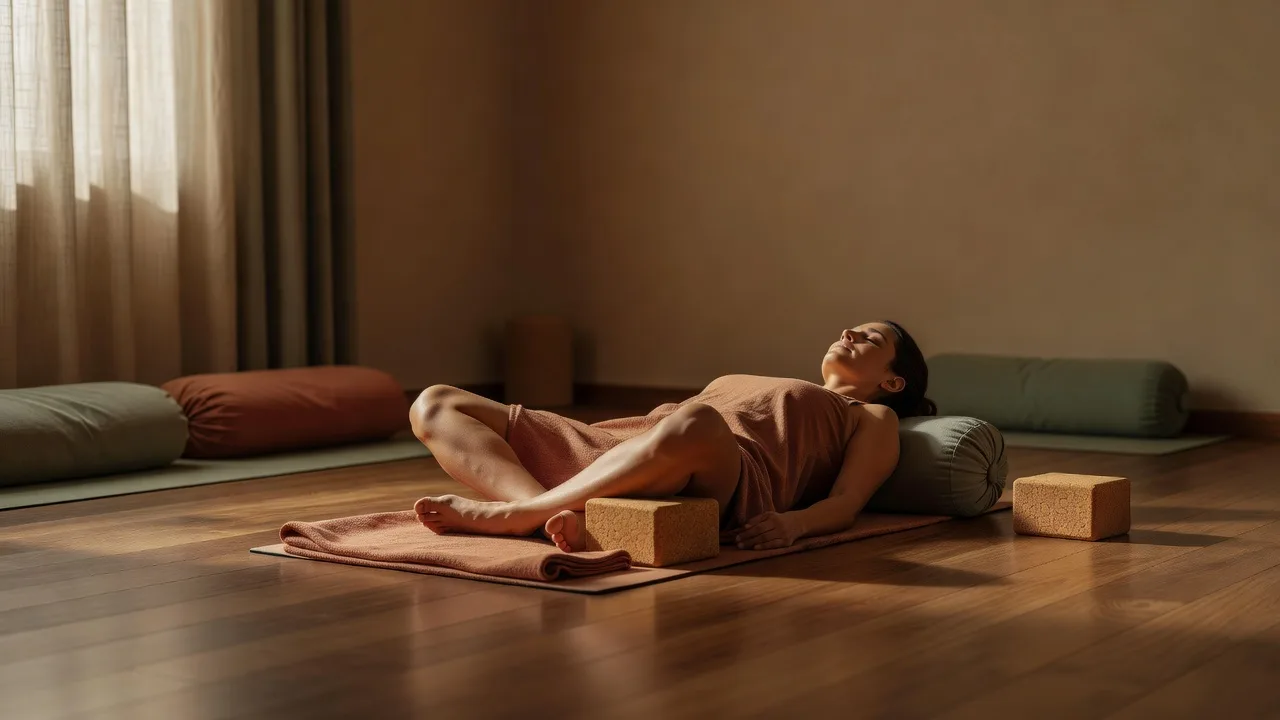
The kitchen timer is already on the mat. Two cork blocks. A bolster that still smells like detergent.
No body in a pose yet. Objects first. Yin yoga poses start with gear, not a heroic stretch. Three to five minutes is long when your knees hunt the floor. Short when the timer keeps you out of your head.
Yin yoga poses are long-held stretches, usually three to five minutes, that load fascia and joints rather than muscle fibers. This guide lists twelve core poses with anatomical focus, props and contraindications so you can build a complete home sequence without forcing range.
I set the timer to 3:00 before I lie down. Not after. Otherwise I count. Counting is not yin.
What yin yoga poses actually ask
Yin yoga poses are long-held stretches (usually three to five minutes) that load fascia and joints, not the muscle belly.
- Yin yoga pose
- A yin yoga pose is a long-held stretch (usually 3 to 5 minutes) with little muscle tension, so connective tissue, joints and fascia carry the load instead of the muscle belly.
Hold time is how long you stay in one yin pose. Beginners often need 2 to 3 minutes. Experienced practitioners go to 4 to 5 minutes if the sensation stays dull and bearable, not sharp.
Want to know which holds fit your body? Take the Yin Check. Not a test to pass. A scan.
If you are new, start with yin yoga for beginners. For fascia and feeling: yin yoga, fascia and emotions.
| Zone | Example poses | Time | First prop |
|---|---|---|---|
| Hips / groin | Butterfly, Dragon, Sleeping Swan, Deer | 3 to 5 min | Pillows under knees |
| Spine | Sphinx, Seal, Twisted Roots, Banana | 3 to 4 min | Blanket under pelvis |
| Hamstrings / back line | Caterpillar, Square | 3 to 5 min | Bolster on the lap |
| Shoulders / side body | Banana, Deer arms | 3 to 4 min | Block under the hand |
An evening yin sequence helps when sleep will not come. See yin yoga evening routine for better sleep. Same family of poses. Different order.

Twelve core poses: names, times, stop rules
A yin pose overview is not a contest to cram all twelve into one session. Pick four to six. Repeat them weekly. Consistency beats an endless catalog.
1. Butterfly (Baddha Konasana)
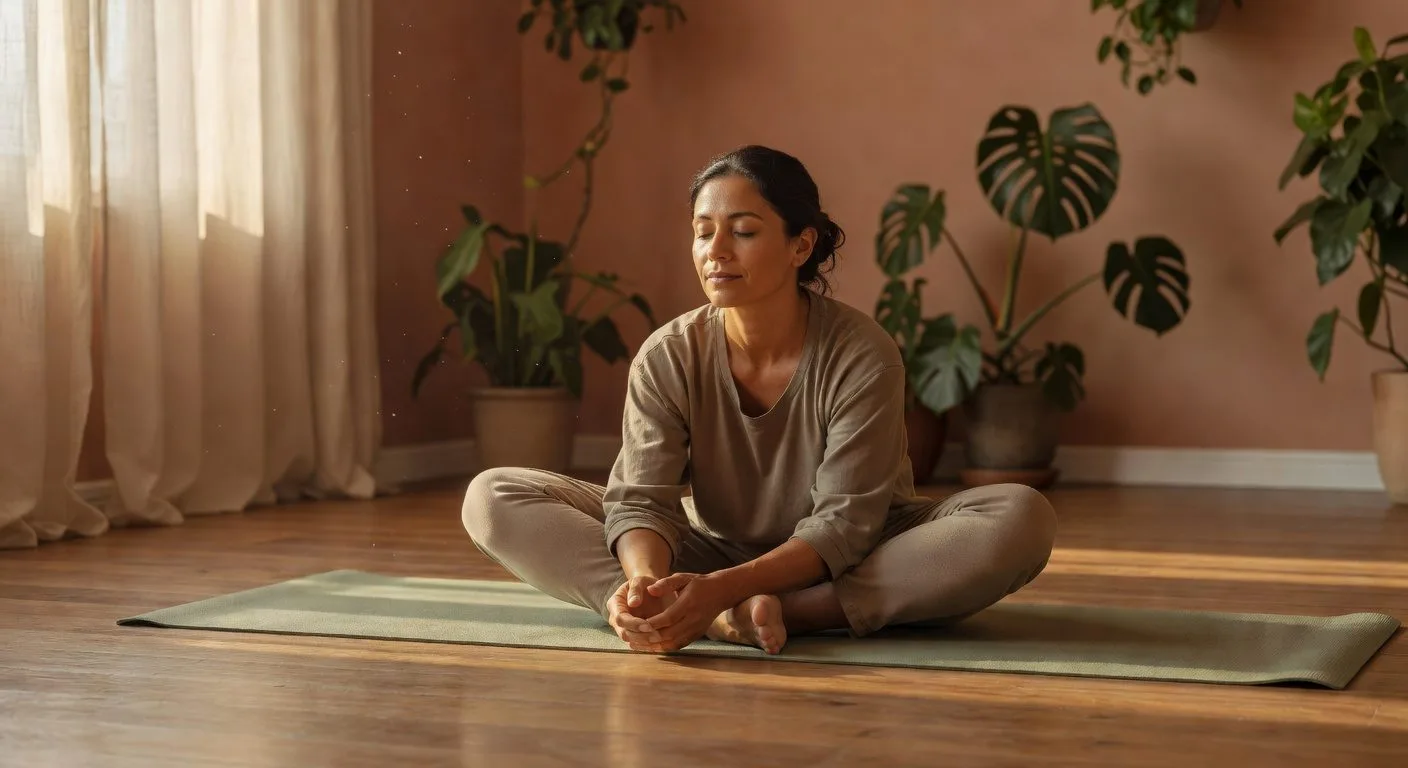
Sit. Soles together. Pillows under the knees until the knees feel heavy, not until they hit the mat out of pride. 3 to 5 minutes. Focus: inner thighs and groin. Shorten or skip with acute groin irritation.
Check if your jaw softens. If your teeth clench, the pose is too deep. Props up.
2. Dragon (lunge)
Back knee on a blanket. Front knee over the ankle. 3 minutes each side. Focus: hip flexors. Do not force with knee pain. Hands on blocks.
Dragon is not a split. It is a hip warming slowly. If the knee shouts, it is the knee. Come out.
3. Caterpillar (seated forward fold)
Legs long. Small bolster on the lap if the back rounds. 3 to 5 minutes. Focus: hamstrings and low back. Keep knees softly bent.
Hamstrings without ego. I say it out loud in class. People laugh. Then they bend their knees anyway. Good.
4. Sphinx or Seal
On the belly. Forearms (Sphinx) or hands (Seal). 3 minutes. Focus: lumbar compression. With acute low-back pain: keep Sphinx lower, or skip.
Seal is the deeper sister. Not the first choice if your back already complained this week.
5. Sleeping Swan (pigeon variant)
Front shin on mat or bolster. Back leg long. 3 minutes each side. Focus: outer hip. With knee issues: Figure Four on the back.
Swan looks pretty in photos. On the mat it is often a knee negotiating. Believe the knee.
6. Twisted Roots (supine twist)
On the back. Knees to one side. Pillow between the knees. 3 to 4 minutes each side. Focus: spinal rotation. Keep both shoulders heavy on the mat.
If the top shoulder lifts, the twist is too big. Pillow higher. Time can stay.
7. Saddle
Sit between the heels, or on a block between the feet. 2 to 4 minutes. Focus: front thighs and front hips. With knee or low-back issues: skip. This is often the first pose you drop.
8. Banana
On the back, both feet and both arms to one side, like a banana. 3 to 4 minutes each side. Focus: side body, intercostals. Blanket under the bottom leg if the waist floats.
9. Square (Firelog-ish)
Sit with shins stacked or almost stacked. 3 to 4 minutes. Focus: outer hip. Block under the top knee. If the knee is sharp: Deer or Figure Four.
10. Deer
One leg in front, one beside. Both knees soft. 3 to 4 minutes each side. Focus: hip rotation without wringing the knee. Arms can rest. Shoulders can drop.
11. Seal (as a separate choice next to Sphinx)
Higher than Sphinx. Arms straight. Hold shorter: 2 to 3 minutes. Focus: deeper lumbar compression. Only if Sphinx got boring, not if Sphinx was already too much.
12. Savasana with timer
4 to 6 minutes flat. Blanket over the hips. Let the nervous system close the sequence. No scrolling.
Savasana is a yin yoga exercise, not a pause between apps. The timer stays on.
Pro-tip: Set the timer to 3:00 before you step on the mat. Not after. Props shorten the distance to the floor, not the value of the pose.
How long, when to stop, what yoga does and does not prove
Hold time is the clock plus your stop rule. Sharp, electric or panicky: exit. The timer is a guide, not a contest.
- Hold time
- Hold time is how long you stay in one yin pose. For beginners, 2 to 3 minutes is often enough; experienced practitioners go to 4 to 5 minutes if the sensation stays dull and bearable, not sharp.
Yoga can help knee pain in a broad sense. A 2025 JAMA Network Open study found yoga not inferior to strengthening for knee osteoarthritis over twelve weeks. That does not prove your three-minute Dragon does the same. Not a yin-specific trial. No fascia claim.
Jaw and face can join in when the whole body is locked. Yoga-based exercise for myofascial jaw pain improved outcomes in a small group of women. n=39. Not this twelve-pose protocol.
Low back is another story. Manual 3D myofascial release reduced pain and an inflammation marker in nonspecific low back pain. That is hands on fascia, not Caterpillar. Do not draw that line as if your seated fold has the same cytokine effect.
If a hold makes you restless, breath can join. Breathwork coaching of sixty minutes (60 euro) is an option, not a demand. Wider frame: yoga and 1:1 online yin yoga with Tessa. Course videos: courses.
A forty-minute home sequence
Yesterday the analog timer sat next to the laundry basket. I did not need extra pillows. Two from the bed. A blanket that already had cat hair. That is a toolkit.
Hips first. Then spine. Then the back line. Props within reach. A scannable core-pose sequence: each pose 3 to 5 minutes.
I hear people whisper in class. "Has it been two minutes?" No. Seconds stretch when the jaw is still clenched. When the jaw drops, the clock speeds up. Weird. True.
- Butterfly 3 min, pillows under knees.
- Dragon 3 min each side, hands on blocks.
- Caterpillar 4 min, knees bent.
- Twisted Roots 3 min each side.
- Savasana 5 min, phone in the other room.
Pregnancy: no deep belly compression, no long prone holds. Recent surgery, acute disc issues, unstable knee: skip or modify. When unsure: more props, less time, or a teacher who knows your medical context.
Pro-tip: Without props people shove their knees to the mat. That is not discipline. It is compression on a joint that does not deserve four minutes of forcing.
If this lands, start small. Four poses. One timer. A blanket you already own.
Johannes makes tea while I square the blocks. He does not count. He hears the beep. That is enough. Yin is boring until it is not. Until your hip finally drops and you notice you have not thought about your inbox for three minutes.
Do you need props at home? Yes. At least one blanket and two pillows. Blocks and a bolster make Dragon, Swan and Caterpillar tolerable. A kitchen timer is the third prop: it keeps you out of your head.
Yin yoga exercises can feel like doing nothing. That is the point. The muscle can stay soft. The joint can have time. You can come out if it turns sharp. Longer is not automatically better.
Key takeaways
- Essential yin yoga poses usually last 3 to 5 minutes. Beginners may start at 2.
- Twelve core poses cover hips, spine, hamstrings and shoulders. Not all twelve in one session.
- Props are not weakness. At least one blanket and two pillows at home.
- Sharp pain, recent surgery or an unstable knee: skip or shorten.
- Set the timer before you lie down. Savasana belongs in the sequence.
- Yoga studies on knee or jaw do not prove these exact yin holds do the same thing.
Want guidance instead of a list? Look at yin yoga sessions or the Yin Check.