Yin yoga for beginners raises more questions than it answers: how long do you hold a pose, is it supposed to hurt, and why is everyone lying still on a bolster? In this guide we explain what yin yoga really is, how it differs from hatha and vinyasa, which props you need and how to safely experience your first class — without performing, but with real results in your nervous system, sleep, and body awareness.
What Yin Yoga Really Is — and Why It Has Nothing to Do With Performing
You walk into a yoga studio, mat under your arm, and everyone is already lying still on a bolster. No sweat, no powerful transitions, no breath-counting. Just silence. And somewhere in that silence you think: this can't be it, can it? This is the moment most beginners misunderstand yin yoga — or fall in love with it. Because yin is not less than vinyasa. It's something else entirely.
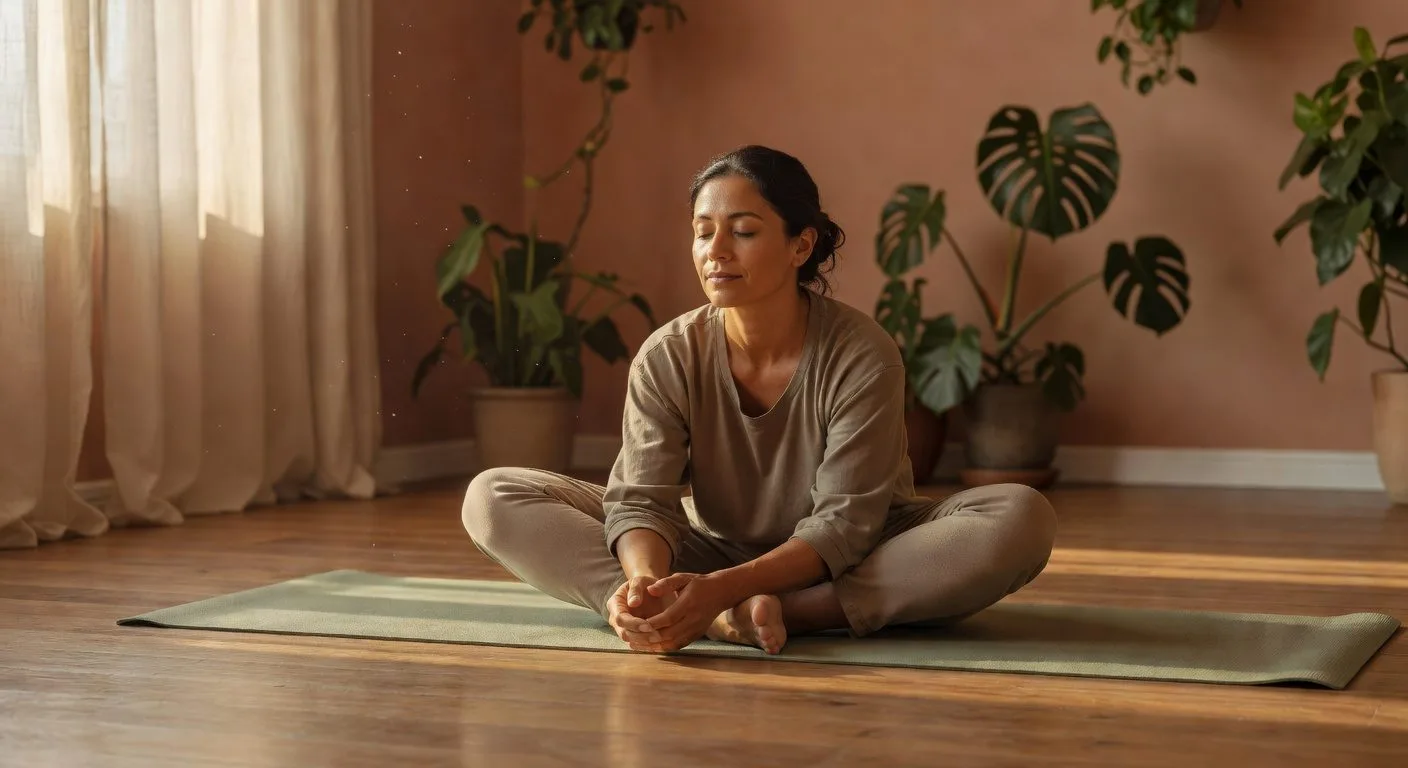
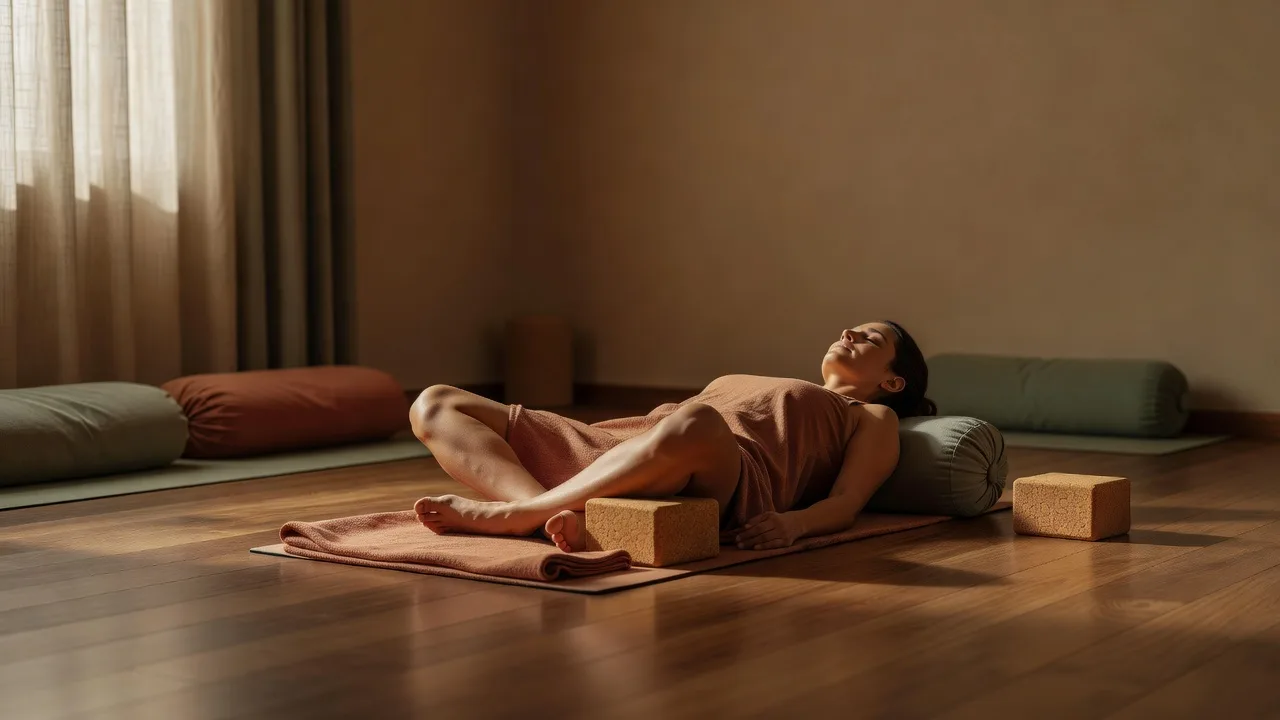
Yin yoga is a slow, meditative practice where poses are held for 3 to 5 minutes, mostly seated or reclined, supported by cushions, blocks, and blankets. Where hatha and vinyasa work your muscles — yang tissues — yin targets the deeper connective tissue: fascia, ligaments, tendons. The goal isn't to become more flexible or to perform. The goal is to slow down, to feel, and to discover what your body has been trying to tell you.
For many people, that's a shift. We're used to movement meaning effort, sweat, measurable progress. Yin asks something different. Yin asks you to sit still with what is — even when that's uncomfortable. And our yin yoga classes are designed to guide you safely into that experience.
How Yin Differs from Hatha, Vinyasa, and Restorative Yoga
- Yang vs yin tissue
- Yang tissue (muscles) responds to active movement and strength; yin tissue (connective tissue/fascia) responds to long, mild stretch. Hatha and vinyasa train mostly yang; yin seeks a warm, inviting stretch held for 3 to 5 minutes — actively staying still with what arises.
If you've done "regular yoga," you've probably tried hatha or vinyasa. Active styles where you engage muscles, flow through sequences, and raise your heart rate. Yin is the opposite. You lie down. You sit. You stay. And that "staying" is exactly where the magic lives — but also where the discomfort begins.
The difference with restorative yoga? In restorative, you're completely comfortable — no tension, no sensation. In yin, you seek a mild stretch in the connective tissue — a warm, inviting pull that you hold for 3 to 5 minutes. It's not passive. It's actively sitting still with what arises.
That's exactly why yin yoga and breathwork go so well together: the breath becomes your anchor when the pose lasts longer than you're used to. Without breathwork, yin is a physical exercise. With breathwork, it becomes a meeting with yourself.
What You Need to Know Before Your First Yin Class
Your first yin class doesn't have to be a surprise. Here's what you really need to know — practical, honest, and no fluff.
Clothing: Think Layers
When you hold still for 5 minutes, your body cools down. Sometimes 3 to 5 degrees. That sounds like nothing, but in a quiet studio it feels significant. Wear comfortable layers you can add or remove. Long sleeves. A sweater next to your mat. Socks are not a sign of weakness in yin — they're a sign of wisdom.
Props: Your Best Friends
Blocks, bolsters, blankets, straps — in yin, props aren't optional. They're essential. They allow you to adapt the pose to your body, rather than forcing your body into a pose. Most studios have them ready for you. As a beginner, it's nice to bring your own blanket — not because studios don't have enough, but because familiarity helps you relax.
Timing: Arrive 10 Minutes Early
A yin class begins with landing. Not with warming up, not with setting intentions. If you rush in, you need 15 minutes just to descend from your day. Plan 10 extra minutes. Sit on your mat. Breathe. Let the outside world stay outside. Those 10 minutes change your entire experience.
Eating: Light and Timely
Eat something light about two hours before class. No heavy meals. Yin poses sometimes press on your belly — a full stomach and a long forward fold are not friends. A banana, a rice cake, a handful of nuts. Enough to not be ravenous, not so much that you feel sluggish.
Sensation vs Pain: The Most Important Thing to Understand
- Sensation vs pain
- Sensation in yin feels like a warm, soft stretch you can breathe through; after a few minutes it becomes more comfortable. Pain feels sharp, stabbing or tearing — your breath speeds up and intensity increases. If you cannot relax in the pose, you are going too deep.
This is the core of safe yin practice, and it's where most beginners make mistakes. So listen carefully.
Sensation in yin feels like a warm, gentle stretch. It pulls, it pulls, but you can breathe through it calmly. The sensation doesn't increase as you hold the pose. After 2 to 3 minutes, the tissue begins to release and the stretch becomes more comfortable. That's yin.
Pain in yin feels sharp, stabbing, tingling, or like a tear. Your breath quickens. You can't relax. The sensation gets worse, not better. That's your body saying: too far. Back off. Now.
The rule of thumb: you should be able to breathe, relax, and stay in the pose for at least two minutes without the sensation increasing. Can't do that? You're going too deep. Less depth, more props, adjust the pose. The pose adapts to you — not the other way around.
Research confirms this. A 20-year epidemiological study on yoga injuries found that hip injuries occur more often in practitioners over 45 — precisely because they try to go deeper than their body allows. Watson et al. (2025) found that props and mindful boundaries are the most important preventive factors. So: listen to your body. Not to the person on the next mat.
What Happens in Your Body During Yin Yoga
- Fascia
- Fascia is the connective-tissue network that wraps your whole body. It contracts under stress and holds tension. Long, gentle yin stretches help fascia release without force — biomechanics that feel like your body slowly thawing.
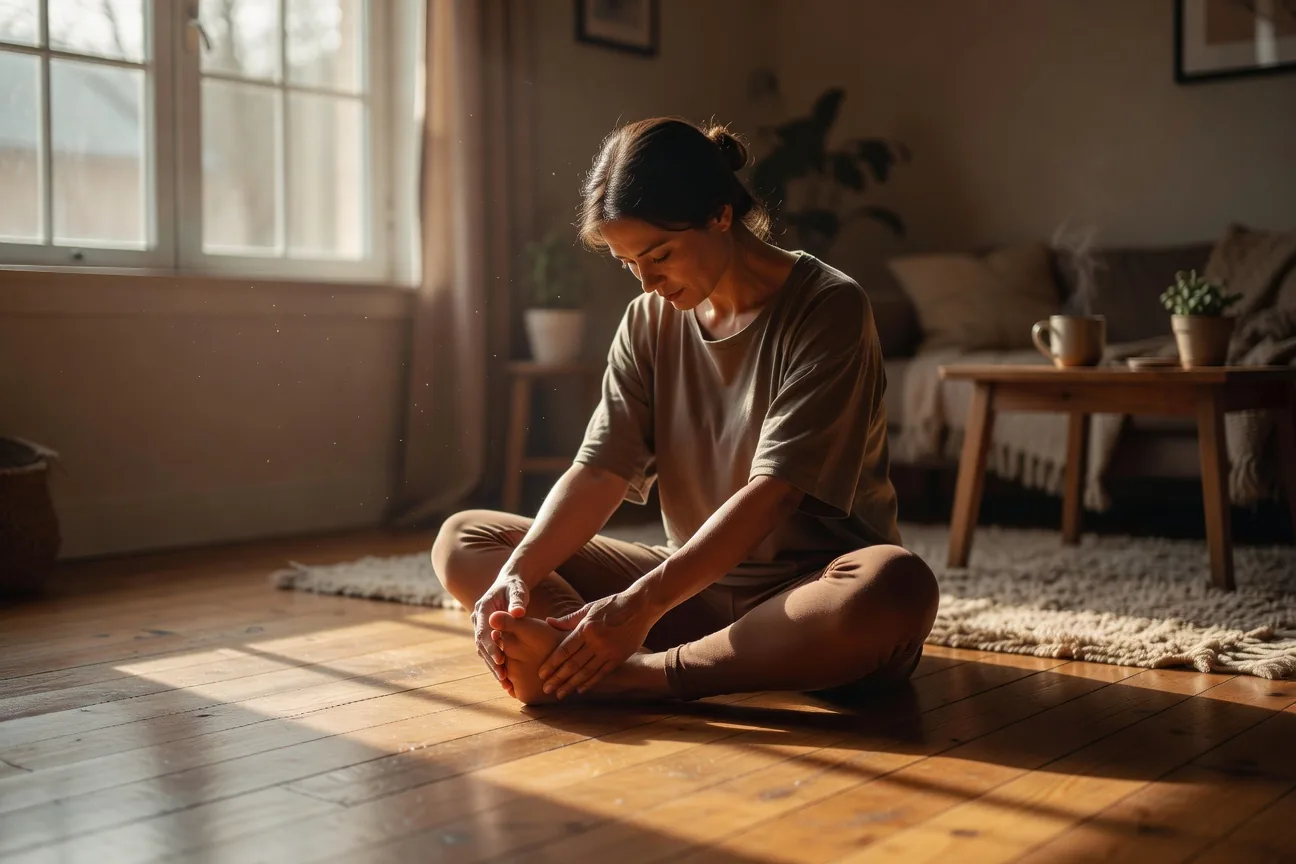
When you sit in butterfly pose for the first time for 5 minutes, something remarkable happens. The first minute feels like stretching. The second minute, the tissue begins to adapt. And somewhere around the third or fourth minute, space opens up — as if your body finally says: okay, I trust you. That's fascia letting go.
Fascia is the web of connective tissue that wraps your entire body. It responds to stress by contracting and holding tight. Long, gentle stretches — exactly what yin provides — help fascia release without forcing. It's not magic. It's biomechanics. And it feels like your body slowly thawing.
But it's not just physical. Research on yin yoga and anxiety shows that the slow, long-held poses have a direct calming effect on the nervous system. Somere et al. (2024) found that a 10-week yin yoga intervention significantly reduced state anxiety — immediately after each session and cumulatively over the full 10 weeks. Not because you "lay down calmly," but because your body was given the time to shift from survival mode into recovery mode.
That explains why beginners often say after just one class: "I've never felt this deeply relaxed." It's not suggestion. It's your nervous system getting permission to stop fighting — maybe for the first time in a long time.
How Often Should You Practice as a Beginner?
Once a week is a solid start. Really. Yin is not a performance sport with a training schedule. It's an invitation to slow down — and you can't force slowing down.
Two to three times per week accelerates the noticeable effects: better sleep, less stress, more body awareness. But practicing yin daily? That's unnecessary and sometimes counterproductive. Connective tissue needs 24 to 48 hours to recover after deep stretching. Give it that time.
If you want to understand yin's impact on sleep, read our guide on yin yoga for better sleep. It explains exactly why 20 minutes of yin before bed does more than a sleeping pill — and how to apply it yourself.
A systematic review of 13 RCTs in stressed adults confirms this: Schleinzer et al. (2024) found a consistent, clinically significant reduction in perceived stress after yoga interventions — with favorable effects on quality of life. You don't need to be on the mat every day. But you do need to show up regularly.
Mindset for Your First Class: Three Tips Nobody Tells You
1. It's Not a Competition — Not Even With Yourself
The person next to you might be in a perfect butterfly pose with both knees on the ground. You're sitting upright with bent knees and a bolster behind your back. Both are fine. Yin doesn't measure how deep you go. Yin measures how still you can be with what is.
2. Tell the Teacher What's Going On
Injuries. Pregnancy. Joint problems. Osteoporosis. Or simply: I'm having a rough day and I'm not sure I can do this. Tell the teacher before class starts. Yin is one of the safest yoga styles — the epidemiological data confirms that — but only if the teacher knows what's going on. A good teacher adapts poses for you. But only if you speak up.
3. You Can Come Out
This might be the most important thing you can know. If a pose becomes too much — physically or emotionally — come out. No guilt, no failure. Just come out. Resume your breathing. Return when you're ready. Yin is not a test. It's a conversation with your body, and sometimes your body says: not right now. That's not weakness. That's wisdom.
What to Expect After Your First Class
After your first yin class, you might feel strange. Lighter. More flexible. But sometimes also emotional. That's normal. Connective tissue holds tension — physical and emotional. When that tissue begins to release, more can come up than you expected.
Some people sleep like a baby that night. Others feel a bit vulnerable. Both responses are healthy. It means something moved. Literally.
And if you're curious about how yin works on a deeper level — how connective tissue holds emotions and how you can release that — read our blog on yin yoga, fascia, and emotions. It gives you a look beneath the surface of what happens in your body when you're "just" sitting still.
If you'd rather explore the basics of yin and breathwork together first, our breathwork guide is a great starting point. Yin and breathwork amplify each other — the breath gets you there, yin keeps you there.
Ready to Begin?
You don't need to be able to do anything. You don't need to be flexible, experienced, or "good at relaxing." You just need the willingness to be still for 60 to 90 minutes with whatever shows up. That's it. The rest follows naturally.
Curious about how yin and breathwork come together in our approach? Read more about our yin yoga classes — and discover how slowing down is the beginning of everything you've been looking for.
Want to experience yin not in a group, but at your own pace with attention for your body? Schedule a free introduction — we meet you where you are.
Not sure if yin is right for you? Start with our free yin yoga video series — from your own home, no pressure, no audience. Just you, your mat, and the silence.