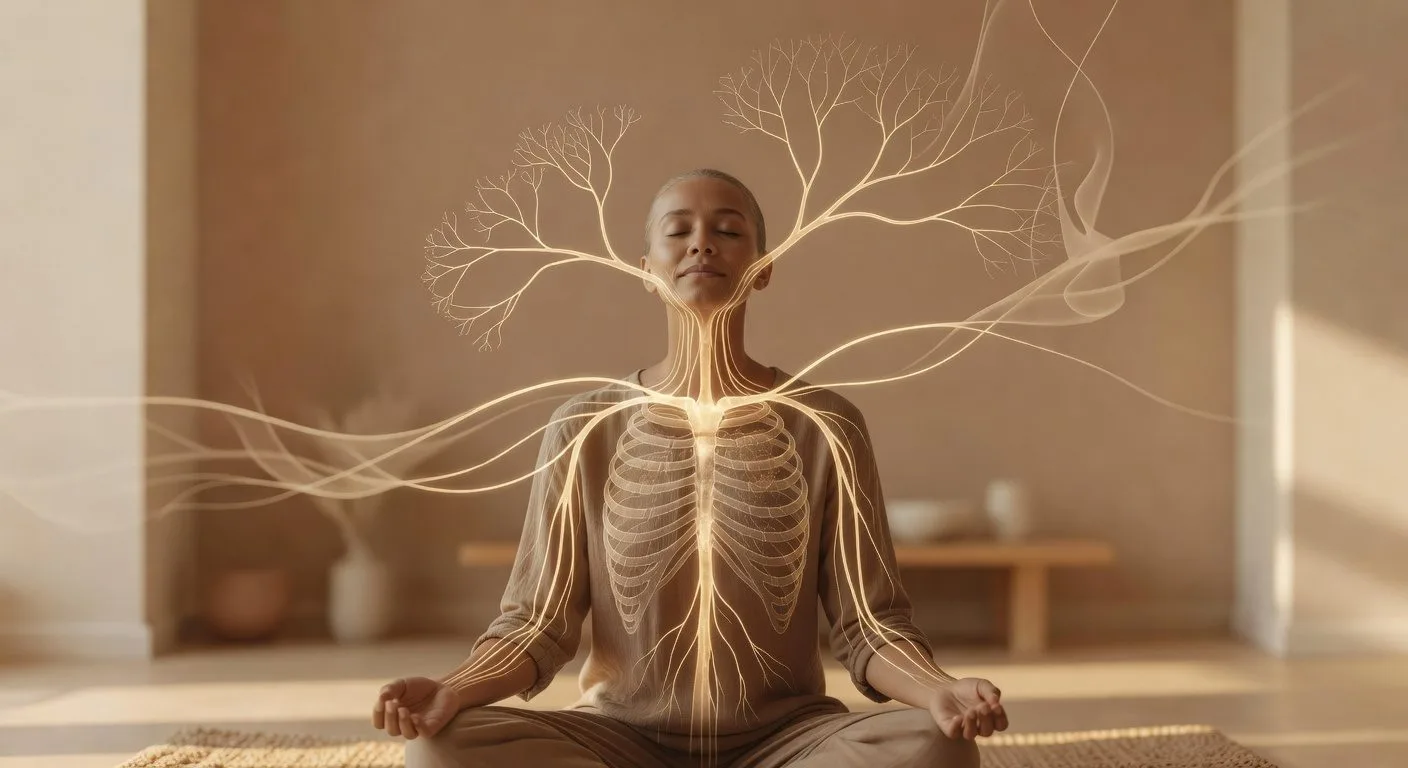
You open your mouth to say you're fine. But something tightens in your chest.
You feel it before you think it. A pressure in your chest, a knot in your stomach, a swallow that won't go down. Feeling emotions in your body doesn't start with a thought — it starts with a sensation. Most of us have unlearned how to listen. We live in our heads, analyze what we feel, and miss the signal the body already gave.
In this article, you'll discover where emotions are felt physically, what your nervous system tells you through those signals, and how to step by step reconnect with what lives in your body. Not nervous system theory — the practical translation into daily body awareness.
What is interoception?
Interoception is your inner sense that picks up signals from your body — heartbeat, breathing, muscle tension — and relays them to your brain long before you have words for them.
- What is interoception?
- Interoception is the ability to perceive signals from within your body — your heartbeat, breathing, muscle tension, and sensations in your organs. It is your 'inner sense of touch' that tells you how you are on the inside, long before your brain puts words to it.
Your nervous system communicates continuously through these signals. Your heartbeat quickens when something moves you. Your breathing becomes shallow when you're alert. Your shoulders rise when tension is present. This happens below your conscious threshold — you only notice it when you pay explicit attention. Research shows that interoceptive ability is central to how you experience and regulate emotions — not as a mental exercise, but as a physical skill you can train.
The good news: what you pay attention to, grows. Like a muscle, interoception gets stronger the more you practice. And you don't need to sit for an hour — two minutes a day is enough to begin.
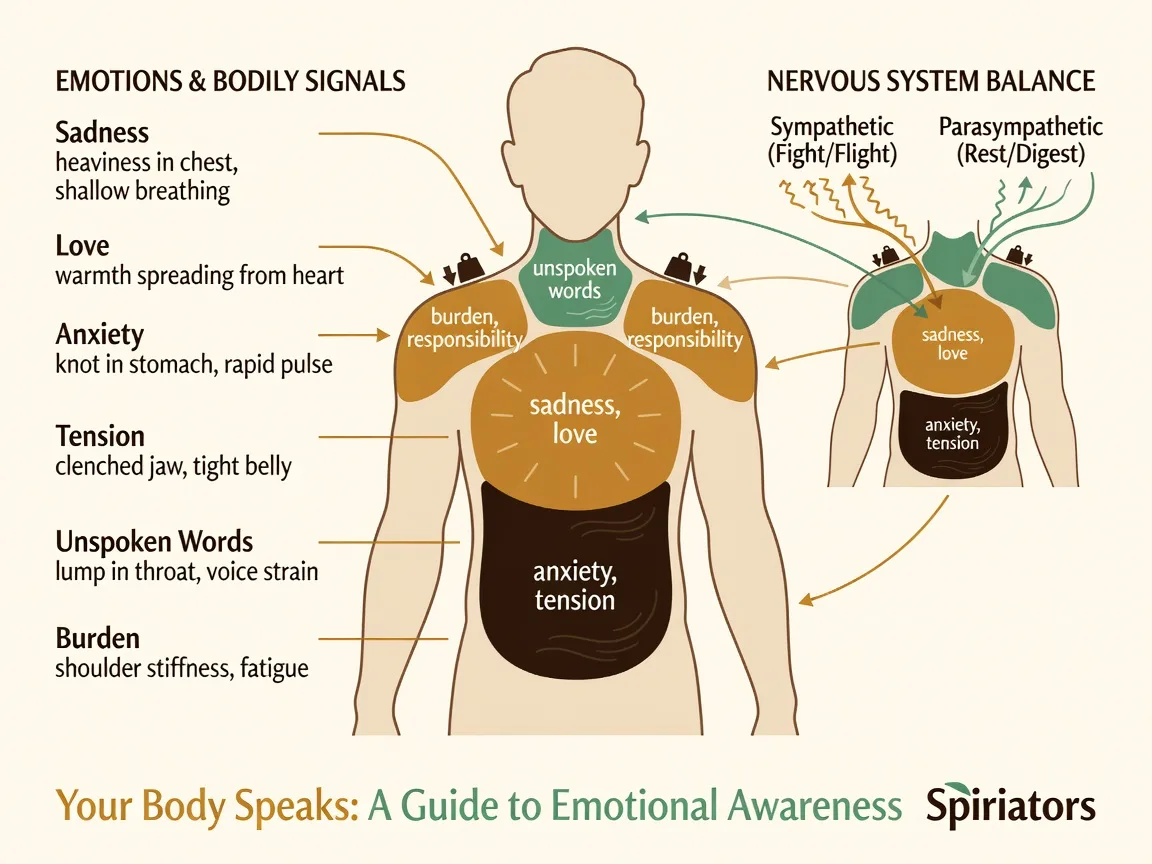
Where do you feel emotions in your body?
Every emotion has an address. Sadness lives in your chest. Anxiety resides in your belly. Anger sits in your shoulders and jaw. Love warms your heart. This isn't poetry — it's physiology that researchers worldwide have mapped.
Your body has its own map for emotions, and that map is remarkably universal. People from Finland to Japan point to the same regions for the same feelings. Your body doesn't respond randomly — it follows a pattern you can learn to read.
The table below shows where the most common emotions manifest physically:
| Emotion | Body location | Sensation | What it means |
|---|---|---|---|
| Sadness | Chest, heart area | Pressure, heaviness, emptiness | Something or someone has been let go or is missed |
| Anxiety | Belly, lower abdomen | Knot, butterflies, cold | Your nervous system anticipates danger |
| Anger | Shoulders, jaw, hands | Heat, tension, fists | A boundary has been crossed |
| Love | Heart, chest, whole body | Warmth, openness, flow | Connection and safety |
| Shame | Face, cheeks | Heat, shrinking, becoming small | Fear of rejection by the group |
| Joy | Whole body, head | Lightness, space, energy | Something touches what your essence knows |
What stands out: each emotion doesn't occupy a single point, but a region. You often feel multiple emotions at once — a knot in your stomach could be anxiety, but also excitement. The difference lies in the nuance of the sensation and the context in which it arises. A heaviness in your chest with sadness feels different from pressure with anxiety, even though it's in the same spot.
Why your nervous system makes emotions physical
Your autonomic nervous system is the unconscious network that controls your organs — it regulates your heartbeat, breathing, and digestion without you thinking about it, and it's the physiological foundation of every emotion.
Emotions are evolutionarily physical reactions that prepare you for action. Fear raises your heart rate and tenses your muscles so you can flee. Anger sends blood to your arms so you can fight. Sadness slows your system to create space for processing. These reactions are controlled by your autonomic nervous system via the vagus nerve — the information highway between your organs and your brain.
You feel emotions physically because your nervous system literally influences your organs, muscles, and tissues. It's not a metaphor. It's physiology. Polyvagal theory describes how smoothly shifting between autonomic states — safety, activation, relaxation — is essential for emotional health. When that shifting flows, you feel an emotion arise, move, and pass. When it gets stuck, the emotion lingers — literally, in muscle tension that won't release.
Thinking about emotions versus feeling emotions
Most of us were raised in our heads. We analyze what we feel instead of feeling it. "I am sad because..." is a story. The pressure in your chest is the experience.
The difference isn't subtle. It's the difference between talking about water and swimming. When you think about an emotion, you activate the analytical part of your brain. When you feel an emotion, you activate the interoceptive network — the part that processes signals from your body. These two systems can't be dominant at the same time. When you're analyzing, you're moving past feeling.
Pro-tip: The next time you say "I feel...", stop after those two words. Don't go to "because." Stay with the sensation. Where do you feel it? What's the texture? Warm, cold, pressing, pulsing? That's where the emotion lives — not in the story around it.
Your nervous system registers emotions faster than your conscious brain can name them — about 0.3 seconds faster. That means your body is already responding before you have words for it. When you learn to notice that first signal, you don't have to wait for an emotion to explode to know what's happening. You catch it at a whisper, instead of at a shout.
When you can't feel: alexithymia
Some people don't feel emotions as sensations, but as confusion or physical complaints. Headaches without cause. Stomach pain that comes and goes. A permanent sense of emptiness that can't be named.
- What is alexithymia?
- Alexithymia is a trait where someone has difficulty recognizing, naming, and describing their own emotions. People with alexithymia often experience emotions only as physical complaints — such as headaches or stomach pain — without being able to interpret the underlying emotional layer.
This isn't "not wanting to feel" — it's "not being able to feel." And it's more common than you think. A meta-analysis of 32 studies shows that reduced interoception is associated with alexithymia — difficulty identifying emotions is directly linked to diminished body awareness. Interoceptive confidence — the trust that your body signals are accurate — is a protective factor.
If this sounds familiar: you're not broken. Your body is communicating — you just haven't learned to decode the signals yet. That's a skill, not a shortcoming. And like any skill: you can learn it.
How to learn feeling emotions in your body
Learning to feel starts small. Not with an hour of meditation, but with two minutes of stillness. Not with analysis, but with noticing. Here are four exercises you can start today:
1. The 2-minute body scan
Sit down, close your eyes, and scan from your feet to your crown in two minutes. Notice what you feel: warmth, tension, tingling, heaviness. Label nothing as good or bad. This is your daily check-in with your nervous system — a conversation, not an exam.
2. Breath as a bridge to emotion
When you feel an emotion arising — or when you don't feel one — place a hand on the spot in your body where you notice something. Breathe consciously into that area five times. Don't ask "why do I feel this?" but "what exactly do I feel here?" The breath is the bridge between your conscious attention and your unconscious nervous system.
3. The emotion body map
Draw a simple outline of a body on paper. Think of a recent emotion — joy, frustration, sadness — and color in where you felt it. Do this every evening for a week. You'll discover patterns in how your body processes emotions. Some emotions always sit in the same spot. Others move around.
4. The safety scan
Ask yourself three times a day: "Does my body feel safe right now?" Scan your shoulders (raised = alarm), your belly (soft = safe, tense = watchful), your breath (high and fast = stress, low and slow = rest). This trains your neuroception — the ability to recognize your autonomic state without judging it.
A randomized study shows that interoceptive training not only improves the ability to recognize body signals, but also increases confidence in that ability. You don't just learn to feel — you learn to trust what you feel. That's the difference between knowing something is there and daring to listen to what it says.
Pro-tip: Want to discover how your breathing pattern affects your nervous system? Take the free breath check and get immediate insight into your breathing and stress level. It takes two minutes and tells you more than an hour of thinking.
Yin yoga and breathwork as a bridge to your body
Yin yoga opens the body in a way that makes held emotions accessible. In a yin yoga session, you stay in a pose for five minutes — not to stretch deeper, but to feel what moves when you become still. The fascia relaxes, the muscles let go, and what's underneath surfaces. Sometimes that's an emotion you've been carrying for a long time without knowing.
Breath is the fastest route to your autonomic nervous system — you can't directly stop your thoughts, but you can steer your breath. Breathwork works complementary to yin. Where yin opens the body, breathwork coaching opens the nervous system. Through connected breathing, you make contact with emotions held in your body — not by analyzing them, but by giving them space.
If you recognize this — living in your head, missing the signals, sensing something is there that you can't reach — you're not alone. Read more about how polyvagal theory works, discover exercises to stimulate your vagus nerve, or learn how connected breathing resets your nervous system. And if you want to understand how yin yoga releases emotions, read about the connection between fascia and emotions.
You don't have to do it alone. In a personal breathwork coaching trajectory, you'll learn step by step how to make contact with what lives in your body through your breath. No theory — experience. And if you want to feel what yin does for you first, try a 1:1 yin yoga session with Tessa. Or use our free breathing timer to calm your nervous system in five minutes.
Key takeaways
- Emotions live in your body, not in your head. They manifest as physical sensations — pressure, warmth, tension, knots — before you have words for them.
- Interoception is a trainable skill. Like a muscle, body awareness grows stronger the more attention you give it.
- Every emotion has a body region. Sadness in the chest, anxiety in the belly, anger in the shoulders. The map is universal.
- Thinking about emotions isn't the same as feeling them. Analysis activates your intellect; feeling activates your interoceptive network. You can't do both at once.
- Breathwork and yin yoga are the fastest bridges back to your body. Breath directly influences your nervous system; yin opens the tissue where emotions are held.
- If you can't feel, you're not broken. Alexithymia is disrupted interoception, not a flaw. It can be trained.
If this resonates — if you recognize that you live more in your head than in your body — there's a way back. Not through more thinking, but through more feeling. Get in touch for a no-obligation conversation, or start small with the free breathing timer. Your body has been waiting for you your whole life. It's time to listen.