You open your mouth. The words are ready. But something tightens.
Not in your throat. Not in your chest. Deeper. Somewhere you can't name. And in that moment of tightening, you have two choices: breathe through it, or live around it.
Five years ago, Tessa and I chose the first. Not because we were heroes. Because we were tired. Tired of fixing. Tired of solving. Tired of thinking that change is something you sort out between coffee and lunch.
From Tool to Lifestyle: Our Discovery
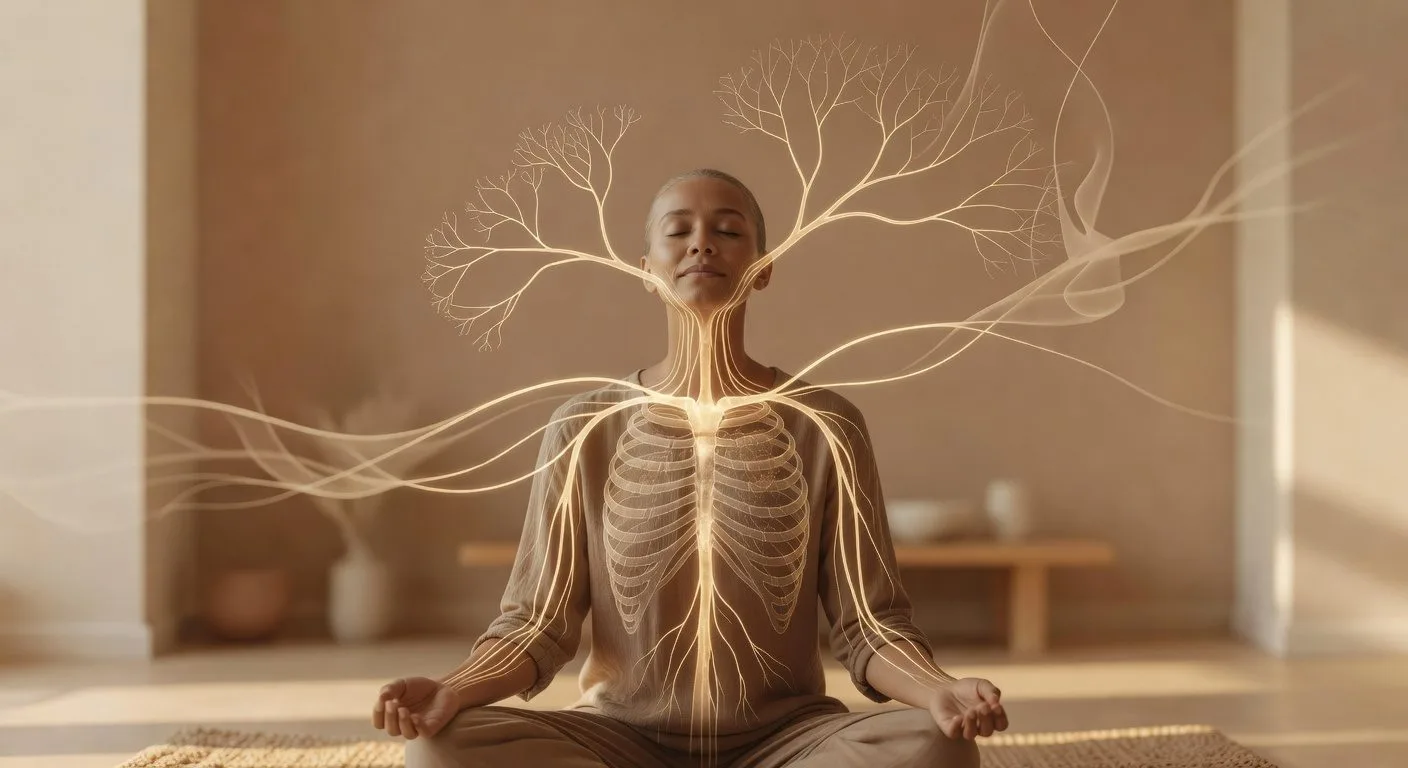
The vagus nerve is the longest cranial nerve, connecting your brain to your heart, lungs and gut, where it regulates your rest-and-recover response.
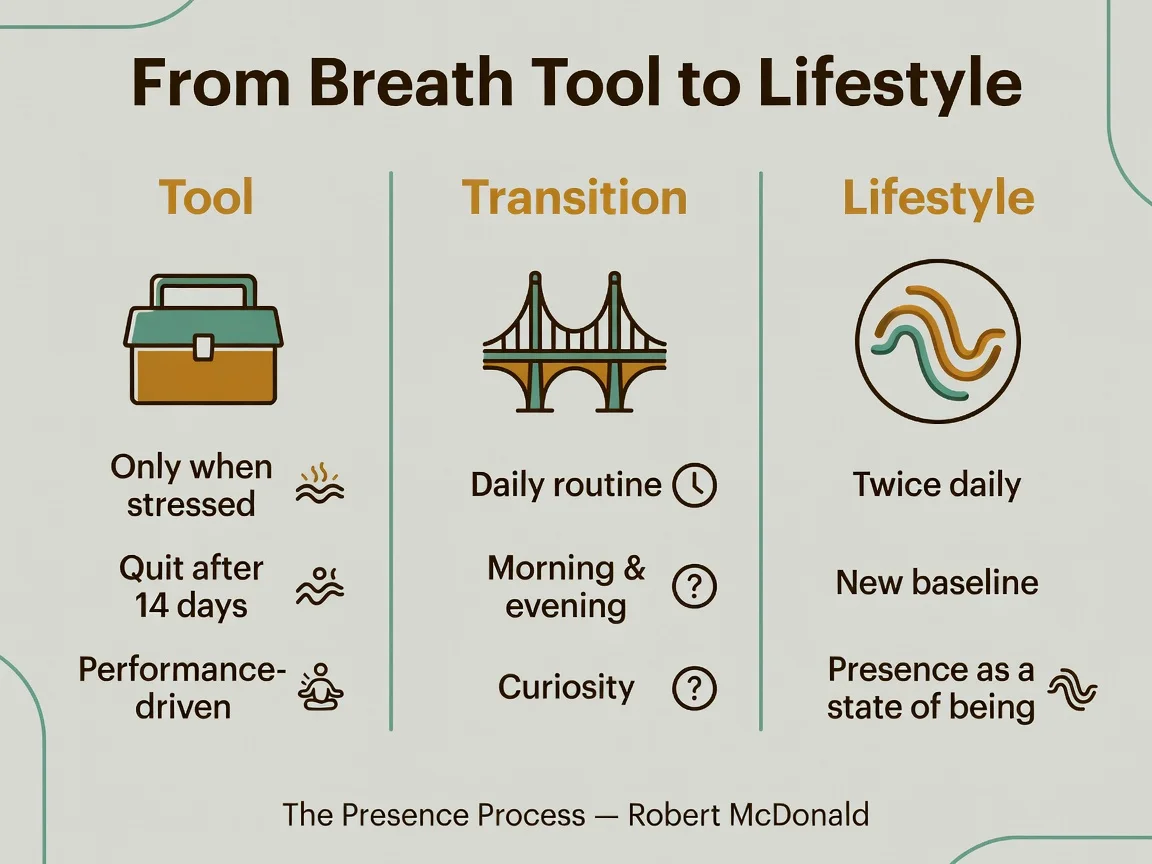
We thought we could "hack" it. A few minutes of box breathing before a meeting. A quick Wim Hof session when we felt sluggish. Breath as a tool — you grab it when something's broken, and put it back in the toolbox when it works.
But tools repair. Tools don't transform.
The shift didn't come with a bang. It came with a book. The Presence Process by Michael Brown. And one sentence that changed everything: "Presence instead of progress."
- What is The Presence Process?
- The Presence Process is a method developed by Michael Brown involving twice-daily connected breathing, focused on cultivating presence instead of solving problems. It is not a technique you apply temporarily, but a lifelong practice that fundamentally changes your relationship with yourself and the world.
Suddenly we understood. We had approached breathwork like a toolbox. But what if breath isn't a tool? What if breath is the space in which all tools exist?
If you want to understand how breathing affects your nervous system, read our Connected Breathing & Nervous System blog for a deeper dive into the physiology.
What Is Connected Breathing?
Connected breathing is a breathing technique where the inhale and exhale flow seamlessly into each other, without pauses in between. This continuous breath stream activates the parasympathetic nervous system, moves stored tension, and opens the door to deeper layers of consciousness and emotional processing.
It sounds simple. In practice, it's anything but.
Imagine: you're lying on your mat. You start breathing. In-out, in-out, without pause. The first two minutes you feel great. The third minute your chest starts tightening. The fourth minute you want to give up. The fifth minute you feel an emotion rising that you haven't felt in years.
And then you have two choices: stop (tool mode) or continue (lifestyle mode).
Pro-tip: The days you least feel like breathing are often the most important sessions. Resistance isn't a sign it's not working — it's an invitation to feel what lies beneath the resistance.
New to connected breathing? Our Connected Breathing beginner's guide helps you get started with practical tips for your first sessions.
Our Daily Practice: Morning and Evening
What does it look like when breath is no longer a tool, but a lifestyle? For us, it means: twice a day. Every day. No exceptions.
Morning (06:30, Thailand time): We wake up. No phone. No coffee. First, the mat. Fifteen minutes of connected breathing. The world can wait. In those fifteen minutes, we're alone with ourselves — and with what the night left behind.
Evening (20:00, Thailand time): The day is done. Everything that happened — the conversations, the decisions, the moments of clarity and the moments of doubt — is allowed to be there. The evening session isn't a correction. It's a closing. A way of saying: this was the day. And I was there.
| Tool Mode | Lifestyle Mode |
|---|---|
| Only during stress or crisis | Twice daily, always |
| "I have to do this" | "This is who I am" |
| Result-oriented (less anxiety, better focus) | Process-oriented (presence as a state of being) |
| Stop when it "works" | Continue, regardless of whether things are good or bad |
| Breath as repair | Breath as relationship |
Why Twice a Day?
Research on habit formation shows that the time to automate a new habit varies greatly per person — from 4 to 335 days, with a median of about 60 days. But with breathwork as a lifestyle, it's not about the habit itself.
It's about the shift in perspective.
Once a day is an exercise. Twice a day is a rhythm. It creates an arc around your day — a morning anchor and an evening closing. Between those two moments, life is allowed to happen. And when life gets hard (and it does), you have two anchor points to return to.
We noticed something interesting: after about six weeks of breathing twice daily, something fundamental changed. It wasn't that we had less stress. It was that our relationship with stress changed.
Stress was no longer an enemy to be defeated. It was a signal. An invitation. A moment to feel: what's actually happening right now?
The Resistance That Came (And Went)
Let me be honest: there were days we hated it. Days when the mat looked at us like an accusation. Days when we made excuses. Not today. Tomorrow again. I'm too tired. It's not working anyway.
The resistance isn't a bug. It's a feature.
Michael Brown writes in The Presence Process that emotional triggers are not problems to be solved, but invitations to feel consciously. The days we least wanted to breathe were precisely the days we needed it most.
There was one morning, about three months in, when Tessa said: "I can't do this anymore." She was lying on the mat, tears flowing, and she wanted to stop. I kept breathing beside her. Not to fix her. Not to save her. Just to be present.
After that session, she said: "I thought I was too tired to breathe. But I was too tired not to breathe."
That was the moment it shifted. Not from tool to lifestyle. From having to to getting to.
What It Did to Our Relationship
Breathing together is different from breathing side by side.
When you and your partner share the same space, breathe at the same rhythm, and move through the same resistance, something happens that words can't capture. It creates a shared language — a language of presence.
We noticed our conversations changed. Fewer arguments about who was right. More moments of: "What are you feeling right now?" Less judgment. More curiosity.
Not because we became better people. But because we learned to be present with what was — in ourselves, and in each other.
Pro-tip: Breathe together. It strengthens not only the practice, but also the relationship. Breathing together creates a shared space of presence where words sometimes become unnecessary.
The Science Behind the Practice
You don't have to take our word for it. Science is starting to see it too.
A 2026 study showed that conscious connected breathing produces significant improvements in mood, sleep quality, and sexual function in women with fibromyalgia — and that the effects go beyond stress reduction alone (Uysal et al., 2026).
Another study concluded that most breathwork techniques share the same neurophysiological mechanisms that promote wellbeing, regardless of theoretical differences between specific techniques. The key is not which technique you choose, but that you practice consistently (Siebieszuk et al., 2025).
But here's the interesting part: none of these studies are about "tools". They're about practice. About consistency. About the difference between doing something when there's a problem, and being something when there's no problem.
Want to know what a 21-day schedule looks like? Check our Breathwork at Home: 21-day schedule for a structured build-up of your practice.
How to Start (If Twice a Day Feels Like Too Much)
Let me be clear: this isn't a "14-day challenge". This isn't a "try it for a week and see how it goes". This is an invitation to change your relationship with yourself.
But if twice a day feels like too much, start small:
- Start with one session per day — If twice a day feels like too much, start with one morning session of 15 minutes connected breathing. It's not about quantity, it's about consistency.
- Link breath to an existing ritual — Breathe immediately after waking up (before you pick up your phone) and right before going to sleep. By linking breath to existing anchor points in your day, it quickly becomes a natural part of your rhythm.
- Let the resistance be there — The days you least feel like breathing are often the most important sessions. Resistance isn't a sign it's not working — it's an invitation to feel what lies beneath the resistance. Breathe through it, not around it.
- Breathe together — Johannes and Tessa breathe together. It strengthens not only the practice, but also the relationship. Breathing together creates a shared space of presence where words sometimes become unnecessary. Invite your partner, friend, or housemate to a shared session.
- Keep a breath journal — After each session, write one sentence: what did you feel? No analysis, no judgment — just observation. Reading back after a month shows how your relationship with your breath — and with yourself — has changed.
What's the Difference With Other Breath Methods?
Where many breath methods focus on a specific result — less stress, better focus, deeper relaxation — The Presence Process focuses on the process itself. The goal is not to get somewhere, but to be fully present where you are now.
Michael Brown calls this "presence instead of progress." It is not a technique you master, but a relationship you enter into — with your breath, your body, and ultimately with life itself.
Wim Hof? Great for energy. Box breathing? Perfect for focus. But The Presence Process? That's for when you're done with fixing yourself.
Key Takeaways
- The Presence Process is a twice-daily connected breathing method developed by Michael Brown — not a quick fix, but a lifelong practice of presence.
- Connected breathing is a technique where inhale and exhale flow seamlessly without pauses — this activates your parasympathetic nervous system and moves stored tension.
- The difference between tool and lifestyle is fundamental: a tool repairs, a lifestyle transforms. A tool is used when there's a problem, a lifestyle is always there.
- Breathing twice a day creates a rhythm around your day — a morning anchor and an evening closing — that helps you stay present regardless of what life brings.
- Resistance isn't a bug but a feature: the days you least want to breathe are often the days you need it most.
- Breathing together strengthens not only the practice, but also your relationship — it creates a shared language of presence.
- Science confirms what practitioners already knew: daily breathwork practice has measurable long-term effects on mental health, sleep quality, and emotional regulation.
If This Resonates
Maybe you recognize something in this story. Maybe you've tried breathwork and couldn't sustain it. Maybe you're looking for something that goes beyond a temporary fix.
Experience it yourself — book a free 30-minute breathwork coaching trial session and discover how connected breathing can work for you. No obligations, just experience.
Or start today with our free breathing timer to structure your own daily breathing sessions. Set your desired breathing rhythm and let the timer guide you.
Want to go deeper? In our 1:1 breathwork coaching, you learn to integrate connected breathing as a lifestyle. Johannes guides you in building a daily practice that fits your life.
And if you want to know more about The Presence Process itself, Michael Brown's book is the foundation of this lifestyle. Not a self-help book, but a practical guide to presence as a state of being. The Presence Process Portal.
Breath isn't a tool. Breath is a lifestyle. And it starts with one conscious inhale.