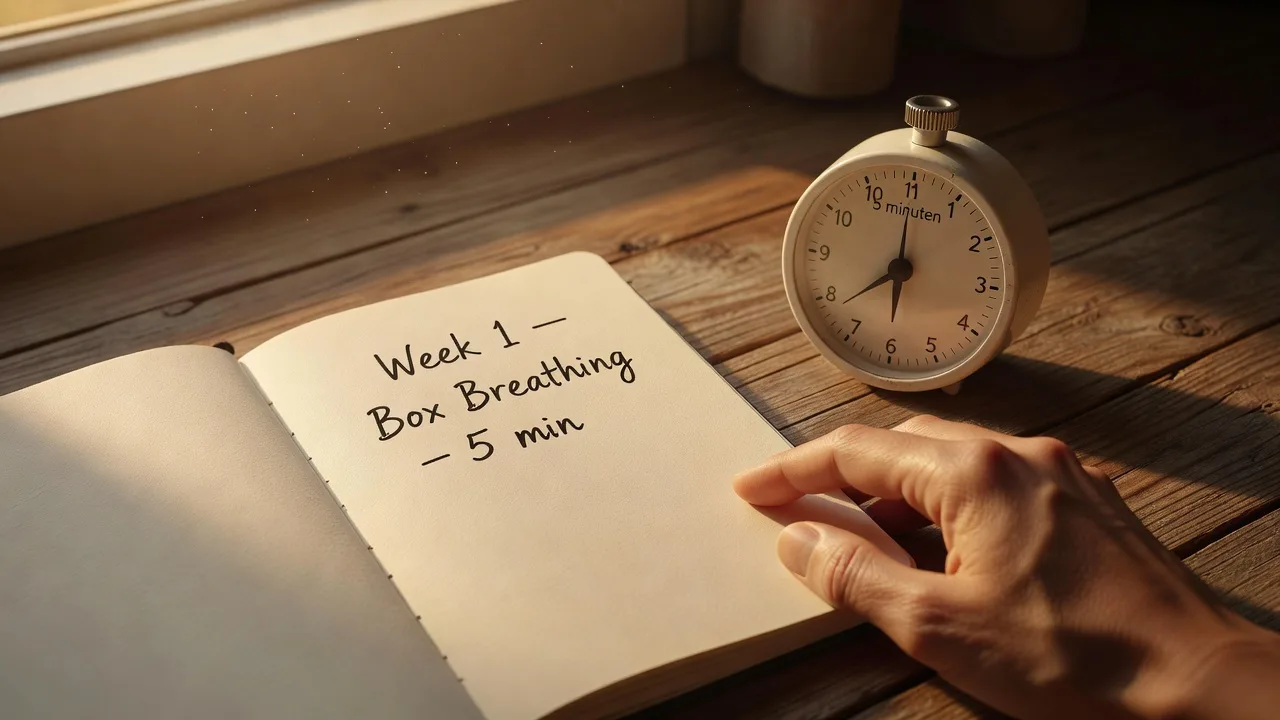
You open your mouth. The words are ready. But something tightens. Your breath becomes shallow. Your shoulders rise. And that voice whispers: "If I start now, I won't stick with it anyway." Recognizable? You're not alone. Thousands of people want to "do something with breathwork" — but hesitate because of coaching costs, the vulnerability of a 1:1 session, or simply finding the right guidance. At the same time, just starting breathwork on YouTube is risky: wrong technique, too intense, no integration.
This 21-day schedule offers a way out. An evidence-based, safely progressive program you can do at home without a coach. No quick-fix, no "transform your life in 3 weeks" promise — just a structured build-up from 5 minutes of box breathing to 20 minutes of connected breathing, grounded in peer-reviewed research on breathwork, HRV, and stress regulation.
- What is breathwork (ademwerk)?
- Breathwork — in Dutch often called ademwerk — is the conscious steering of your breathing to influence your nervous system, emotions, and physical state. It includes techniques like box breathing, coherent breathing, and connected breathing — each with its own rhythm, pace, and effect on the autonomic nervous system.
The vagus nerve is the longest cranial nerve, connecting your brain to your heart, lungs and gut, where it regulates your rest-and-recover response. This nerve is the main pathway through which your body returns to balance after stress — and breathing is the fastest way to activate it.
Research shows what you already feel: self-compassion calms your nervous system. A narrative review of 30 studies concludes that slow, nasal, diaphragmatic breathing significantly improves vagal tone, HRV, and parasympathetic activity, while lowering cortisol, anxiety, and stress Little (2025).
- What is a 21-day breathwork schedule?
- A 21-day breathwork schedule is a structured program where you practice a specific breathing technique daily, progressively increasing in intensity over three weeks. The 21-day duration is based on behavioral psychology research on habit formation: it takes an average of 18 to 254 days to form a new habit, with 21 days being an achievable first milestone for daily consistency.
Why 21 days and not 7 or 30? Research on habit formation shows that new routines take an average of 18 to 254 days to become automatic — 21 days gives you enough time to build a foundation without being overwhelming. It is long enough to measure physiological changes in HRV and short enough to sustain.
A comprehensive review comparing the most commonly used breathing techniques concludes that most techniques share neurophysiological mechanisms that promote well-being, regardless of theoretical differences Siebieszuk et al. (2025). Consistency and regularity matter more than the specific technique.
Pro-tip: The first effects — such as a calmer feeling and better focus — are often noticeable after 3-5 days. Physiological changes in heart rate variability (HRV) are measurable after 2-4 weeks of consistent practice, according to research on slow breathing and HRV biofeedback Giorgi & Tedeschi (2025). Even brief daily sessions have measurable effects on HRV and vagal tone.
Why practice at home without a coach?
You might wonder: can I safely do this on my own? The answer is yes — provided you start with low-intensity techniques and build up gradually. This 21-day schedule begins with 5 minutes of box breathing and only progresses to more intensive techniques in week 3.
A randomized placebo-controlled trial shows that even brief, remotely guided breathwork sessions provide significant improvements in well-being and stress reduction — relevant evidence that home-practiced breathwork without a physical coach can be effective Fincham et al. (2024).
Avoid connected breathing without guidance if you have epilepsy, heart conditions, or severe mental health conditions. For everyone else, this schedule is a safe introduction.
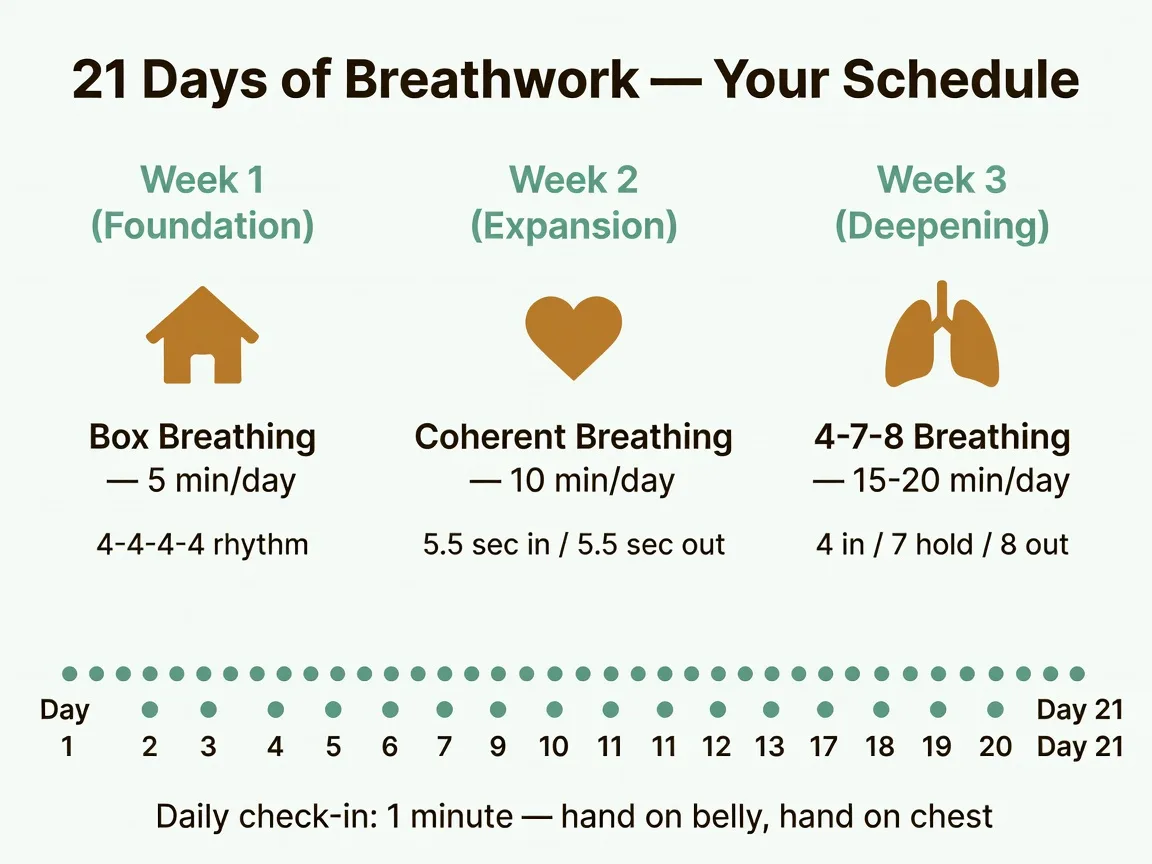
Week 1: Foundation (Day 1-7) — Box Breathing
Start with 5 minutes of box breathing daily (4 seconds in, 4 hold, 4 out, 4 hold). Do this in the morning, sitting with a straight back. This activates your parasympathetic nervous system and builds the foundation for deeper breathing techniques.
Breathe in through your nose for 4 seconds, hold for 4 seconds, breathe out through your mouth for 4 seconds, hold for 4 seconds. Repeat. This is your foundation: it activates the parasympathetic nervous system, lowers cortisol, and trains your interoceptive awareness.
| Day | Exercise | Duration | Rhythm | Contraindications |
|---|---|---|---|---|
| 1-7 | Box Breathing | 5 min | 4-4-4-4 | None — safe for everyone |
Do this in the morning before breakfast, sitting on a chair with a straight back. No pillow, no yoga mat — just upright, feet flat on the ground.
Pro-tip: Use our free breathing timer — with preset rhythms for box breathing (4-4-4-4) and coherent breathing (5.5 sec), right in your browser. No apps, no watch — just open your phone and breathe along.
Week 2: Expansion (Day 8-14) — Coherent Breathing
Increase to 10 minutes of coherent breathing daily (5.5 seconds in, 5.5 seconds out, nasal breathing). This brings your breathing to the resonance frequency of your heart rhythm for maximum HRV. Use a timer or app for the rhythm.
Breathe in through your nose for 5.5 seconds, out through your nose for 5.5 seconds. This brings your breathing to the resonance frequency of your cardiovascular system — the point where HRV is maximal. You're training your vagal brake here — your vagus nerve's ability to quickly lower your heart rate after stress.
Coherent breathing is the bridge between box breathing and deeper techniques. It feels more natural than box breathing — no holding, just an even rhythm.
Week 3: Deepening (Day 15-21) — 4-7-8 Breathing
Build up to 15-20 minutes of 4-7-8 breathing (4 seconds in, 7 hold, 8 out). The extended exhale maximizes vagal activation. Combine with a body scan: feel where tension sits and release it during the exhale.
Breathe in through your nose for 4 seconds, hold for 7 seconds, breathe out through your mouth for 8 seconds with a soft "whoosh" sound. The extended exhale activates the ventral vagus maximally — this is your deepest rest state.
Combine with a body scan: feel where tension sits in your body during the exhale and release it. Start at your toes and work upward to your head.
Daily Check-in (Every Day) — 1 Minute
Before each session: eyes closed, one hand on belly, one on chest. Breathe normally 3 times. Observe where your breath sits and how you feel. Write 1 sentence after the session. This check-in trains your interoceptive awareness.
Before you begin: close your eyes, place one hand on your belly and one on your chest. Breathe normally 3 times. What do you feel? Where is your breath — high in the chest or low in the belly? This check-in trains your interoceptive awareness — the foundation of all breathwork.
Optional: Introduction to Connected Breathing (Day 18-21)
Only if weeks 1-2 went comfortably. 15 minutes of continuous mouth breathing without pause between inhale and exhale. Active inhale (belly), passive exhale. Lying down, eyes closed. Stop if dizzy. Consider booking a guided session on day 22.
Breathe continuously in and out through your mouth, without pause between inhale and exhale. Active inhale (belly), passive exhale (relaxation). Do this lying down, eyes closed. Stop if you feel dizzy or tingling. This is an introduction — not a full session.
Pro-tip: If you feel dizzy or tingling, stop immediately. Breathe normally and wait until the feeling passes. This is a sign you're breathing too fast or too deeply — not that something is wrong.
What if I miss a day?
If you miss a day, simply continue where you left off the next day — do not catch up or start over. The schedule is designed with progressive intensity; going back or doubling up disrupts that progression. Consistency matters more than perfection. One missed day in 21 is 95% compliance — and that is excellent.
Which technique suits me as an absolute beginner?
Start with box breathing (4-4-4-4): 4 seconds in, 4 hold, 4 out, 4 hold. This is the safest entry point — it activates the parasympathetic nervous system without risk of hyperventilation. You need nothing except a timer. From day 8, you expand to coherent breathing (5.5 breaths per minute) and 4-7-8 breathing.
Key takeaways
- Start with 5 minutes of box breathing (4-4-4-4) — safe for everyone, activates parasympathetic nervous system
- Build to 10 minutes of coherent breathing (5.5 sec in/out) in week 2 — maximum HRV at resonance frequency
- Week 3: 15-20 minutes of 4-7-8 breathing — extended exhale maximally activates ventral vagus
- Daily 1-minute check-in trains interoceptive awareness — hand on belly, hand on chest
- One missed day is not failure — simply continue where you left off, 95% compliance is excellent
- Avoid connected breathing without guidance if you have epilepsy, heart conditions, or severe mental health conditions
Your 22nd day: the moment to choose
You've practiced independently for 21 days. You've gotten to know your breath. You've noticed what it does for you — calmer, more focused, more present. Now is the moment to experience what a guided session adds.
A coach sees what you can't see: where your breath gets stuck, where tension sits, where old patterns surface. And a coach holds space for what emerges — without judgment, without rush.
Book a 1:1 breathwork coaching session and discover the difference a coach makes. From practicing alone to deepening together.
Want to learn more about breathing techniques?
Want to learn more breathing techniques? Read our comparison of box breathing, 4-7-8 and Wim Hof — with guidance on when to choose which technique.
Ready for the next step? Our connected breathing beginner's guide takes you beyond the basics — from theory to your first full session.
Or start with our 5 breathing exercises against stress — direct tools for difficult moments.
Deepen your practice
Want to know more about the science behind breathwork? Read our page on breathwork — with explanations of the nervous system, the vagus nerve, and different techniques.
Or discover how yin yoga and breathwork come together in a deep practice of release and trust.
Are you a digital nomad who travels frequently? Read our guide on breathwork for digital nomads — with location-specific routines for Bali, Lisbon, and Mexico City.
Stay in the loop
Subscribe to our newsletter via the contact form. Receive weekly breathwork exercises, scientific insights, and early access to new programs — straight to your inbox.
Or start our 30-day challenge — a free daily challenge that takes you further than 21 days.