Burnout isn't fatigue you can push through — it's a nervous system that has run through its reserves. Anyone doing an intense vinyasa class in this state often feels better during and just after. Endorphins, movement, focus. But 24 to 48 hours later the bill arrives: deeper exhaustion than before, poor sleep, irritability, emptiness. That's not coincidence. That's physiology.
Yoga can be one of the most powerful interventions in burnout — but only in the right form. The wrong style in the wrong phase demonstrably makes it worse. In this article: which yoga forms actually work for yoga for burnout, which to avoid until you're further into recovery, and how to build a progression that doesn't trigger relapse. Including the science behind it all.
What burnout physiologically does to your system
- What does burnout do physiologically?
- Physiologically, burnout is dysregulation of the HPA axis and autonomic nervous system: a flattened cortisol curve, low HRV, sympathetic system permanently slightly on. It is not “mental weakness,” but an empty system that needs recovery — not more pushing.
Burnout is not weakness and not a mental attitude — it's a measurable dysregulation of the HPA axis (hypothalamus-pituitary-adrenal) and the autonomic nervous system. Maslach and Leiter (2016) describe in World Psychiatry three core components: emotional exhaustion, cynicism/depersonalisation, and reduced personal effectiveness. But beneath these symptoms lies something concrete: the cortisol curve is flattened, heart rate variability (HRV) is low, the sympathetic nervous system is permanently slightly on, and parasympathetic recovery is blocked.
This explains why "just pushing through" doesn't work. The system has no energy to push with. Every effort that further burdens the sympathetic system — intense sport, deadlines, hot yoga, cold showers, intermittent fasting — pushes an empty system even deeper into exhaustion. What works: anything that reactivates the parasympathetic nervous system, slowly, patiently, daily. For broader context, read our article on how your nervous system remembers what the body experiences.
The three phases of burnout — and the yoga that fits
- Which yoga helps in burnout recovery?
- Yoga for burnout recovery follows the phase: first restorative, then yin yoga for burnout, later mild hatha. The wrong intensity at the wrong moment demonstrably worsens burnout recovery yoga — phasing is not a detail, but physiology.
Burnout isn't one state but a trajectory with phases. Each phase calls for a different yoga approach. Anyone ignoring this phasing gets stuck.
Phase 1: Acute exhaustion (week 0-4)
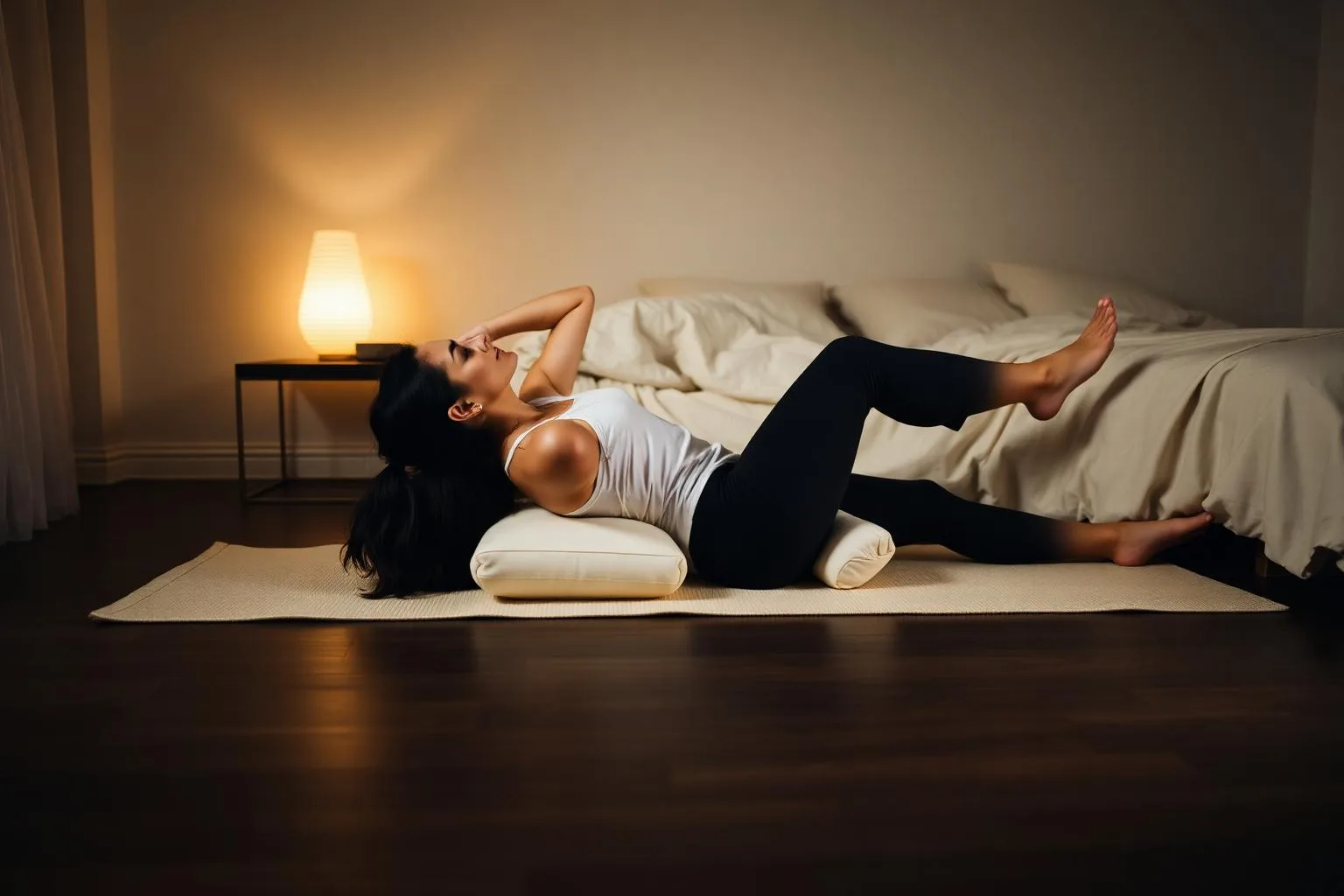
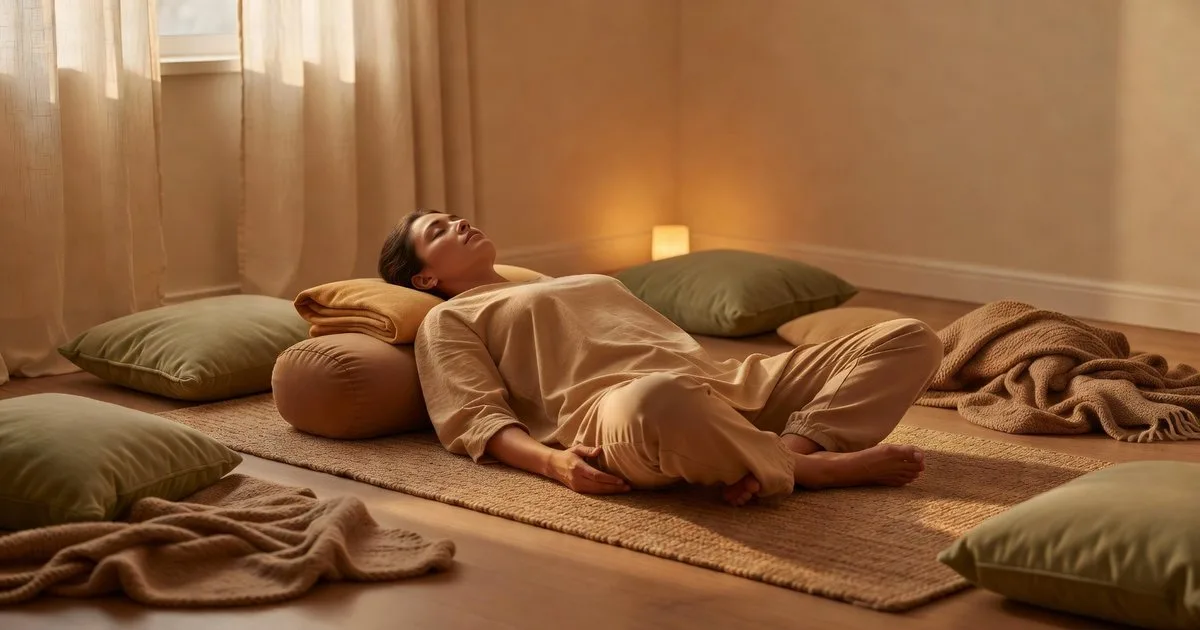
Symptoms: can't get out of bed, crying without reason, no concentration, physical pain without cause. What helps: restorative yoga — completely passive poses with bolsters and blankets, 15-20 minutes daily. No stretching. No "doing" breath exercises. Just lying, supported, breathing. The parasympathetic switch must be carefully re-taught to the nervous system.
Phase 2: Subacute recovery (week 4-12)
Symptoms: more energy, but still quickly exhausted. Better sleep alternates with bad nights. This is where yin yoga enters: 3-5 poses of 5 minutes, totalling 25-30 minutes. This actively trains vagal tone and slowly builds stress resilience. Add breathwork: 4-7-8 or slow nasal breathing. For those wanting to see how this connects, our article on yin yoga for sleep problems describes a similar protocol that also works in burnout recovery.
- What is yin / restorative yoga for burnout?
- Restorative yoga for burnout is fully supported, passive rest; yin yoga for burnout holds gentle poses longer to rebuild vagal tone. Together they form the core of gentle burnout recovery yoga: reactivating the parasympathetic system without emptying the system again.
Phase 3: Re-integration (month 3-6)
Symptoms: most energy back, sleep stable, interest in things again. Now hatha yoga can join — a few times a week, 30-45 minutes, at 50-70% of what you used to do. Hatha provides movement without overstimulating the nervous system. Vinyasa and ashtanga stay reserved for when you're truly fully recovered — usually after 6 months, sometimes longer.
Which yoga to avoid — and why
Not every yoga helps. In fact: certain styles can worsen burnout. Below the four risk categories in acute and subacute phases:
- Vinyasa and power yoga — dynamic, fast styles activate the sympathetic nervous system. Pascoe et al. (2017) showed in Journal of Psychiatric Research that active yoga in highly stressed people actually raised the cortisol response rather than lowering it.
- Ashtanga — fixed, intensive 90-minute series. Too much discipline, too much volume, too much "performing" — exactly the mindset that caused burnout.
- Hot yoga / Bikram — extreme heat (35-42°C) heavily burdens the sympathetic system. What energises healthy people exhausts burnout patients further.
- Intensive pranayama (kapalabhati, bhastrika) — "fire breaths" are activating. Stick to slow, long breathing. See our article on breathing in yoga for which techniques do fit.
This isn't a verdict on these styles — they're fantastic for healthy, energetic people. But on an empty system they work like water on a burnt skin: irritating instead of healing.
What science says about yoga for burnout
The evidence base has become serious over ten years. The key studies:
- West et al. (2017) — RCT with 73 working adults with burnout symptoms. 8 weeks of daily gentle yoga (20 min) reduced emotional exhaustion by 33%, significantly lowered cortisol, and improved sleep quality.
- Lin et al. (2015) — Meta-analysis of 8 RCTs in burnout and compassion fatigue (nurses, teachers). Yoga produced an effect size of 0.74 on the Maslach Burnout Inventory — clinically very relevant.
- Pascoe et al. (2017) — Review of 42 studies in Journal of Psychiatric Research. Conclusion: gentle yoga lowers cortisol consistently; intensive yoga does not, or raises it in stressed populations.
- Riley & Park (2015) — Review in Health Psychology Review: yin/restorative yoga + breathwork is the combination with the strongest effects on autonomic regulation.
The throughline: slow beats intense. Not because gentle is "better", but because it fits what an exhausted system can handle and needs.
A 30-day protocol for burnout recovery
For those currently in burnout wanting to start, this is what works in practice. No perfection — consistency.
Week 1-2: restorative only. Three poses daily: supported butterfly (supta baddha konasana, 7 min), legs-up-the-wall (viparita karani, 7 min), savasana with blanket (6 min). 20 min total. No breath exercises, no music, no guidance. Just lying.
Week 3-4: add slow breathing. Do the same poses, but add a 4-6 breath (4 in, 6 out) in viparita karani. Not longer, not more intense — just attention to the exhale.
Week 5-8: introduce yin. Alternate restorative with yin yoga. Classic yin poses like dragon, snail and swan — 3-5 minutes each. Start with 2 yin days per week, build to 4. Other days remain restorative. Never start yin if you still wake up tearful or overstimulated.
Week 9-12: re-integration. Add one hatha class per week (45 min, 50% intensity). Rest stays yin and restorative. Monitor your energy 48 hours after each hatha class: do you feel better or worse? Worse? Step back.
For those wanting structure, consider our 30-day practice — a daily programme tailored to recovery phases. Or explore the course library, where nervous system regulation and gentle yoga are central themes. For those who want to use breath as the entry point: see our breathwork coaching.
When yoga is not enough
Honestly: yoga is a powerful part of burnout recovery, but no miracle cure. Severe burnout with depressive symptoms, suicidal thoughts or physical breakdown requires medical and psychological care. Yoga works best as a complement to a broader approach — not as a replacement.
But for anyone recovering from overload, chronic stress or mild-to-moderate burnout, yoga — in the right form — is one of the most effective, cheapest and most sustainable interventions there is. No waiting list, no prescription, no side effects. Just a mat, some cushions, and the wisdom to choose slow in a world that rewards fast.
Start today. Restorative. Twenty minutes. And tomorrow again.
Go deeper: Read our pillar pages on yoga and breathwork, explore yin yoga, or consider a retreat to integrate body and mind.