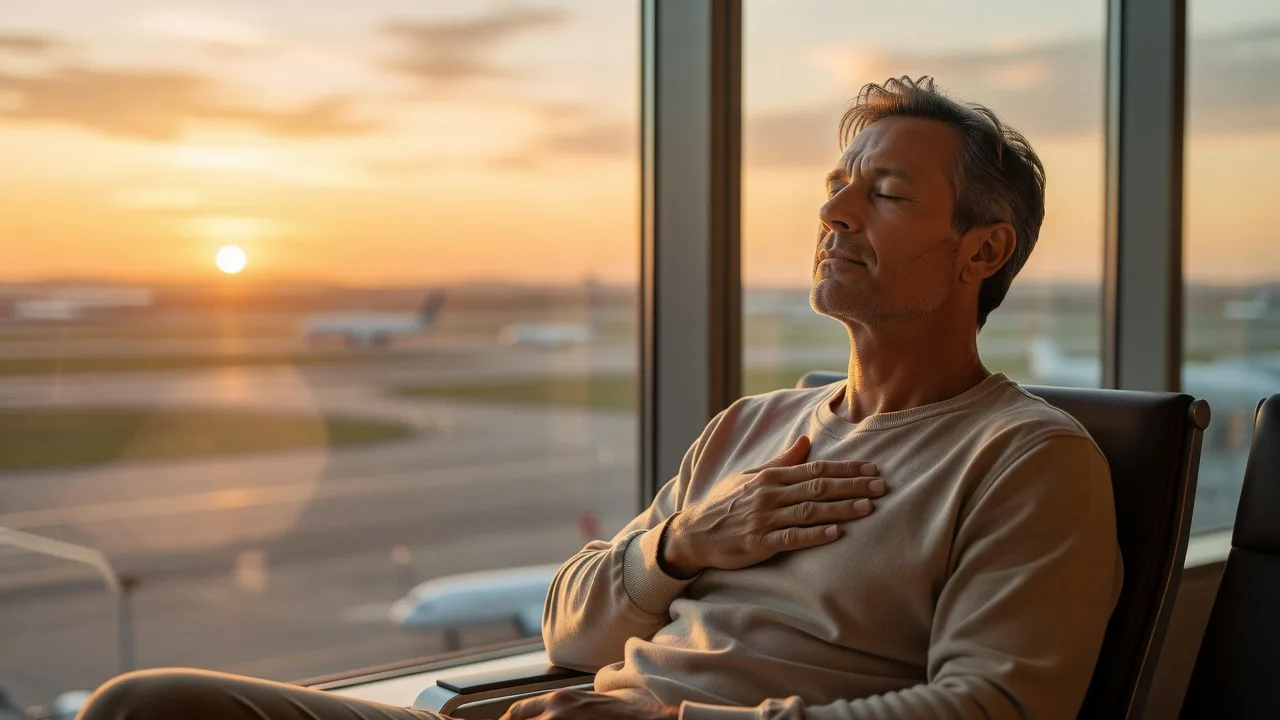
You open your laptop on a balcony in Canggu. The sun is barely up, but you feel like you've run a marathon. By six, the heat woke you. By seven, you were on your second coffee. By eight, you realized your breathing has been shallow and fast all morning. Your body is awake, but your nervous system is somewhere between yesterday and today.
A breathing routine for digital nomads doesn't mean sitting on a meditation cushion for an hour every morning. It means tuning your breath to what your body needs in this specific place — the heat of Bali, the sea breeze of Lisbon, the thin air of Mexico City. Because your breath is the one thing that travels everywhere with you, with no baggage fee.
In this guide, you'll get three location-specific breathing routines you can do in five to eight minutes, anywhere in the world. Plus an adaptation guide for your own destination.
Why your breathing works differently on the road
At home, you have a rhythm. Your bed is in the same place, the air has the same temperature, your body knows the routine. On the road, all of that is gone. Every new destination sends a different signal to your nervous system: tropical heat accelerates your breathing, altitude lowers your oxygen uptake, and a seven-hour time zone shift displaces your entire circadian rhythm.
Your body isn't broken on the road — it's adapting. But adaptation costs energy, and that energy comes from your breath. When your breathing is uncoordinated, you sleep longer, work slower, and feel foggier than necessary.
Research shows that travel significantly disrupts your circadian rhythm, and that combined interventions — light exposure, melatonin timing, and breathwork — accelerate recovery. A systematic review of 23 studies concludes that breathwork as a complementary intervention for circadian realignment is recommended.
- What is a breathing routine for the road?
- A breathing routine for the road is a short, location-specific set of breathing exercises that helps regulate your nervous system despite changing climates, time zones, and altitudes. Unlike a fixed home routine, it adapts to the physiological challenges of your destination — from tropical heat to thin mountain air.
That means you don't need one routine — you need three, for three different conditions. And that's what you'll get here.
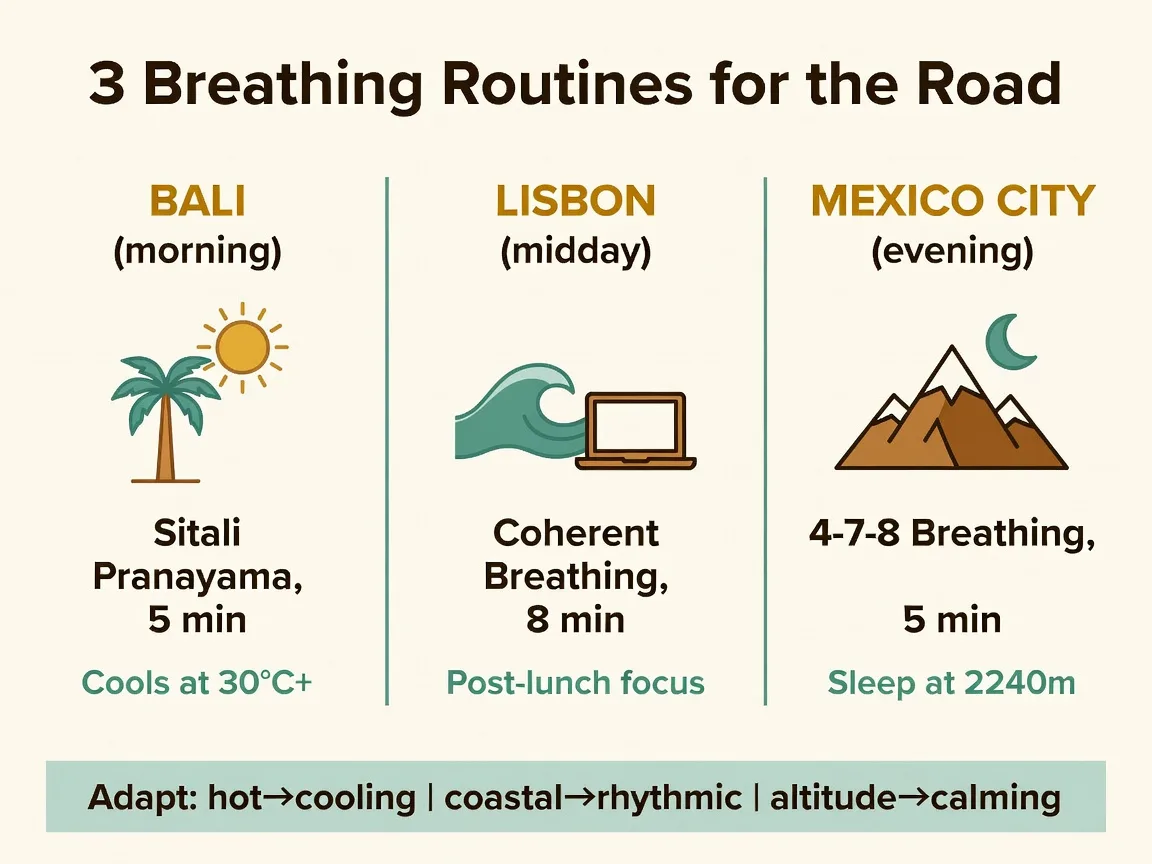
Bali: Morning routine for tropical heat
Sitali Pranayama is a cooling breathing technique where you inhale through the mouth as if sipping through a straw, cooling the air through moisture evaporation on your tongue and lips.
You wake up to the sun, not your alarm. Humidity is 85%, temperature already 28°C at seven. Your body responds with an elevated heart rate and faster breathing — it's trying to cool down, but cooling air through breathing only works when you do it consciously.
You curl your tongue into a tube. Or purse your lips if tongue-rolling doesn't work for you. Inhale for four seconds through the mouth as if sipping through a straw. Close your mouth. Exhale for six seconds through the nose. Twelve cycles. It sounds simple, but the effect is immediate: your heart rate drops, your breath deepens, and the heat feels less like an assault and more like background.
After Sitali, follow with three minutes of box breathing: four counts in, four hold, four out, four hold. Eight rounds. This stabilizes your heart rhythm after the cooling phase and grounds your nervous system for the workday — even if the tropical sun woke you at six.
| Step | Technique | Duration | Effect |
|---|---|---|---|
| 1. Cool down | Sitali Pranayama: 4 sec in through mouth, 6 sec out through nose | 5 min | Lower body temperature, parasympathetic activation |
| 2. Stabilize | Box Breathing: 4-4-4-4 through nose | 3 min | Stabilize heart rhythm, grounding for workday |
Pro-tip: If you can't roll your tongue, purse your lips as if breathing through a straw. The cooling effect is nearly identical — it's about airflow over moist mucous membranes, not the exact tongue shape.
Want to go deeper with breathwork on the road? Our free breathing timer helps you set the right interval for Sitali, box breathing, or coherent breathing — wherever you are in the world.
Lisbon: Midday routine for focus by the sea
Coherent breathing is a breathing technique where you inhale for 5.5 seconds and exhale for 5.5 seconds without pause, producing exactly 5.5 breaths per minute — the resonance frequency where heart rate and breathing synchronize.
Lisbon is mild. The Atlantic Ocean keeps the temperature around 24°C, humidity is bearable, and the light sea breeze feels like natural air conditioning. But there's a different enemy: the post-lunch dip. In a coastal climate, that dip hits harder than at home — the combination of a heavy lunch, warm afternoon sun, and the city's quiet makes your eyes heavy by three.
You breathe 5.5 seconds in and 5.5 seconds out, with no pause. That's exactly 5.5 breaths per minute — the resonance frequency where your heart rate variability optimizes. It's the technique that brings your heart rate and breathing into sync.
Slow-paced breathing is the most accessible way to influence your autonomic nervous system. Research shows that slow breathing is effective for stress reduction, cardiovascular health, and emotional regulation — directly applicable to the focus and calming routines in this guide.
Do this for eight minutes, by the window with a view of the Tagus or ocean, after lunch. The rhythmic cadence restores focus without caffeine and compensates for the postprandial dip that feels stronger in a mild coastal climate.
Pro-tip: Set a timer for 5.5 seconds per phase. If you don't have a timer, count in your head "one-two-three-four-five" for inhalation and the same for exhalation. The rhythm matters more than the exact second.
If you're wondering whether your breathing is even right on the road, take our free breath check — a short self-test that shows you in two minutes where your breathing holds tension.
Mexico City: Evening routine for sleep at altitude
The 4-7-8 breath is a calming technique where you inhale for four counts, hold for seven, and exhale for eight, where the extended exhalation activates the vagus nerve and slows your heart rate.
Mexico City sits at 2240 meters. That's not high enough for altitude sickness, but it's high enough to disrupt your sleep. You breathe about 29% more than at sea level here. Your hemoglobin concentration rises 10% to compensate. And your sleep becomes more restless — more periodic breathing, more frequent awakenings, less deep sleep.
The lower oxygen pressure puts your body in a mild state of alertness. Not enough to notice during the day, but enough to keep your nervous system on edge at night. A calming evening routine with extended exhalation helps your nervous system settle despite that hypoxic stress.
A comprehensive review in Nature describes how hypoxia leads to increased ventilation, cerebral blood flow changes, and sleep disruption — and confirms that controlled breathing can dampen the autonomic stress response to hypoxia.
The 4-7-8 evening routine
Four counts in through the nose. Seven counts hold. Eight counts controlled out through the mouth with a soft 'whoosh' sound. Six to eight cycles. The extended exhalation activates the vagus nerve and slows your heart rate — crucial at 2240 meters where your body is in a heightened state of alertness.
Do this in bed, twenty minutes before you want to sleep. Not on the couch, not at your desk — in bed, so your brain links the routine to sleep.
A randomized study shows that diaphragmatic breathing significantly improves sleep quality, comparable to cognitive behavioral therapy — strong support for the evening routine at altitude.
Adapt these routines to your destination
Not everyone is in Bali, Lisbon, or Mexico City. But the principle works everywhere. The key is tuning your breathing to what your body needs in that specific place.
| Climate type | Characteristics | Technique | Timing |
|---|---|---|---|
| Hot and humid | 30°C+, high humidity, early sun | Sitali, Chandra Bhedana | Morning, before work |
| Temperate and coastal | 20-25°C, sea breeze, mild dip | Coherent breathing, box breathing | Midday, after lunch |
| Altitude and dry | 1500m+, lower oxygen, restless sleep | 4-7-8, extended exhalation | Evening, before sleep |
Three steps to build your own routine:
- Identify your climate type. Hot and humid? Choose cooling techniques. Temperate and coastal? Choose rhythmic techniques. Altitude and dry? Choose calming techniques.
- Pick your timing. Morning is for activation without forcing. Midday is for focus recovery. Evening is for downregulation.
- Keep it short. Five to ten minutes is enough. On the road, consistency outweighs duration. Better five minutes every day than one hour once a week.
Start on arrival, not once symptoms appear. The physiological effects of slow-paced breathing occur within two to five minutes — reductions in heart rate and blood pressure are immediately measurable. For sleep improvement at altitude or after jetlag, consistency over multiple days is needed; studies show significant improvement after seven to fourteen days of daily practice.
Why a fixed routine is so hard on the road
At home, your routine is automatic. On the road, it's a choice — every single day. Your room is different, your bed is different, the sounds are different, the air is different. Your nervous system is in a constant state of evaluation: is this safe? Do I need to be alert?
That's not weakness. That's your brain doing its job. But it does mean you can't force your routine — you have to adapt it. A breathing routine that works perfectly at home at seven might be too late in Bali at six, or too early in Mexico City at nine.
Read our guide on working from anywhere: freedom and fear if you recognize the emotional side of nomadic life. Or discover how to feel at home anywhere in your body — the foundation for any routine on the road.
Key takeaways
- Match your breath to your destination: hot climates call for cooling techniques, coasts call for rhythmic breathing, altitude calls for calming exhalations.
- Five minutes is enough: the physiological effects of slow-paced breathing are measurable within two to five minutes. Consistency outweighs duration.
- Start on arrival: don't wait for symptoms. Begin your breathing routine on day one — your nervous system adapts faster when you support it.
- Your breath travels with you: no mat needed, no app, no coach. Just your body and your awareness.
- Location-specific beats universal: a routine that accounts for temperature, altitude, and light works better than a one-formula-fits-all approach.
If this resonates and you want to go deeper — our breathwork coaching teaches you a personal set of techniques you can apply anywhere. Or travel with us on retreat and experience how breathwork, yin yoga, and coliving come together in the most beautiful places in the world. For more exercises you can do anywhere, read our five breathing exercises against stress.