The keys clink in the bowl. The door clicks shut. And you are still standing in the hallway as if you just left the lift.
Your coat hangs. Your shoes sit crooked. Someone in the house says something, a question, a greeting. A short answer leaves your mouth. Not because you are cold. Because your nervous system is still at the office while your body is already home.
Breathwork after work is not another task after the laundry. It is a ten-minute threshold ritual between the front door and the sofa. You close the workday in the body so you arrive present with yourself, your partner, or your home. No mindfulness app. No menu of five techniques. Keys down. Tempo down. Exhale longer. Done.
On Karimunjawa we do not come home from an office. We come off a boat, out of a chat, out of a to-do that sat in the neck all afternoon. Tessa puts her phone in a wooden bowl by the door. Not because the island asks for it. Because otherwise the evening starts while work mode is still running. Johannes does the same with a lanyard from nowhere, a cord that hung around his neck all day as if a badge still belonged there. The ritual is small. It is enough to change the tone in the kitchen.
Maybe you know this: you made choices all day. Helped people. Answered mail. And now, on the mat, there is nothing left to greet with. Only a short yes. A shrug. A glance at the screen as if something is still on fire. That is not a character flaw. That is a nervous system that has not switched context yet.
Why you are home and still working
Psychological detachment is the ability to mentally leave work matters during free time. Without that shift the nervous system stays in work mode, even when you are already home.
You notice it in small things. Jaw locked. Phone in your hand while the water boils. A child telling a story while you half-answer an email in your head. The sofa is there. You are not.
- Psychological detachment
- Psychological detachment is the ability to mentally leave work matters during free time. Without that shift the nervous system stays in work mode, even when you are already home.
A long-running cohort study shows that coming off work predicts mental wellbeing in working-age adults. Note: that is observation, not a breath trial. Nobody in that study got a bowl by the front door. It still explains why a body action is needed. A sentence in your head (I am free now) does little if the breath stays short and high.
That is also the difference with connected breathing behind the screen. There the breath stalls during work. Here it is about the metres after. The transition. What your body does when the laptop is closed and the front door is open.
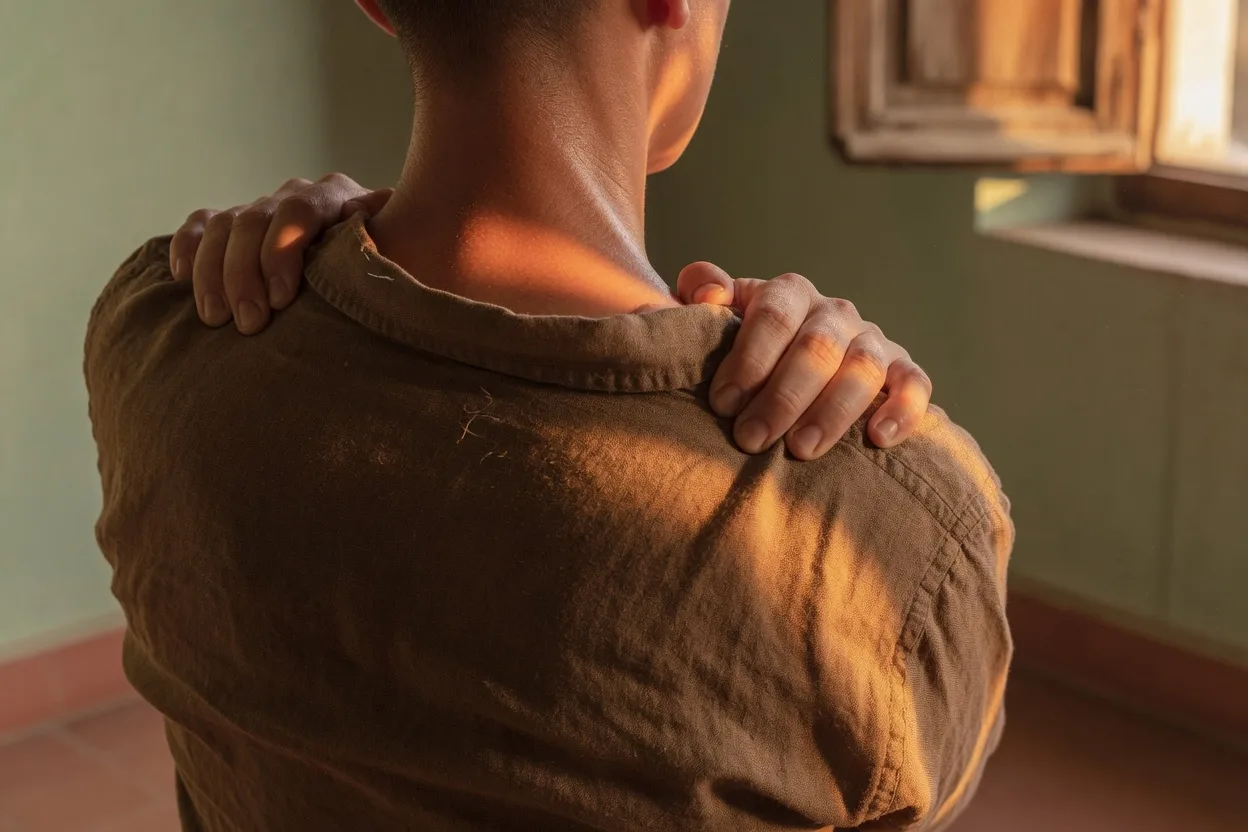
Stress sometimes stays in the shoulders and jaw, as we wrote about vagus nerve stimulation exercises. Breathwork after a long workday does not fix that with an hour of yoga. It catches it at the threshold, before the evening gets the bill. If the evening already grinds in the body, that is the moment. Not tomorrow. Now, in the hallway.
Think of a coat you keep wearing indoors. Warm. Familiar. And after fifteen minutes too much. The coat is your work breath: high, fast, ready to react. Home asks for something else. A body that can drop. A voice that is not still replaying the last meeting.

The threshold ritual: ten minutes, four zones
A threshold ritual is a short, repeatable crossing between two contexts. Here: the metres between front door and sofa, where breath closes the workday in the body.
No stretching. No Wim Hof. No 4-7-8 as a menu. Pace around six breaths per minute, in for 4, out for 6 to 8. If you want to count without the phone in your face, set the free breathing timer first. Then the phone goes in the bowl. Really.
Ten minutes sounds short until you feel how long a minute is when you are not allowed to scroll. That is fine. The restlessness can stay. You do not have to breathe it away. You only give it another speed.
| Zone | Time | What you do | What you drop |
|---|---|---|---|
| Keys down | 1 min | Close the door, fill the bowl, one long exhale | Talking, scrolling, answering the greeting |
| Shoulders drop | 2 min | In 4, out 6, jaw and hands loose | Stretching as if it were sport |
| Lengthen the exhale | 5 min | Sit, about six breaths a minute | Answering mail in your head |
| Arrive at the sofa | 2 min | Walk slowly, three breaths, one real sentence | A work update as a greeting |
Zone 1. Keys down
Close the door. Put keys, lanyard and phone in one bowl. One conscious inhale through the nose. One longer exhale. Do not talk yet. Do not scroll yet.
The bowl is boring. That is the point. One place. Same every day. Your body learns: work stops here. We use a wooden bowl Tessa once bought for 15,000 rupiah from a man by the road. Not sacred. Just fixed. If the phone stays beside it, the zone is fake. Then the evening has already started in your thumb.
If someone stands in the doorway, nod. Smile if you can. Say nothing of substance yet. One minute is short for you and long for whoever is waiting. That is why the sentence comes later: I will be here in ten minutes. That line belongs to zone 2, not to the bowl. Land first. Then explain.
Zone 2. Shoulders drop
Stand or lean against the wall. Inhale into the belly, count of four. On the exhale of six, let jaw, shoulders and hands drop. Two minutes.
This is not stretching. This is slowing the tempo. Like shifting a car from fifth to second, not like finishing a workout. Feel the back of your teeth. Often they still clamp. Let the tongue get heavy. Let the hands open. Not theatrical. Just heavier than they were in the car or on the bike.
Pro-tip: Say out loud to whoever is there: I will be here in ten minutes. That is not rejection. That is arriving. Do it in sight in the hallway, not secretly in the bathroom.
Zone 3. Lengthen the exhale
Sit on a chair or on the floor. Pace around six breaths per minute: in 4, out 6 to 8. Five minutes. If email thoughts return, label them as work and come back to the exhale.
Research in a simulated office setting shows that paced, quiet breathing can speed stress recovery. Limitation: that was a lab, with light guidance, not your actual front door. Take it as support, not as proof that your hallway turns magic.
A review of breathwork and stress gathers what many people already feel: slow breathing sits with more heart-rate variability and a less wound-up mood. It is a narrative review, not a new trial in your living room. So the practice stays simple. Count. Longer exhale. Done.
If you want loose exercises for during the day, that lives in five breathing exercises against stress. Not tonight. Tonight one chain. The exhale is the hook. Longer out than in. Soft. Through the nose if you can, through the mouth if the jaw is still stuck. No contest for who can blow the longest.
Thoughts come. Of course. Tomorrow's presentation. The line you should have said. Label: work. Back to 6, 7, 8. As if you put down a bag you had picked up again by accident.
Zone 4. Arrive at the sofa
Walk slowly to the sofa. One hand on the chest. Feel three breaths. Notice who or what is already there: partner, child, home, silence. Speak one sentence that belongs here. Not a work update.
For us it is sometimes: the sea smells of salt tonight. Or: I am here. Short. Human. The sentence is not a performance. It is a flag for the nervous system: other context. If you live alone, say it anyway. To the room. To the plant. To the silence that is also someone when you let it in.
Working from home without a commute
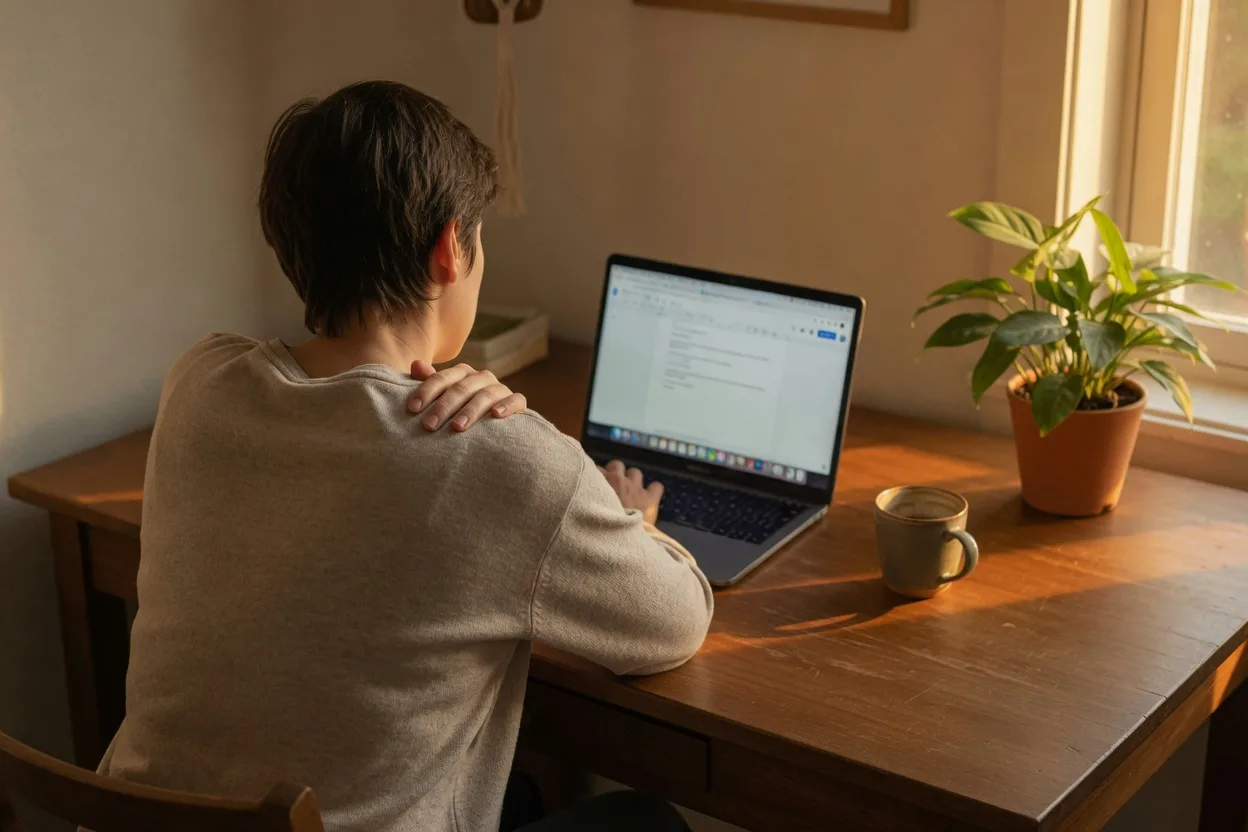
No commute? Especially then. Without a commute you have no natural threshold. Pick a physical border: laptop closed, leave the work chair, a bowl by the kitchen door. Same four steps. Same ten minutes.
Detachment needs a body action, not a mindset slogan. Leaving the chair is the fake commute. Take it seriously. As if you really walk through a front door, even if that door is three metres away. We learned this in small rooms: work and life share the same square metres. If you do not stand up, the evening stays an extended afternoon.
If you want more than an evening ritual, the wider practice lives in the breathwork guide. Not as a trick. As a way to set tempo in the body. Yin can come later, on the mat, once the body is already a little home. Threshold first. Then the rest.
When someone wants something from you right away
Say it. I will be here in ten minutes. Partners notice the difference between a body still answering mail and a body that is home. Children do too, faster than you think.
Slow breathing is not meditation. You do not need to empty the mind. Thoughts sometimes stay. Then you keep counting the exhale until the ten minutes are done. Help is the goal. Perfection is not.
If the threshold jams every evening, sixty minutes of breathwork coaching is a clear next step (sixty minutes, €60). Not sure if one-to-one fits? A short introduction is enough to feel if it clicks.
Sometimes the resistance is not your partner. It is you. Ten minutes feel like luxury while dinner waits. Do it anyway. An evening that starts with a short body costs more than ten minutes of soup. If the soup is truly boiling over, skip zone 2. Not zone 3.
Pro-tip: The five minutes of exhale are the heart of the ritual. If you have to choose because the soup is boiling over, skip zone 2, not zone 3.
Key takeaways
- Breathwork after work is a ten-minute threshold ritual, not an extra wellness task.
- Psychological detachment starts in the body: bowl, shoulders, longer exhale.
- Four zones: keys down, shoulders drop, lengthen the exhale, arrive at the sofa.
- Working from home: close the laptop and leave the chair as a fake commute, same ten minutes.
- Say out loud that you will be there in ten minutes. That is arriving, not rejection.
- Use the timer for zone 3, then put the phone in the bowl.
If this lands, start tonight at the bowl. Not in an app. At the keys.