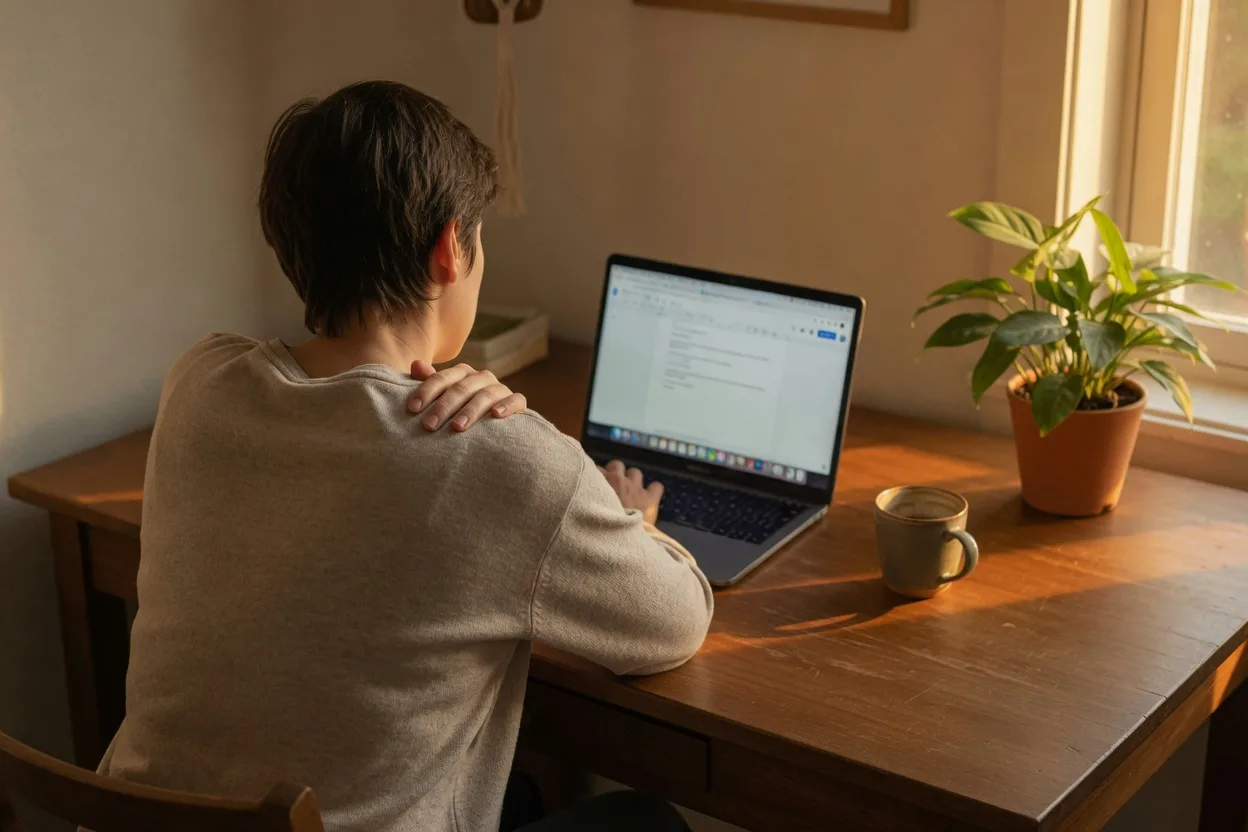
Your fingers hover above the keyboard. Your shoulders are sitting somewhere near your ears. And halfway through a sentence you notice: you have not been breathing for a while.
Sound familiar? You are far from alone. This pattern has a name: email apnea. It is the unconscious tendency to hold your breath or breathe shallowly while reading emails, scrolling through messages or typing a difficult sentence. Not a medical condition — but a daily reality for almost everyone who works behind a screen.
In this article I will take you through what happens in your body the moment your breath goes quiet, how to recognize the pattern in yourself, and what you can do about it: five micro-interventions of one to three minutes, done right at your laptop. Not another task on your to-do list — just finding your breath again, exactly where you lost it.
What is email apnea?
- What is email apnea?
- Email apnea is the unconscious tendency to hold your breath or breathe shallowly while reading and answering emails, messages or other screen tasks. It is not a medical condition but a nervous system response to cognitive overload: when your attention is fully locked onto a task, your breathing pauses on its own. Researchers estimate that up to eighty percent of people show this pattern, usually without noticing.
The phenomenon is easy to observe. Watch someone typing with deep concentration: the head slides forward, the ribcage goes still, the jaw tightens, and the breathing first becomes shallow — and then simply stops. Sometimes for dozens of seconds at a time. What makes it remarkable is that the person doing it never notices.
Email apnea is not a sign of weakness or of a lack of discipline. It is an automatic response of a nervous system that pulls all available attention toward a single task. Your brain essentially says: no breathing right now, first this reply. Most knowledge workers show this pattern several times a day without ever realizing it.
Why your breath pauses when you check your inbox
Imagine this: you open your inbox and there it is — the email you have been dreading for days. Before you even start reading, something happens in your body. Your muscles tighten slightly, your gaze narrows and your breathing drops to a simmer. Your body is bracing itself, as if something real is at stake, while all there is, is a screen.
Email apnea is a silent freeze response: your nervous system pulls all attention into your head and your breathing pauses along with it.
- What is cognitive overload?
- Cognitive overload is the state in which your working memory has to process more information than it can handle — a full inbox, a complex email, several tabs open at once. Your brain then switches off automatic functions like smooth breathing to give all its processing power to the task. The result: short, shallow breaths, or a breath that stops altogether for a moment.
This connection between breath and attention works in both directions. Your breathing does not only follow what you think and feel — it also steers it. Recent research shows that the pace, phase and depth of your breathing actively influence your emotions and cognitive performance. A breath that stands still keeps your nervous system in a mild state of alert. A breath that flows calmly does exactly the opposite.
Want to understand more deeply why your nervous system reacts this way to concentration and tension? Our article on polyvagal theory explains it clearly.
How to recognize email apnea in yourself
The tricky thing about this pattern is that it happens below the level of awareness. You do not feel yourself holding your breath — at most you feel the consequences: a tense jaw, stiff shoulders, a restless feeling by the end of the afternoon. Concrete signals help you recognize it.
- Shoulders near your ears. Your shoulders creep up without you noticing and stay there, often for the entire morning.
- A silent ribcage. Your chest and belly barely move, as if your breathing is on pause.
- A tense jaw or tongue. Your jaw is clenched or your tongue presses against the roof of your mouth.
- Small, shallow sips of air. When you do breathe, it is high and short — just enough to keep going.
- A head that keeps spinning. After an hour of email, your head feels fuller than before, without you being able to say why.
The fastest test takes ten seconds. Right now, while reading this, place a hand on your belly. Does it move? If not: you are holding your breath, or breathing so shallowly that your belly does not register it. Let your shoulders drop, exhale once slowly through your nose and start again. That is not even an exercise yet — that is simply coming back.
If the pattern keeps returning and you notice more than just tension — poor sleep, constant fatigue, little joy in your work — it is wise to look at the bigger picture. Our article on the early warning signs of burnout helps you see where the line runs.
Is email apnea harmful?
Good to know: email apnea is not comparable to sleep apnea, a medical condition that requires diagnosis and treatment. Holding your breath once per email will not make you ill. But the pattern is a silent amplifier of stress.
Every time your breath pauses, your nervous system stays caught in a mild alarm state. Your heart rate stays slightly higher than it needs to be, your shoulders stay slightly higher than is healthy, and your body never receives the signal: it is safe, you can relax. After a workday of dozens of emails, that adds up. Many people experience it as fatigue, irritability or a head that will not go quiet — without ever connecting it to their breathing.
The good news: because it is a habit and not a disease, you can change it yourself. With small interventions that take less time than reading a single email.
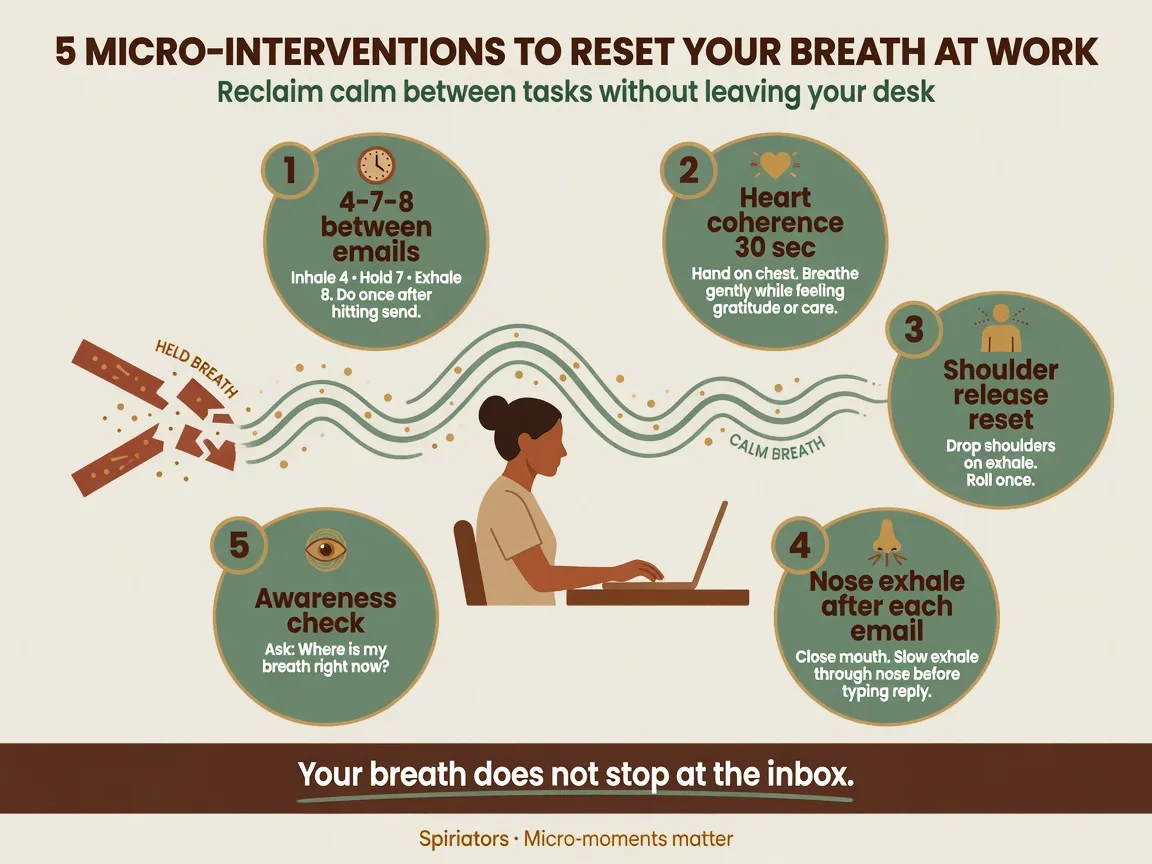
Five micro-interventions to bring your breath back
A micro-intervention is a breathing exercise of one to three minutes that you do between tasks, without stopping your work.
You do not need to set anything up, you do not need to step away, and nobody has to notice. You do them in your desk chair, on the train or at the kitchen table — exactly in the places where the pattern arises.
| Intervention | Duration | Moment |
|---|---|---|
| 4-7-8 breathing | ± 90 seconds | After sending an email |
| Heart coherence | 30 seconds | Between two tasks |
| Shoulder release reset | 30 seconds | When shoulders are raised |
| Nose exhale | 5 seconds | After every sent email |
| Awareness check | 10 seconds | Every hour |
1. 4-7-8 between emails
After sending an email: inhale through your nose for four seconds, hold for seven seconds and exhale through your mouth for eight seconds. Three rounds. The longer exhale activates the rest branch of your nervous system and interrupts the held-breath pattern, exactly at the moment your brain would normally jump to the next task.
Research shows that a brief breathing exercise with an extended exhale improves working memory and positively affects stress, mood and alertness — precisely the pattern behind 4-7-8. You invest a minute and a half and get back a calmer head and a sharper one.
Pro-tip: Let your rounds be guided by the free breathing timer. Then you do not have to count between emails, and your attention stays with your breath instead of with the clock.
Curious how this technique compares to other breathing forms? In our article box breathing versus 4-7-8 versus Wim Hof we place them side by side.
2. Heart coherence, 30 seconds
Heart coherence is a breathing rhythm of five seconds in and five seconds out, bringing your heart rate, breathing and nervous system into the same rhythm.
Breathe in for five seconds, out for five seconds, evenly, for thirty seconds. Place a hand on your chest and feel the rhythm. Research shows that slow breathing during computer work measurably increases parasympathetic activity — the rest branch of your nervous system — and lowers perceived stress, without hurting your productivity.
3. Shoulder release reset
Shrug your shoulders up toward your ears, hold for three seconds and let them drop with a deep exhale. Repeat three times. Held breath and raised shoulders belong together; consciously dropping your shoulders opens your ribcage and makes room for a fuller breath. Feel free to do it in the middle of a meeting — nobody will notice, but you will feel it immediately.
4. Nose exhale after each email
Make it a habit: after every sent email, one conscious, slow exhale through your nose. One exhale per email is enough to break the pattern. Because you send dozens of emails a day, this naturally becomes one of the most repeated micro-interventions of your workday — and the easiest one to remember.
5. Awareness check
Ask yourself every hour: am I breathing right now? Place a hand on your belly and feel whether it moves. Awareness is the first intervention; without recognition, nothing changes. Set a reminder on your phone or stick a note on your monitor. Within a week the check becomes automatic and you will notice your shoulders hanging lower. For more techniques you can weave into a busy workday, read our article on five breathing exercises against stress.
Micro-breaks are not a waste of time
Many knowledge workers feel resistance to this kind of pause. As if you are not doing something, as if stillness is a luxury you can only afford when everything is done. That very thought keeps the pattern alive: you keep working, your breath keeps hanging, and at the end of the day you wonder where your energy went.
Research shows that short breaks during the workday contribute to employee recovery and well-being. A pause of one to three minutes is not an interruption of your work — it is the maintenance that keeps your work running.
For those who work nomadically — from a beach café in Canggu, a train through Europe or a balcony in Lisbon — the same applies, perhaps even more strongly. The screen travels with you, and the pattern travels with you. Precisely when your workplace keeps changing, your breath is the only rhythm that is always yours. Our program breathwork for digital nomads is built exactly for this.
Pro-tip: Do not see your breath as a break from your work, but as the undercurrent your work runs on. Whoever breathes consciously for one minute between two emails loses no time — you win the next email back with a calmer head.
When your breath asks for more than a micro-break
Sometimes email apnea is a small symptom of a bigger story. Of a nervous system that is on high alert not only behind the laptop, but also in the evening, in the weekend, on holiday. Do you recognize that? Then micro-interventions are a beautiful beginning, but not the endpoint.
With Nomad Reset you calculate how your screen work, travel rhythm and breathing rhythm are loading your nervous system, and receive a personal reset recommendation. Want to go deeper? Personal breathwork coaching helps you not only calm your nervous system but truly learn to read it — not just behind your laptop, but in your whole life.
And if you want to make breathwork a daily practice, so you are not only intervening when things go wrong? Discover what breathwork can mean as the foundation under your workday.
Key takeaways
- Email apnea is the unconscious habit of holding your breath behind your screen. It is not a medical condition but a nervous system response to cognitive overload — up to eighty percent of people do it.
- Recognize it by your shoulders, your silent ribcage and your jaw. The fastest test: place a hand on your belly and feel whether it moves while you work.
- The pattern amplifies chronic stress. Not dangerous like sleep apnea, but a quiet source of tension, fatigue and a restless head.
- Five micro-interventions break the pattern: 4-7-8 between emails, thirty seconds of heart coherence, a shoulder release reset, one nose exhale after each email and an hourly awareness check.
- Micro-breaks do not cost you time, they return it. Research shows that short breaks during work support recovery and well-being.
- Awareness is the first intervention. Whoever recognizes the pattern can change it — one conscious exhale at a time.
Your breath does not stop because you are weak — it stops because you are focused. The good news is that you can call it back at any moment. One email at a time. 🌿