You are lying in bed, completely exhausted. And still your shoulders are hitched up around your ears.
You want to relax. You really do. You take a deep breath, close your eyes, tell yourself the day is over. And nothing melts. As if your body no longer trusts rest. That is not in your head. Stress stored in your body is real: chronic tension physically settles into your muscles, your connective tissue and your nervous system. And only when you understand how that works can you actually let it go.
This is a look at how that holding works, place by place. And more importantly: what you can do about it. No quick fix. A path your body can trust, because it never asks you to force anything.
Why you cannot just relax
Last week a woman sat across from me in Karimunjawa. Three years of bad sleep, she told me. She had tried everything: mindfulness apps, magnesium, a weighted blanket, even a silent retreat. Nothing really helped. When I asked her where she felt the tension, she looked at me, puzzled. "Everywhere? But honestly, I don't feel anything anymore."
I hear that answer often. And it is exactly the point. Where stress piles up for years, your body gets used to the tension until it becomes the norm. You stop noticing it. You carry it.
Relaxation is not a matter of willpower. It is a function of your nervous system. That nervous system is constantly making one simple, brutal assessment: am I safe? As long as the answer is no, your muscles stay on guard and your body keeps holding on to stress hormones. Relaxation gets no permission, however badly you want it. That is why "just relax for a moment" feels, to someone with chronic stress, like an assignment they cannot complete. That is not failure. That is physiology.
In our sessions we see it over and over: people trying so hard to relax that the trying itself creates more tension. The good news is that this vicious circle has an exit. But the exit starts with understanding what is happening inside your body.
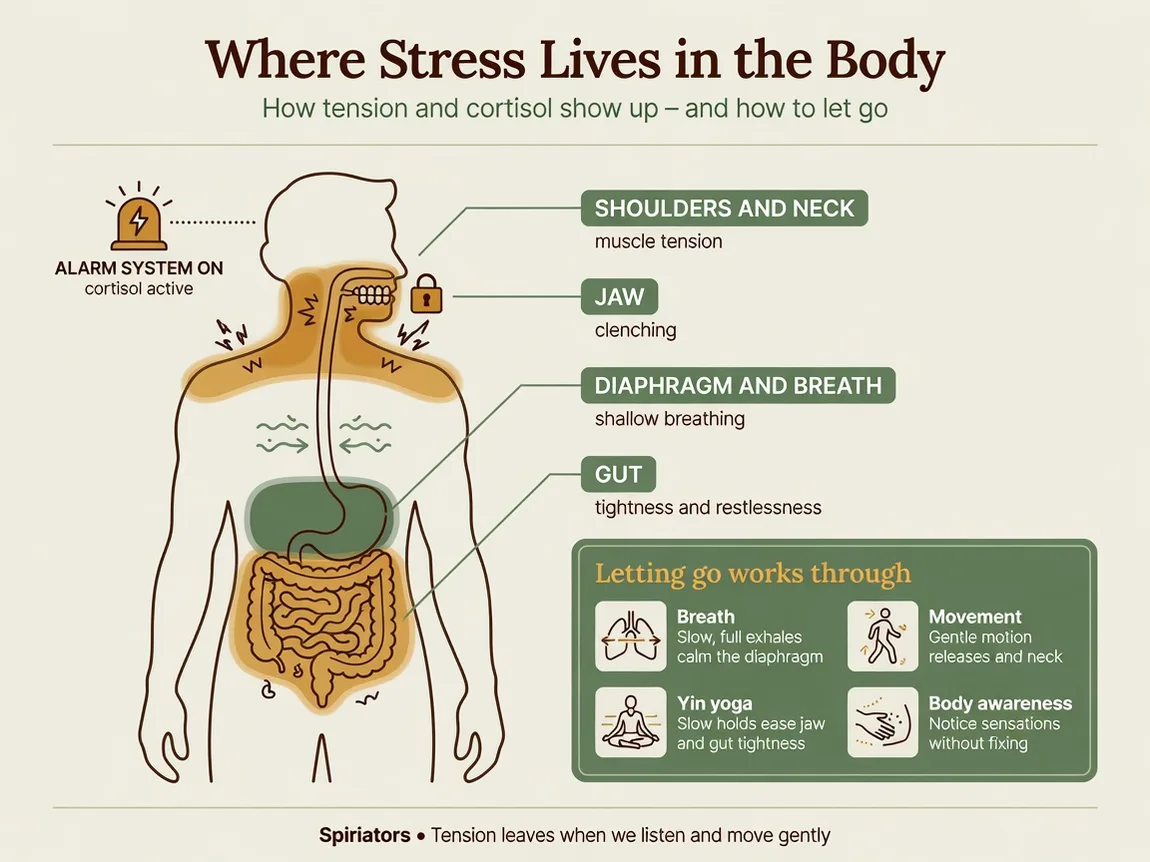
Stress stored in your body: the four places it settles
Stress stored in your body is the physical residue of chronic tension: muscles stay contracted, connective tissue thickens and your nervous system keeps the alarm system on high alert.
- Allostatic load
- The cumulative physical effect of chronic stress on your nervous system, muscles, fascia and organs. It is the biological tally of everything your life has made your body remember.
Where does stress settle? In four places, usually all at once.
| Place | What happens | How you notice it |
|---|---|---|
| Shoulders, neck and jaw | Muscles stay chronically contracted, ready for action | Raised shoulders, clenching, headaches at the end of the day |
| Nervous system | Cortisol and adrenaline stay elevated, the alarm is permanently on | Shallow breathing, poor sleep, no longer able to recover |
| Belly and organs | Stress reduces blood flow to your gut and disrupts digestion | Tight belly, bloating, a knot in your stomach |
| Fascia and connective tissue | Connective tissue thickens and hardens around tense muscles | Stiffness that stays, even after a massage or a good night |
The tricky part is that these four places reinforce each other. A tight jaw creates restless breathing. Restless breathing keeps your nervous system on guard. A nervous system on guard keeps your muscles tight. The circle feeds itself, day in, day out, without you noticing.
One muscle we come across remarkably often in sessions is the psoas, hidden deep inside your hips. Under threat it is the first to contract, and under chronic stress it stays shortened. What that feels like and what you can do about it is covered in our blog on the psoas and emotions.
This is not a soft story, and research backs that up. A large population study measured perceived stress and its physical traces in thousands of people. The link was clear: the more stress someone experiences, the higher the allostatic load. Stress becomes literally measurable in your body, in your blood pressure, your inflammation markers, your metabolism. Anyone who says it is fine because you "handle it well" is wrong. Your body keeps its own books.
Fascia: your body's memory
Fascia is the connective tissue network that wraps every muscle and organ, transmits tension through your entire body and actively responds to chronic stress.
For a long time, connective tissue was seen as nothing more than packaging material. Filler between the real players. We now know better. Research describes fascia as a regulatory system of the body: it holds tension, transmits force and plays a role in how you physically experience stress. Under chronic tension, fascia thickens and stiffens. Your body builds armour around you, layer by layer, day by day.
In yin yoga sessions I see what that means in practice. Someone lies in a pose for three minutes. For the first minute and a half, not much happens except restlessness and the urge to fidget. Then, suddenly, a deep sigh. A shoulder dropping without the person noticing. Sometimes tears, with no obvious reason. No drama. Just tissue finally getting permission to let go.
Fascia needs time to discharge. Rushing backfires, because speed feels like extra stress to your body. That is exactly why standing still in one pose for three minutes can work better than an hour of sweating in the gym. More about this connection in our blog on fascia and emotions.
Why your nervous system keeps the alarm on
Your nervous system was not built for a three-month deadline, a relationship crisis and an overfull agenda all at once. It was built for short peaks: danger, action, recovery. Under chronic stress, that recovery never comes. The alarm stays on, day and night, until your body starts treating the alarm as the new normal.
Cortisol plays the lead role in this. Cortisol is your body's primary stress hormone: it keeps you ready to act, and under chronic stress it stays set too high. During acute stress that saves your life. With an agenda that has been too full for three months, it becomes a problem. You sleep more lightly, your breath stays high in your chest, recovery slows down and small things suddenly feel big.
You might recognize it in yourself. First day of vacation, finally free, and you get sick. Or you feel empty instead of relieved. That is your nervous system that has forgotten how to settle, because for months it received not a single signal of safety. If that pattern sounds familiar, our blog on vagus nerve stimulation shows how you can steer that alarm system through your body.
The way out of the circle is surprisingly simple: safety. Your nervous system only releases tension when it registers that the danger has passed. Not when you tell yourself so. Not when you stop worrying about it. It listens to your body: to a slow exhale, to warmth, to a hand on your chest. That is exactly what the exercises below work with.
How to release stress stored in your body
Letting go does not work through force. You cannot think tension away, and you cannot fight it away either. What does work: giving your nervous system safety, so it can lower the tension on its own. Interoception is your most important tool for that.
- Interoception
- The ability to sense signals from inside your body, such as muscle tension, breathing and heart rate. It is the bridge between physical tension and consciously releasing it.
Five exercises we see working in sessions, over and over. They are small, simple and more effective than you would expect. More variations in our blog with breathing exercises against stress.
- Notice before you do anything. Stand still for thirty seconds and scan: where do you feel your body? Shoulders? Jaw? Belly? How are you breathing? Naming is already regulating. This is interoception in action.
- Lengthen your exhale. Breathe in through your nose for four counts and out through your mouth for six. Five rounds is enough to steer your nervous system towards rest. A free breathing timer holds the rhythm for you, so you have nothing to keep track of.
- Tense first, then release. Consciously pull your shoulders up towards your ears for three counts, then drop them with a sigh. Repeat three times. What you first tense on purpose can melt deeper afterwards.
- Place your hand on the place that holds. Chest, belly or neck. Stay there breathing quietly for a few minutes. Warmth and touch activate your parasympathetic nervous system, the part that restores.
- Make it a daily moment. Five minutes when you wake up weighs more than an hour in the weekend. Small but daily always beats intensive but occasional.
Pro-tip: Do not do exercise 3 too politely. The more consciously you seek out the tension and even exaggerate it a little, the more clearly your nervous system feels the difference the moment you let go. The contrast is the message.
Science backs this approach. A meta-analysis of randomized trials showed that controlled breathing techniques significantly reduce symptoms of stress and tension. Breathwork is thereby not a fluffy idea but a proven route to a calmer nervous system. And what your breath starts, your body finishes: movement and deep, slow stretches give muscles and fascia the time to discharge the tension they built up. That is why we so often combine breathwork with yin yoga in our sessions.
Small moments, big effect
This is where most people get it wrong. They wait for a vacation, a massage, a free weekend. While stored tension needs exactly the opposite: small daily signals of safety. Three conscious exhales in a traffic jam. A hand on your belly before you pick up your phone. One minute of standing still between two appointments.
After a few weeks, something changes. You notice the tension earlier. Your shoulders drop without you thinking about it. Your sleep gets deeper. Not because you are trying harder, but because your nervous system has learned that it is safe to let go. That is the whole secret: your body does not need fixing. It needs to feel safe again.
Pro-tip: Attach your daily body scan to something you already do anyway: the kettle boiling, the red traffic light, the moment you take off your shoes. A habit does not need extra time, just an anchor.
Key takeaways
- Stress stored in your body is not imagination but measurable biology: muscles, fascia, organs and your nervous system all hold the tension.
- Relaxation is a nervous system function, not willpower. Your body only releases tension when it registers safety.
- The four storage places reinforce each other: a tight jaw, restless breathing, elevated cortisol and thickened connective tissue form a circle together.
- A longer exhale, tensing first and then releasing, and a hand on the place that holds are the simplest doors into your parasympathetic system.
- Interoception, sensing the signals inside your body, is the bridge between recognizing tension and releasing it.
- Small daily moments of safety work better than one big relaxation attempt in the weekend.
What comes next
Do you recognize this? Have you felt the tension for years, but cannot get it to drop? Then you do not have to do it alone. In a 1-on-1 breathwork session we look together at where your body holds on and how to release that tension safely. Would you rather go at your own pace, on your own mat? With yin yoga you give your connective tissue and muscles the time and space to discharge, exactly what stored tension asks for. And would you rather just talk it through first? Plan a free introduction.
Stress stored in your body is not a life sentence. It is a pattern your body has learned, and patterns can be unlearned. One breath at a time.