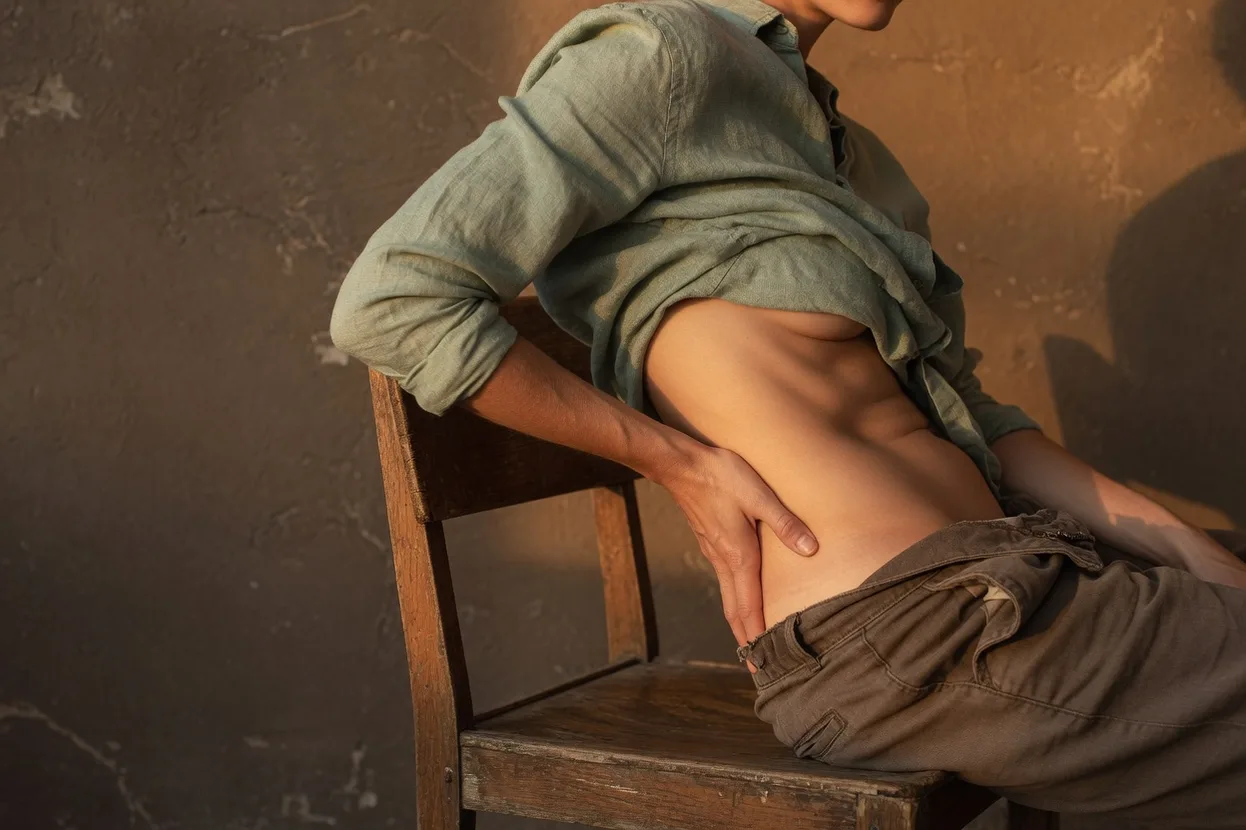
The psoas vagus nerve link, the same bridge people look up as psoas nervus vagus, is not in your head. It sits in the hollow under your waistband. You are on the edge of a chair. The band bites a little. One finger fits the crease between the lowest rib and the front of the hip. It feels hard there, or oddly empty, like a cable running through the floor that you cannot see. The breath stays high. The belly does not join.
Three quiet nose breaths. Notice whether the belly drops or the crease stays tight. Then stop. No score. No app. Only whether that cable gives.
Psoas vagus nerve: one cable, two names
The bridge between the psoas and the vagus nerve is the route through the diaphragm, not a switch you flip and then a calm pulse.
- Psoas
- The psoas is the deep hip flexor running from the lumbar spine to the thigh bone. It shares fascia with the diaphragm. That is anatomy. It does not prove that a tight psoas clamps the vagus nerve.
The psoas hangs from the low back and runs to the upper leg. The diaphragm sits above it, a dome that drops on an inhale. The sheets of connective tissue between them share a wall. Shorten the psoas and that dome has less room. The breath stays in the chest even when you want it deep.
The breathwork guide treats the breath as a practice. This piece is about the floor that breath lands on. Two doors, one room. The room is your nervous system. The doors are called hip and breath.
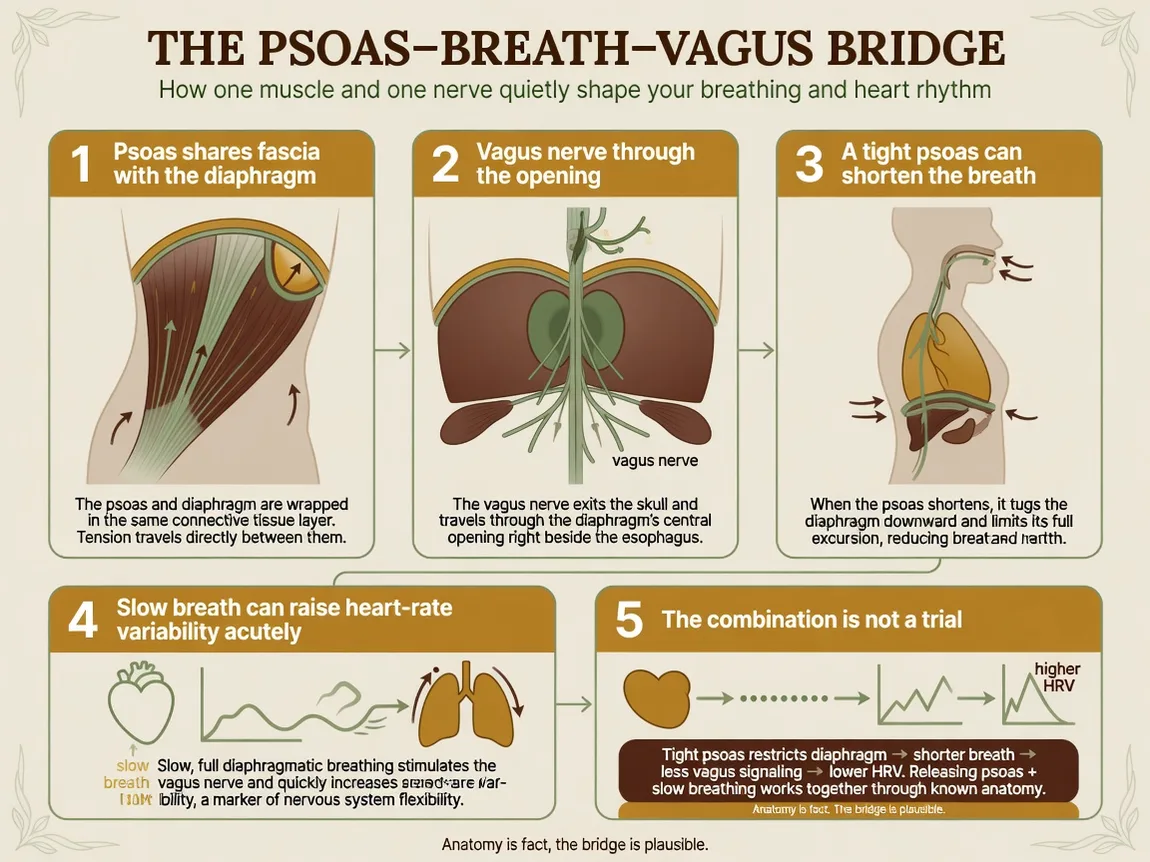
Step 1. The psoas shares fascia with the diaphragm
This part is fact, not hope. The psoas and the diaphragm meet through fascia. Fascia is the wrapping around muscle, not a soft word for energy. Open it in an anatomy lab and the link is there. You do not have to believe in it.
Psoas and diaphragm sit together the way a staircase sits under a landing. Lock the stairs and the landing moves less. That is a floor plan, not a story about your childhood.
If you already read the piece on the psoas and emotion, you know the hip as storage. This blog does not retell that. Here the hip is a cable run, not a diary.
Step 2. The vagus nerve passes through the opening
The vagus nerve is the tenth cranial nerve and the parasympathetic brake. It passes through the opening in the diaphragm. Breath can shift its tone. A free psoas does not measure that tone.
- Vagus nerve
- The vagus nerve is the tenth cranial nerve and the parasympathetic brake. It passes through the opening in the diaphragm. Breath can shift its tone. A free psoas does not measure that tone.
Each breath touches that opening. The dome drops, the opening changes shape, the nerve lies there. Do not add that the breath “massages” the nerve. Nobody measured a massage. It is proximity, not a receipt.
If the nerve still feels like an abstract thing, start with polyvagal theory in plain language. This piece picks up at the floor, not at the three states of the nervous system.
Step 3. A tight psoas can shorten the breath
Careful here. Can. Not: always does.
When the breath stays high, the diaphragm descends little. The psoas lies right there. You notice a hip crease that will not give, a belly that stays still while the chest lifts. The cable in the floor is taut, so the hatch above opens only a crack.
A pilot with eleven people who had an unstable ankle found less iliopsoas activity on the affected side while they held an inhale. Other hip flexors did not differ. That links diaphragm and psoas. It does not measure the vagus nerve. It is a breath-hold, not a free breath, and an ankle complaint rather than a tight hip. A hint. Not a verdict.
A cross-section of fifty people with low back pain found that less belly expansion went with more pain, and more strongly with lung volume. After age, sex and BMI, that expansion still predicted pain. No intervention. No psoas measure. No vagus. The pain link is thinner than the lung-volume link. Your crease is not a diagnosis.
Pro-tip: One hand on the lower belly, one hand in the hip crease. Three nose breaths. If the belly does not move, do not shove it down. Just notice.
For those three breaths you can set the free breathing timer to one minute. Then turn it off. No second technique in this piece.
Step 4. Slow breath can raise heart-rate variability right away
Heart-rate variability is the small gap between one beat and the next. More variation, at rest, often means a nervous system that can shift gears. It is not a medal.
A hospital study during pneumonia had people inhale for four seconds and exhale for six, for twenty minutes. During the exercise, variability measures rose. At rest, across the stay, variability rose too, with no difference between groups. An acute effect. No lasting group gap. No psoas. And not a home plan if you cannot get air.
In sixteen healthy adults, slow breathing (five counts in, five counts out) and humming did the same thing: heart-rate variability rose compared with rest. No difference between the two. A pilot. A healthy group. Mood only on a screen scale. Again, no psoas.
So breath can change the rhythm of the heart, in that moment. The hip crease is not in the measurement. Cable and nerve share a floor. Nobody has tested whether loosening the psoas makes the nerve work harder.
Step 5. The combination is not a trial
Say it out loud or it slides into a pretty sentence. There is no randomized trial testing whether psoas release raises vagal tone. Anatomy is fact. The bridge is plausible. The claim “a tight psoas limits the vagus nerve” is a mechanism, not a result.
| Step | What it is | What it is not |
|---|---|---|
| 1. Psoas and diaphragm fascia | Anatomy | Not proof of a calm nerve |
| 2. Vagus through the opening | Anatomy | Not a measured massage |
| 3. Tight psoas, short breath | Plausible | Not a trial of your hip |
| 4. Slow breath and heart rhythm | An acute effect in studies | Those studies did not measure the psoas |
| 5. The combination | A bridge you can understand | Not a treatment, not a promise |
Hips and the nervous system share a house. That house has no certification on the door yet. Supports. Facilitates. Does not prove.
The salamander, the corner of the eye, the how of a vagus drill: that already lives in the vagus nerve exercises. This blog is the why. Not another menu.
One check, and when you stop
Sit. Waistband. One hand on the lower belly, one in the crease. Three nose breaths. Done.
Some people feel the belly drop at once. Others feel nothing but the chair edge. Both count. A quiet crease is not a failed drill and not a sign that you are “blocked”. It is a note from three breaths.
Sharp groin pain, a hernia, fever, pain running into the leg, or a breath that suddenly will not come: a doctor first. This explains a bridge. It does not treat a hernia, lung disease, or panic.
Pro-tip: Keep the words “can” and “plausible” for yourself too. A hard crease is a cue to sit softer, not a verdict on your nerve.
If you want that bridge in a session, not in a blog, breathwork coaching is the door. The hip itself, without a pose list here, belongs with yin yoga. Long, low, and without a demand to “activate” the nerve.
The 30-day protocol The Muscle of the Soul works this cable further, day by day. Introduction €14.95 until 18 November 2026, then €29.95. Not a free pdf. It may be a web version or an app. The price is for the work, not the file type. You will find it at spiriators.com/ebook/psoas-reset.
A floor plan of diaphragm and psoas also explains why “just breathe deeper” sometimes does nothing. The chest rises. The crease stays a ridge. You want to pull harder on a cable that is already tight. Sit softer, loosen the waistband, three counts, then stop. More repeats do not turn the bridge into proof.
Vagus nerve and breath stay neighbors, not a couple with a contract. The opening in the diaphragm is the shared door. A long drill list walks out of this blog. One minute on the timer is the illustration. The thirty-day protocol is where the repetition lives, not here.
Key takeaways
- The psoas and the diaphragm share fascia. That is anatomy, not an opinion.
- The vagus nerve passes through the opening in the diaphragm. Nearness is not a measured massage.
- A tight psoas can shorten the breath. That stays a can, not a law.
- Slow breathing can raise heart-rate variability right away. Those studies did not measure the psoas.
- No trial links psoas release to vagal tone. Say supports, not proves.
- One check of three breaths is enough. Sharp pain or sudden shortness of breath belongs with a doctor.
If that crease under your waistband feels familiar, you do not have to fix it today. Just see whether the cable gives. The rest is practice for another day.
With compassion, Johannes and Luna, on behalf of Spiriators