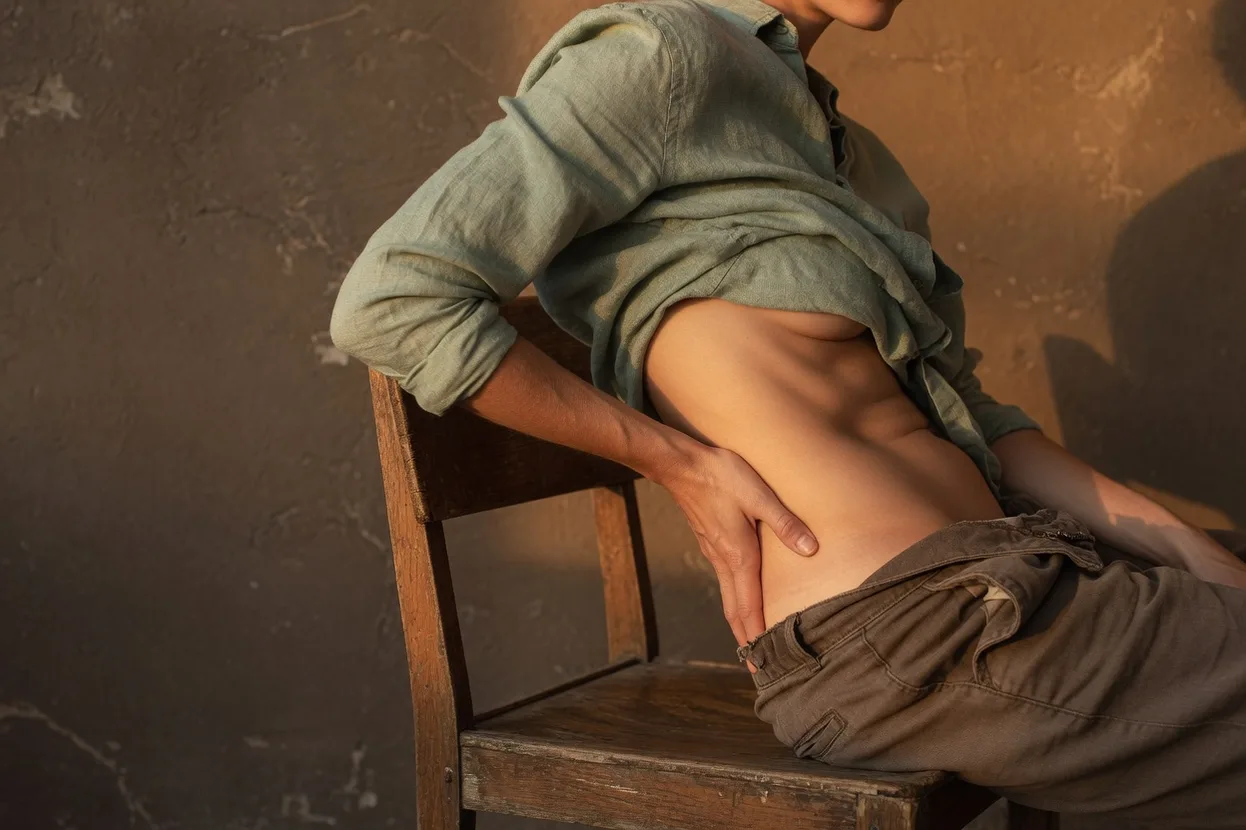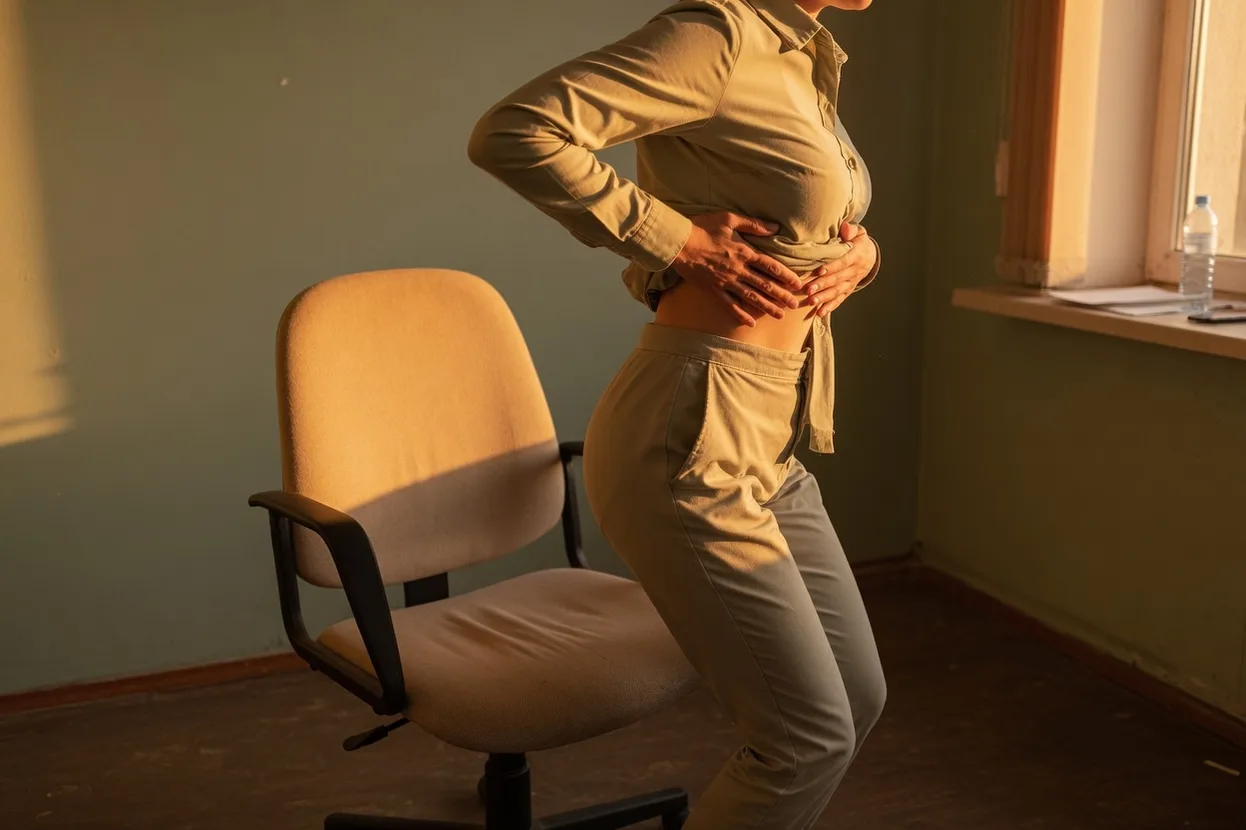
Shallow breath when sitting shows up the moment you stand and put both hands on your lower ribs. The chair is empty. Your weight is still in the balls of your feet, as if the seat just let you go. The ribs barely move sideways. The chest lifts a little and drops straight back. Thirty seconds. That is the whole check.
You already tried to breathe deeper this afternoon, sitting, shoulders down, belly soft. The air stayed up high. Not because you did it wrong. Because the hip had been folded for hours.
Shallow breath when sitting is a high chest breath after a fixed hip angle
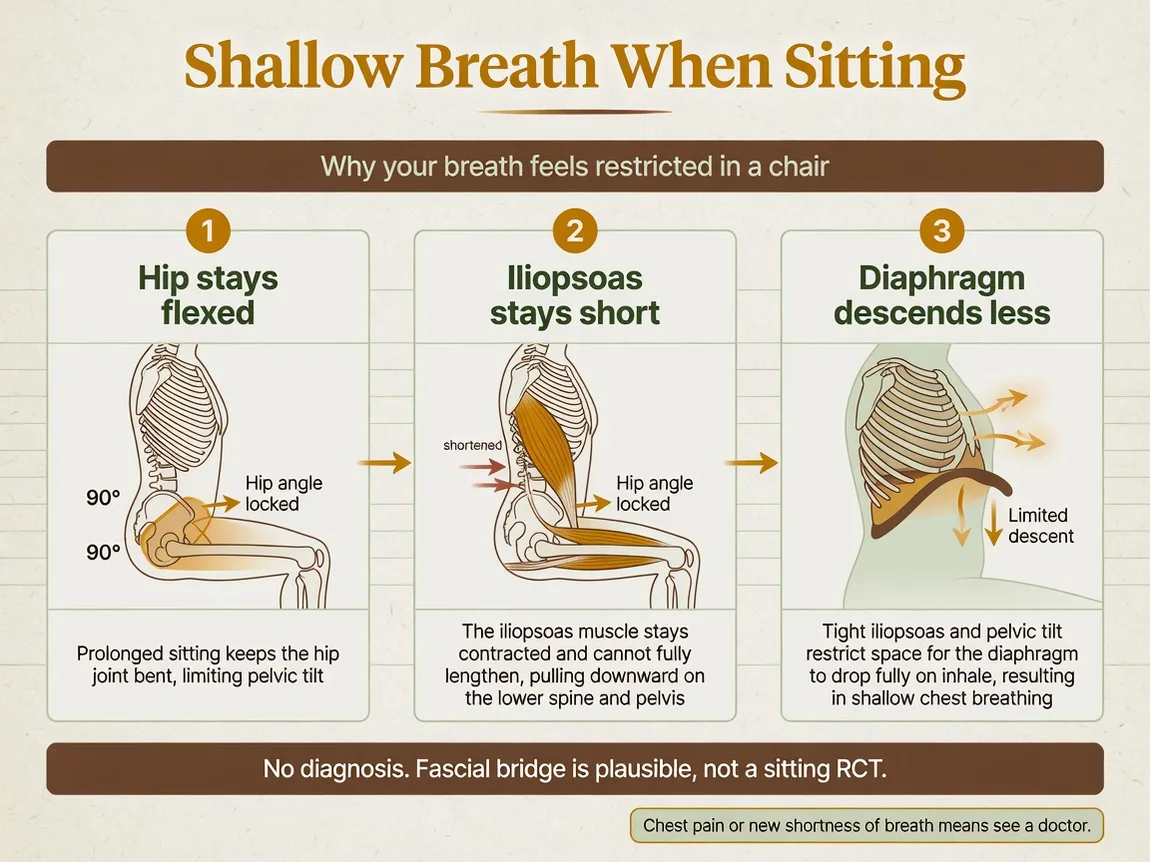
Shallow breath when sitting is a high chest breath after long hip flexion, in which the iliopsoas stays short and the diaphragm has less room to descend.
- Shallow breath when sitting
- Shallow breath when sitting is a high chest breath after prolonged hip flexion, in which the iliopsoas stays short and the diaphragm descends less.
The iliopsoas is the deep hip flexor. It runs from the lumbar spine to the thigh. While you sit, that muscle stays in a shortened position. It does not have to lift anything. It simply hangs in the angle the chair gives it.
The diaphragm is the dome under your lungs. On a belly breath that dome descends. It needs room downward, toward the belly. Call that descent room: the movement the diaphragm needs in order to drop, limited when the hip stays flexed for a long time.
The two share fascia, the sheet around muscle. The crura of the diaphragm, the tendon-like legs on the lumbar spine, sit in the same territory as the psoas. That is anatomy. It is not proof that every desk worker has a tight psoas, and not proof that the psoas clamps the vagus nerve.
Stand for a moment. One hand stays on the lower ribs. Notice whether the ribs widen sideways before the shoulders rise. If they do not, do not force the belly outward. Just notice.
Three positions, one dome
Diaphragm descent room is the downward movement the diaphragm needs for a belly breath, and it shrinks when the hip stays flexed for a long time.
Put the three positions next to each other. Not as a menu of drills. As a floor plan.
| Position | What the hip does | What the breath often does |
|---|---|---|
| Long sitting, hip flexed | Iliopsoas stays short, groin angle closed | Chest lifts, belly stays still |
| Standing, feet flat, hands on the ribs | Hip angle opens a little | Ribs can widen sideways |
| One foot a step back | Back hip lengthens softly | The exhale gets a bit more length |
The first row is your whole morning. The groin angle gets smaller than a right angle when you slump. The psoas does not have to work hard to stay short. The chair does the work.
The second row is you, just stood up. Thirty seconds. Not a workout. One hand on the lower ribs. The question is small: do the ribs widen sideways before the shoulders rise?
The third row: one foot a step back. The back hip lengthens softly. Two quiet exhales. No bounce. No pain in the groin. If the groin pulls, the step is too long.
Pro-tip: Set the free breathing timer to four counts in and six counts out, five rounds, sitting on the edge with both feet flat. Stop if you get dizzy.
That four-six is not a cure for a short psoas. It is an exhale longer than the inhale, while your feet meet the floor. The hip angle is still the door. The counts are only the rhythm on the threshold.
One break an hour is enough. Thirty seconds standing. Not a new training block between two emails. Frequency matters more than intensity here. A desk you never leave keeps the angle closed, however neat the breathing technique looks on paper.
What the studies do and do not say
You feel the chest rise and the belly stay still. That feeling is real. The papers behind it are narrower than a blog sometimes implies.
There is no randomized trial from 2024 through 2026 that measures sitting time, psoas length, and breath depth in one design. The fascial bridge between the psoas and the crura of the diaphragm stays anatomically plausible. That is a hypothesis, not a result.
A 2026 critical appraisal looked at four case-control studies in nonspecific low back pain. The diaphragm was thinner there than in controls. Excursion, how far the dome moves, was mixed. No sitting time. No psoas measure. Thinner tissue in back pain is not the same as: sitting blocks your breath.
In forty-eight healthy young adults, an unstable seated posture raised diaphragm recruitment and activity in the sternocleidomastoid, the muscle along the side of the neck, during a loaded inhale. That is in a study of postural instability. The group was young and healthy. The task was short. Nobody had just finished an office day. Unstable sitting asks more of the dome. It does not prove that your desk chair shortened the psoas.
Ten healthy men breathed quietly in five postures, including sitting. Electrical impedance showed a subtle redistribution of ventilation in sitting compared with lying on the back, tied to diaphragm excursion. Small male sample. Exploratory. No iliopsoas in the measurement. Ten men are not an office floor.
Three papers, three limits. They show that posture and the diaphragm touch each other. They do not show that a psoas stretch makes your breath deeper. If someone promises that, they are selling something other than these studies.
When a high breath is not a sitting story
New shortness of breath with chest pain, dizziness, blue lips, or fever does not belong in a hip drill. Stop. Get medical care. A piece about sitting mechanics does not replace a lung check or a heart check.
Self-diagnosis is also unwise after a fall, surgery, or a known lung condition. The thirty seconds of standing are for a healthy, tired desk breath. Not for warning signs.
If the breath stays high while you are already standing, the ribs are free, and the hip angle is open, the sitting door may not be your door. Then look at breath that pauses at the screen, a different pattern: attention that pauses the breath, not a hip that stays flexed.
The emotion story of the hip lives elsewhere, in the piece on the iliopsoas, emotion, and trauma. This Saturday stays with the angle of the chair. No second memory story.
The bridge between psoas and vagus nerve is another post too: psoas and vagus nerve. Here we do not measure that nerve. We notice whether the ribs widen sideways when you stand up.
The next step is frequency, then the protocol
If the breath stays high only after a full day of sitting, and there are no warning signs, a fifth breathing technique is not the next door. The next door is taking the hip out of that angle more often, and then a protocol that takes that muscle seriously for thirty days.
On the breathwork guide you practice the breath itself. That still makes sense. It does not undo a hip that sits flexed for eight hours. Breathwork coaching is the place if you practice on your own for two weeks and the chest breath stays the same. An introduction, not a medical claim.
For the hip angle, short and beside the protocol, there is yin yoga. One shape for the hip flexors. Not a long sequence. Not a repeat of the trauma essay.
The protocol is called The Muscle of the Soul. Intro price 14.95 euro until 18 November 2026, then 29.95 euro. Never free. You will find it at spiriators.com/ebook/psoas-reset. No promise of a pdf only. The work is the thirty-day protocol, not a loose sheet.
Pro-tip: Once an hour, thirty seconds of standing is the test. If the breath is still high after two weeks of those breaks, and there are no warning signs, the protocol is the next step, not a new app.
If you are unsure whether the complaint goes further than desk fatigue, write via contact. No diagnosis through a form. A person who can see whether breathwork coaching fits.
Key takeaways
- Shallow breath when sitting is a high chest breath after long hip flexion, not a diagnosis.
- The iliopsoas stays short in sitting and shares fascia with the crura of the diaphragm. That is anatomy, not proof of a clamped nerve.
- Thirty seconds standing, hands on the lower ribs: do the ribs widen sideways before the shoulders rise?
- Four counts in, six out, five rounds, feet flat. Stop if you get dizzy. The timer only keeps the rhythm.
- Chest pain, new shortness of breath, dizziness, blue lips, or fever: stop and see a doctor.
- If the desk breath is still high after two weeks of practice, The Muscle of the Soul is the next step: 14.95 euro until 18 November 2026, then 29.95 euro.
Stand up one more time. Hands on the ribs. Thirty seconds. If this lands, start with that break, and read the protocol if the angle keeps holding the breath.