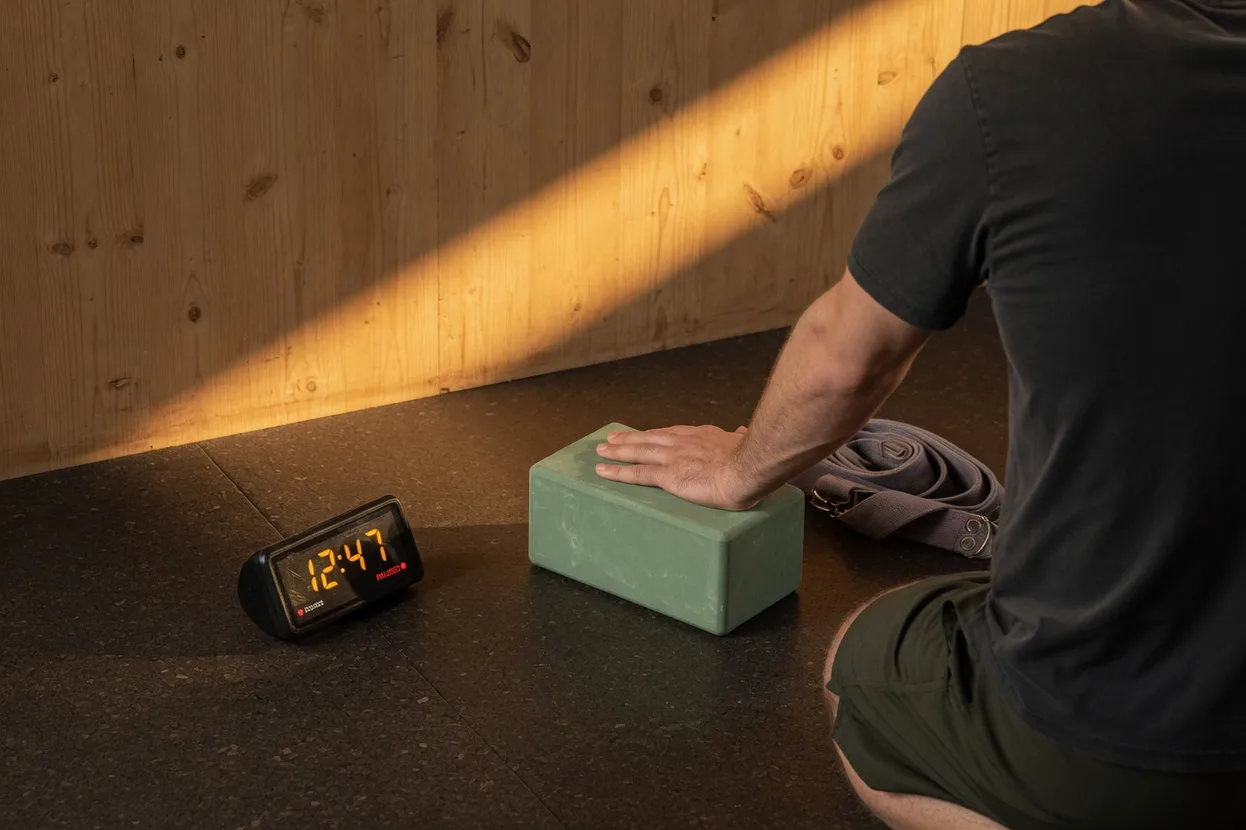
The gym timer sits next to the yoga block. The digits are frozen. So is your hand.
Yoga for men often starts here. Not in a room full of flexible bodies, but with two objects that do not belong together. On the left, a clock that counts reps. On the right, cork, a strap, nothing you can score.
I know that locker-room beat. Towel. T-shirt that does not bind at the hips. The urge to ask how long the class lasts, as if it were an interval. Someone asks if you have done yoga before. You mumble. You think of squats. Sets. Being done.
Yin measures something else. Staying until the nervous system follows. No points. No PR.
I came from a world where time was an order. Navy. Schedule. Done when the clock said so, or earlier if the work was finished. On the mat the clock is not your boss in the same way. It holds you until the body drops. That takes getting used to. Honest: the first minutes feel like wasted training. Then the jaw lets go. Small. Dull. That is why it works.
Yoga for men is not a separate sport
Yoga for men is the same practice with a lower barrier: clothing, expectations and postures that work if you bring hips, back or stress from lifting or desk work.
- Yoga for men
- Yoga for men is not a separate sport, but the same practice with a lower barrier: clothing, expectations and postures that work if you bring hips, back or stress from strength training or office life.
Yin yoga is a slow style where you hold postures for several minutes, aimed at fascia, joints and the nervous system rather than muscle or sweat.
No compression kit. No tempo you have to chase. Props belong. That is not weakness. That is how yin works.
You do not have to follow a flow where everyone has a leg in the air while you still hunt for your hand. Yin asks you to stay. Going deep is optional. Stopping at joint pain is required.
Plenty of men stay away because yoga still reads as soft and feminine. Research shows that role models and a fitness frame lower the barrier. That is interview work, not proof that yin replaces your squat. It only names why the locker room can feel heavier than the mat.
You can lie at the back. Eyes open. You can think this is nothing. Stay until the beep. Judge after.
If you want to see whether staying still fits you, start with the free yin check. No scoreboard. A few questions.
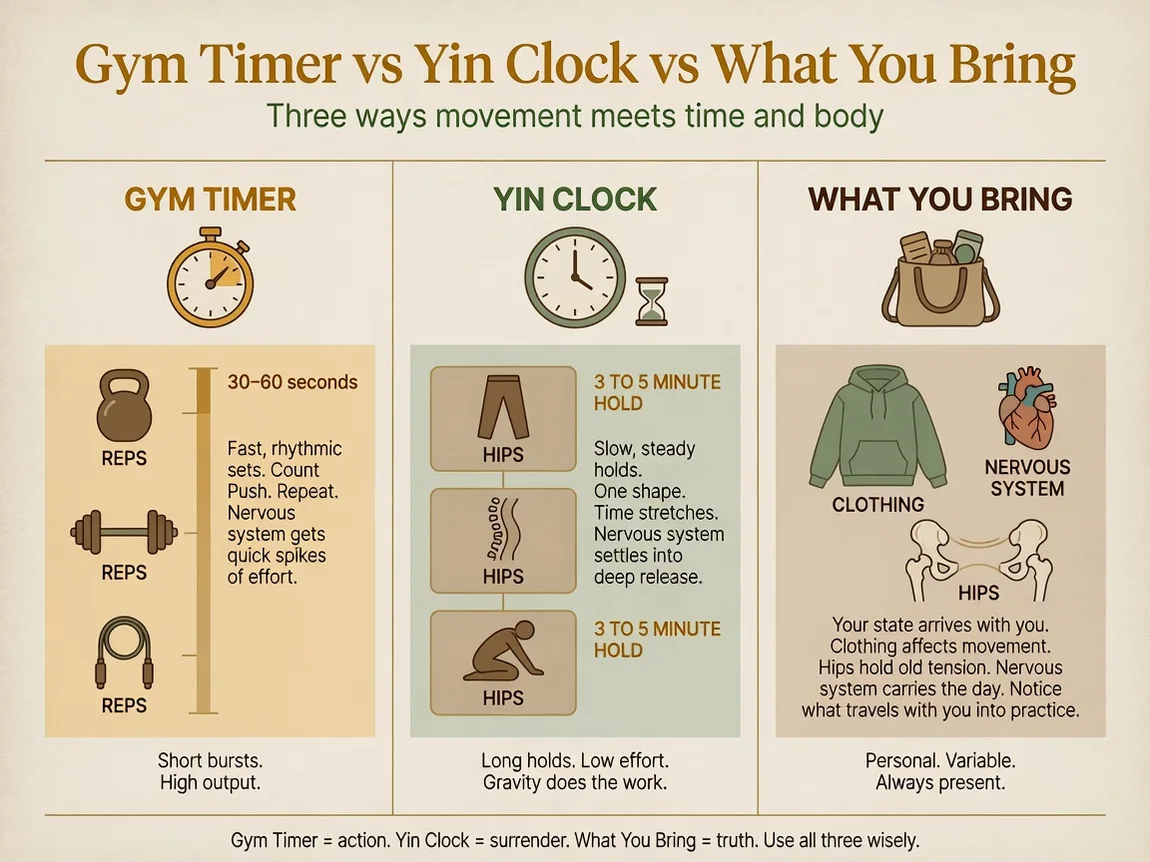
The gym timer versus the yin clock
In the gym you count reps. Done is done when the set ends. In yin you stay 3 to 5 minutes. The itch to stand is the work, not proof you are wasting time.
| Gym timer | Yin clock | What you bring |
|---|---|---|
| Reps and sets | 3 to 5 minute hold | Hips stiff from squats or a chair |
| Muscles on | Muscles soft, fascia gets time | A back that carried the day |
| Stop when it feels heavy | Stay to the clock, stop at joint pain | Stress still sitting in the chest |
| Clothes that perform | Pants, T-shirt, optional socks | The urge to ask: how deep should I go? |
That is why yin sits next to lifting. You are not training the same quality. Strength asks tension. Yin asks staying. Read how a first yin class feels if you have never held a block.
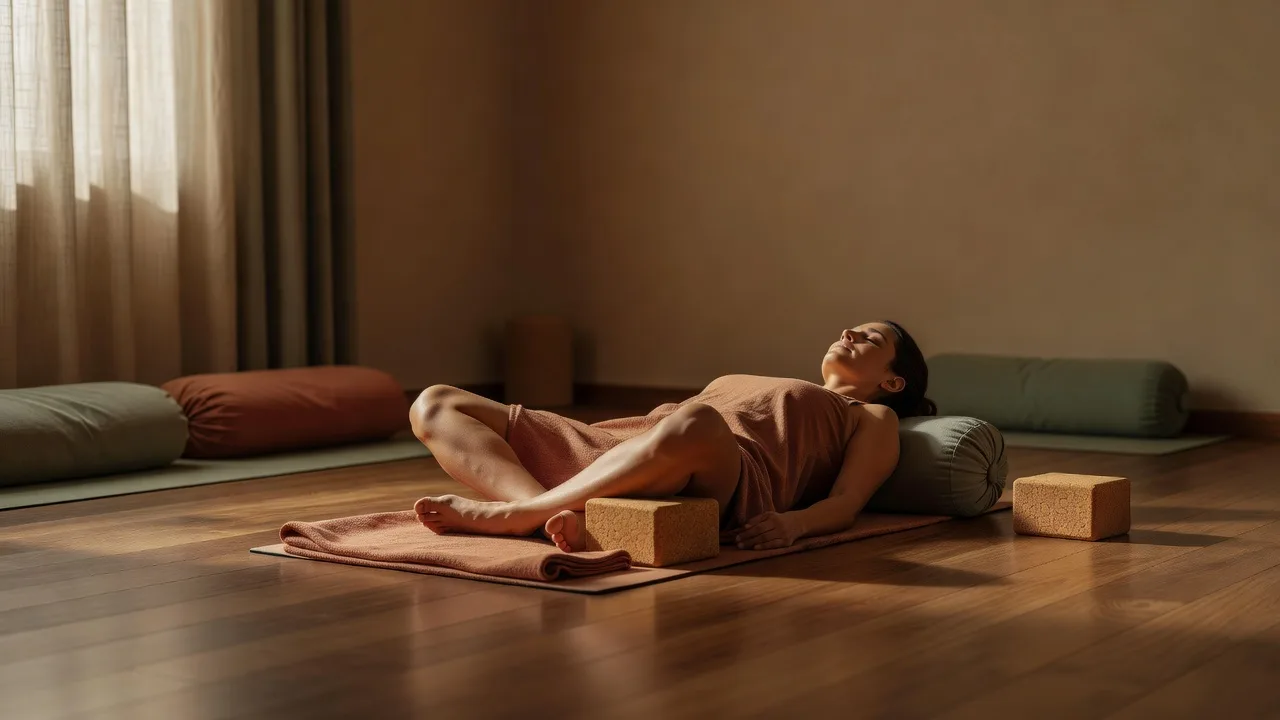
Set the gym timer to 4 minutes at home. Lie in butterfly or on your back with feet wide. Hands on the belly. Nose breath for two minutes before the hold. No performance meter. No record.
Pro-tip: Set the timer to 4 minutes. Lie in butterfly or on your back with feet wide. Stay until the beep, not until your head says enough.
Hip hold with a block under the sitting bone. If the joint goes sharp: come out. Muscle discomfort can stay. You learn that difference in one class better than in ten videos.
What you notice in the first class
Back or side of the room is fine. Grab a block, a blanket, a cushion. Yin is props, not heroics. That belongs to yoga as we practice it here: slow, supported, no show.
First hold. Hip or back. Nose breath. Muscles may soften. Joint pain is a stop sign, not a badge.
Then the restlessness. The itch to perform. Sudden heaviness in the hips. That is the point. Stay until the clock, not until the gym says enough.
Sometimes a calf itches. Sometimes you want the phone in the bag. Sometimes a sentence from the work week shows up with nowhere to go. Leave it. You do not have to solve it in minute three.
Research shows yin can drop state anxiety after weeks of practice. Fair: that trial counted 48 Latvian women, not men in a gym. The mechanism (long stillness, nervous system) is why men pick it up anyway. Not because the study already proved them.
Hips talk louder than biceps. If you lift, expect hamstrings before a hero chest. More on that deep layer in psoas, hips and what stays there. Fascia and feeling travel together, see also yin, fascia and release.
Home practice is allowed. No studio anxiety required. Starting yoga at home is an entry if the locker room still feels too bright.
After-hold: two minutes on your back. Eyes open or closed. Stand slowly. Drink water. No stretching contest afterwards. The body just had time. Do not give it another job at once.
After class the locker room smells of rubber and soap. Nobody asks how deep you went. Good. You do not have to win anything.
Why men are picking up yin now
Not because flexibility is the goal. Pain. Sleep. Performance stress. A back that will not drop after deadlifts. A head that still counts after work.
Sometimes it is the pelvis that will not cooperate. A small trial in men with chronic pelvic pain syndrome found yoga not worse than medication, with fewer side effects. Pilot. Not a yin protocol. No promise your complaint vanishes. Acute pain, urinary issues or depression: clinician first. Yoga beside that, not instead of it.
Men walk in through a body that stopped cooperating, not through a wish to look loose on Instagram. Fine. The mat does not ask for a reason. Only presence.
If the chest stays high after the mat, breathwork coaching fits better than another hold. Sixty minutes, sixty euros. No group pressure.
One-to-one yin via yin yoga is for props and a pace that fits a male body. If you are torn between yin, breath or both: a thirty-minute intro is free.
Pro-tip: After class, two minutes on your back, eyes open. Write one sentence: what wanted to perform, what stayed.
Weekly rhythm: two yin sessions beside existing lifting, not instead of it. You do not have to dump the squats. You give fascia and the nervous system a second clock.
How to start in practice
Clothes: long pants or shorts, a T-shirt that does not bind at the hips. Socks on or off, whatever keeps your feet warm. No special kit. You lie a lot. Comfort beats look.
Place: the back. Props: yes. Block under the sitting bone if the hips protest. Blanket under the knees if the low back pulls.
Hold: 3 to 5 minutes. Breathe through the nose. No Wim Hof as a performance meter in this class. That is a different tool.
What you notice: restlessness, itch, heaviness. Stay to the clock. Stop at sharp joint pain. Ask the teacher for a variation. Information, not a fail.
If stress still sits in sleep or recovery, read yoga for burnout as context, not a diagnosis. Yin is staying still. Burnout sometimes needs a longer horizon than one class.
First week: twice. Home or studio. Same timer. Same hold. Check if the jaw is softer on day three. That is enough.
If the hold feels boring, good. Boring is often the nervous system finally having nothing to win.
Bring water. Leave the phone in the bag. Four minutes is long enough to notice whether you stay or flee.
Key takeaways
- Yoga for men is not a separate sport. Same mat, lower barrier.
- Yin measures staying, not how deep you go.
- First class: props, 3 to 5 minutes, stop at joint pain.
- Two sessions beside lifting is enough to feel if the nervous system follows.
- Clinician first for acute pain. Yin is an add-on.
- Check stillness with the yin check before you walk into a studio.
If this lands, start small. Timer. Block. Four minutes. The digits do not need to run.