You drive home. Radio off. Jaw locked. And under that quiet sits the sentence: this is not for me.
A retreat for men still sounds, in a lot of rooms, like something soft. Something for women. Something you do not mention at the office. The threshold is rarely the price. The threshold is image. What if I get emotional. What they will say if I drop off the map for a week. I know that threshold from the inside. Not as a slogan. As a man who treated the toughness mask as part of the job for years.
I ran a boat. Emotion was noise.
I served on a submarine. Seventy men in a steel tube, weeks under the water. Toughness is not a pose there. It is the protocol. You keep your shoulders up because the watch asks for it. Emotion is noise on the line. You park it until you surface. Then I surfaced and kept doing the same thing. For years. At home, at work, in the car. The armor never came off, because nobody gave the order.
Later, as a breath coach, a man sat across from me. Mid-forties, project lead, jacket still on. He said: if this gets vague, I walk. Not a threat. A border. Twelve minutes of breathing later, one shoulder dropped. No drama. No circle where he had to share. Just a sigh he had not planned. That is what I mean by breaking open. Not on your knees. Armor that gives a centimetre, because the role can stand down for a moment.
A retreat for men is not a wellness week. It is a setting where that drop is allowed. And tough guys break open here more often, not in spite of the toughness, but because of it.
What is a retreat for men?
A retreat for men is a deliberate, multi-day withdrawal from work and family. Usually a weekend to a week. Silence, breathwork or group work makes room to feel without performing. It is not a soft holiday and not a talking circle. It is also not a women's circle with a male sticker on it.
- What is a retreat for men?
- A retreat for men is a deliberate, multi-day withdrawal from work and family, usually a weekend to a week, where silence, breathwork or group work makes room to feel without performing. It is not a soft holiday and not a women's circle. It is a setting where the toughness mask is allowed to drop for a while.
Most men already know the forms. They just have never put the word men on them. Silence. Yoga. Breath. A week away. What changes is the setting: fewer roles, more body, guidance that does not ask for a story before the body has let something go. If you first want the map of what a retreat is, and the five forms, read our piece on what a retreat means and which types exist. The retreat guide lays out duration, cost, and when it does not fit yet.
Yoga for men shows up in some of those weeks. Not as a flexibility test. As a way to let shoulders and hips drop without a performance. Tessa Frunt holds that yin part: slow, precise, no need to be supple. You do not need a meditation CV. You need to stay present when it gets uncomfortable.
Why tough guys break open here
Breaking open on a retreat is not collapsing and it is not weakness. It is the moment when tension, grief or anger that stayed stored at home is finally allowed through the body. At home you keep the role of provider, father or colleague upright. On retreat those roles fall away. Nobody asks how the sprint went. Nobody needs you as the strong one. Then what you already felt in the car, and put away, comes up.
- What does breaking open on a retreat mean?
- Breaking open on a retreat is not collapsing and it is not weakness. It is the moment when tension, grief or anger that stayed stored at home is finally allowed through the body. That happens more often in men who held the strong-man role for years, not in spite of that toughness but because of it.
In sessions I see it in the body before I hear it in words. Jaw. Shoulders. Breath that stops at the thought: what if I cry there. Men who held the strong-man role for years have maintained that armor so well they mistake it for character. Until the body takes the command. In a small group, or one to one, that often surfaces in days. At home it takes years, because the audience never leaves.
You see the same pattern in how stress stays in the body. Shoulders that no longer drop. A jaw still clenched at night. How that works in tissue is in our blog on stress stored in your body. When the hold sits low in the hips, there is more in the piece on the psoas and what gets stuck there.
The threshold is image, not price
Soft-fear is the label men stick on a retreat before they have been. Afterwards they call it work. The fear is concrete. What if I get emotional. What they will say at the office. What if I am the only man among yoga mats. What if I lose control and someone sees it.
That fear is not childish. It is trained. Staying tough is, for a lot of men between thirty and fifty-five, a job skill. Projects. A family. A father who never said it either. You learn that feeling equals failing, until you no longer have a word for it. A retreat for men takes the audience away for a while. Not to unmask you. To let the mask rest for a weekend.
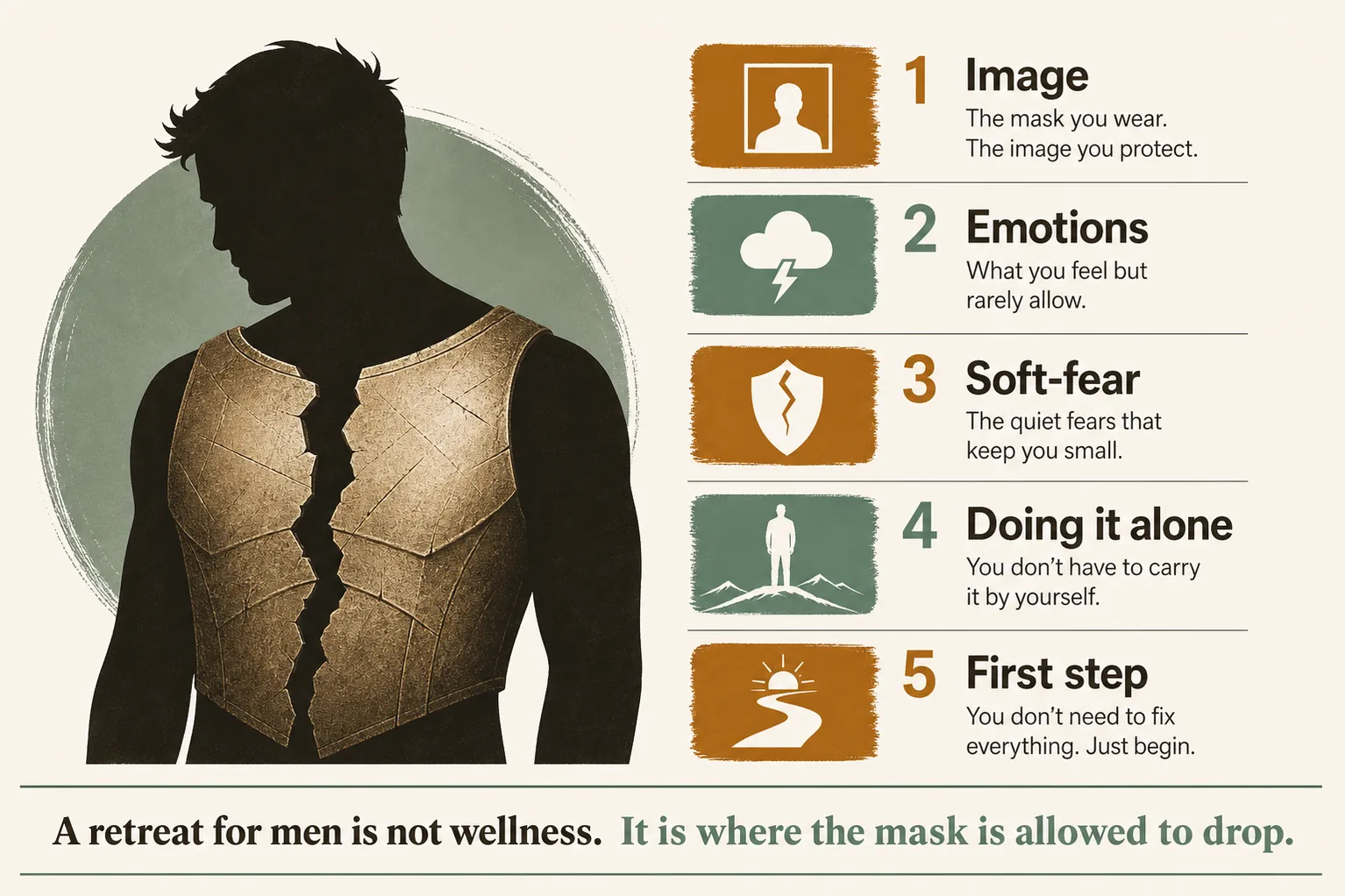
Five thresholds I hear again and again, and what sits behind them.
| Threshold | What you think | What usually happens |
|---|---|---|
| Image | What they will say at work | Nobody asks for a report. You say you were away for a week. Done. |
| Emotions | What if I cry | Often a sigh first, a jaw that drops, no performance. |
| Soft-fear | This is too soft for me | Yoga and silence show up. The work is feeling without performing. |
| Doing it alone | I will fix this myself | Doing it alone is exactly how the mask stayed on for years. |
| The first step | A week is too big | You start smaller. A session. A conversation. Then the week. |
If a whole week feels too big, that is not a rejection. That is data. Then you do not start in the group. You start in your body, alone, sixty minutes. One-to-one breath coaching is built for that: online with me, €60 an hour, no talking circle, just the body. Want the forms side by side first? How to choose a retreat that fits asks the questions that matter, without a pitch.
Pro-tip: Tell the office no more than you want. "I am away for a week" is a complete sentence. You do not have to pitch the retreat. Dropping the mask is not a press release.
Being tough means feeling it later
This is not a character flaw. It is a pattern with numbers behind it. Not proof that a retreat in another country dissolves your stigma. Proof that tough norms raise the threshold to help, and that midlife men often do not say it.
In 2025 Emir Üzümçeker put 35 samples together on traditional masculinity and asking for help. The stronger the tough norm, the more negative the attitude toward psychological help, and the heavier the self-stigma. Country or scale barely moved that. You can read it in his meta-analysis on masculinity and help-seeking. What I take into the room: the man who says a retreat is too soft is often not defending taste. He is defending a norm that turns help into loss.
Ferdi Botha followed 12,117 men in Australia across years. Loneliness peaked in midlife, around the late forties. On a direct question ("are you lonely?") men reported it less than on a multi-item measure. They understated it. Breadwinner norms and insecure work pushed loneliness up in working men. The study on male loneliness across life stages reads like this: men from thirty to fifty-five are a risk group, and they often do not say so. It does not read: a weekend away cures loneliness.
Vincent Mancini looked at 740 men, average age forty, and at emotional control, self-reliance and work-first. Those norms linked to alexithymia: not having the word. Then to trouble regulating emotion. Then to symptoms that turn inward. His study on masculine norms and internalising symptoms names what I feel in a session: tough guys feel it later because they have no word for it, not because nothing is there. Breathwork does not cure that wordlessness. It gives the body room first, so the word can arrive later.
A retreat is not a medical claim. Still, there is evidence that a multi-day intensive setting can shift measurable scores. In a registered trial of a six-day insight meditation retreat (Hadash et al., 2026), participants scored better on well-being after two weeks, with less rumination and fewer depressive symptoms than a matched control group. Effects were small to medium. The group was mixed, just over half women. Worsening was equal or lower than in controls. That does not prove a Spiriators men's retreat or a breathwork retreat. It does show that a multi-day withdrawal need not be wishful thinking, including for people with elevated symptoms.
Four studies. Same line, plus that extra layer. The mask keeps help out. Midlife men do not say it. And if you have no word, the tension stays in the body until the setting changes. A retreat for men is that kind of setting. Not proof that our form fixes it. A reason why tough guys break open here sooner than on the sofa at home.
Five threshold exercises for men considering a retreat
No yoga CV. Five short exercises of one to three minutes, at home, for when a retreat for men feels too soft or too big. They come from how men walk into sessions: shoulders, jaw, breath that stops, a sentence they never say at work. More breath variations sit in our guide to five breathing exercises against stress. What a multi-day breath setting actually does is in the honest account of a breathwork retreat.
- Shoulder drop on the exhale (60 sec). Stand or sit. Inhale through your nose. On the exhale drop both shoulders as if taking off a jacket. Three rounds. Most men keep their armor in their shoulders. This is not yoga. This is noticing you have been bracing for hours.
- Jaw release (90 sec). Clench your teeth for three seconds, then let the lower jaw hang heavy. Tongue off the palate. Exhale through the mouth. Repeat five times. Men who stay tough often literally bite down. When the jaw drops, a sigh or an unplanned feeling often follows.
- Box breathing, field rhythm (3 min). In 4, hold 4, out 4, empty 4. Six rounds. Men from high-pressure jobs know this as control, not as fluff. Use it when your breath stops at the thought: what if I cry there.
- One sentence you never say at work (2 min). Write one sentence on paper. Not "I am fine". Something true: I am tired, I miss my father, I am afraid I fail. Notice what happens in your chest. That is the same material that surfaces on a retreat for men, only without an audience.
- Hand on the chest, name it (90 sec). Flat hand on your sternum. Breathe slowly three times. Say one word out loud: angry, sad, empty, or nothing. No analysis. Just the word. If you can say the word, you have already crossed part of the threshold.
Pro-tip: Do exercise 4 on paper, not in your head. A sentence in your head stays a thought. On paper it becomes a fact your chest responds to. That response is the data. Not the story you build after.
A retreat is not emergency care and not a replacement for therapy. If you are in an acute crisis, or a psychiatric crisis, wait and seek care first. If you only come to escape a concrete problem (work, a relationship, debt) the week will not solve it. It is a safe entry if you are stuck in stress, burnout or a life that looks fine on paper, and you are not in crisis. Start small. A session. A short conversation. Then you choose a form that fits your nervous system.
Key takeaways
- A retreat for men is a multi-day withdrawal, not a soft wellness week and not a talking circle.
- Tough guys break open here more often because the mask can drop, not in spite of the toughness but because of it.
- The threshold is image: the office, crying, soft-fear. Price comes later.
- Research links tough norms to asking less for help, under-reported midlife loneliness, and not having the word.
- Breaking open is a sigh, a jaw, a shoulder. Not a collapse.
- You do not need to know how to meditate. You need to stay when it gets uncomfortable.
- Too big? Start with sixty minutes one to one, not a week in a group.
What comes next
Not sure whether this is bodywork or something vague? Take the short breath check and see where your breath stands. Want the forms, the duration and when it does not fit, in one place? Open the retreat guide. Prefer to start alone, no group: one-to-one breath coaching, sixty minutes online, €60. No talking circle, just the body. If a week feels too short and you want the rhythm in your life, not only in a programme, look at nomadic co-travel. Yin as a way in, with no flexibility test, lives at yin yoga. And if you only want to test whether this fits? Send a message.
A retreat for men is not a holiday from your character. It is the place where the mask is allowed to drop. Afterwards most men do not call it soft. They call it work.