A craving can rise like a wave, in the middle of the afternoon or late at night, even when you have been in recovery for weeks or months. In those moments, many people wonder how to deal with cravings in a way they can manage themselves, alongside the care they already receive. Breath can have a place there, not as treatment and not as a way to get through withdrawal, but as a calm anchor you practise. Getting through withdrawal itself needs medical supervision. This article is about what you can do alongside it, in concrete moments.
Stopping alcohol, benzodiazepines (sleeping pills and tranquillisers) or opioids can cause dangerous withdrawal symptoms. Always talk to your doctor or an addiction service before you stop or cut down. How the nervous system and addiction are connected is explained in what your body remembers about addiction. For a broader, more reflective view, read addiction as a portal to wholeness. This piece stays practical: the craving wave, a daily rhythm, difficult evenings and loved ones who want to help.
Recognising the craving wave and placing an anchor
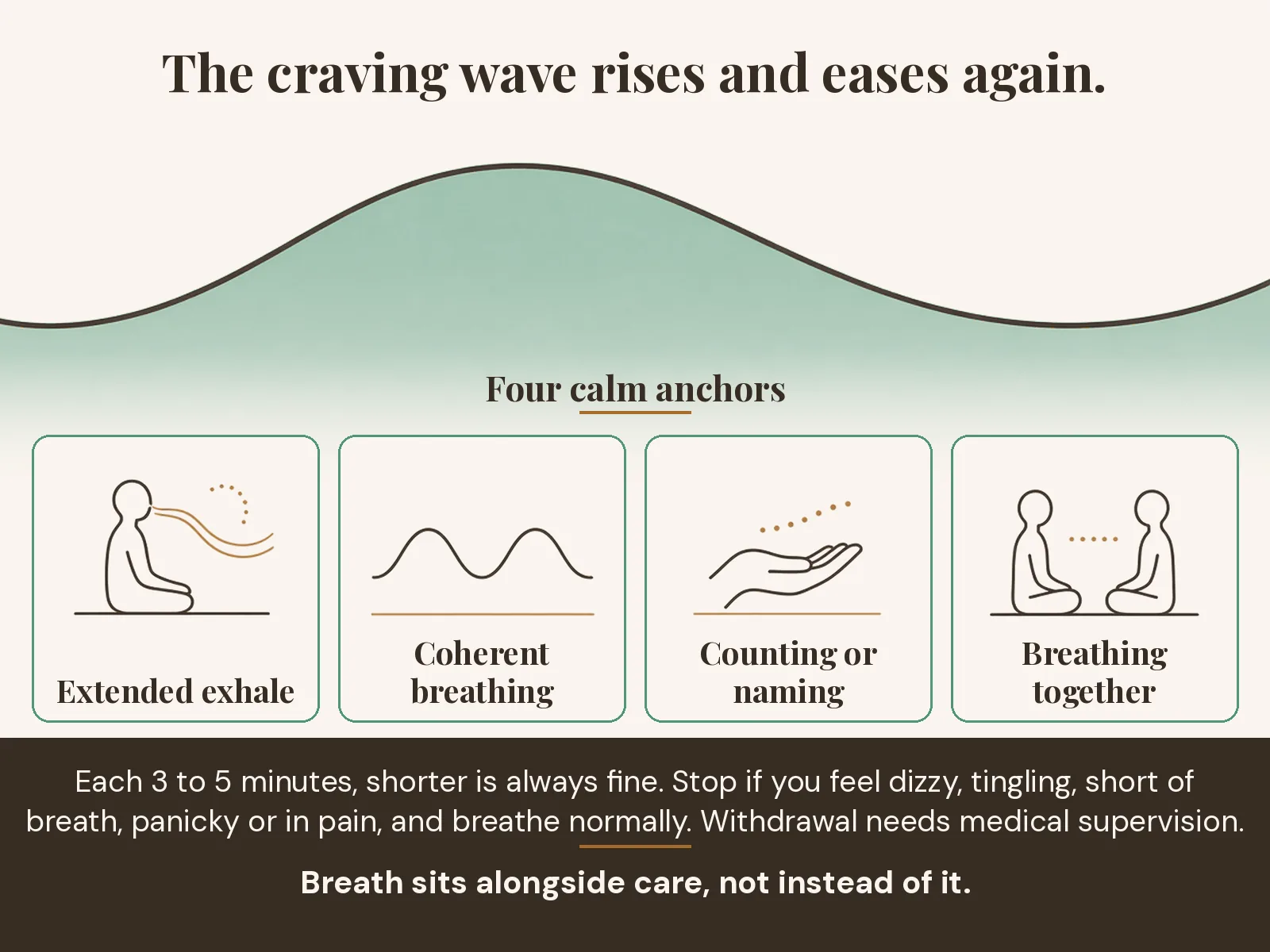
A craving is often more than a thought. You may also feel it in your body: restlessness in your chest, a dry mouth, hands that want something to do. The image of a craving wave fits, because that is how it can feel: it builds, reaches a peak and then eases again. You do not have to push the wave away or defeat it. You can notice it while you breathe.
A first anchor is naming what is happening, without getting lost in it. Say it out loud or to yourself: "There is a craving." "My heart is beating faster." "I want to get up." This is not a trick. It moves your attention from the urge to what you feel right now, and gives you a few seconds of space before you act.
A hypothetical example: someone is sitting alone on the sofa in the evening, the day is done, and the thought of a drink comes up. Instead of walking straight to the kitchen, they put their feet on the floor, name the craving and start one of the calm exercises below. That is no guarantee the craving will go away. It is a pause in which they can choose again.
Pro-tip: Choose one fixed phrase in advance to name the wave, such as "This is a craving wave, and it is allowed to be here." The more familiar the phrase, the more easily it comes back to you when things get tense.
How to deal with cravings: four calm breathing exercises
These are calm, safe techniques only. No hyperventilation, no prolonged connected breathing, no Wim Hof-style rounds and no breath holding as the core. Each exercise takes 3 to 5 minutes; shorter is always fine. Stop sooner if you feel dizzy, notice tingling, become short of breath, feel panic or have pain: go back to breathing at your own pace, open your eyes, move a little, and seek help if it does not settle. These exercises are an addition to care, not a replacement for it.
1. Extended exhale
Position: sit with your feet flat on the floor, or lie on your back with your knees bent. Breathe in gently through your nose for about 4 counts, and breathe out more slowly for 6 to 8 counts, through your nose or softly through your mouth. Duration: 3 to 5 minutes. For some people, a longer exhale feels calmer. Stop rule: if you feel dizzy or notice tingling, breathe normally again and wait until it passes.
2. Coherent breathing
Position: sit upright but relaxed, or lie on your back. Breathe in an even rhythm of about 5.5 to 6 breaths per minute, for example 5 seconds in and 5 seconds out. The coherent breathing timer can set the pace for you. Duration: 3 to 5 minutes. You can read more about this way of breathing in heart coherence: how to train and measure it. Stop rule: if you feel panic or shortness of breath, let go of the rhythm and return to your ordinary breathing.
3. Counting or naming
Position: sit comfortably, with your hands on your thighs or your belly. Breathe at your own pace without changing anything, and count each exhale: one, two, up to ten, then start again at one. Prefer not to count? Softly name "in" and "out" instead. Duration: 3 to 5 minutes. Counting gives your attention something to hold without forcing anything. Stop rule: if you become more restless rather than calmer, or notice tingling, open your eyes, look around the room and breathe normally.
4. Breathing together with a loved one
Position: sit side by side, both with your feet on the floor. You set the pace; the other person breathes quietly along with you or simply sits with you. Nothing needs to be said. Duration: 3 to 5 minutes. Stop rule: if either of you feels uncomfortable or notices physical signals, you both stop and simply keep breathing normally.
If you are looking for more general exercises for everyday tension, see five breathing exercises against stress.
Pro-tip: Practise at a quiet moment first, not only when the craving is already strong. Pick one exercise that feels good and stay with it for a week, so it feels familiar when you need it.
Urge surfing: staying with the wave without using
Urge surfing comes from Marlatt's work on relapse prevention. The idea is that you stay with a craving as it rises and falls, without acting on it, as if you were riding a wave instead of fighting it. Breath can be your anchor. You turn your attention to what you feel and to your exhale, and you let the urge be there without having to do anything with it.
The research on this is still small. In a study by Bowen and Marlatt (2009) with 123 college students who smoked, some of them were given a brief instruction in this way of handling cravings (PubMed). Their urges were no weaker afterwards than in the comparison group, but over the following seven days they did smoke fewer cigarettes. That is a preliminary finding, in smokers, not in people withdrawing from alcohol or drugs.
In practice it can look like this. You notice the craving, sit down and do one of the calm exercises above for 3 to 5 minutes. Then you check in again: is the craving still there, how strong is it now, what do you need? So you do not have to keep breathing for a long time. The short exercise is an anchor; the moment after it is a moment to choose again, for example to call someone, go for a walk or contact your treatment provider.
Pro-tip: After your exercise, set a short alarm for a few minutes, not to breathe for longer, but as a reminder to pause and choose again what you need right now.
What research on breathing and cravings shows
There is research on breathing in substance use, but it is young and set up differently from the exercises in this article. A meta-analysis by Roxburgh and colleagues in the journal Addiction (2026) pooled studies of controlled breathing and heart rate variability (HRV) biofeedback, some of them using biofeedback devices (meta-analysis in Addiction). Participants used alcohol, drugs or nicotine. The effect on cravings was small but consistent (Hedges' g = 0.30, across 12 studies with 696 participants). Whether it helps with withdrawal symptoms remained uncertain.
A phase 2 trial by Eddie and colleagues in JAMA Psychiatry (2025) followed 120 adults in early recovery who were already in treatment (PubMed). For eight weeks, one group practised with a wearable biofeedback device alongside their usual treatment; the other group received usual treatment only. In the biofeedback group, negative feelings and cravings decreased more, and there were fewer days of use. According to the researchers, this now needs further testing in a larger phase 3 trial.
That is encouraging, but it does not mean the exercises above do the same. A biofeedback device used alongside treatment is something different from a few minutes of calm breathing at home. As far as is known, there is no research yet on simple, calm breathing exercises without a device during acute withdrawal. Here, breath is a calm addition, not a treatment.
Pro-tip: Take a study you have read to your treatment provider and ask what it means for your situation. That way curiosity becomes a conversation, rather than an experiment you take on alone.
A daily rhythm and difficult evenings
In early recovery, evenings are often the hardest part, because the structure of the day falls away. A fixed moment for breathing can give a rhythm, for example after dinner or before bed. It does not need to be long: one of the exercises above, for 3 to 5 minutes. Some people link it to something they already do, such as making tea or taking a short walk.
A fixed breathing spot helps too: the same chair or the same corner of the sofa, with your feet on the floor. Then you do not have to think about where to sit when you feel restless. Breath can sit alongside other things in your day: appointments with your treatment provider, support from the people around you, movement and a recognisable daily routine. It is not a ranking. Whatever fits with what you already do is enough to start with.
A hypothetical example: someone notices that the restlessness is strongest between eight and ten in the evening. Instead of trying to "survive" the evening, they plan a short breathing moment and a call with a loved one or a coach. That is no guarantee, but it is structure. If the restlessness becomes too much, or thoughts of relapse come up, contact your doctor or addiction service.
Pro-tip: Put your breathing moment in your calendar or stick a note on the fridge. A visible reminder makes it easier, especially on days when motivation is low.
Loved ones who want to help
A partner or family member often wants to do something. Helping here means inviting, not pushing or checking up. An invitation can be: "Would you like to breathe quietly together for a few minutes?" or "I'm sitting right here, if you want." If the other person says no, that is fine too. Breathing together can be a moment of connection without anything needing to be fixed, and without having to talk about the addiction.
As a loved one, you have your own limits too. It is not your job to make the other person better. You can say that you would rather not talk about the addiction right now, or that you would like some time alone. Support matters for loved ones as well; ask an addiction service or your doctor what help is available for you. You do not have to carry it alone.
Pro-tip: At a calm moment, agree together what helping means. For example: "When I get restless, you can ask whether I want to breathe, but you won't insist."
Withdrawal under medical supervision: limits and safety
Breathwork is a possible addition to professional care, never a replacement. It is not a treatment for addiction and it does not prevent relapse. Stopping alcohol, benzodiazepines or opioids can cause dangerous withdrawal symptoms and needs to happen under medical supervision. The NHS puts it plainly: "It can be very dangerous to stop drinking suddenly if you're dependent on alcohol" (NHS). NIAAA explains that stopping suddenly after prolonged heavy drinking can lead to a painful or even potentially life-threatening withdrawal process, and advises seeking medical help to plan a safe recovery (NIAAA).
Intense breathing techniques, such as hyperventilation, holotropic breathwork, Wim Hof-style rounds or prolonged connected breathing, are not a tool for cravings. At most, they fit with guidance and outside acute withdrawal.
- What breath can be
- A calm anchor alongside your care, at moments you choose yourself.
- What breath does not replace
- Medical supervision during withdrawal, your doctor, an addiction service or medication you have been prescribed.
- When to seek help
- If you have withdrawal symptoms after stopping, or if the exercises make you more restless: contact your doctor or treatment provider.
If you are in danger or thinking about suicide, contact your local emergency number or a local crisis line.
Coaching at Spiriators is not therapy and not a substitute for medical care; anyone who needs medical treatment for addiction is referred on. If you would like to give breath a steady place alongside your care, you can look at 1:1 breathwork coaching. For more background on your nervous system, see the Nervous System Reset e-book, and for more exercises and forms, the breathwork guide. If you have a question about how breath fits your situation, you can book an introduction via contact.
Pro-tip: Write the stop rules and the crisis line on a note and keep it by your breathing spot. In a tense moment, reading something is easier than coming up with it.
Recovery rarely runs in a straight line. Breath can be one of the things you carry with you, alongside the people and the care that are already there. You can practise, you can stop, and you can always return to professional help. You do not have to repair yourself before you are allowed to begin. It is about remembering: returning, again and again, to a calm exhale, even after a hard day.