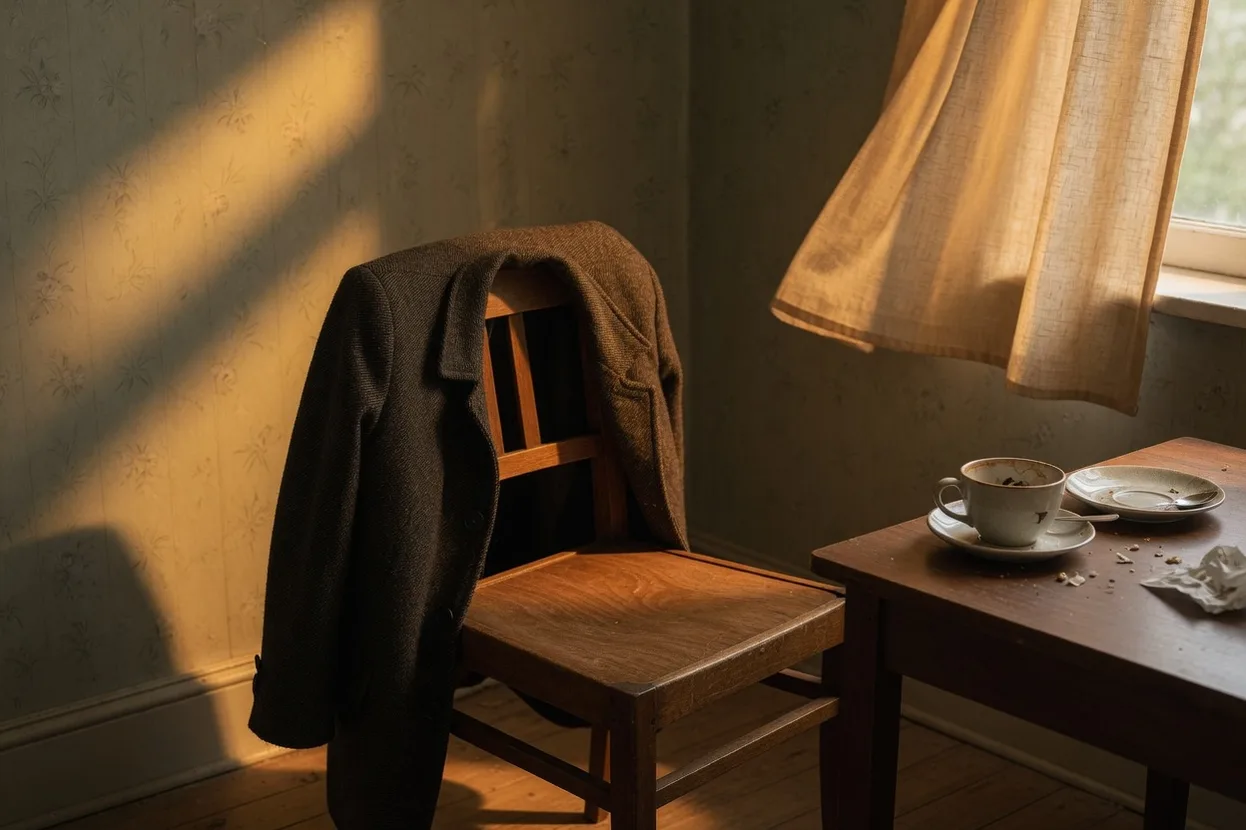
The coat is still on the chair. The teacup beside it has gone cold. Nobody moved it. You did not either. Breathwork for grief often starts like that: not with an exercise, but with an object that still belongs to someone, or to a life that is no longer here.
You can touch the coat. Or walk around it. The chest sometimes pulls tight then, as if a weight has settled there and refuses a name. That weight is not proof you are doing grief wrong. It is the place where loss cannot travel any further, for now.
Breathwork does not take the loss away. A slow exhale makes room so you can carry it, instead of pressing it down until the throat closes.
What breathwork for grief does, and does not do
Breathwork for grief is slow, deliberate breathing while you allow the physical pressure of loss, with an exhale that lasts longer than the inhale.
- Breathwork for grief
- Breathwork for grief is slow, deliberate breathing while you allow the physical pressure of loss. The exhale is longer than the inhale. The aim is capacity to carry, not the erasure of mourning.
People sometimes ask if they can breathe the grief out. As if mourning were a gas you could empty from the lungs. It does not work that way. The coat stays. The chair stays empty. What can shift is whether the chest, throat and belly still have a millimeter of room to hold that fact.
Grief follows different paths. A review of grief trajectories shows that a minority moves into prolonged, disabling grief, and that most people follow another course. That study does not prove breath changes a trajectory. It is not a breathing study. It only says this: loss is not one straight line, and you do not have to defend your pace.
Sometimes the mind wants a story. What you missed. What you should have said. That story keeps you awake, while the body has already answered: tight, hollow, shaky. Breathwork for grief speaks to that answer first. The story can wait. Or never arrive.
Where the weight settles
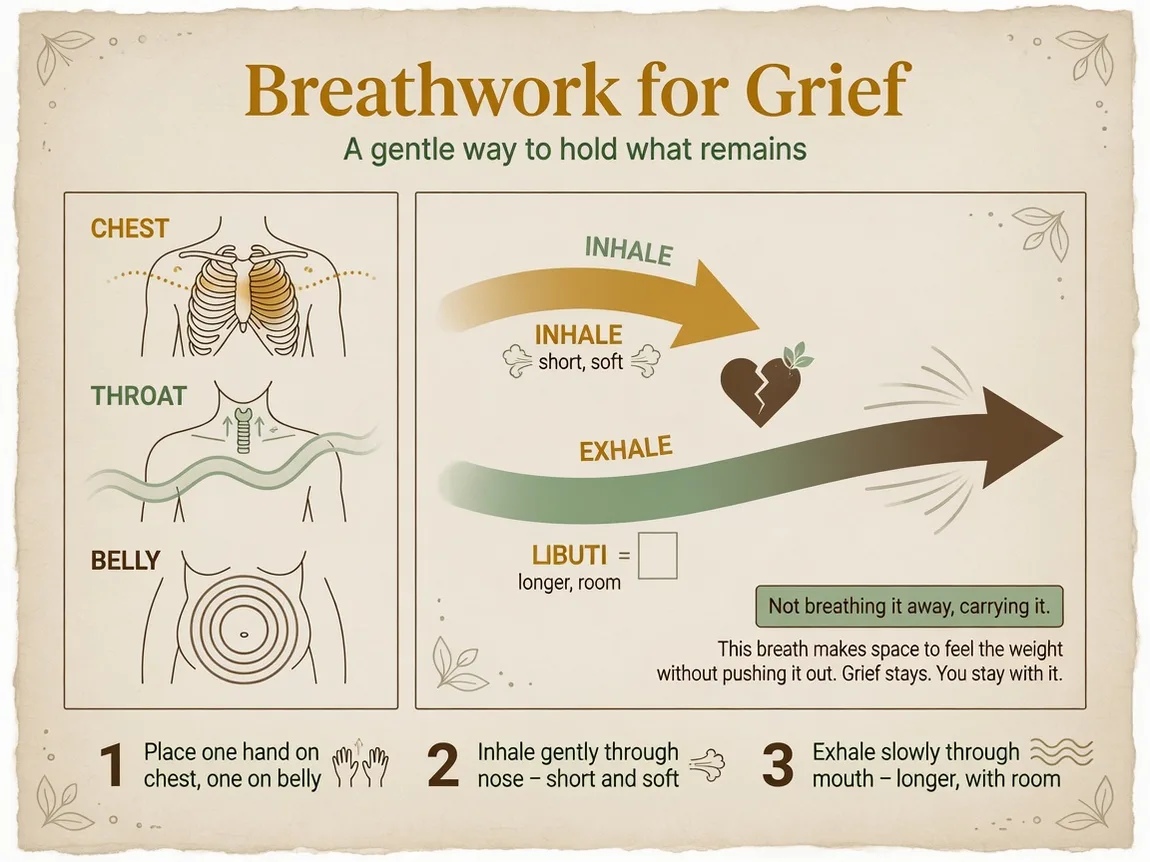
Grief in the body is the pressure you notice in the chest, throat or belly when loss is no longer only a thought, but a place that feels heavy, dense or empty.
One day it is the chest. Dense, like a blanket that will not warm. Another day it is the throat. A lump. Words that reach the lips and stay there. Sometimes it is the belly, hollow, as if something was taken and the rest of you has not learned how to stand yet.
It switches. A morning can leave the throat free and the chest shut. An evening can reverse that. You do not have to decide which place is the real one.
| Place | How it can feel | What the breath does then |
|---|---|---|
| Chest | Heavy, dense, small | Short, high sips. Little room for a full exhale. |
| Throat | Lump, pinched, silent | Air stays high. A sigh wants out and stalls. |
| Belly | Hollow, empty, restless | The belly pulls in. The breath does not dare to drop. |
A grief dam is the tightening of throat, chest or belly so the loss does not fully enter, which leaves the breath short and high.
- Grief dam
- A grief dam is the pattern in which the throat, chest or belly tightens so grief does not fully come in. The breath then becomes short and high. Making room means not forcing that dam, but breathing gently alongside it.
The dam is not an enemy. It may have carried you through a funeral, a move, or a quiet house. Forcing it does not help. A hand on the tight place, and an exhale a little longer than the inhale, is enough for today.
If the chest has been shut for days, lying down can give more room than sitting up and pushing through. Yin yoga fits that: lying down is allowed, with no performance. In this piece on a chest that stays tight you can read how that pressure already has its own language, even without a grief story. And if the tissue holds the feeling longer than the mind wants, yin yoga and fascia shows why staying down, softly, can do more than talking.
One mechanism: the longer exhale
A carrying breath is a gentle breath in which you inhale to a count of four and exhale to six, so the nervous system gets a little less alarm without the loss disappearing.
That is the whole mechanism. No menu. No second technique you must remember if the first one "does not work". Inhale short and soft. Exhale longer. Room, not erasure.
Three minutes of slow breathing can soften the edge of a negative image. A small pilot found that in young adults looking at unpleasant pictures. The limit matters: no grieving sample, small, and only an acute moment. Not the same as an empty house on a Tuesday afternoon.
Another experiment, with 27 people, found that slow breathing lowered anxiety, valence and arousal during uncertain threat. Research on slow breathing and anxiety is about tension and brain signals, not a cure for grief. The mechanism is useful. The sentence "breath takes the pain away" does not follow.
What you may notice: the shoulders drop a centimeter. The jaw lets go. The chair becomes a chair again, not only a memory. That is capacity. Small. Real.
Pro-tip: Set the free breathing timer to three minutes, inhale four, exhale six. If you start counting in your head and forget the coat, the timer is your anchor. Not your coach.
If you want to see whether your breath is already high and short before you begin, the breath check is a short self-test. Not a diagnosis. A mirror.
Three minutes on the chair
The three-minute carrying breath means sitting with both feet on the floor, breathing softly in through the nose to four, letting the air leave to six, and stopping as soon as the room fades.
Set the feet flat. Not crossed, not on the toes. Hands on the thighs. Pick one point in the room: a door handle, a ledge, the rim of that teacup. Eyes stay open. Grief and closed eyes together can make the world too small.
Breathe in through the nose, count to four. No deeper than comfortable. If four is already too much, count to three. The coat does not have to count with you.
Let the air leave for longer, count to six. Lips relaxed, as if you are letting a candle dance rather than blowing it out. Do not force a sigh. A sigh that comes on its own is allowed. A sigh you manufacture in order to "feel something" can be skipped.
About three minutes. Then stop. Water. A window. No debrief with yourself about whether it worked.
Pro-tip: If you feel dizzy, tingly, or the room disappears: eyes wider, feel the feet, ordinary breath. No second round. The stop is part of the practice, not a failure.
Other breath shapes have a place on an ordinary day. With loss, a long, intense session is often too much. Five breathing exercises for stress lists options for tension. Do not use them as a menu to speed mourning. One gentle sequence is the whole practice here.
If the throat is where everything stalls, talking is sometimes the last thing that works. Not being able to say what you feel describes that silence without asking you to find the right sentence at once.
When carrying becomes too heavy
Breathwork in grief is too much when you hyperventilate, feel faint, or the pain grows so large that you no longer feel the room. Then a short exhale for two minutes is enough, or stopping entirely.
Intense connected breathing, long sessions, or pushing through do not belong here. Forcing the dam makes the room smaller, not wider.
If despair stays for days, if loss shuts down your day, or if thoughts arrive that you do not want to be here: a doctor or a crisis line belongs in the picture. A blog is not a helpline. Breathwork does not replace therapy.
Sometimes you do not want to lift the weight alone. Breathwork coaching is then an hour beside someone, without a promise that the pain will leave. Meet first. Feel whether the chair in that room is safe enough.
If you are unsure a session fits, or you only want to talk it through: get in touch. No sales pitch. A person on the other side.
And if the body is too tired to "do" anything, lying down can be the whole exercise. The coat can stay. You do not have to put it away today.
Key takeaways
- Breathwork for grief makes room in the chest, throat and belly. It does not erase the loss.
- One mechanism is enough: inhale to four, exhale to six, about three minutes, feet on the floor.
- A grief dam protects. Do not force it. Breathe gently alongside it, with a hand on the tight place.
- Slow breathing can soften tension. That is not proof grief heals, and not a reason to rush a trajectory.
- Dizzy, tingly, or the room disappears: stop. If despair persists: a doctor or a crisis line, not a longer session.
- Lying down is allowed. Yin yoga is allowed. You do not have to carry this alone if you want company.
The teacup can stay cold. You can stay seated. If three minutes is too much, one longer exhale is already a way of carrying.