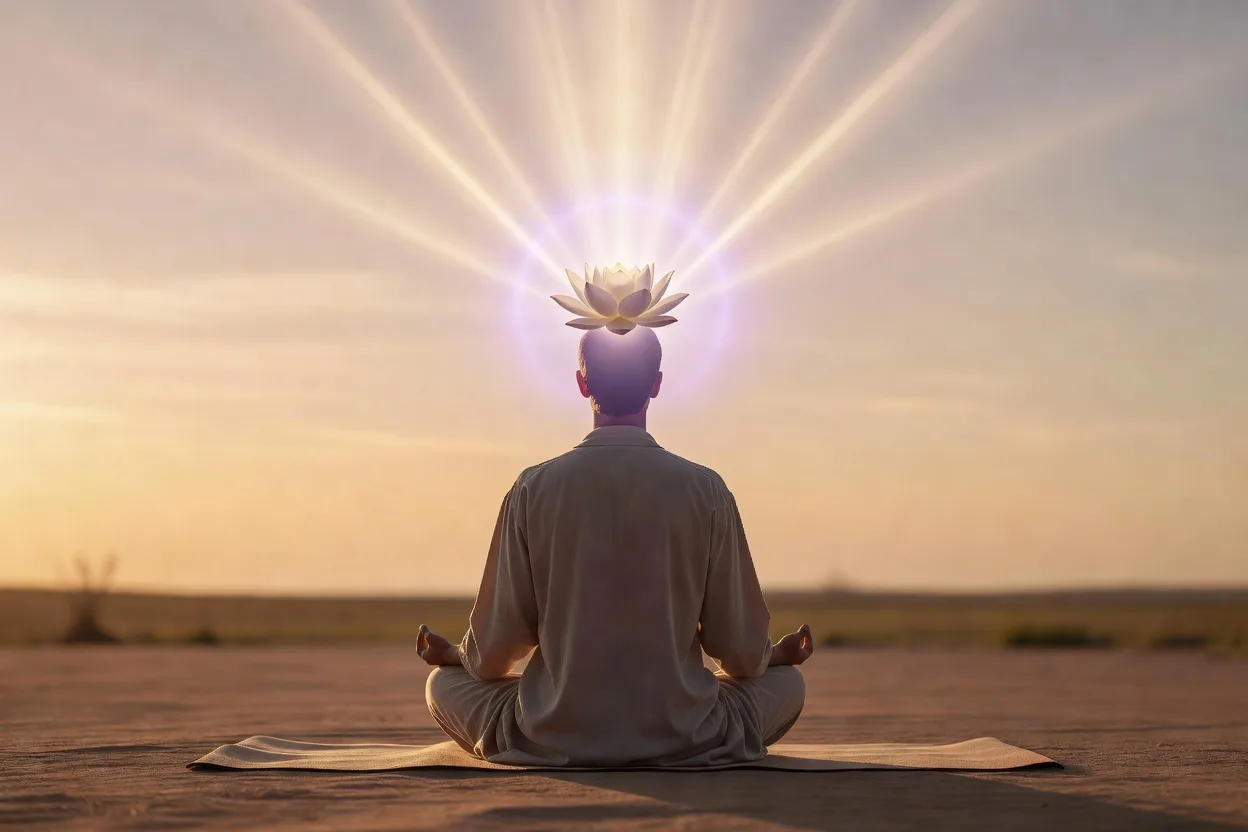
Heart Chakra Opening: Why Your Chest Feels Tight
You know that feeling: a constricting sensation in your chest, as if an invisible band is wrapped around you. Your breathing becomes shallow, your shoulders roll forward, and your heart feels... closed. This is no coincidence. It's your heart chakra asking for attention. In this article, you'll discover why your heart chakra blocks, 7 signs that your chest feels tight, and how to gently open your anahata chakra with yin yoga and connected breathing.
As the fourth chakra in the traditional chakra journey, the heart chakra symbolizes love, compassion, and connection. But when this energy center falls out of balance, it can lead to a physical and emotional sense of closure. Let's explore together what's happening — and how you can create space again.
What Is the Heart Chakra (Anahata)?
- What is the heart chakra (anahata)?
- The heart chakra (anahata) is the fourth energy center, in the middle of the chest at heart level. It bridges the lower chakras (survival, emotions, power) and the higher ones (communication, intuition, connection). Opening the heart chakra means cultivating love, compassion, and safe vulnerability — not forcing an opening.
The heart chakra, or anahata in Sanskrit, is the fourth chakra in your body's energy system. It's located in the center of your chest, at heart level, and serves as a bridge between the lower chakras (which deal with survival, emotions, and personal power) and the higher chakras (which govern communication, intuition, and spiritual connection).
When your heart chakra is balanced, you feel:
- Open and receptive to love
- Compassionate toward yourself and others
- Connected to your surroundings
- Able to forgive and let go
But with a blockage, you experience the opposite: emotional distance, jealousy, fear of intimacy, or that constricting feeling of a tight chest. This is your body literally shielding itself from further pain.
According to van der Kolk (1994), unprocessed emotions store themselves in your body — and the heart area is one of the most common places. Your nervous system switches into protection mode, and your chest closes as a defense mechanism.
7 Signs Your Heart Chakra Is Blocked
- What does a blocked heart chakra mean?
- A blocked heart chakra means love and connection close off physically or emotionally: chest tightness, shallow breath, distance, fear of intimacy, or difficulty receiving. It is not a medical diagnosis for heart conditions — it is a way to describe how protection can get stuck in the chest.
A blocked heart chakra manifests in various ways. Sometimes subtle, sometimes unmistakable. Here are 7 signs to watch for:
Physical Signs
Your body speaks a clear language when it comes to chakra blockages. With a blocked heart chakra, you may experience:
- Chest tension: As if a heavy blanket is lying on your chest
- Shallow breathing: You breathe mainly in your upper chest, not deep into your belly
- Shoulder and neck pain: Your shoulders roll forward, as if protecting yourself
- Heart palpitations or irregular heartbeat: Without medical cause
These physical symptoms are often the first sign that something isn't flowing in your anahata chakra. Note: sharp chest pain, radiation to arm or jaw, or breathlessness with nausea can be medical. See a doctor then. Yin yoga and breathwork are not a diagnosis or treatment for heart conditions — they are a gentle way to explore tension and emotional closing.
Emotional Signs
On an emotional level, you can recognize a blocked heart chakra by:
- Difficulty feeling: You're disconnected from your own emotions
- Fear of vulnerability: You don't let anyone truly in
- Resentment or inability to forgive: Old pain keeps lingering
- Lack of self-love: You're hard on yourself
Emotions like grief, rejection, or fear of intimacy accumulate in your heart area. Instead of feeling and releasing them, you hold onto them — and you literally feel that in your chest.
Relational Signs
You can also see the impact of a blocked heart chakra in your relationships:
- Difficulty with intimacy: You keep people at a distance
- Jealousy or possessiveness: Fear of losing love
- Excessive giving without receiving: You give love but can't receive it
- Fear of rejection: You don't dare to open your heart
Relationships become superficial, or intense and dramatic, because there's no balance in giving and receiving.
Why Does Your Chest Feel Tight? Causes of a Blocked Heart Chakra
There are several reasons why your heart chakra may become blocked. Often it's a combination of factors:
1. Unprocessed emotions
Grief, disappointment, or rejection from the past that you haven't processed remain stuck in your chest. Your body remembers everything — this is called cellular memory.
2. Trauma or painful experiences
A broken heart, loss of a loved one, or emotional neglect can lead to a protective closing of your heart chakra. According to Porges' (2007) Polyvagal Theory, your nervous system then switches into survival mode.
3. Lack of self-love
If you're hard on yourself, critical, or perfectionistic, you close your heart to your own vulnerability. Without self-compassion, your heart chakra cannot flow freely.
4. Relationship problems
Conflicts, unresolved tensions, or lack of connection in your relationships can affect your heart chakra. Your heart responds to every emotional exchange.
5. Stress and overstimulation
Chronic stress keeps your nervous system in a state of alertness. Your body has no room to relax, and your chest remains tense.
The good news? Your heart chakra is resilient. With the right practices, you can open it again — gently, safely, and at your own pace.
5 Practical Exercises to Open Your Heart Chakra
Here are five proven methods to open your heart chakra and relieve that tightness in your chest. These exercises combine yin yoga, breathwork, and meditation for a holistic approach.
Yin yoga poses for the heart
- What is yin yoga for the heart?
- Yin yoga for the heart is a gentle practice of long, passive poses (3–5 minutes) that open connective tissue around the chest and shoulders. That gives your nervous system time to shift from fight-or-flight toward rest. Poses like Melting Heart or Supported Fish support opening the heart chakra without force.
Yin yoga works directly on the connective tissue and fascia around your chest and shoulders. By holding passive poses for extended periods (3-5 minutes), you give your nervous system time to shift from fight-or-flight to rest-and-digest.
Melting Heart Pose (Anahatasana)
Start on hands and knees. Walk your hands forward and let your chest sink toward the ground. Your chin or forehead rests on the mat. Feel how your upper back and shoulders open. Breathe deeply into your chest.
Supported Fish Pose
Place a block or rolled blanket under your shoulder blades. Lie back on it with arms wide, and let your chest open toward the ceiling. Stay for 5 minutes, breathing and feeling how your heart area relaxes.
Puppy Pose
From hands and knees, walk your hands forward while keeping your hips above your knees. Let your chest sink and feel the stretch in your shoulders and upper back.
Want to learn more yin yoga poses? Discover our yin yoga page for detailed instructions, or watch the guided yin yoga videos in which Tessa walks you through these poses.
Connected breathing for anahata
Connected breathing is a powerful breathwork technique that works directly on your heart chakra. By keeping your breath continuous and without pauses, you activate the limbic system and give stored emotions a way out.
Practice:
- Lie comfortably on your back, hands on your heart
- Breathe deeply in through your nose (4 counts)
- Breathe out through your mouth (4 counts)
- Don't hold any pause between inhale and exhale
- Let the breath flow in a circular motion
- Continue for 10-15 minutes
Many participants experience a warm glow in their chest or spontaneous tears of relief during a session. This method is often used in our Chakra Journey to gently break through deep blockages.
Want to experience connected breathing? Book an ademcoaching session with Johannes.
Meditation and affirmations
Meditation helps you consciously connect with your heart chakra. Combine this with affirmations to break through old patterns.
Heart chakra meditation:
- Sit comfortably with a straight back
- Place your hands on your heart
- Close your eyes and feel the warmth of your hands
- Visualize a green light in the center of your chest
- Gently repeat: "I am open to love. I am safe to feel."
Affirmations for the heart chakra:
- "I deserve love, exactly as I am"
- "My heart is open and safe"
- "I release old pain with compassion"
- "I give and receive love in balance"
Journaling for emotional release
Writing helps you process emotions stuck in your chest. Take 10 minutes and write about:
- When did I last feel truly connected?
- What old pain am I still holding onto?
- What do I need to open my heart?
No judgment, just let flow what's there.
Nature and heart coherence
Time in nature helps calm your nervous system. Walking in a forest, sitting by water, or simply breathing outdoors — it helps ground and open your heart chakra.
Want to learn more about the science behind yin yoga and breathwork? Read our article on yin yoga, breathwork & science.
When Should You Seek Professional Support?
Sometimes self-practices aren't enough. That's okay. Seek professional support if:
- You've had a constricting feeling in your chest for an extended period
- Emotions become overwhelming
- You notice old patterns keep returning
- You feel you need support in your process
At Spiriators, we offer various forms of support:
- Ademcoaching: Deep emotional release via connected breathing
- Yin Yoga: Physical opening of your heart area
- Chakra Reis: A complete meditation journey through all 7 chakras
Unsure if support is right for you? Book a free introductory conversation with Tessa and feel what breath coaching can mean for you.
Also read our article on root chakra and insecurity — often healing starts at the foundation. Or explore how your connective tissue holds emotions and discover how the sacral chakra unlocks your creativity.
Conclusion: Your Heart Is Already Whole
Opening your heart chakra isn't an achievement. It's a homecoming. Your heart is already whole — it's about gently removing the layers of protection so you can feel what's already there.
With yin yoga, connected breathing, and meditation, you create space in your chest. Not by forcing, but by allowing. By breathing. By feeling.
Every time you breathe consciously, every time you do a yin pose, every time you choose self-compassion — your heart opens a little more.
You're allowed to feel. You're allowed to be open. You're allowed to receive love — from others, and especially from yourself.
Want to experience the Chakra Journey? Discover our Chakra Journey and feel how yin yoga and connected breathing can open your heart chakra.
Or download our free guide: '5 Yin Poses for Each Chakra' and start today.
— Tessa Frunt, Yin Yoga Teacher & Breath Coach at Spiriators
Continue the chakra series: Third eye chakra opening · Crown chakra opening · or the full Chakra Journey. Also read when opening chakras can feel dangerous — and how to stay grounded.
Go deeper: Read our pillar pages on yoga and breathwork, explore yin yoga, or join a retreat to deepen your practice.