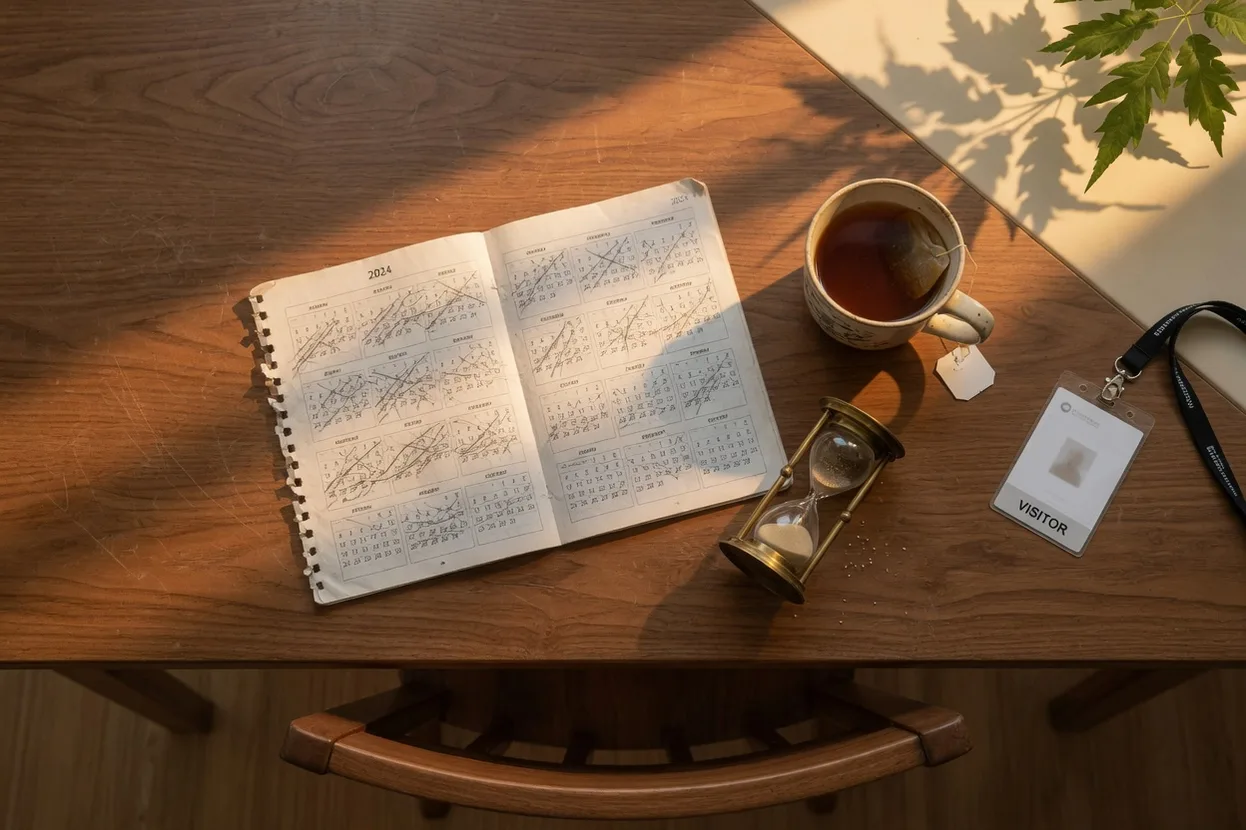
The calendar is open. Three weeks crossed out in pencil. The hourglass lies on its side.
Your work badge hangs off the table edge. Tea gone cold. And the question still ticks: how long does burnout recovery actually take?
Not two weeks of holiday. Not "rest a bit and go full speed." More like a season that does not tick in a straight line. A week that feels like three. A month that goes nowhere, until one morning you have a clear hour again.
This is not a protocol. Not a 30-day plan. It is an expectation map: week 1, month 1, month 3, month 6, year 1. What is often normal. What warns you. When support helps, without letting the calendar run the show.
What burnout recovery actually is
Burnout recovery is the gradual return of energy, focus and capacity after chronic work stress has emptied the system, without the calendar deciding when you are done.
- Burnout recovery
- Burnout recovery is the gradual return of energy, focus and capacity after chronic work stress has emptied the system. It is not a fixed number of weeks, but a path where rest, boundaries and return to work take turns.
On the submarine I learned this too early: wanting to be ready is not proof that you are. After a hard watch I wanted the next one. Pride. Pace. As if the clock was right. The body had a seasonal clock. That lesson shows up in almost everyone who wants to be "on" too soon after collapse.
Tessa reads the same calendar differently. She notices whether you can still talk in the evening. I used to count watches. That is not a fight. It is two ways of measuring time.
A recovery timeline is a realistic expectation frame (acute, stabilize, rebuild, integrate) that describes what often happens, not what everyone must hit.
- Recovery timeline
- A recovery timeline is a realistic expectation frame (acute, stabilize, rebuild, integrate) that describes what often happens, not what everyone must hit. It is not a treatment plan and not a guarantee.
Definitions of burnout wander in the literature. A scoping review on chronic stress and clinical burnout mostly shows how measuring and naming differ. That does not predict your week 6. It does explain why "average recovery" feels slippery.
If you want early signs in nomad or hybrid work, see nervous system and what the body remembers. Movement as a support layer, not a class, is in yoga for burnout.
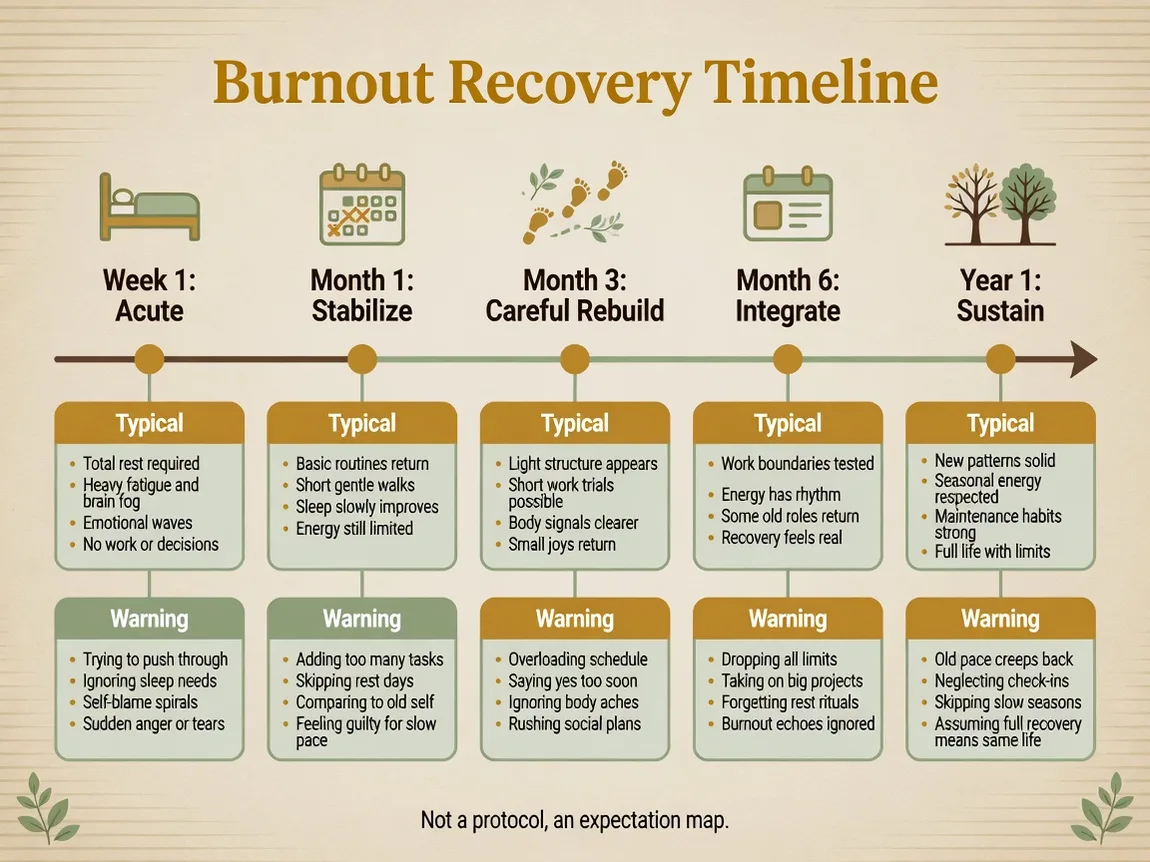
Week 1: stop, do not perform
Week 1 is often: sleep, cry, handle nothing, and feel guilty about the nothing. Your mind still hunts tasks. Your body hunts a bed.
Typical: you cannot finish an email. Sound is too much. One errand feels like an eight-hour watch. You sleep long or sleep badly. That is not proof rest "does not work." It is the season where the engine goes off.
Warning: no drop in panic after real rest, suicidal thoughts, or pressure to write a return plan in week 1. Alcohol or stimulants as the only energy. Not a moral score. A signal to seek medical or psychological help.
Treat the calendar as expectation boxes, not a scoreboard. Week 1 / month 1 / 3 / 6 / year 1. Boxes you are allowed to miss.
Pro-tip: In week 1, do not measure productivity. Measure after-effects. Five minutes of email, then stop. What does your body do the rest of the day?
Month 1: stabilize, not a comeback
Month 1 is often stabilization. Sleep, sensory load and emotions can still be chaotic while the body only just stops surviving. Panic at one email after rest is data about capacity, not proof rest failed.
Typical: one clear hour. Then flat again. Your partner sees progress you deny, or the other way around. You want to do "something useful" and crash after the dishes.
Warning: full-time return in that month. Same inbox. Same hero role. That often lengthens the dip. If weeks of real rest bring zero improvement, or you collapse after a tiny task, see a GP or occupational physician. Not a harder recovery plan.
Do a 24-hour energy audit. Three notes: when you drop, when there is one clear hour, what that hour cost. No app. A scrap on the fridge is enough.
In that first month the pull is to organise recovery like a project. A schedule. A list. Proof that you are “doing something with it.” That is the same engine as on the boat: wanting to be ready. The body asks for something else. Fewer new demands. More repetition of what already feels safe: food, light, one person who is not scoring you.
If a partner, colleague or manager asks “how long?”, you may name the season instead of a date. “I am in stabilize.” That is not weakness. It is an honest clock. You do not have to make their impatience into your calendar.
If stress and exhaustion blur, the free breath check is a soft first mirror. Not a diagnosis. A starting point.
| Window | Often typical | Warning |
|---|---|---|
| Week 1 | Sleep, overload, cannot handle much | No rest effect, suicidal thoughts, substances as only energy |
| Month 1 | Stabilize, messy sleep, one clear hour | Full-time return, collapse after a tiny task |
| Month 3 | Careful part time, rhythm grows | Same overload, no boundaries, "I have to catch up" |
| Month 6 | Integrate, test capacity at 20% | Old hero role, no support, denying setbacks |
| Year 1 | Sustain, know the seasons, guard pace | Pretend it never happened until the body stops again |
Month 3: rebuild carefully
Return to work is not a prize for sitting still. It is a capacity test. Many people start part time after sleep and basic rhythm stabilize, often nearer month 3 than week 2.
Quality of return matters more than the date. Boundaries. Tasks. Support. If work repeats the same overload, return is not recovery. A GP or occupational physician should lead.
People who guide return describe in research on return-to-work for burned-out employees what helpers find useful. That is professionals' perspective, not an RCT of how long your recovery lasts. The human core still holds: pace and context, not a magic week.
Do not ask "am I ready?". Ask: which 20% of work can I hold without the same fall?
If lying still already feels too heavy, yin yoga is a support layer, not a pose lesson. Depth comes later. Now it matters whether the body may drop without performing.
Month 6 to year 1: integrate and stay
Month 6 is often the season you look like "someone" again. Dangerous moment. People celebrate the comeback. You feel the old pull toward too much.
Typical: you can carry a morning and need an afternoon. You notice earlier when the tank empties. Setbacks are information. Not proof you failed.
Warning: taking the hero role back as if burnout was a typo. No support. No boundaries. Pretending it never happened until the body stops again.
Social context weighs a lot. Qualitative research on recovery after work-related psychological injury listens to employees and managers. It does not give a universal week-by-week calendar. It does show: support, workload, and whether you are allowed to stop, matter more than the date on a sick note.
Year 1 is staying. Knowing seasons. Knowing winter is allowed even when the diary demands spring. Some people are solid by then. Others still careful. Both can be true.
What often goes missing in these talks is the slow in-between. Not the week of collapse, not the day of “I am back.” The months when you can laugh again and still go flat at three. When you can hold a meeting and then need two days. That is not a failed comeback. That is capacity still counting in seasons.
If you notice yourself catching up again — extra watches, extra care, extra proof — you may pick up the red-flag card before you say yes. Pace is not a luxury here. It is how burnout recovery stays, instead of a pause between two crashes.
Pro-tip: Write three red flags on a card (no sleep, panic at a tiny task, pressure from outside). Share them with one support person. You do not have to read the calendar alone.
Boundaries belong to this season. Not as a trick, as pace. We wrote about that in setting boundaries without guilt. If the nervous system is still in survival, polyvagal theory explained helps show why "just wanting it" is not enough.
Want to check where you sit on the timeline? A thirty-minute intro via contact is not treatment. It is a talk about pace. 1:1 breathwork coaching is sixty minutes and costs €60. No recovery protocol for this hub. A place to feel if you want to be ready too soon.
Wider on breath as a category, not a week-39 protocol: breathwork guide.
Key takeaways
- Burnout recovery is a season, not a two-week rest sprint.
- Week 1 asks for stopping and sleep. Month 1 is stabilize, not a comeback.
- Return to work is a capacity test, often closer to month 3 than week 2.
- Setbacks are often information, not proof you failed.
- Warnings (no improvement, collapse, suicidal thoughts) ask for help, not harder recovery.
- Measure the 20% of work you can hold without the same fall, not whether you are "done."
If this lands: start with the calendar on the table. Not the badge. The season is already ticking. You may go slower.