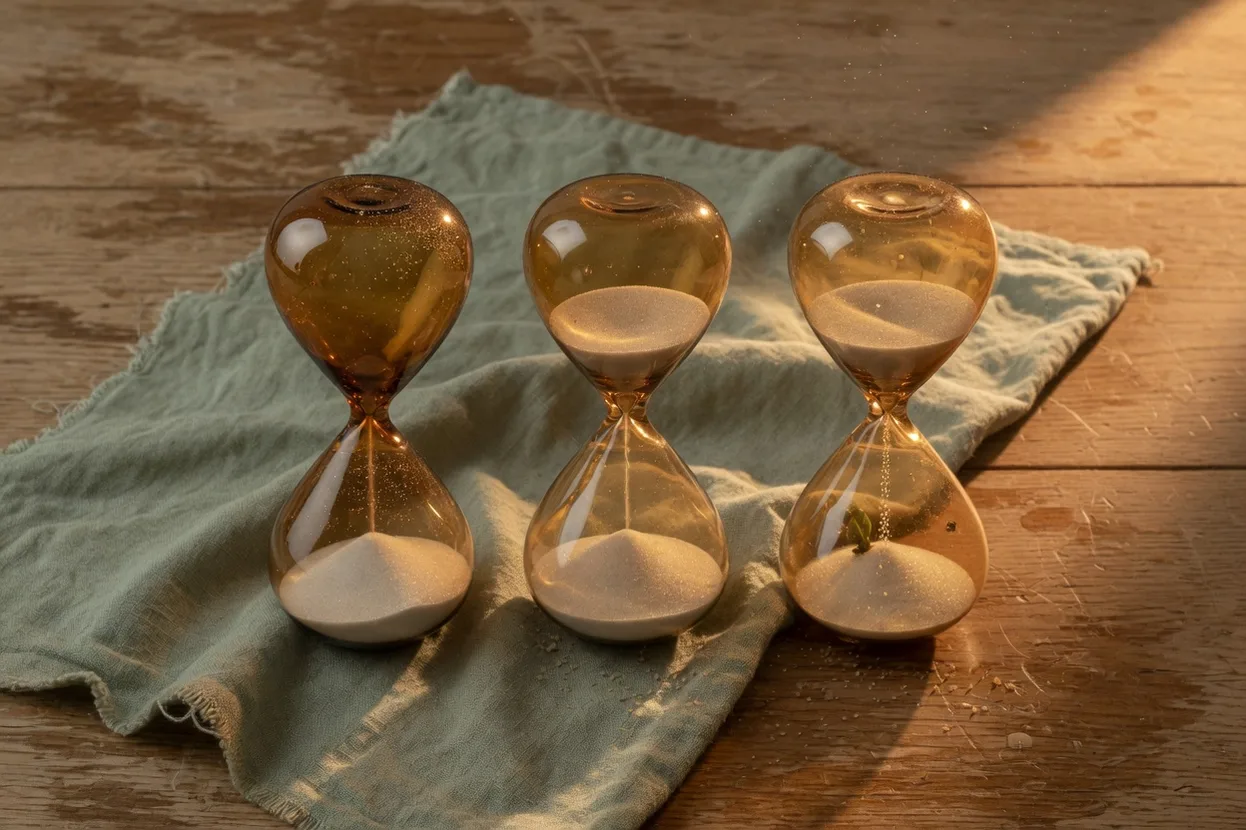
Three hourglasses on a wooden table. Same grains of sand. Three different speeds.
Breathwork in burnout is that table. Not one exercise for everyone. A dose. In week one, the session that gives space in month four can leave you emptier the next morning. The calendar in the burnout recovery timeline roughly says where you sit. This piece is about what your breath may do in that phase, and what you leave alone.
I wish I had this in 2020. I thought bigger, deeper, longer. It felt like commitment. It was overdose. Evenings of “one more round” because the first round felt too soft. Soft equalled nothing. The next morning my body was lead. Not transformation. Debt.
What breathwork in burnout actually is
Breathwork in burnout is matching technique and duration to the phase of exhaustion, instead of one intense session for every body.
- Breathwork in burnout
- Breathwork in burnout means matching technique and duration to the phase of exhaustion: acute, recovery, or integration, instead of one intense session for everyone.
It does not cure the diagnosis. It does not replace a doctor, a psychologist, or a return-to-work plan. It is a dosing tool for a nervous system that already ran too hard. For the wider practice, start at the breathwork guide. For a guided hour, breathwork coaching (sixty minutes, €60).
A trial in paramedicine students showed twelve weeks of slow nasal breathing (about five breaths a minute, ten minutes, twice a day) can shift stress and resilience. No clinical burnout diagnosis in that group. Self-report. Differential dropout. Support for a slow dose, not proof your burnout is “done” after two weeks with a timer.
You notice it in small things. Coffee that does not have to be fuel. An email that can wait until after the ten minutes. Not a spiritual programme. Nervous-system homework.
Phase check: not the calendar alone
A phase check is three questions on paper, not a diagnosis. Sleep. Recovery after lying still. How a deep inhale feels.
- Is sleep wrecked or too light, as if you never really go under?
- Do ten minutes of lying still empty you, or do you sink?
- Does a deep inhale feel like pressure in the chest, or like space?
Empty + pressure + light sleep: closer to acute. Sinking + some space the next day: closer to recovery. Breath as routine without a crash: closer to integration. When unsure, take the smaller dose. Always. Calendar weeks lie if you went full-time again in between.
The breath check helps you see how your pattern already sits under stress. Not a test that “wins” the phase. A mirror.
Pro-tip: Write the three answers once. Not in your head. Paper lies less than a 11 p.m. mood.
Acute: weeks 1 to 4, the small hourglass
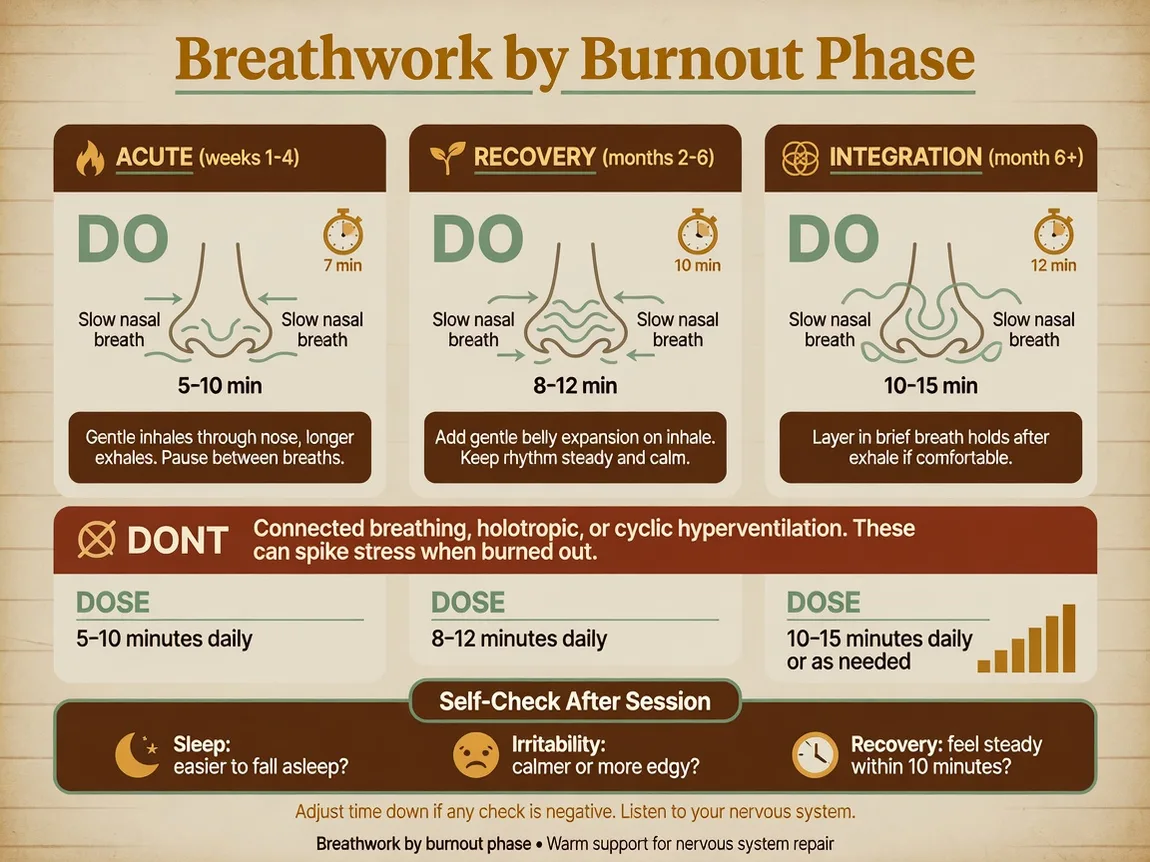
The acute phase is the first weeks when the nervous system is overloaded. Slow, nasal, short breath is the safe dose. Hyperventilation breath is a contraindication, not a shortcut.
- Acute phase (breath)
- The acute phase is the first weeks when the nervous system is overloaded. Slow, nasal, short breath is the safe dose; hyperventilation breath is a contraindication, not an accelerator.
Five to ten minutes. Sitting or lying. Five seconds in, five seconds out, optional two-second pause after the exhale. Stop if dizziness, tingling, or panic rises. No connected breathing. No holotropic. No Wim Hof cycles. No breath holds until it sparks.
Why does “doing little” feel wrong? Because effort used to be how you survived. In 2020 I wanted to feel the session. Sweat. Emotion. Proof. My system needed proof of safety, not heroics. Yoga can still fit in those weeks, soft, without performance. More in yoga for burnout.
A study of breath plus cold excludes people with heart, airway, or psychosis risk on purpose. Hormesis is not a protocol for acute depletion. Wim Hof-style hyperventilation does not belong here, not even “once to see if I still can”.
If a tear comes on the mat, fine. Do not force the next tear. The job is five-in, five-out until the timer ends. Done.
Put the minutes on the free breathing timer. When it rings, you stop. Dose is a boundary, not a vibe.
Recovery: months 2 to 6, the middle glass
Recovery dose is ten to twenty minutes of slow nasal breath, more belly movement, a few longer sessions a week, still without holotropic or Wim Hof cycles.
Volume may grow. Not drama. Same cadence. A little more air in the lower belly. At most a few times a week longer than ten minutes. The measure is the next morning. Do you function? Or are you empty on the sofa as if you ran a marathon without moving?
A review of slow nasal diaphragmatic breathing ties that cadence to HRV and lower anxiety. The protocol itself was still thinly validated then. No evidence that intense hyperventilation is safer while you are still in the pit. Read it as backing for slow, not a licence for “now anything goes”.
If the chest still slams shut on small emails, the vagal side is in vagus nerve exercises. For the three gears of the nervous system without a lecture: polyvagal theory explained. For five short stress breaths later, not tonight: five breathing exercises against stress.
Connected breathing in this phase? Only if sleep and appetite already have a floor, and preferably with someone next to you. Alone in the living room “because it used to feel so good” is a classic trap. You were not empty then.
| Phase | Do | Don't | Dose |
|---|---|---|---|
| Acute (weeks 1–4) | Slow nasal breath, 5 in / 5 out | Connected, holotropic, Wim Hof cycles | 5–10 minutes, daily or every other day |
| Recovery (months 2–6) | Same cadence, more belly | Catharsis hour, cold plus hyperventilation | 10–20 minutes, longer only a few times a week |
| Integration (month 6+) | Fixed routine, later optional guided deep session | Crisis breath at every dip | 10–15 minutes daily as maintenance |
Integration: month 6 onward, maintenance
Integration breath is daily maintenance of ten to fifteen minutes, no longer a crisis intervention.
Here the hourglass gets boring. Good. Boring is the point. You pair the session with the timer. You do it on days when nothing is wrong. Transformative connected sessions can come later, with someone beside you. Not as a prize because you are “back”. As a choice, with a floor.
If you later want to understand connected breathing, start with connected breathing and the nervous system. Not tonight. When the floor is there. Laptop work that stops the breath mid-sentence shows up in box breathing versus 4-7-8 versus Wim Hof: same families of tempo, different dose.
Pro-tip: If you sleep worse after ten minutes of slow breath, the dose is too big for today. Smaller tomorrow. No extra round “to make it right”.
Maintenance fails most on travel days and Monday mornings. You skip “because it is busy”. Exactly then, five minutes of nasal breath is enough to not knock the glass over. Not a hero. Continuity.
What you force in no phase
Connected breathing during burnout in the acute weeks: no. That form raises arousal. Your system already has too much. Extra can mean insomnia, panic, a crash after the session. Intense work belongs in recovery or integration, with guidance. Period.
Also not: an hour of crying-through-breath because Instagram calls it “release”. Release without a floor is another crash. Floor is sleep, food, a human who looks with you, a doctor if the complaints are medical.
If this lands and you do not want to pick the dose alone, breathwork coaching is the short route. A first conversation can start via contact.
I say it again, because I learned it late. Bigger is not faster better. Three hourglasses. Keep the small one until your body can hold the middle.
Tessa says it harder than I do: if you feel worse after breath, it is not a spiritual lesson. It is too much sand through too small an opening. Tomorrow again, smaller.
Key takeaways
- Breathwork in burnout is phase work: acute small and nasal, recovery a little longer, integration daily maintenance.
- Connected, holotropic, and Wim Hof-style cycles do not belong in the acute weeks.
- Phase check: sleep, recovery after lying still, feel of a deep inhale. When unsure, smaller dose.
- Studies support slow cadence under stress, not a cure for clinical burnout.
- Use a timer. Stop rule: dizziness, tingling, panic, or an empty morning after.
- Guidance is not a luxury if you do not know which hourglass you are holding.
If this lands, practise the slow dose with the timer. Or book sixty minutes. No heroics. A fitting amount of sand.