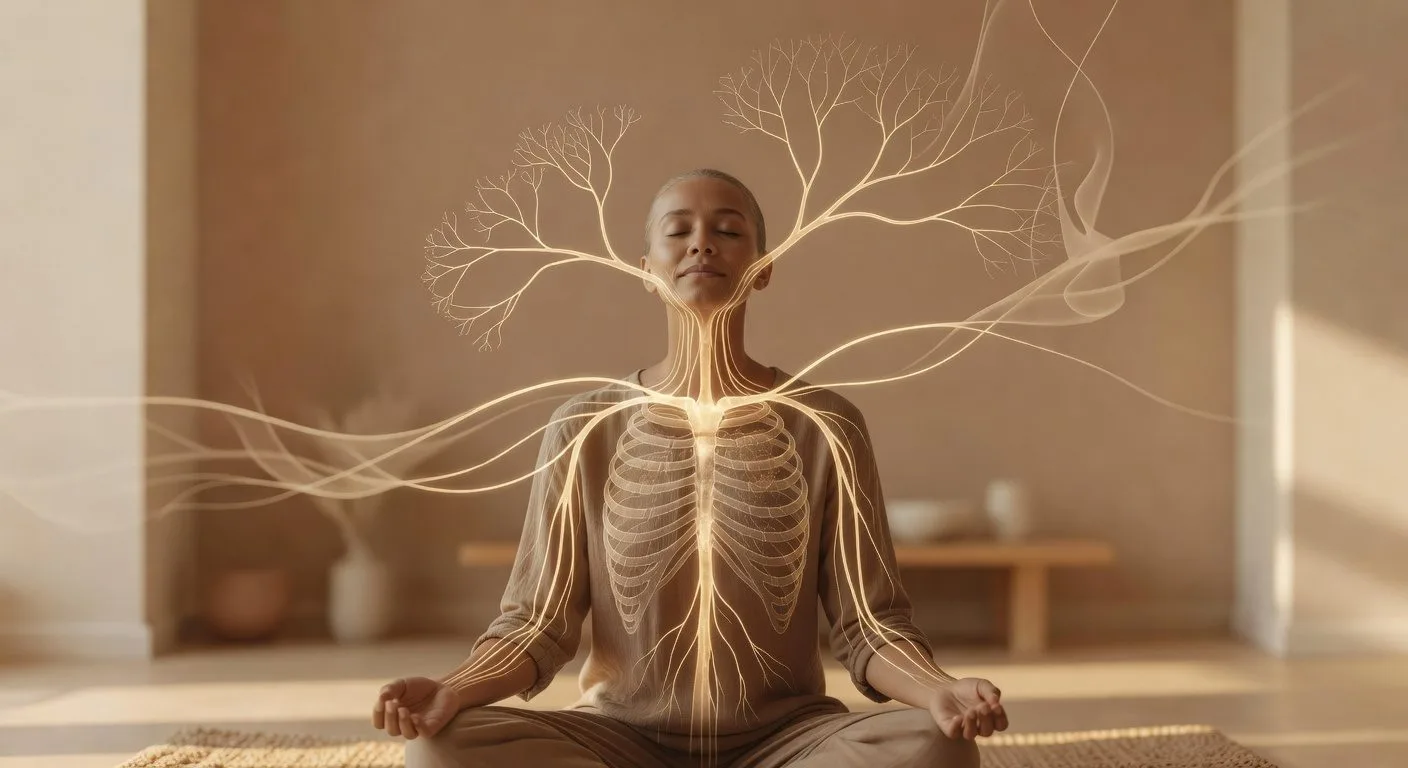
You open your mouth. The words are ready. But something tightens — a whisper saying: this doesn't feel right.
That whisper? That's your third eye. Not some woo-woo mystery, but a biologically factual intelligence that's been inside you for millions of years. The ajna chakra — the sixth energy center between your eyebrows — isn't a spiritual fantasy. It's your prefrontal cortex, your capacity for insight, pattern recognition, and that unexplainable "just knowing" that can change your life.
In this blog, you'll discover how the third eye truly works: the neuroscience behind intuition, the polyvagal theory that explains why anxiety and intuition feel so different, and practical exercises from yin yoga and breathwork that safely open your ajna chakra. No forced openings, no overstimulation — just grounded, scientifically backed work that brings you back to your deepest knowing. You'll also learn which third eye symptoms people often recognize — and when to slow down instead.
What is the third eye chakra (ajna) really?
- What is the third eye chakra (ajna)?
- The third eye chakra (ajna) is the sixth energy center in the chakra system, between the eyebrows near the pineal gland. It represents intuition, clarity, imagination, and inner knowing. Opening the third eye in practice means learning to tell mental noise from real inner knowing — not forcing clairvoyance.
The third eye chakra, called ajna in Sanskrit, is the sixth energy center in the traditional chakra system. It sits physically between the eyebrows, at the location of the pineal gland. In yoga tradition, this chakra represents intuition, clarity, imagination, and inner knowing.
But let's set aside the mysticism for a moment and look at what neuroscience says. The region corresponding to the ajna chakra is the prefrontal cortex — the hub for planning, insight, and pattern recognition. When people speak of "intuition," they're often describing a process where the prefrontal cortex integrates information that's already been subconsciously processed.
So an open ajna doesn't mean you suddenly become clairvoyant. It means you can distinguish between noise — the endless stream of thoughts, fears, external opinions — and genuine inner wisdom. The difference between "what if it goes wrong?" and "this feels right, even though I can't explain it."
The pineal gland, physically located at the third eye spot, produces melatonin — the hormone that regulates your sleep process and is sensitive to light and dark. In yoga tradition, this gland is seen as a kind of antenna connecting us to deeper layers of consciousness. Scientifically, it's a fascinating organ that sleeps, wakes, and possibly does more than we currently understand.
The science behind intuition: what does research say?
- What is intuition according to research?
- Intuition according to research is not a mystical organ, but an integrated brain process: the prefrontal cortex combines subconsciously processed information into “just knowing.” Slow breathing and mindfulness strengthen that connection. Polyvagal theory suggests clear intuition arises mainly in a safe (ventral) nervous-system state.
Let's be honest: the concept of a physical "third eye" is a metaphor — not a medical organ you can touch. But neuroscientifically, there's much to say about the processes we call "intuition."
The prefrontal cortex is responsible for insight, pattern recognition, and "gut feeling" decisions. Slow breathing strengthens the connection between the prefrontal cortex and limbic system, increasing emotional insight. Research from 2024-2025 shows that mindfulness and meditation rewire the neural networks involved in self-awareness and decision-making.
A systematic review by Calderone et al. (2024) in Biomedicines shows that mindfulness and meditation promote neuroplasticity, reduce amygdala reactivity, and strengthen functional connectivity in prefrontal regions — exactly the areas involved in intuition and clarity. This isn't spiritual belief, this is measurable brain activity.
Stephen Porges, the founder of polyvagal theory, explains in his work that intuition arises from the ventral vagal state — a state of safety and social connection. When your nervous system feels safe, the prefrontal cortex can function optimally. When you're in survival mode (sympathetic or dorsal vagal state), access to intuition is nearly impossible.
This explains why you make poor decisions under stress. It's not that you're dumb — it's that your nervous system is in survival mode and has no room for subtle signals.
Want to understand polyvagal theory deeper? Read the work of Stephen Porges, the founder himself.
Intuition versus anxiety: how do you know what's real?
This is the question I get most often in my yoga classes and 1-on-1 sessions: "How do I know if it's intuition or just anxiety?"
The difference is subtle, but unmistakable once you know what to look for.
Intuition feels calm, clear, and direct. The body relaxes, breath stays fluid. It comes as a whisper, not a scream. It doesn't repeat endlessly — it says it once, clearly, and then it's there.
Anxiety feels urgent, repetitive, and contracting. Heart rate up, breath short, thoughts racing. It comes like an alarm bell that keeps ringing. It says: "right now, or something terrible will happen."
Polyvagal theory (Porges) explains: intuition arises from the ventral vagal state (safety + social connection), while anxiety arises from the sympathetic or dorsal vagal state (danger). The key is: become aware of the quality of your inner experience, not just the content.
Don't ask yourself: "what is this thought saying?" Ask yourself: "how does this thought feel in my body?"
An exercise I recommend to all my students: keep an intuition journal. Each evening, write down one decision from that day. Note: did it feel light and clear (intuition) or heavy and repetitive (anxiety)? After two weeks, you'll see a pattern. This trains the prefrontal cortex to distinguish.
Third eye symptoms: what you notice (and what you don't)
- What are third eye symptoms?
- Third eye symptoms are signs people often mention with gentle ajna practice: clearer dreams, faster “just knowing,” calmer decisions, or light pressure between the eyebrows. There is no medical diagnosis of an “open ajna.” Overstimulation (insomnia, anxiety, feeling out of body) is a cue to ground and slow down.
People often search for third eye symptoms as a checklist. Honestly: there is no medical diagnosis called "ajna open". What is often reported with gentle, grounded practice:
- Clearer dreams or faster "just knowing"
- More calm in decisions, less mental noise
- Light pressure or warmth between the brows during meditation
- More sensitivity to light, sound or social stimuli
With overstimulation you more often see insomnia, headaches, anxiety or a sense of being "out of your body". That is not proof of a magical organ — it is a signal to ground, slow down and not force. Then return to breath, yin and root-chakra work.
Safely opening your third eye: 5 practical exercises
Safety first. Opening the ajna chakra too quickly can lead to overstimulation, insomnia, or anxiety. Move at your own pace. Force nothing.
1. Slow Breathing Reset (5 minutes)
Breathe in for 5 seconds, out for 6 seconds, repeat for 5 minutes. This activates the ventral vagus (safety), slows theta waves, and brings you into the state where intuition speaks most clearly. Do this before every meditation or yin yoga session.
Research by Li et al. (2024) shows that slow breathing (5.5 breaths per minute) interacts with prefrontal activity to increase vagal tone — direct evidence that breathwork affects the third eye region.
2. Ajna Point Meditation (10 minutes)
Close your eyes. Place your index or middle finger lightly between your eyebrows (ajna point). Inhale for 4 counts, hold for 2 counts, exhale for 6 counts. Repeat 10-15 cycles. Observe what arises — images, colors, words — without judging.
This isn't a visualization exercise. It's a listening exercise. You're training your attention to perceive subtle signals that normally get lost in daily noise.
3. Yin Yoga: Child's Pose with Forehead on the Mat (5 minutes)
Kneel, lean forward, forehead resting on the mat, arms extended or along your body. Stay for 3-5 minutes. This relaxes the eye sockets, forehead, and pineal gland region. Combine with ujjayi breathing.
This pose is one of the most calming yin yoga positions for the ajna chakra. The forehead on the mat creates gentle pressure that soothes the pineal gland region. Many students report thinking more clearly and having less "headache" after this pose — literally and figuratively.
For more yin yoga exercises that calm your nervous system, visit our Yin Yoga page or start free with our Yin Yoga video library.
4. Journaling: Intuition vs. Anxiety Check (5 minutes)
Each evening, write down 1 decision from that day. Note: did it feel light and clear (intuition) or heavy and repetitive (anxiety)? After 2 weeks, you'll see a pattern. This trains the prefrontal cortex to distinguish.
This is the same exercise I mentioned earlier — but now with the instruction to actually do it. Not "I should remember this," but physically writing it down. The written process activates different neural networks than mental noting.
5. Darkness Practice (5-10 minutes)
Do your ajna meditation in a darkened room, or with a soft eye mask. The pineal gland is stimulated by darkness (melatonin production). Symbolically and physiologically, this is a powerful third eye exercise.
A comprehensive review on melatonin and the pineal gland by Khraiwesh et al. (2024) confirms that this physical organ — associated with the third eye in yoga tradition — is more than a myth. It's a hormone factory that responds to light and dark, and may form a bridge between physiology and consciousness.
The Chakra Journey: from root to crown
The third eye is step 6 of our Chakra Journey. But here's the important part: you can't start at step 6 if steps 1–5 aren't grounded yet.
An open third eye without a grounded foundation is like building a house without a foundation. It can become unstable, overwhelming, even dangerous. That's why we start at the root chakra — safety, grounding, basic needs. Only when that's stable do you build further.
Notice your head is often "on," but your body is rarely heard? Our Chakra Journey starts at the root and builds step by step upward — so opening feels safe and grounded.
If you want to understand how the root chakra works and why grounding is essential before opening higher chakras, read our blog on Root Chakra — Insecurity.
For more context on how chakras work in relation to your nervous system, read our blog on Yin Yoga, Breathwork & Science.
When your third eye truly opens
I want to be honest with you: opening the third eye isn't a one-time event. It's not a flash of light after which you suddenly know everything. It's a gradual process of building trust — in yourself, in your body, in that whisper that was always there.
What students report after consistent practice:
- Clearer decisions, less doubt
- More trust in their own knowing, less noise from outside
- Better distinction between intuition and anxiety
- Deeper meditation experiences
- Less insomnia (because the pineal gland works better)
But most importantly: they feel more "at home" in themselves. As if they've finally tuned the antenna to the right frequency.
Want to understand polyvagal theory not just intellectually, but feel it in your body? Our 1-on-1 breath sessions with Tessa combine science with practice. Visit Breathwork Coaching for more information.
Common pitfalls
Let me warn you about what I often see happen — and what you'd better avoid.
Wanting to go too fast. Opening the third eye isn't a race. People who go too fast report overstimulation, headaches, insomnia. Listen to your body. If it's too much, go back to the root chakra — grounding, grounding, basics.
Expecting it to feel "magical." Intuition is rarely dramatic. It's subtle, calm, almost boring. If you're waiting for a lightning strike, you'll miss the whisper.
Confusing intuition with wishes. "I feel I should do that expensive course" is often not intuition — it's desire. Intuition has no emotional charge. It's neutral, clear, direct.
Sleeping poorly or feeling overstimulated? Then your nervous system is surviving, not opening. Start with the basics — our 30-Day Challenge program is designed for exactly this.
Back to your own knowing
The third eye is no mystery. It's a biologically factual intelligence inside you — just like in everyone. It's not a gift for the chosen few, it's a skill you can train.
Everyone has a prefrontal cortex and a vagus nerve — the biological basis is universal. What varies is the degree of neural connection and body awareness. Like a muscle, you can train intuition: through meditation, breathwork, journaling, and repeatedly slowing your reactions.
People who do this consistently report: clearer decisions, more trust in their own knowing, less noise.
Share in the comments: when was the last time you "just knew" something was right or wrong — before your head could explain it? We read everything.
And if you want to dive deeper into how your nervous system influences your decisions, read our blog on Connected Breathing and the nervous system.
Want to learn more about the scientific foundation of trauma and the body? Explore the work of Bessel van der Kolk, pioneer in trauma research.
— Tessa Frunt, Yin Yoga Teacher & Breathwork Coach at Spiriators
Continue the chakra series: Heart chakra opening · Crown chakra opening · or follow the full Chakra Journey. Wondering if opening chakras is dangerous? See the FAQ above on safe opening.
Go deeper: Read our pillar pages on yoga and breathwork, explore yin yoga, or join a retreat to deepen your practice.