
Expectations can quietly weigh on you, keeping you tied to how things should be instead of how they are. Letting go of expectations sounds simple, yet anyone who has tried knows that a fixed picture rarely disappears just because you decide it should. Buddhist teaching speaks of tanha, a craving or thirst, and upadana, the clinging that follows. Together they feed dukkha, the unease that arises when we keep reaching for a picture of how life ought to look. In this article, breathwork is a place to practice with your body: not to fix anything, but to notice what is already here and gently loosen your grip.
Most of us know the feeling: a setback you didn’t see coming can hit harder than one you were braced for. Picture, as an example, a conversation you expect to go smoothly, and then it doesn’t. The tightness in your shoulders or the knot in your stomach isn’t a mistake. It’s your body responding to a picture it was holding on to. This article invites you to get to know that place through gentle breathing, with no promise of healing or lasting change.
What expectations really are
An expectation is a fixed picture of how a moment, a relationship or an outcome should turn out. That’s different from an intention or a hope. The difference is subtle, but you can often feel it in your body.
- Expectation
- A fixed picture of the outcome: it has to go this way, or it isn’t good enough. The body often tightens to keep that picture standing.
- Intention
- An open direction for yourself: I want to be fully present in this conversation. You choose how you show up, not how it ends.
- Hope
- A wish that stays open: I hope it goes well. There is still room for things to unfold differently.
In Buddhist terms, an expectation is close to tanha: the thirst for a particular experience. Upadana is the clinging that follows. The popular saying that expectations are the root of suffering is a modern reading of that teaching, not a direct quote from the early texts. So there’s nothing you have to renounce. An intention can stay. The fixed picture can soften.
A small example: you head out for a walk counting on dry weather, and it starts to rain. Feeling disappointed is human, and it doesn’t have to go away. What matters is what happens next: do you treat the rain as a flaw in your plan, or simply as what is happening now? Your breath gives you a way to practice that shift, again and again, in small moments.
Pro-tip: The next time you catch yourself thinking “it has to”, ask whether this is an intention, a hope or an expectation. Write that one word down. Simply naming it often creates a little room.
How expectations settle into body and mind
Expectations don’t live only in your head. They can settle in as tension: a clenched jaw, high and shallow breathing, a belly that won’t let go. Meanwhile, the mind keeps replaying the picture: it should be different. The longer you hold on to it, the more energy it can take.
When an expectation isn’t met, there are roughly three ways to respond. You can try even harder to make the picture come true. You can brush the gap aside and act as if nothing happened. Or you can adjust the picture to what is actually in front of you. That last option is often the hardest, precisely because it feels like letting go of control. And wanting control makes sense: it’s a way of protecting yourself from uncertainty.
Your body plays its part too. It holds on to tension as if it were trying to steer what can’t be steered. So the practice isn’t to fight that need for control, but to notice when your grip gets too tight. Learning to let go often starts right there: with noticing, before you change anything at all.
In relationships, it might look like this: you expect someone to say or do something in a certain way. When they don’t, tension builds. That tension is information. It shows you where a picture is stuck. The same can happen with work, with your own pace, or with the belief that you always have to keep performing. Gentle breathing lets you see that picture without having to solve it right away.
Pro-tip: Notice a “must” creeping into a conversation? Quietly rest a hand on your belly or press both feet into the floor. For three out-breaths, simply feel where the tension sits, without doing anything about it.
How breathwork helps with letting go of expectations
Breathing always happens in this moment. That makes the breath a simple place to practice receiving what is here. You don’t need any special skill; your body is already breathing.
Research on breathwork exists too, with cautious results. A meta-analysis in Scientific Reports of twelve randomized controlled trials with 785 adults in total (Fincham et al., 2023) found a small-to-medium effect of breathwork on self-reported stress (g = −0.35). Slow-paced breathing was the form where the effect was significant. The effect was only clear in groups without a clinical diagnosis; in people with physical or mental health conditions it was not demonstrated. The authors note a moderate risk of bias and warn against a mismatch between hype and evidence. Breathwork is not a treatment for burnout, depression or trauma.
In practice, this isn’t about a technique that fixes something. A longer out-breath is simply a way to slow down and bring your attention back into your body. Whatever you notice there is allowed. Sometimes it’s calm, sometimes restlessness, sometimes nothing special. That’s practice too.
If you’d like to go deeper with guidance, 1:1 breathwork coaching is a gentle next step. The breathwork guide covers the basics. And if you’d like to let your body settle even further, 1:1 yin yoga brings together stillness, breath and long-held poses.
Pro-tip: Start with two minutes of calm breathing through your nose, without counting. Just notice that the breath is there. When your attention drifts to an expectation, quietly label it “thinking” and return to the next out-breath.
Three gentle letting-go practices
These practices are designed for home and stay gentle: only calm nose breathing, a longer out-breath and attention. Stop if you feel dizzy. If you are pregnant, or live with epilepsy, heart or circulation problems, or a mental health condition, check with a doctor or healthcare provider first. This is not a substitute for professional care; if symptoms persist, see your GP or family doctor. In a crisis in the Netherlands, use 113.nl or 112; elsewhere, contact your local emergency services.
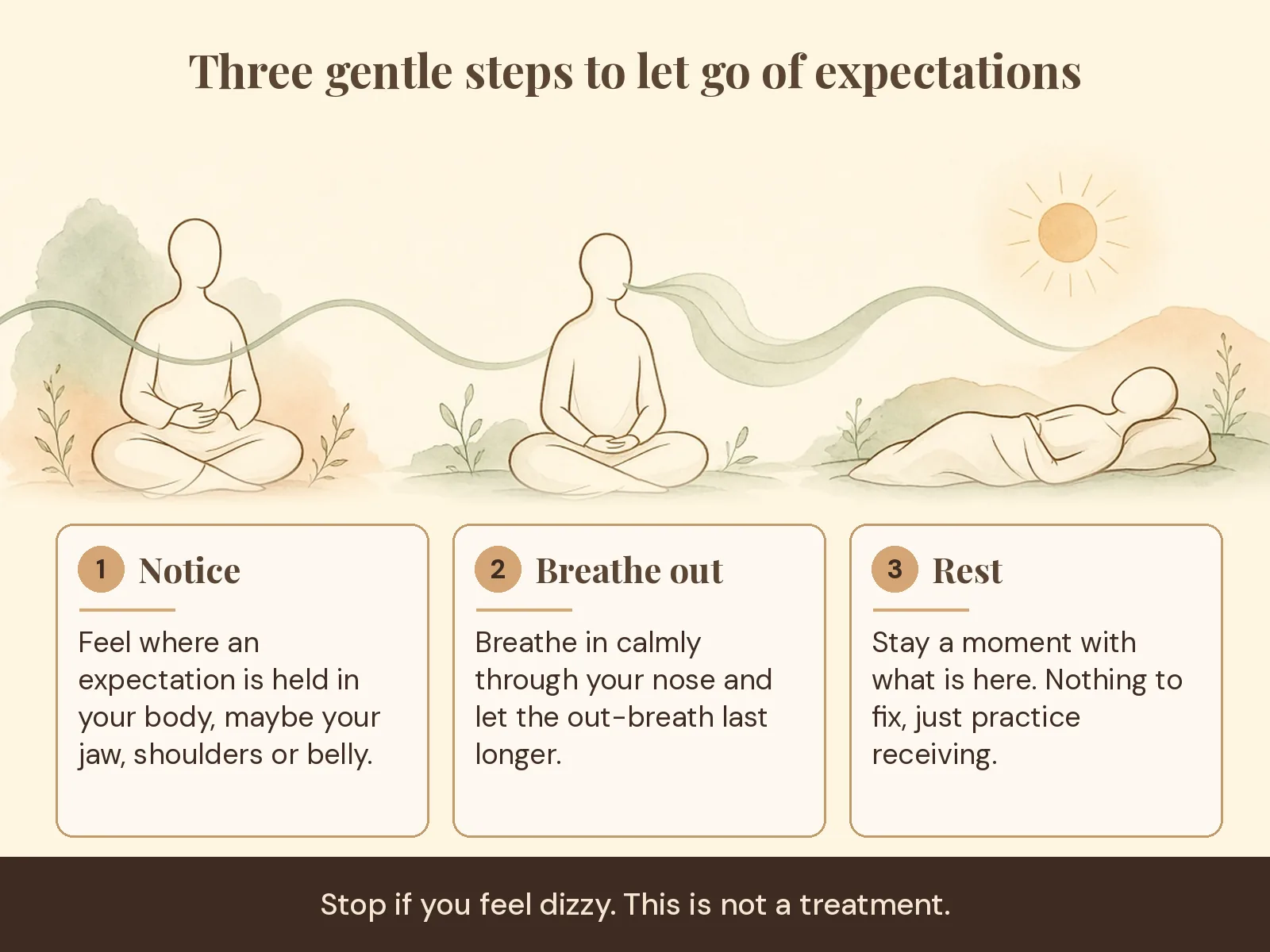
1. A longer out-breath for space
- Sit or lie down comfortably, with your back supported.
- Breathe in through your nose for a slow count of four.
- Breathe out through your nose or softly parted lips for a count of six to eight.
- Repeat for five to ten rounds, keeping the out-breath soft rather than forced.
What it may offer: a sense of more room in your belly and shoulders, and a moment in which the fixed picture feels a little less close. Safety note: stop if you feel dizzy or uncomfortable, and don’t hold your breath.
A hypothetical example: you’re sitting in the car before an appointment you hope will go perfectly. Five rounds of longer out-breaths won’t change the appointment, but they may help you walk in a little more settled.
2. Breathing into the place of “should”
- Gently close your eyes or let your gaze rest on the floor.
- Think of an expectation you are carrying right now, and scan your body: where do you feel it?
- Breathe in softly and imagine the breath moving toward that place.
- As you breathe out, let your attention rest there for a moment, without pushing.
- Stay with this for three to five minutes.
What it may offer: a way to recognize the tension as something that is allowed to be here, rather than something that has to go. Safety note: if it becomes too intense, open your eyes, feel your feet and return to calm belly breathing.
A hypothetical example: after a message from a friend, you notice your jaw is tight because you were hoping for a different reply. Three minutes of breathing with that jaw can be enough to see the picture before you respond.
3. A soft sigh of surrender
- Breathe in calmly through your nose.
- Let out a soft sigh, with a little sound if it comes naturally.
- Repeat this five times.
- After the last sigh, stay for a moment in the quiet.
What it may offer: a small moment of physical surrender, in which it may feel easier to release the control an expectation is holding on to. Safety note: don’t force the sigh, and stop if you feel dizzy.
These practices are meant for everyday life, not as a one-off fix. If you’d like your body to join in more, read about yin yoga, fascia and emotional release. You can also alternate the practices with moments of simple stillness. It’s about repetition, not perfection. When an expectation comes back, that isn’t failure. It’s a fresh invitation to notice.
Pro-tip: Pair one practice with something you already do every day, like waiting for the kettle or closing your laptop. Three minutes is enough. Afterwards, write down in one word what you noticed, without judging it.
What practice can open up
As you practice letting go of expectations, space sometimes opens up. Not because something has been fixed, but because you notice what was already there. From the Spiriators perspective, you are already whole; practice is about remembering, not repairing. That’s a way of looking at yourself, not a promise of any particular result.
Buddhist teaching speaks of the thirst coming to rest. In daily life, that might mean holding on to an intention while loosening your grip on how things turn out. You want a good conversation, and you leave room for how it actually goes. You commit to your work, and you don’t need to know how it will end.
There’s no guarantee this will always feel lighter. Sometimes sadness or disappointment surfaces first as an old picture softens. That’s allowed too. Your breath remains a place to come back to, at any moment of the day.
You might also enjoy reading about living in the now in a temporary body or the Presence Process as a breath-centered way of life. Curious what a retreat can be as a space to practice more deeply? Read what a retreat is. Travel also tends to bring plenty of the unexpected; if you’d like to experience that consciously in a small group, take a look at nomadic co-travel. And if you’d like to get acquainted first, you can reach out via contact.
Pro-tip: Tonight, pick one expectation for tomorrow and rewrite it as an intention. “The meeting has to go well” might become “I want to listen and be honest.” Tomorrow evening, check in on how that sentence felt.
Expectations are allowed to be here. They’re human. The practice is to notice them and gently return to the breath that is already breathing. That’s enough for today. The next time a picture gets stuck, you can pause, breathe, and see what is already here. No performance. Just presence.