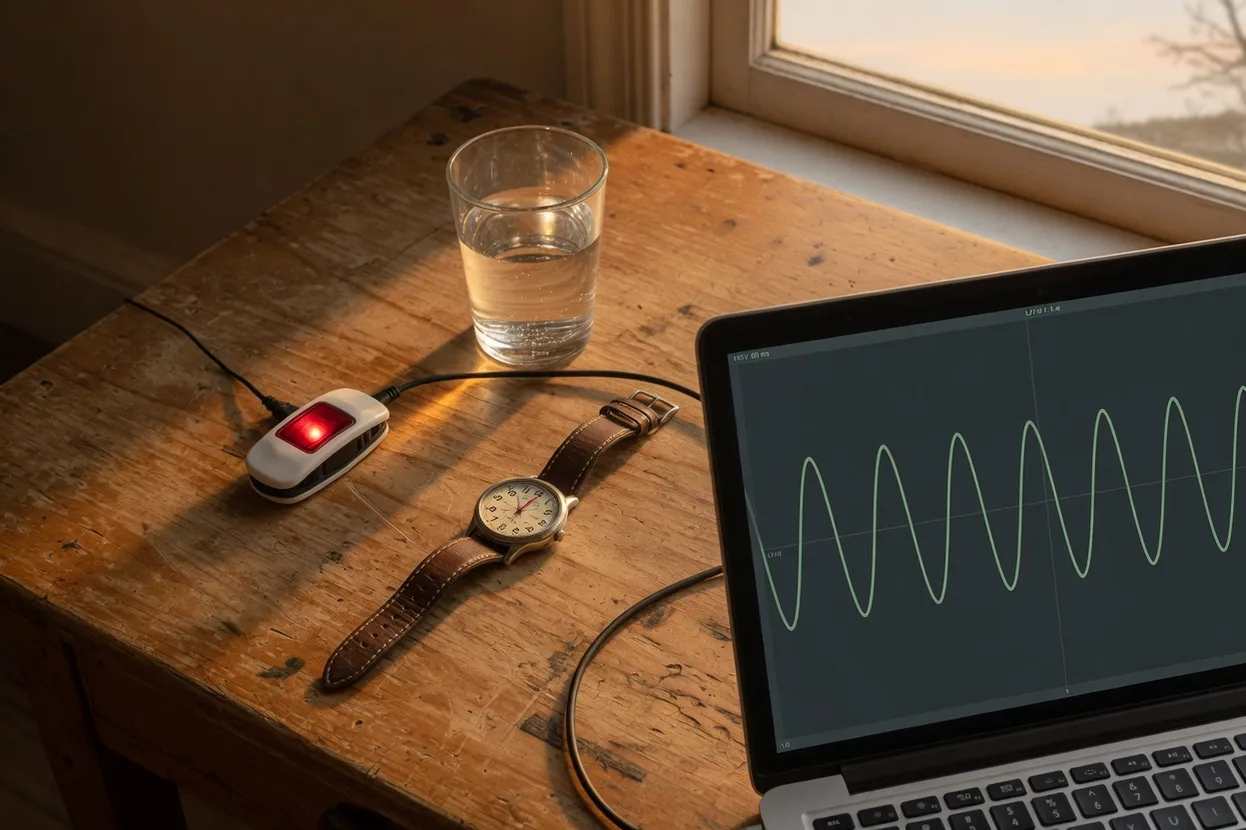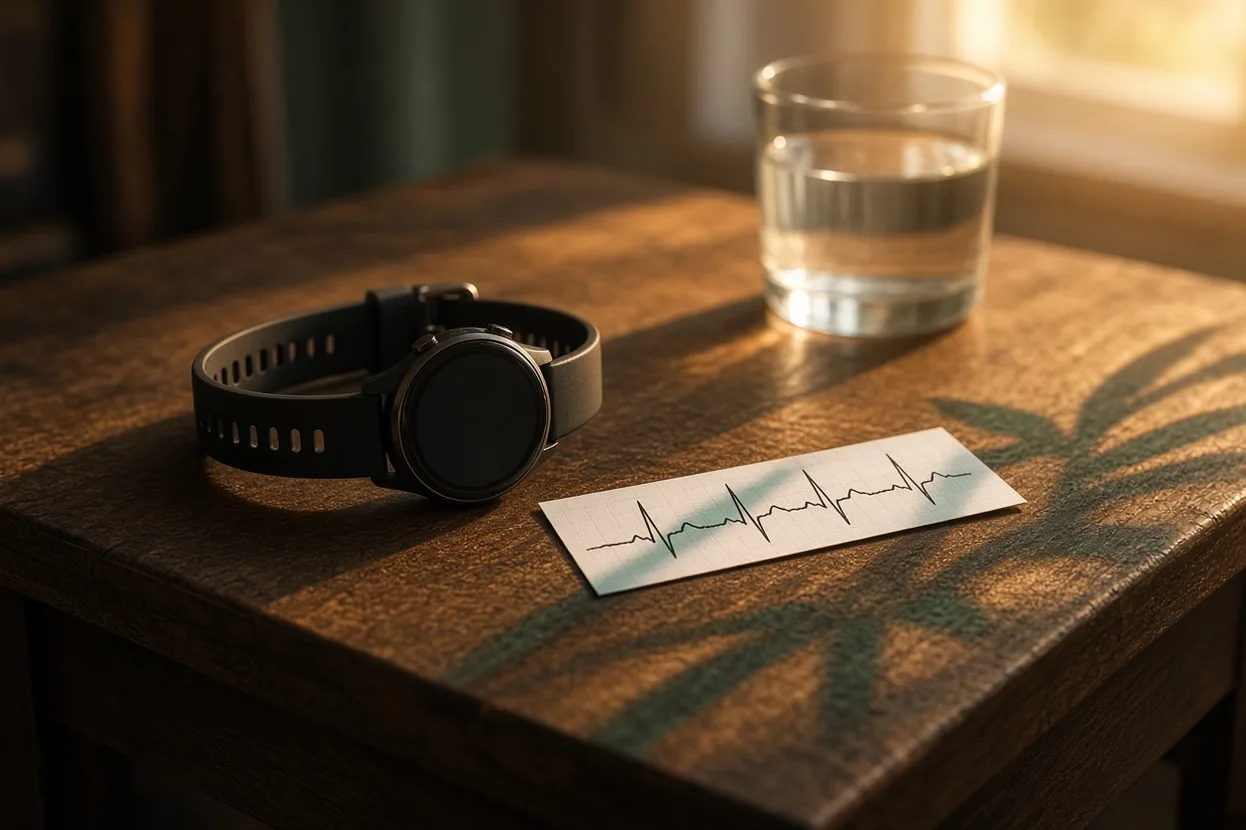
The wristwatch lies face down on the nightstand, strap unbuckled, beside a short paper strip with uneven spikes. Nobody is wearing it. The room is quiet. To measure HRV starts here, with a device that is off and a strip that explains nothing.
Heart rate variability is the spread in time between successive heartbeats, not an average heart rate and not a number that says whether your day succeeded.
Your heart does not beat like a metronome. One pause runs a little longer. The next runs a little shorter. Those milliseconds are what a reading tries to catch. A high heart rate says how fast it is going. The spread says something about the room between beats. That is a different conversation.
- Heart rate variability
- Heart rate variability is the spread in time between successive heartbeats, not an average heart rate.
- RMSSD
- RMSSD is a short-term measure of successive differences and, at rest, often tracks parasympathetic influence without being a diagnosis.
A dashboard, not a verdict
A dashboard shows a trend across days. It does not pass a verdict on your nervous system, your recovery, or your character.
The screen wants a judgment. Green is good. Red is a failure. An app reads that way because a color clicks faster than a week of the same morning. Your body reads otherwise. Sleep, coffee, fever, and the hour you sit all shift the number. One dip is noise until you set it next to those things.
More variation at rest, often as RMSSD, points more often to parasympathetic room. That is room, not proof that you are safe, healed, or relaxed. The autonomic nervous system is sympathetic and parasympathetic activity together. A number cannot pull those two apart into a story about who you are.
I have picked the watch up as if the answer were already waiting. The screen stayed dark until I turned it over. That moment is more useful than the color that comes after. You choose whether you read a trend or hunt a verdict. The strip on the wood does the first. It shows gaps. It does not say what those gaps mean for your week.
Measure HRV: watch, ECG, and breath at rest
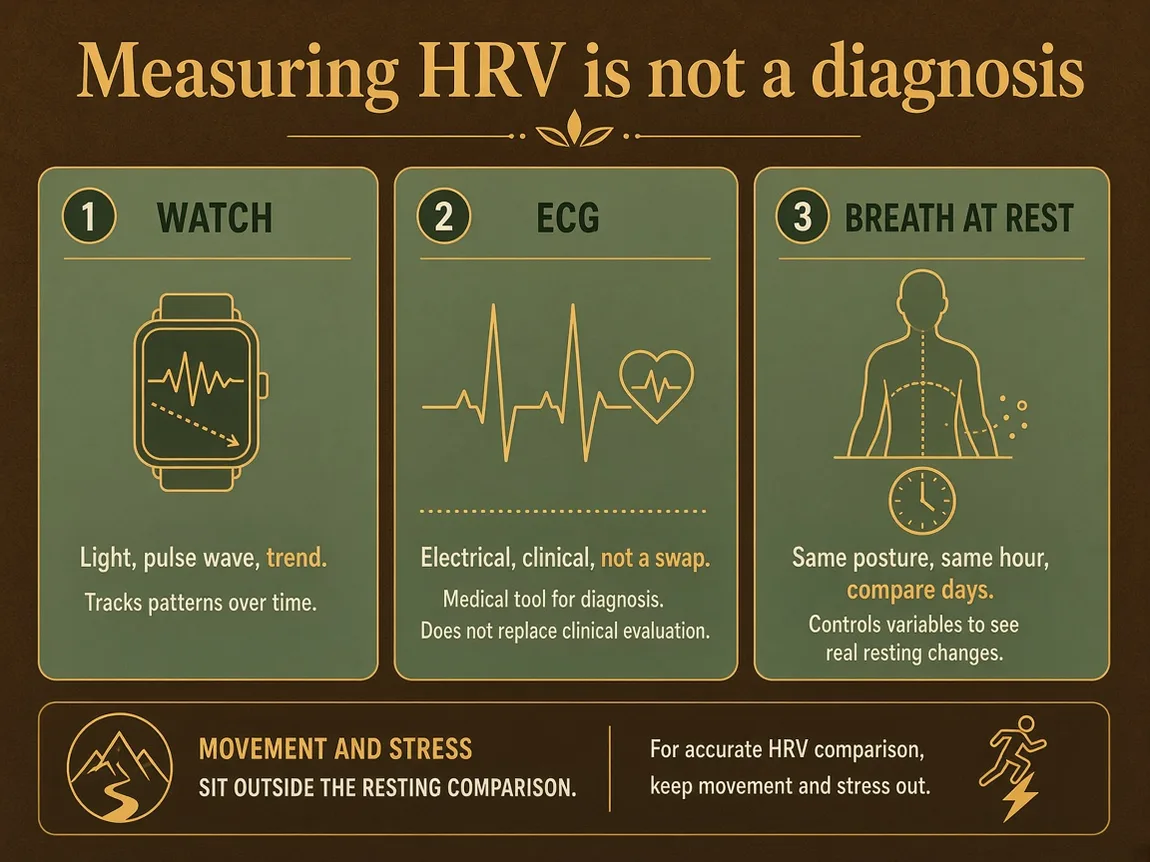
To measure HRV with a wristwatch is usually light on the skin. The watch reads a pulse wave. An electrocardiogram reads the electrical activity of the heart. Those are two instruments. They sit closer while you are still than during movement or stress. They are not a swap.
| Watch | ECG | Breath at rest | |
|---|---|---|---|
| What it sees | Light, pulse wave | Electrical signal | Your rhythm, not a sensor |
| What it is for | A daily trend | A clinical recording | Comparing days |
| What it is not | Not a diagnosis | Not a swap with the watch | Not a trick to pretty the number |
A wristwatch at rest is a trend meter through light, not an electrocardiogram and not an explanation of how you feel.
Sit still, feet on the floor, band snug, screen down. No treadmill. No bed. For two minutes, breathe as you already breathe. Do not force a deep belly breath to flatter the graph. Note RMSSD if the watch shows it, plus the hour and whether you had coffee. The rest of the dashboard can stay shut.
Breath belongs beside the reading, not above it. Someone who wants to steer the graph breathes differently from someone who wants to see what is already there. You feel that difference in the shoulders. They climb as soon as the number becomes an assignment. Then you are measuring a performance, not your morning.
Pro-tip: Seven mornings at the same hour, before mail and before coffee, say more than one pretty score after a forced breath.
A free breathing timer sets those two minutes beside the reading, with no account. Keep it quiet. It is a clock, not a coach. You breathe as the breath already goes. The timer only holds the time, so you do not start counting in your head to please the screen.
What the studies hold, and what they do not
You can already feel that a quiet morning sits roomier than a rushed one. Research on heart rate variability describes that spread as a window on the balance between sympathetic and parasympathetic activity, along lines set down in 1996. A review shows that this window is not yet a standard clinical measure. That is a review, not a new trial. It does not prove that a consumer watch measures clinical autonomic function. It says the idea is old. The translation to your wrist is a different question.
The wrist and the strip lie next to each other on the wood. In controlled rest, in healthy people, the error between a light reading and an electrocardiogram is small for RMSSD and SDNN. A meta-analysis of ten studies found that small error mainly at rest. Ten studies. Controlled rest. Movement, stress, sleep, and an ordinary day sit outside that conclusion. If you carry the error from the chair into a walk, you are reading something the research did not measure. The watch stays a daily trend. The electrocardiogram stays the electrical trace. Not interchangeable.
Anxiety is slipperier still. You can feel unsettled while the number looks calm, and the other way around. Research found only weak to moderate links between some metrics and anxiety scales, and not every metric joined in. That is correlation. Not a replacement for a conversation. Not proof that a higher RMSSD dissolves anxiety. Other parameters were not significant. If an app still issues a mood verdict, it is running ahead of what the figures hold.
There is a longer trail as well. Longitudinal studies saw a link between higher parasympathetic activity and better cognition. Twelve studies, a large group of people, a narrative synthesis through mid-2023. No advice to buy a watch because of it. No recipe for breathwork. A link across time is not an exercise you can tick off this morning.
One honest limit weighs more here than three ringing claims. The review does not measure a watch. The meta-analysis stops at rest. The anxiety figures are small and not for every metric. The cognition line is not a treatment plan. Measuring HRV adds a body signal beside what you feel. It replaces neither a clinician, nor a diagnosis, nor breathwork coaching.
Seven mornings, one metric
The comparison works only if the posture stays the same. Same chair. Same wrist. Same hour. Screen down, so you are not measuring while you watch yourself.
Write three things down. RMSSD, if it is there. The hour. Whether you had coffee. Sleep and fever belong the next day, not as an excuse in advance, but as context if the number drops. A dip without fever and without a short night can be a question. A dip with fever is a body that is ill first, not a story about your character.
Breathe for two minutes as the breath already goes. No performance breath. No deep belly breathing to talk the line upward. If you know breathwork, you know the pull: rhythm turns into a score fast. Here the rhythm is only the background of the reading. You do not steer it to flatter the dashboard.
The nervous system has more doors than a watch. The vagus nerve is one route between brain, heart, and gut, not a button that raises RMSSD on command. Polyvagal theory sorts states of safety and alarm. It is a map, not the result of your morning reading. And yin yoga beside breathwork is another door: lying still, without the screen looking on.
If you want to set the reading down for a while, yin yoga is a place where the watch stays home. The wood of the mat asks nothing about milliseconds. You notice warmth, pressure, the breath growing shorter or longer on its own. That is practice without a verdict.
Chest pain, fainting, or symptoms that last: stop interpreting them yourself. Call a clinician. The same applies with a hernia, acute pain, or recent surgery, even though this piece is not about the hip. An app supplies a number. A clinician judges a symptom.
Pro-tip: Read the week, not the morning. One red day is noise. Seven notes in the same chair show whether the line is shifting.
Key takeaways
- Measuring HRV looks at the milliseconds between beats, not at how high your heart rate is.
- RMSSD at rest often tracks parasympathetic room. It is not proof that you are safe or healed.
- A watch reads light. An ECG reads electricity. At rest they sit closer than during movement or stress. Not a swap.
- Studies on balance, wrist versus ECG, anxiety, and cognition have limits: a review, ten rest studies, correlation, no breath recipe.
- Seven mornings, the same posture, one metric, plus hour and coffee. Set a dip beside sleep and fever.
- Lasting symptoms, chest pain, or fainting belong with a clinician, not with the app.
If the strip on the nightstand lands, you do not need a new device. Set two minutes beside the reading with the timer, or read the trend with someone who will not reduce your body to a color. Breathwork coaching is then one hour, sixty minutes, €60, online. The watch stays home. The conversation is about what you feel, not about a verdict on a dark screen.